
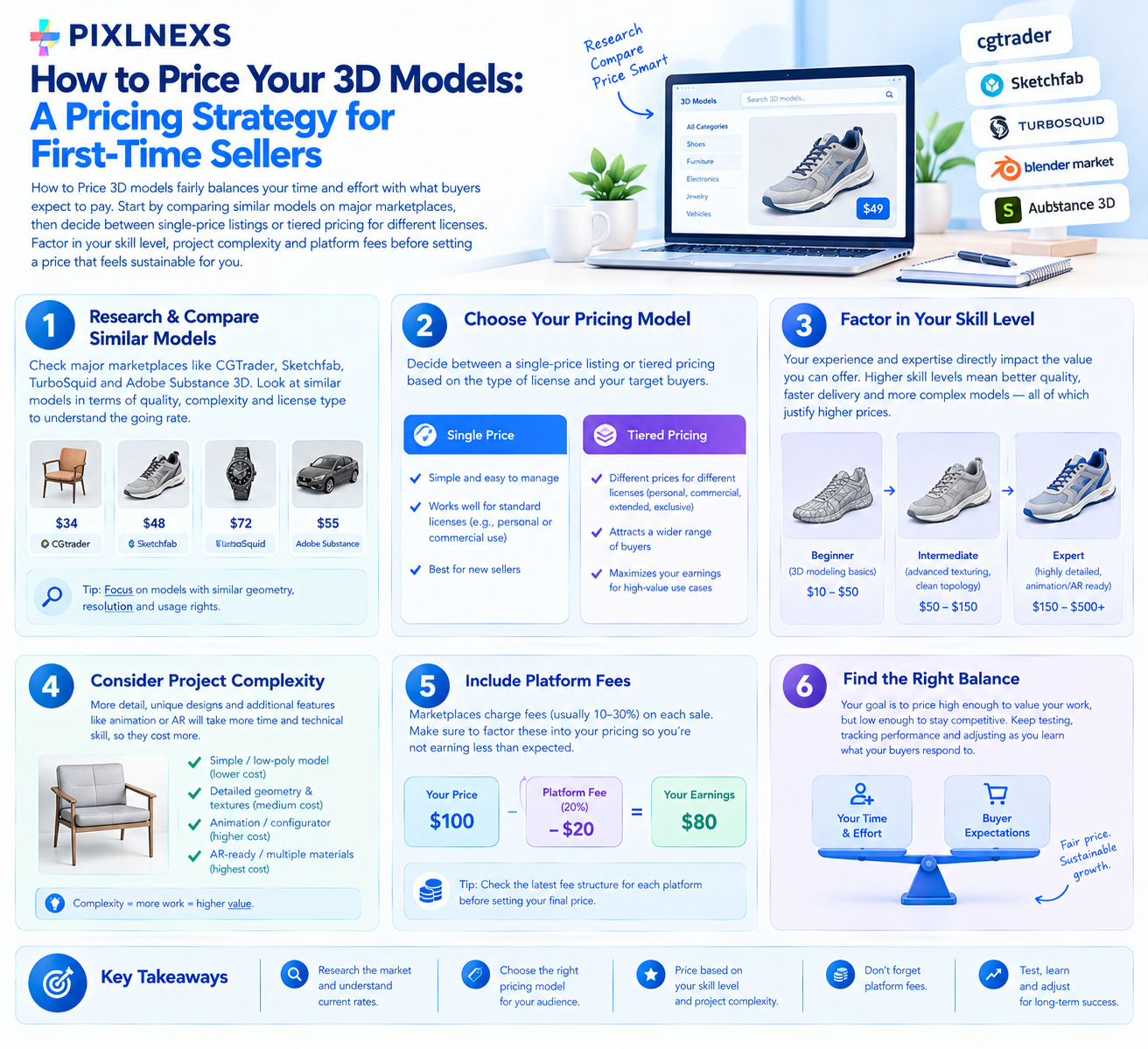
Quick Answer: How to Price 3D models fairly balances your time and effort with what buyers expect to pay. Start by comparing similar models on major marketplaces, then decide between single-price listings or tiered pricing for different licenses. Factor in your skill level, project complexity and platform fees before setting a price that feels sustainable for you.
By Bali Balaji, Pixlnexs Studio. Pixlnexs builds interactive 3D and AR product visualization for eCommerce brands worldwide and our team works with 3D asset pipelines and marketplace-ready model delivery every day.
Key Takeaways
- Research live listings on multiple marketplaces to anchor your pricing.
- Match license types to buyer needs, from personal hobby use to commercial product visualization.
- Adjust prices for complexity originality and the time you invest in modeling and texturing.
- Factor in platform fees and your profit goal when finalizing the price.
- Test small price changes and track conversion rates to refine your strategy over time.
Why Does Pricing 3D Models Feel So Hard When You’re Just Starting Out?
You’ve spent hours modeling, texturing and optimizing a 3D asset you’re proud of. Now you’re ready to list it but the price tag feels impossible to set. Too low and you undervalue your work; too high and you scare off buyers. The uncertainty isn’t just about money it’s about whether anyone will even see your work if the price is wrong.
Most first-time sellers fall into two traps. Some copy the lowest price they see, hoping to attract buyers quickly, only to realize they can’t cover their time. Others price based on vague feelings of “what feels right,” which often leads to pricing too high for their audience. Neither approach builds confidence with buyers or yourself.
The real issue isn’t just the number it’s the mismatch between what you think your model is worth and what buyers expect to pay. Buyers compare your listing to dozens of similar ones in seconds. If your price doesn’t align with their expectations, your model disappears into the noise, no matter how good it is.
What Determines a Fair Price for Your 3D Model?
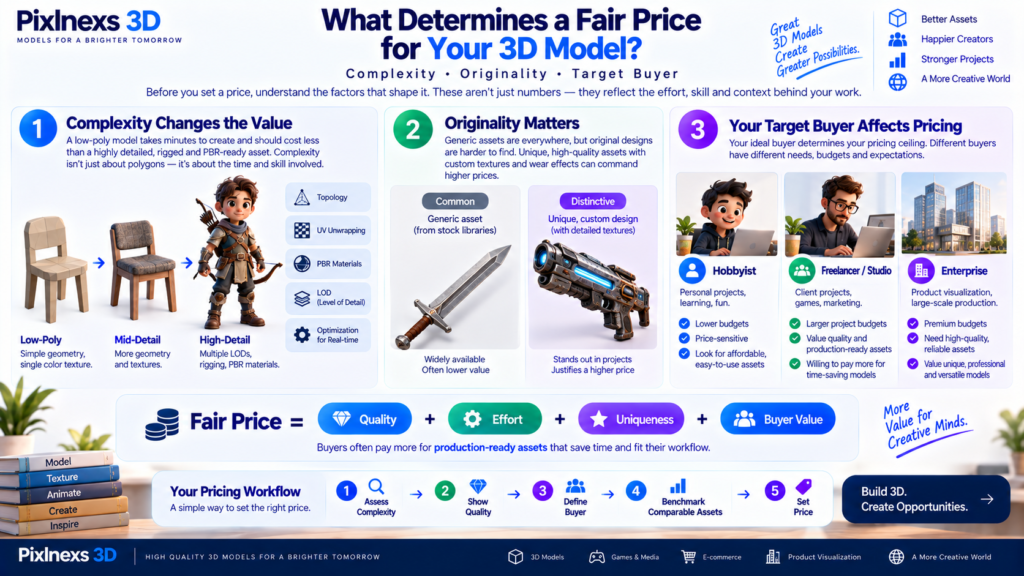
Before you set a price, you need to understand the factors that shape it. These aren’t just numbers they reflect the effort, skill and context behind your work.
How Does Complexity Change the Value of a 3D Model?
A low-poly chair with a single color texture takes minutes to create and should cost less than a high-resolution character with multiple LODs, rigging and PBR materials. Complexity isn’t just about polygons it’s about the time spent on topology, UV unwrapping, material setup and optimization for real-time engines.
Some artists argue that simple models deserve higher prices because they’re easier to use. But buyers rarely pay a premium for convenience alone unless the model fills a specific niche. Most buyers expect to pay more for models that save them weeks of work.
Why Does Originality Matter More Than You Think?
Original designs command higher prices because they’re harder to find. A generic medieval sword from a stock asset pack might sell for a few dollars but a uniquely styled sci-fi weapon with custom textures and wear effects can justify a much higher price.
Buyers are willing to pay for models that stand out in their projects. If your asset looks like it came from a free library, price accordingly. If it looks like a professional asset used in a commercial project, price it like one.
How Does Your Target Buyer Affect What You Can Charge?
Your ideal buyer determines your pricing ceiling. Hobbyists buying for personal projects expect low prices. Freelancers and small studios working on client projects have bigger budgets. Enterprise buyers working on product visualization or game development can afford premium prices.
If you’re targeting game developers, your price should reflect the value your model adds to their pipeline. If you’re selling to hobbyists, your price should match what they’re willing to spend on fun, not profit.
How Do You Research What Similar 3D Models Are Actually Selling For?
You can’t set a fair price without knowing what’s already out there. But researching live listings is trickier than it seems.
Where to Look Beyond One Marketplace
Start with the big three: TurboSquid, CGTrader and Sketchfab. Each attracts different buyers, so prices vary. TurboSquid tends to have higher commercial traffic, CGTrader is strong in freelance and indie development and Sketchfab skews toward real-time viewers and AR/VR projects.
Don’t stop at the top results. Scroll through multiple pages and sort by “Most Popular” or “Top Sellers” to see what’s actually moving. Look at models with similar poly counts, materials and intended use cases. Ignore outliers both the dirt-cheap and the absurdly expensive listings.
How to Compare Models Accurately
Compare apples to apples. A 2K PBR texture pack isn’t the same as a single 4K high-poly prop. A rigged character with blendshapes isn’t the same as a static mesh. If your model includes animations, LODs or custom shaders, it’s worth more than a basic static object.
Check the file formats too. If your model only exports to .fbx but most competitors offer .glb, .obj and .blend, buyers may see less value in yours. On Fab specifically, buyers often filter for Unreal- and Unity-ready formats, so native engine compatibility can matter more than raw format count.
Why Do Some Models Sell for Less While Others Sell for More?
The difference isn’t random. Models priced lower are usually simple assets from template libraries or free packs. Models priced higher are often high-quality original or bundled with extras like LODs, materials or animations.
The lower price range is crowded because buyers expect instant gratification for small purchases. The higher price range has less competition because it requires more effort to create and market. If your model fits in the middle, you’ll need to justify its value clearly.
Should You Use a Single Price or Tiered Pricing for Your 3D Model?
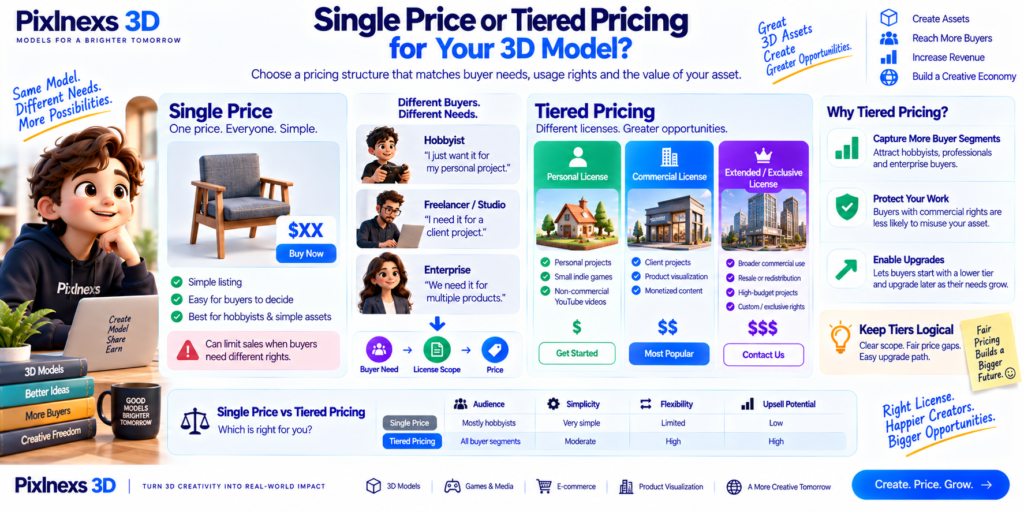
You have two main options: a flat price for all buyers or tiered pricing based on license type. Each has pros and cons and the best choice depends on your goals and audience.
When Does a Single Price Work Best?
A single price simplifies your listing and makes it easier for buyers to decide. It’s ideal if you’re selling to hobbyists or if your model is simple enough that buyers won’t need different license tiers.
But a single price can backfire if your model has multiple use cases. A developer might want a commercial license for a client project, while a hobbyist only needs a personal license. If you don’t offer both, you risk losing sales to competitors who do.
How Does Tiered Pricing Increase Sales and Protect Your Work?
Tiered pricing lets you capture different buyer segments. A basic license for personal or small-scale use can be priced low to attract hobbyists. A commercial license for client work or product visualization can be priced higher to reflect the added value.
This approach also protects your work. Buyers who need commercial rights are less likely to misuse a personal license, reducing the risk of piracy. It also lets you upsell buyers who start with a low-tier license and later need an upgrade.
Examples of Effective Tiered Pricing Structures
- Personal License: Lower price. Allows use in personal projects, small indie games or non-commercial YouTube videos.
- Commercial License: Higher price. Allows use in client projects, product visualization or monetized content.
- Extended/Exclusive License: Premium price. Allows resale, redistribution or use in high-budget commercial projects.
The key is to make the tiers feel logical and fair. If the jump between tiers feels too steep, buyers will skip the personal license and go straight for the commercial one, defeating the purpose.
How Do You Price Different Types of 3D Models?
Not all 3D models are created equal. The type of model you’re selling changes how buyers perceive its value and what they’re willing to pay.
Pricing 3D Characters and Creatures
Characters are among the most complex assets to create. They require modeling, rigging, skinning and often facial blendshapes or motion data. A single high-quality character can take days or weeks to complete.
Buyers expect to pay more for characters because they’re central to many projects. A stylized low-poly character without a rig typically lists in the $25–$75 range. A photorealistic rigged character with animations and blendshapes commonly runs $150–$500 and can go well beyond that for AAA-quality work with full facial rigs.
Pricing 3D Environments and Props
Environments and props are easier to price because they’re often modular. A single room or a set of furniture can be sold as a bundle. Buyers are more forgiving of repetitive assets if the style is cohesive and the textures are high quality.
A single simple prop like a chair or lamp typically sits in the $5–$30 range, with detailed hero props reaching $30–$80. A full interior environment with multiple rooms generally lists between $100 and $400 depending on room count, texture resolution and whether it ships modular.
Pricing 3D Vehicles and Machinery
Vehicles and machinery are high-value assets because they’re detailed and often require multiple LODs for real-time engines. A simple exterior-only car model typically lists at $40–$120. A detailed vehicle with a modeled interior, multiple LODs and custom damage or wear textures commonly runs $150–$600.
Machinery models are similar. A single industrial machine might sell for less, while a complex factory setup with multiple interconnected machines can sell for more.
Pricing 3D Materials and Textures
Material and texture packs are priced differently because they’re not 3D models. Buyers expect to pay less for a set of PBR materials than for a 3D prop. A single PBR material set typically lists at $10–$25, while a large pack with multiple variations and 4K maps generally runs $30–$60.
The key is to price based on the number of materials, resolution and whether they include additional files like Substance Painter projects or Photoshop templates.
Pricing 3D Animation and Motion Capture
Animations and motion capture data are niche but valuable. A single animation clip typically lists at $15–$50, while a full motion capture set with multiple takes and cleaned-up data generally runs $80–$300.
Buyers in this category are often game developers or film studios, so they have higher budgets. But they’re also more selective, so quality and uniqueness matter more than quantity.
How Do You Factor in Platform Fees and Your Own Costs?
Your final price isn’t just about the model it’s about what you keep after fees and expenses.
Understanding Marketplace Fee Structures
Most marketplaces take a cut of every sale, and the splits are steeper than most first-time sellers expect. Here is where the three major platforms sit:
| Marketplace | Seller Royalty | How It Scales |
|---|---|---|
| TurboSquid | 40% base, up to 80% | New non-exclusive sellers start at 40%. SquidGuild (exclusive) members start at 50%, rising to 60% after $150 in sales. Lifetime sales over $10,000 hold at 60%. Adding the Affiliate Program’s 20% commission can reach 80% total. |
| CGTrader | 60%–85% | A 26-level payout system tied to a rolling 365-day sales threshold, each level adding 1%. Reviewed daily, so rates can move down as well as up. |
| Fab (Epic Games) | Varies by license tier | Supports separate Personal and Professional tier pricing per product. Absorbed the Sketchfab Store, Quixel, ArtStation Marketplace and the Unreal Engine Marketplace. |
Two things follow from this table. First, a $50 model does not earn you $50 at TurboSquid’s base rate it earns $20 before tax and processing. Second, exclusivity is a real lever: committing to one platform is usually worth 10–20 percentage points of royalty, which is worth weighing against the traffic you give up elsewhere.
Some platforms also charge listing or activation fees on top of the royalty split and payment processing typically takes another 2–3% before the money reaches you. Build both into your price from the start rather than discovering them on your first payout.
How to Calculate Your Profit After Fees
Start with your target profit and work backwards. If you want to clear $40 on a model and you are on TurboSquid’s base 40% royalty, you need to list at $100. On CGTrader at a 70% rate, the same $40 target only needs a $57 listing which is exactly why the same model is often priced differently on different platforms.
Then subtract the rest: payment processing usually takes 2–3% and US-sourced sales can carry up to 30% withholding tax unless your country has a treaty rate that reduces it. A $100 sale at a 40% royalty with withholding applied can land closer to $28 than $40. Build all three layers royalty split, processing, tax into your price before you list, not after your first payout surprises you.
When to Offer Discounts or Sales
Discounts can drive traffic and clear inventory but they can also train buyers to wait for sales. Use them strategically during holidays, for product launches or to promote new bundles.
Avoid deep discounts on your best-selling models. Instead, bundle slow-moving assets with popular ones or offer limited-time discounts on older models to make room for new work.
How Do You Adjust Your Pricing Based on Market Trends?
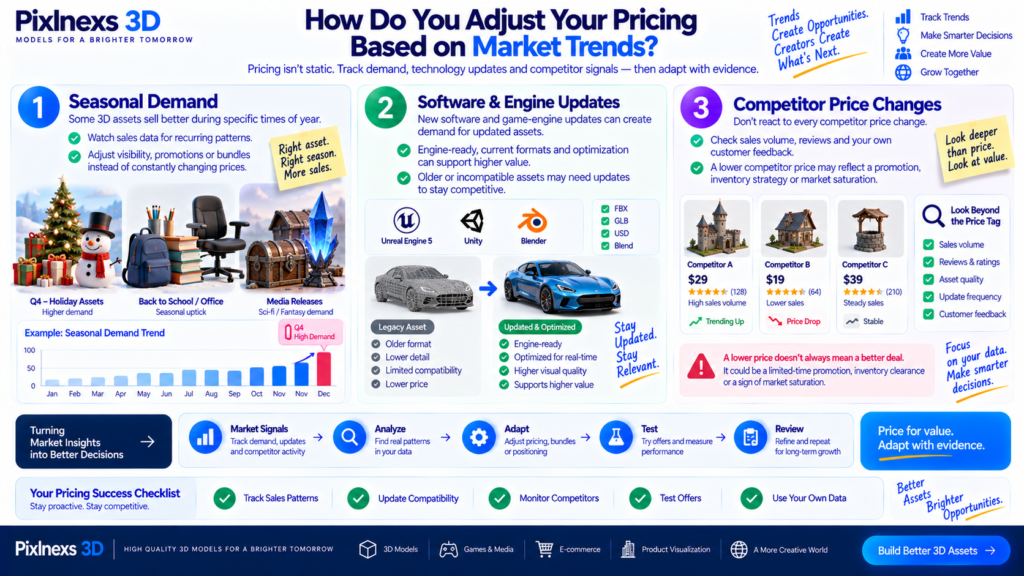
Pricing isn’t static. What works today might not work next month. Staying aware of trends helps you adapt without constantly second-guessing yourself.
How Does Seasonal Demand Affect Pricing?
Some 3D assets sell better during specific times of the year. Holiday-themed props spike in demand in Q4. Back-to-school or office-themed assets might sell better in late summer. Sci-fi or fantasy assets can see upticks around major media releases.
Watch your sales data to spot patterns. If a particular category sells well during certain months, plan your pricing and promotions accordingly. You don’t need to change prices drastically just adjust visibility or bundle offers.
How Do New Software and Engine Updates Impact Pricing?
New versions of game engines or 3D software can create demand for updated assets. For example, when Unreal Engine 5 launched, many buyers looked for high-poly assets compatible with Nanite. If your models are optimized for the latest tools, you can justify slightly higher prices.
On the flip side, older assets may need updates to stay relevant. If your model is outdated or incompatible with current tools, buyers may expect a discount. Keeping your assets updated ensures you don’t have to compete on price alone.
How Do Competitor Price Changes Affect Your Strategy?
If a top-selling competitor lowers their prices, you might feel pressured to do the same. But before you react, check their sales volume and reviews. Are they selling more because of the lower price or are they struggling?
Sometimes, competitors drop prices to clear inventory or test new strategies. If their models aren’t selling despite low prices, it might indicate a saturated market rather than a pricing issue. Focus on your own data and customer feedback instead of reacting to every price change.
How Do You Test and Refine Your Pricing Strategy Over Time?
Pricing isn’t a one-time decision. It’s an ongoing process of testing, learning and adjusting.
How to Run A/B Tests on Your Listings
A/B testing means listing the same model at two different prices and tracking which performs better. You can do this by creating two separate listings or by adjusting the price on an existing one and monitoring sales.
Start with small changes to avoid scaring off buyers. Track conversion rates, not just sales. A lower price might sell more units but leave you with less profit. A higher price might sell fewer units but increase your earnings per sale.
How to Use Customer Feedback to Improve Pricing
Listen to what buyers say about your pricing. If multiple buyers mention that your model is too expensive for their budget, consider offering a basic license tier. If buyers say your model is a great value, you can confidently raise prices on future listings.
Don’t rely solely on reviews reach out to buyers directly if possible. Ask why they chose your model over competitors. Their answers will tell you whether your pricing is aligned with their expectations.
How to Scale Pricing as You Build a Reputation
As you gain more sales and positive reviews, you can gradually increase your prices. New sellers often underprice their work to attract buyers but once you have a portfolio of successful sales, buyers will pay more for your models.
Don’t wait too long to raise prices. If you’re selling consistently at a certain price point, test a small increase. If sales hold steady or improve, you’ve found a new baseline.
What Are Common Pricing Mistakes First-Time 3D Sellers Make?
Even experienced sellers fall into these traps. Avoiding them early saves you time, money and frustration.
Undervaluing Your Work Because You’re New
It’s tempting to set low prices to attract your first sales but undervaluing your work sets a precedent. Buyers who pay less for your model won’t suddenly pay more later, even if your quality improves.
Price your work fairly from the start. If you’re unsure, look at what similar models sell for and price slightly below the average. As you gain confidence and reviews, adjust accordingly.
Ignoring License Restrictions in Your Pricing
Some sellers price their models as if they’re selling full rights, then get surprised when buyers misuse the asset. If you’re selling a personal license, price it lower than a commercial license. If you’re selling an exclusive license, price it higher to reflect the added value.
Be clear about what each license allows. Buyers appreciate transparency and it reduces the risk of disputes later.
Chasing the Lowest Price Instead of the Best Value
The cheapest model isn’t always the best buy. Buyers who prioritize price over quality often end up with assets that need rework, saving you time in the long run.
Highlight the value of your model in your listing. Emphasize originality, quality and compatibility with popular tools. Buyers who see the value will pay more, even if your price isn’t the lowest.
How Do You Communicate Value When Your Price Is Higher Than Competitors?
If your price is higher, you need to justify it. Buyers won’t pay more unless they see a clear reason.
Highlight What Makes Your Model Unique
Point out the details that set your model apart. Is it hand-modeled instead of sculpted? Does it include custom materials or LODs? Are the textures hand-painted instead of generated?
Buyers care about the little things. If your model has features that competitors’ models lack, make sure those features are front and center in your listing.
Showcase Real-World Examples of Your Model in Use
Include turntables, screenshots or even short videos showing your model in a real project. If you’ve used the model in your own work, share that too. Seeing the model in action helps buyers visualize its value.
Don’t just show the model isolated on a gray background. Show it in a scene that reflects how buyers might use it. A chair in a living room, a car on a city street or a character in a fantasy setting context matters.
Offer Bonuses or Extras to Justify the Price
Small extras can make a big difference. Include additional LODs, alternate texture variations or a basic rig if applicable. Even simple things like a thumbnail pack or a quick start guide add perceived value.
Bundles work well too. Sell a set of related models at a slight discount to increase the total sale value. For example, a furniture pack with a chair, table and lamp can sell for more than the sum of its parts.
How Do You Handle Custom Work and One-Off Pricing Requests?
Not every sale will fit into your standard pricing. Custom work requires a different approach.
When to Charge a Premium for Custom 3D Models
Custom models take more time and effort. If a buyer wants significant changes to an existing model or a completely new design, charge accordingly. Don’t underprice custom work it undervalues your skills and sets a bad precedent.
Be transparent about your pricing structure. If you charge by the hour, state your rate upfront. If you charge per asset, provide a clear breakdown of what’s included.
How to Structure Custom Pricing Without Scaring Off Buyers
Offer tiered custom pricing. For example:
– Basic Customization: Small changes like color swaps or minor adjustments.
– Full Redesign: Major changes to shape, materials or structure.
– From Scratch: A completely new model based on the buyer’s specifications.
Provide examples of what each tier includes. Buyers appreciate clarity and it reduces the chance of misunderstandings later.
How to Protect Yourself with Contracts and Deposits
Custom work should always involve a contract or agreement. Outline the scope of work, delivery timeline and payment terms. Require a deposit before starting 30–50% of the total is the standard range for custom 3D work to protect yourself from non-payment.
Use simple contracts or invoices. Platforms like PayPal or Stripe can generate invoices with clear terms. Keep communication professional and document all changes to avoid disputes.
Need 3D or AR product visualization built for your store?
Pixlnexs sources, optimizes and integrates 3D and AR product assets for eCommerce brands from GLB/USDZ conversion to Shopify theme and app setup to full interactive 3D configurators.
See Our Interactive 3D eCommerce WorkHow Do You Price Bundles and Collections to Increase Revenue?
Bundles are a powerful way to increase your average sale value while providing more value to buyers.
How to Structure Bundles for Maximum Appeal
Group related models together. A furniture bundle might include chairs, tables and lamps. A character bundle might include multiple outfits or accessories. The key is to create a cohesive set that buyers can use together.
Price bundles at a discount compared to buying each model separately. A 15–30% discount off the sum of individual prices is the standard range enough to feel like a genuine saving without signalling that your individual listings were overpriced to begin with. The discount should feel like a bonus, not a necessity.
How to Price Large Collections vs Small Bundles
Small bundles (3–5 models) can be priced lower, while large collections (10+ models) can be priced higher. The per-model price should still feel fair but the total value should be attractive enough to encourage bulk purchases.
Highlight the savings clearly. For example: “Buy all 5 models for less (save on individual prices).” Buyers love feeling like they’re getting a deal.
How to Use Bundles to Upsell Future Purchases
Bundles can introduce buyers to your work and encourage them to buy more from you later. Include a mix of popular models and new or niche assets to showcase your range.
Promote bundles in your newsletters or social media. If a buyer purchases one bundle, offer a discount on a second bundle to encourage repeat purchases.
How Do You Set Pricing for Subscription or Membership Models?
Subscriptions and memberships are less common in the 3D market but can be lucrative if done right.
When Does a Subscription Model Make Sense?
Subscriptions work best if you can provide ongoing value. For example:
– A monthly pack of new props or characters.
– Access to exclusive models before they’re released publicly.
– A library of materials or textures with regular updates.
The key is to deliver consistent value. If buyers feel like they’re paying for content they could get elsewhere for free, they won’t renew.
How to Price Memberships Competitively
Memberships should feel like a bargain compared to buying models individually. Offer tiered pricing to cater to different buyer needs, with discounts for long-term commitments.
Offer a free trial or a money-back guarantee to reduce the risk for buyers. Highlight the savings compared to buying models one by one.
How to Prevent Churn and Keep Members Engaged
Churn is the biggest challenge with subscriptions. Keep members engaged by:
– Releasing new content regularly.
– Sending email updates with previews of upcoming models.
– Offering discounts or bonuses for long-term members.
Track engagement metrics like login frequency and download counts. If members aren’t using the service, it’s time to rethink your offering.
How Do You Price 3D Models for Direct Sales vs Marketplaces?
Selling directly from your own website gives you more control over pricing but it also requires more effort.
Pros and Cons of Selling Directly
Pros:
– Higher profit margins (no marketplace fees).
– Full control over pricing, discounts and bundles.
– Direct relationship with buyers for marketing and upsells.
Cons:
– More work to drive traffic and convert sales.
– No built-in audience like marketplaces provide.
– Need to handle payments, taxes and customer support yourself.
How to Price Competitively When Selling Directly
Compare your prices to marketplace listings. If your model is similar to one selling for a certain price on TurboSquid, price it competitively to attract buyers. Offer a small discount for direct purchases to offset the lack of marketplace visibility.
Highlight the benefits of buying directly. For example:
– Instant downloads without moderation delays.
– Access to exclusive models not available elsewhere.
– Direct support from the artist.
How to Drive Traffic to Your Direct Sales Page
Use your portfolio website, social media and email lists to promote direct sales. Share behind-the-scenes content, turntables and customer testimonials to build trust.
Offer limited-time discounts or bundles to encourage first-time buyers. Partner with other artists or studios for cross-promotions to expand your reach.
How to Price 3D Models for Niche Markets and Specialized Buyers?
Niche markets can be less competitive and more profitable if you target the right audience.
How to Identify Profitable Niche Markets
Look for underserved categories where buyers have specific needs. For example:
– Medical or scientific 3D models for researchers.
– Architectural visualization assets for studios.
– Vehicle models for flight simulators or racing games.
Research forums, Reddit threads and Facebook groups to see what buyers in these niches are asking for. If you see repeated requests for a specific type of model, it’s a sign of demand.
How to Price Models for Specialized Industries
Specialized models often command higher prices because they require specific knowledge or tools. For example:
– A medical 3D model might sell for more due to its accuracy and detail.
– An architectural visualization asset might sell for more because of its complexity.
– A flight simulator aircraft model might sell for more due to its realism.
Buyers in these industries have bigger budgets, so don’t be afraid to price accordingly. Highlight the accuracy, detail and compatibility with industry-standard tools.
How to Market Niche Models Effectively
Niche models require targeted marketing. Share your work in industry-specific forums, Facebook groups or Discord servers. Partner with influencers or YouTubers in the niche to showcase your models.
Use keywords in your listings that buyers in the niche are searching for. For example, “medical 3D model heart anatomy” or “architectural visualization skyscraper model.” This helps your models rank higher in search results.
How Do You Price 3D Models for AI and Procedural Generation?
AI and procedural generation are changing how 3D models are created and used. Pricing these models requires a different approach.
How to Price AI-Generated 3D Models
AI-generated models are often faster and cheaper to produce but their value depends on uniqueness and usability. A model generated by an AI tool might sell for less if it’s generic. A model refined by a human artist with custom textures and optimizations can sell for more.
Buyers are still learning what to expect from AI models. If your model is AI-generated but polished by hand, make that clear in your listing. Buyers may pay more for the human touch.
How to Price Procedural Asset Packs
Procedural asset packs, like those for Houdini or Blender, are priced based on their versatility and ease of use. A simple pack of modular buildings might sell for less. A complex system with multiple parameters and presets can sell for more.
Highlight the time-saving benefits. Buyers pay for efficiency, so emphasize how your pack can generate hundreds of variations with minimal effort.
How to Adapt Pricing as AI Tools Improve
As AI tools become more advanced, the barrier to entry for creating 3D models will drop. This could lead to more competition and lower prices for basic models. To stay competitive, focus on quality, originality and niche markets where human craftsmanship still matters.
Offer hybrid models AI-generated base assets refined by hand to justify higher prices. As AI tools improve, your ability to iterate and refine will become a key differentiator.
Frequently Asked Questions
How Do I Price a 3D Model if I’m New with No Sales History?
Start by researching similar models on marketplaces and pricing slightly below the average. Consider your time investment if the model took you a significant amount of time, price it to reflect that, even if you’re new. As you gain sales and reviews, you can gradually increase your prices.
Should I Price My 3D Models Higher on My Own Website Than on Marketplaces?
Not necessarily. Marketplaces provide built-in traffic, so your prices should align with what buyers expect to pay there. On your own website, you can offer small discounts or bundles to encourage direct sales but don’t price too low buyers expect to pay a fair price regardless of where they buy.
How Often Should I Adjust My 3D Model Prices?
Review your prices every few months or when you release new models. If a model isn’t selling after several weeks, consider lowering the price or offering a limited-time discount. If a model is selling consistently, you can gradually increase the price as your reputation grows.
What’s the Best Way to Handle Pricing for a Model That’s Been Sitting Unsold for Months?
First, check if the model meets marketplace quality standards. If it does, consider lowering the price or bundling it with other models. Update the thumbnail and preview images to make it more appealing. If it still doesn’t sell, it might not be the right fit for the market consider revising or discontinuing it.
How Do I Price a 3D Model That Includes Custom Animations or Rigging?
Models with animations or rigging are more valuable because they save buyers significant time. Price them higher than static models typically in a higher range depending on complexity. If the animations are custom and unique, you can justify even higher prices. Always specify which software the rigging or animations are compatible with.
How much should I charge for a 3D model if I’m selling exclusively on one platform?
Exclusivity usually earns you a meaningfully higher royalty split on TurboSquid, for example, exclusive SquidGuild sellers start at 50% versus 40% for non-exclusive, rising further with sales volume. Because you’re trading platform reach for a better cut, it’s reasonable to price 10–15% lower than you would on a non-exclusive multi-platform listing, since the higher royalty percentage largely offsets the lower list price, and a slightly lower price can help you build sales volume faster on a single platform.
Should I price the same model differently across TurboSquid, CGTrader, and Fab?
Yes, if you want your take-home pay to be consistent across platforms. Because royalty rates differ significantly by platform, listing the same model at the same price everywhere means you effectively earn less on lower-royalty platforms. If your target payout is $40 per sale, that might mean listing at $100 on TurboSquid’s base 40% rate but only $57 on CGTrader at a 70% rate. Buyers rarely comparison-shop the exact same model across all three marketplaces, so pricing for consistent take-home pay is usually a better strategy than pricing for a consistent sticker price.
For a full fee-and-traffic comparison across platforms, see our guide to the best marketplaces to sell 3D models in 2026.
If you have not made a sale yet, our beginner playbook on making your first sale covers the steps that come before pricing.
Marketplaces reject models that miss technical requirements, so it is worth reviewing the 3D model quality standards buyers and marketplaces expect before you price anything.
Our guide on how to showcase 3D models with thumbnails, turntables and previews goes deeper on presentation.
New to selling 3D models?
Pricing is one piece of a larger process. Our complete guide walks through preparing, listing and selling 3D models online, from file prep to your first payout.Read the Complete Selling Guide










Leave a Reply