
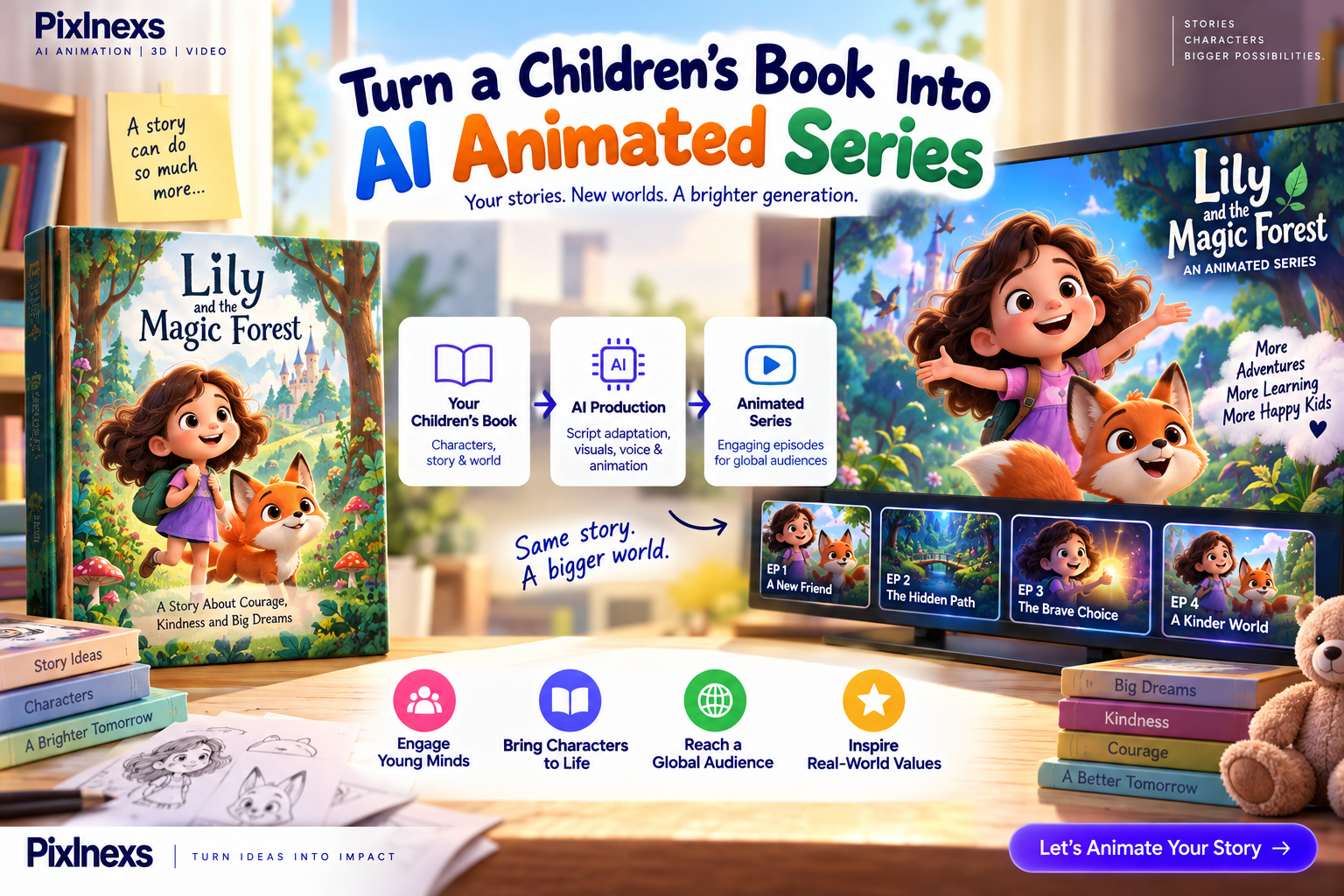
Quick answer: To turn children’s book into ai animated video series content, you first deconstruct the static page spreads into a dynamic scene breakdown, mapping visual elements to camera movements and audio cues. You then use AI video generation tools to create consistent character assets and background environments, keeping the visual style uniform across every episode. Finally, you edit the generated clips together, adding voiceovers, sound effects and music to build a cohesive story that respects the pacing of the original text. This process turns a static illustration into a moving, engaging series suitable for streaming platforms and YouTube Kids channels.
By Bali Balaji, Pixlnexs Studio. Pixlnexs builds AI animated video production for children’s content channels, EdTech platforms and independent publishers worldwide.We focus on the technical and creative bridge between static print media and dynamic digital animation, ensuring that the unique voice of a book is preserved while gaining the visual momentum required for modern screen consumption.
Why Publishers and Authors Are Moving to Animation
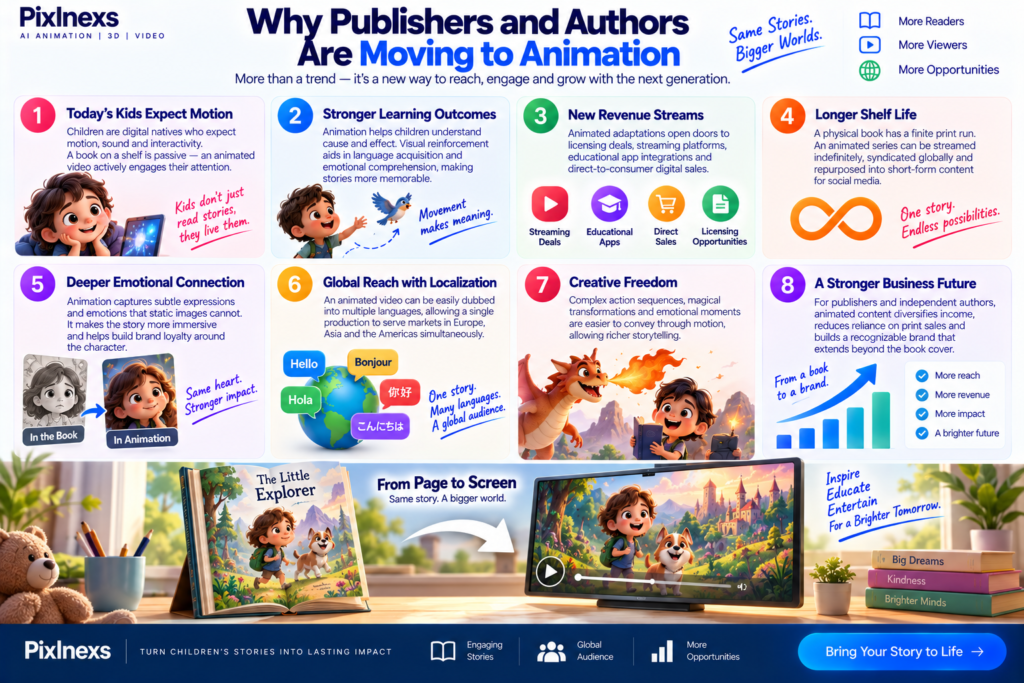
The shift from static print to animated video is not just a trend; it is a fundamental change in how young audiences consume stories. Children today are digital natives who expect motion, sound and interactivity. A book that sits on a shelf is passive but an animated video actively engages the viewer’s attention. For authors and publishers who want to turn children’s book into animated video franchises, this transition opens new revenue streams, including licensing deals with streaming platforms, educational app integrations and direct-to-consumer digital sales.
There is a distinct psychological benefit to animation for early learners. When a character moves, jumps or interacts with their environment, children can better understand cause and effect. This visual reinforcement aids in language acquisition and emotional comprehension. A story about a dragon breathing fire is powerful in text but seeing the flames lick the edges of the screen creates an immediate visceral connection. This emotional hook is what keeps young viewers returning for more, building brand loyalty around the character rather than just the title.
From a business perspective, animation extends the shelf life of a property. A physical book has a finite print run and distribution window. An animated series, however, can be streamed indefinitely, syndicated globally and repurposed into short-form content for social media. It allows a single creative asset to serve multiple markets simultaneously. The initial investment in animation is higher than print but the long-term value of a recognizable animated character often exceeds that of a static illustration.
We often see authors hesitate because they fear losing the intimacy of the book. They worry that the animation will feel cold or mechanical. This concern is valid if the production is rushed or lacks artistic direction. However, when approached with a clear visual strategy, animation can enhance the intimacy by allowing the camera to get close to the character’s face, capturing subtle expressions that a static image cannot convey. The key is to treat the animation not as a replacement for the book but as a new medium that tells the same story in a different language.
The commercial intent behind this shift is clear. Publishers are looking for ways to diversify their income. Relying solely on print sales is risky in a market where e-books and digital subscriptions are growing. Animation provides a tangible, high-value product that can be sold to educational institutions, streaming services and parents directly. It transforms a one-time purchase into a recurring engagement. For independent authors, this is even more critical. Without the backing of a major publisher, creating an animated series can be a way to build an audience and establish a brand that is recognized beyond the book cover.
We have observed that the most successful adaptations are those that understand the target age group. A story for toddlers requires simple, repetitive actions and bright colors. A story for older children can handle more complex camera angles and narrative pacing. The animation must match the cognitive development of the viewer. This is why a generic conversion from page to screen often falls flat it lacks the specific tuning required for the intended audience.
Another reason for the shift is the global reach of digital content. A book printed in English can only be sold to English speakers, unless it is translated and reprinted. An animated video, however, can be easily dubbed into multiple languages, a process we cover in detail in our localization guide for multi-language animated video. The visuals remain the same but the audio can be swapped. This allows a single production to serve markets in Europe, Asia and the Americas simultaneously, at a fraction of the cost of reprinting and distributing physical books.
Finally, animation allows for the exploration of themes that are difficult to depict in static images. Action sequences, magical transformations and complex emotional shifts are easier to convey through motion. A character who is sad can be shown slumping, their eyes downcast, their movements slow. In a static image, this must be implied through posture and color. In animation, it is explicit. This clarity helps young viewers understand the emotional landscape of the story, fostering empathy and emotional intelligence.
The Scene-Breakdown Framework: From Page to Screen
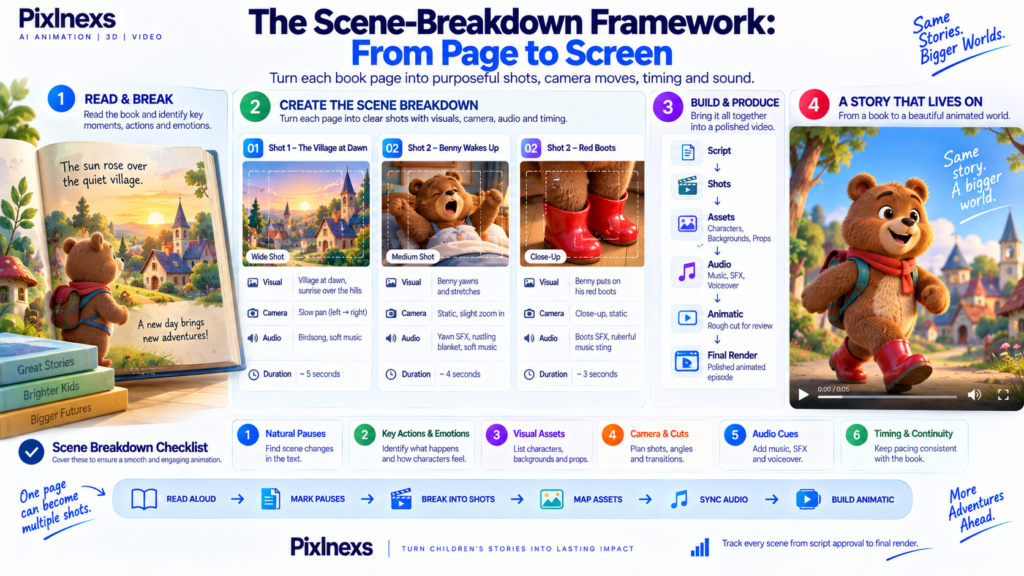
The most critical step in the process of turning a children’s book into animated video is the scene breakdown (deconstructing each page spread into a shot-by-shot plan of camera moves, actions and audio cues). This is where the static text and images are deconstructed into a dynamic script for animation. It is not enough to simply animate the illustrations. You must think in terms of shots, cuts and camera movements. A single page spread in a book might contain three distinct scenes in the video.
The first step is to read the book aloud and mark the natural pauses. These pauses correspond to scene changes. Each paragraph or stanza often represents a new visual idea. You need to identify the key actions and emotions in each section. For example, if the text says, “The little mouse ran across the kitchen floor,” the scene breakdown would include a wide shot of the kitchen, a medium shot of the mouse running and a close-up of the mouse’s face as it stops.
Next, you must map the visual elements from the book to the animation assets. The characters, backgrounds and props in the book must be recreated as digital assets. This is where the style guide becomes essential. The animation must match the artistic style of the book to maintain brand consistency. If the book uses watercolor textures, the animation should incorporate similar soft edges and color palettes. If the book uses bold, flat colors, the animation should reflect that simplicity.
The scene breakdown should also include audio cues. What sounds should be heard in each scene? Background music, sound effects and voiceovers must be synchronized with the visual action. For example, when the mouse runs, there should be a soft scurrying sound. When it stops, there should be a pause in the music. These audio cues help guide the viewer’s attention and enhance the storytelling.
Here is an example of a scene breakdown for a single page spread:
Page Spread 1: * Text: “The sun rose over the quiet village.” * Visuals: Wide shot of the village at dawn. The sky changes from dark blue to orange. * Camera: Slow pan from left to right. * Audio: Gentle birdsong, soft ambient music. * Duration: roughly 5 seconds (illustrative, adjust to pacing).
Page Spread 2: * Text: “Benny the bear yawned and stretched.” * Visuals: Medium shot of Benny in his bed. He yawns, showing his teeth and stretches his arms. * Camera: Static shot, slight zoom in on Benny’s face. * Audio: Yawn sound effect, rustling of blankets. * Duration: roughly 4 seconds (illustrative).
Page Spread 3: * Text: “He put on his red boots.” * Visuals: Close-up of Benny’s paws putting on the boots. The boots are bright red and shiny. * Camera: Close-up, static. * Audio: Sound of boots being pulled on, a small emphasis cue on the color reveal. * Duration: roughly 3 seconds (illustrative).
This level of detail is necessary to ensure that the animation flows smoothly. Each shot must have a clear purpose and duration. The total runtime of the video should match the pacing of the book. If the book reads aloud in about five minutes, the video should land near that same length, so the viewer experiences the story at a similar pace to reading it.
The scene breakdown is also where you identify the key moments that need special attention. These are the emotional peaks of the story, such as a character’s realization, a conflict or a resolution. These moments require more detailed animation and careful timing. The camera might move more dramatically or the music might swell. These moments are what make the video engaging and memorable.
In our production process, we use a shared scene-tracking sheet to manage the breakdown from script through final render. This allows the team to track the progress of each scene and make changes easily if the director or client requests adjustments a flexibility that matters most in the early stages of production, while the story is still being refined.
The scene breakdown is not just a technical document. It is a creative tool that helps the team understand the story. It forces the team to think about how the story will look and sound on screen. It is a bridge between the written word and the visual medium. By investing time in this step, you ensure that the final product is coherent and engaging.
Comparison of Adaptation Approaches
There are three main approaches to turning a children’s book into an animated video: faithful page-by-page, expanded-scene and hybrid. Each approach has its own advantages and disadvantages and the choice depends on the goals of the project and the nature of the book.
| Feature | Faithful Page-by-Page | Expanded-Scene | Hybrid |
|---|---|---|---|
| Fidelity to Original | High. Every element of the book is preserved. | Medium. New scenes are added to enhance the story. | High. Key scenes are faithful, others are expanded. |
| Production Time | Shorter. Fewer unique assets needed. | Longer. More assets and scenes to create. | Medium. Balanced workload. |
| Relative Cost | Lower. Less complex animation. | Higher. More complex animation and assets. | Moderate. Balanced cost. |
| Viewer Engagement | Moderate. Can feel static if not well executed. | High. Dynamic and engaging. | High. Balances fidelity and engagement. |
| Best For | Short stories, picture books for toddlers. | Longer narratives, stories with complex plots. | Most children’s books, especially those with strong characters. |
| Main Risk | Feels flat if pacing is slow. | Deviation from the original story. | Complexity in maintaining consistency. |
The faithful page-by-page approach is the most straightforward. It involves animating each page of the book close to how it appears, with minimal camera movement often just a slow pan or zoom. This approach suits short stories with simple plots and strong visual elements and it is the most cost-effective, since it requires fewer unique assets and less complex animation. The tradeoff is that it can feel static if the book lacks a strong visual narrative on its own.
The expanded-scene approach adds new scenes to the book to enhance the story. This might include introducing new supporting characters, adding action sequences or exploring a character’s backstory. This approach suits longer narratives with complex plots and lets the animation tell a richer story than the book alone. It is also the most time-consuming and expensive and it carries a real risk of deviating from the original story in a way that upsets fans of the book.
The hybrid approach combines elements of both. It keeps the key scenes from the book faithful to the original, while expanding on other scenes to add depth and engagement. In our experience, the hybrid approach is the most successful for commercial adaptation projects. It lets the publisher maintain the brand identity of the book while creating a product that is engaging for modern viewers and it allows the team to adjust the scope of expansion based on budget and timeline.
The choice of approach should be made early in the production process. It affects the script, the asset creation plan and the animation style, so it is worth discussing directly with the client and creative team before work begins.
Step-by-Step Production Workflow
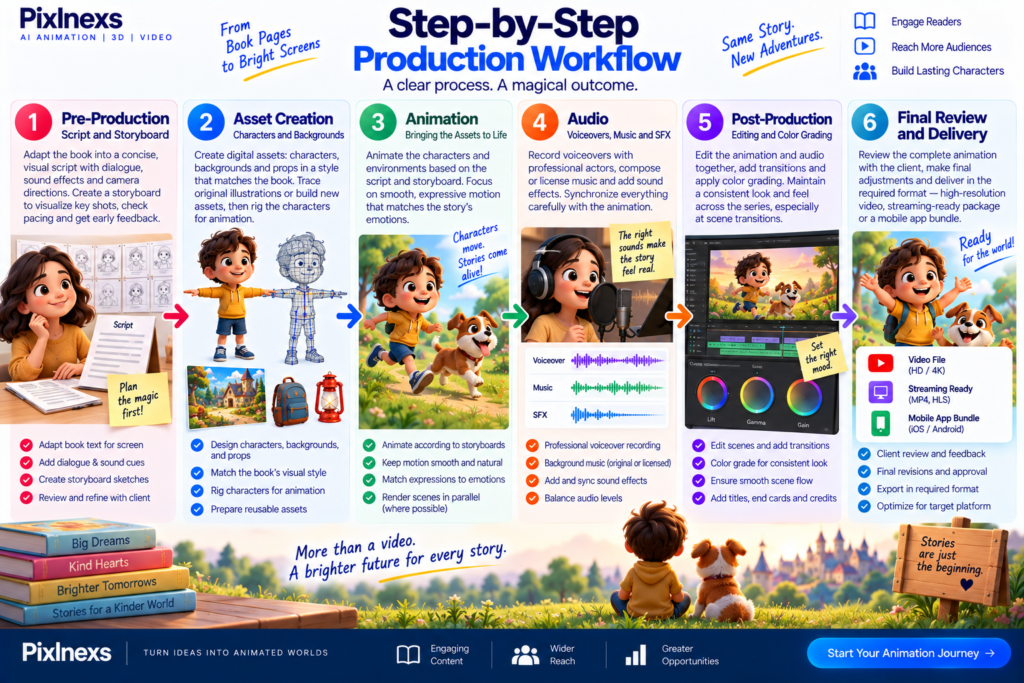
The production workflow for turning a children’s book into an animated video is a multi-stage process that requires careful planning and execution.
1. Pre-Production: Script and Storyboard
The first step is to create a script for the animation, adapted from the book’s text for the screen. It includes dialogue, sound effects and camera directions and should stay concise and visual. Next comes the storyboard a series of sketches showing the key shots of the animation. The storyboard helps the team visualize the story, spot pacing or composition issues early and gather feedback from the client.
2. Asset Creation: Characters and Backgrounds
Once the script and storyboard are approved, the team creates the digital assets: characters, backgrounds and props, built in a style that matches the book. This might involve tracing the original illustrations or building new assets from scratch that echo the original palette and line work. Characters are then rigged for animation adding joints and controls that let the animator move them. A well-rigged character can perform a wide range of movements; a poorly rigged one looks stiff and unnatural.
3. Animation: Bringing the Assets to Life
With assets ready, the team animates them according to the script and storyboard, aiming for motion that is smooth and true to the intended emotion. In our render queue, we process multiple scenes in parallel wherever the shot list allows, which shortens overall production time and lets us flag inconsistencies like a stray color shift in a background before they propagate into later episodes.
4. Audio: Voiceovers, Music and Sound Effects
Audio is a critical component. Voiceovers should be performed by actors who can convey the emotions of the characters; music should match the tone of the story; sound effects should reinforce the visual action without overpowering it. The audio must be synchronized carefully with the animation, since a mistimed sound effect breaks the illusion faster than almost any visual error.
5. Post-Production: Editing and Color Grading
The final creative step is editing the animation and audio together cutting scenes, adding transitions and color grading the footage. Color grading sets the mood of the animation and should stay consistent across the series, especially at scene transitions where an inconsistent grade is most noticeable to young viewers.
6. Final Review and Delivery
Once the animation is complete, the client and creative team review it for any final changes. After approval, the animation is delivered in the format required for the target platform a high-resolution video file, a streaming-ready package or a mobile app bundle optimized for the best possible viewing experience on that platform.
Maintaining Character Consistency Across Episodes
One of the biggest challenges in creating an animated series is maintaining character consistency across episodes. If the character looks different in each episode, the viewer will be confused and disengaged especially important for children, who are still developing their visual recognition skills.
To maintain consistency, build a style guide for the characters covering design, colors, proportions and expressions, along with reference poses. This guide should be followed by every animator and artist on the production. Reuse the same core assets for each episode the character’s model, rig and textures should stay the same from episode to episode, with any changes (a new outfit for a seasonal episode, for instance) designed to match the character’s established style rather than introduce a new one.
In our production process, we keep a centralized asset library for every character, prop and background so that every animator on the team pulls from the same version of each asset. This library is version-tracked, so if a design detail is refined mid-series, the change can be applied consistently across future episodes rather than drifting scene by scene.
Rights, Licensing and Ethical Considerations
Adapting a children’s book into an animated series raises rights questions that need to be settled before production begins. If the author and illustrator are not the same person, both parties typically hold separate rights that must be cleared for adaptation, distribution and merchandising. A publisher planning a series should confirm in writing who holds animation, streaming and merchandising rights and for which territories and languages, before committing production budget.
Voice talent contracts should also specify usage across future episodes, dubbed versions and any promotional cuts, so the production is not blocked later by a narrow original agreement. For EdTech-facing series in particular, it’s worth confirming that any educational claims embedded in the story (counting, letters, safety lessons) are reviewed by someone with relevant subject expertise rather than left to the animation team’s assumptions.
Where AI tools are used to generate character art, backgrounds or voice performances, it is good practice to disclose that AI was used in production, consistent with general guidance on synthetic media and disclosure discussed by outlets like Wikipedia’s overview of the picture book form and its history as a medium built around the interplay of text and image context worth understanding before deciding how much an animated adaptation should depart from the original layout.
Ready to bring your book to the screen?
Pixlnexs works with publishers and content channels to take a book from script through a finished, consistent animated series.
See Our AI Animated Video Production ServicesDistribution and Syndication After Production
Finishing the first episode is not the end of the project; it is the point where a distribution plan needs to already be in place. Children’s animated series typically reach audiences through a mix of a branded YouTube channel, licensing to streaming platforms aimed at families and syndication into EdTech apps or school platforms if the content has curricular value. Each of these channels has different technical delivery requirements aspect ratio, caption formats and content rating metadata so it is worth confirming the target platform’s specifications before the final render, not after.
A YouTube-first strategy tends to suit independent authors and smaller publishers because it has the lowest barrier to entry and gives the team direct audience data: watch time, drop-off points and repeat viewership by episode. That data is genuinely useful for planning season two if viewers consistently drop off two minutes into every episode, that is a pacing signal worth acting on before committing to another twelve episodes of the same structure.
Streaming platform licensing usually requires a more polished pilot and a season bible describing the full arc, tone and target age group and it often comes with stricter technical delivery specs than a YouTube upload. Publishers considering this route should build the pilot episode to the highest technical standard the team can manage, since it doubles as both content and a sales asset.
Syndication into EdTech platforms adds a layer of curriculum alignment on top of the animation itself. A phonics-focused adaptation, for example, may need to map each episode to specific learning objectives so the platform can slot it into a broader lesson sequence. This is a collaboration between the production team and an education specialist, not something the animation team should decide alone.
Budget Planning for a Book-to-Series Adaptation
Budgeting for an animated series adaptation should separate three distinct cost centers: asset creation (characters, backgrounds, rigging), per-episode production (animation, audio, editing) and post-launch costs (localization, platform-specific reformatting, marketing cutdowns). Asset creation is the largest up-front cost and the one most publishers underestimate, because it is tempting to treat the first episode’s budget as representative of every future episode. In practice, the first episode always costs more per minute than subsequent ones, since it is absorbing the cost of building the character models, rig and style guide that every later episode reuses.
A practical way to budget is to price the pilot episode as a combined “asset creation plus episode one” cost, then price every subsequent episode using only the per-episode production line, since the reusable assets are already built. This makes season-two budgeting far more predictable and it is the single biggest argument for investing properly in the scene-breakdown and asset-consistency work described earlier in this guide rather than treating each episode as a standalone production.
Frequently Asked Questions
How long does it take to turn a children’s book into ai animated video series?
The timeline depends on the length of the book, the number of episodes planned and the adaptation approach chosen. A single faithful page-by-page episode of a short picture book can move from script to final render in a few weeks once assets are built. An expanded-scene series with original supporting characters and multiple episodes takes considerably longer, since new assets must be designed, rigged and tested for consistency before the first episode is finished. Treat any timeline as illustrative until you have a locked script and shot list.
Do I need the illustrator’s permission to animate their artwork?
In most cases, yes. If the illustrator is not the sole rights holder or the original publishing contract did not include animation rights, you need a separate agreement covering adaptation, distribution and any merchandising tied to the animated characters. This is a legal question specific to the original publishing contract, so it should be reviewed by a rights specialist or entertainment attorney rather than assumed from general practice.
Can the animated series stay faithful to the book’s art style?
Yes and in most cases it should. The scene-breakdown framework described above is built around matching the book’s color palette, linework and texture so the animation reads as a natural extension of the book rather than a different product wearing the same title. Faithfulness to style is usually more important to young viewers and parents than photorealism or heavy stylistic departure.
What age groups work best for AI animated book adaptations?
Picture books for toddlers and early readers tend to adapt cleanly because their visual language is already simple, repetitive and high-contrast, which suits both animation and AI-assisted asset generation. Middle-grade books with denser plots can also be adapted but they usually need the expanded-scene or hybrid approach to sustain a longer runtime, since a faithful page-by-page approach can feel slow once the story has more than a handful of visual beats per chapter.
How many episodes should a first season have?
There is no fixed number but many children’s animated adaptations launch with a shorter first season often in the range of six to twelve episodes so the production team can validate the character models, pacing and audience response before committing to a longer run. Treat any specific episode count as a planning starting point, not a rule and adjust based on the book’s chapter or story-arc structure.
How is dialogue handled when the book has little to no dialogue?
Many picture books rely on narration rather than character dialogue. When adapting these, the production team typically keeps a narrator track close to the book’s original text and adds light dialogue only where it clarifies an action or emotion that the illustration conveyed visually but the animation needs spoken to land. This should be done carefully so the added dialogue does not change the author’s voice or the story’s intended meaning.
What happens if a character’s design needs to change mid-series?
If a character’s design must change a new outfit, a growth arc, a corrected proportion the version-tracked asset library approach described earlier lets the team apply the change forward from a specific episode while keeping earlier episodes on the original design. Retroactively re-rendering earlier episodes to match a new design is possible but adds cost and time, so design changes should go through a review step before they are approved.
Can this framework be used for EdTech-branded children’s book adaptations?
Yes. EdTech platforms adapting a children’s book into an animated series generally follow the same scene-breakdown and consistency framework, with an added review step where subject-matter experts check that any embedded educational content (phonics, numeracy, safety lessons) is accurate before the episode goes into animation. This review should happen at the script stage, not after animation is complete, since script-stage corrections are far cheaper than reanimating a finished scene.
Start Your Animation Project
If you are a publisher, author or EdTech team weighing whether to turn a children’s book into an animated video series, the scene-breakdown framework above gives you a starting structure but the execution consistent character assets, synchronized audio and a production pipeline that holds quality across every episode is where most independent attempts stall. Pixlnexs works with publishers and content channels to take a book from script through a finished, consistent animated series. See our AI animated video production services for how we structure a book-to-series adaptation project from scene breakdown to delivery.
Read More
How to Make AI Video in 2026: The Complete Script to Screen Workflow
AI Video Production: The Complete 2026 Guide
How Much Does AI Video Generation Cost in 2026? (Pricing Breakdown)
Best Free AI Video Generators (and the Hidden Limits You Hit Fast)









Leave a Reply