
Quick answer: AI Video Ads for Facebook/Instagram should conform to the exact specifications of each placement, starting with a “thumb-stopping” intro within the first 1-2 seconds. The message should be clearly readable without audio. Vertical videos 1:1 ratio/4:5 aspect should be used for Feed; for Stories & Reels use 9:16 full-screen videos. The most reliable path is to start from a proven hook structure, produce several short variants, and let Meta’s delivery system find the winner. If you’d rather have polished, on-brand animated ads produced for you, Pixlnexs Animation Studio creates AI-assisted animation ads built to these specs. We lean toward animation when you need clean product motion, explainer clarity, or scroll-stopping motion graphics without booking a film crew.
By the Pixlnexs Animation Studio team, we produce AI video and 3D content and run store.pixlnexs.com, so this reflects real production experience.
Why AI video ads are now the default for paid social
Paid social rewards volume and iteration. The advertisers who win AI Video Ads for Facebook and Instagram are rarely the ones with a single “perfect” film. They’re the ones who can ship many honest variations, read the data, and double down on what performs. That’s exactly where an AI-assisted production pipeline earns its keep. You can generate motion, voiceover, captions, and animated scenes far faster than a traditional shoot, then test hooks and formats at a pace manual editing can’t match.
“AI video ads” can mean a few different things, and it’s worth being honest about each. There’s fully AI-generated footage (great for abstract motion and concepts, still imperfect for realistic faces and hands), AI-assisted animation and motion graphics (reliable, controllable, on-brand), and AI editing of footage you already own (fast captions, reframes, and cutdowns). Most brands get the best results from a blend. Animation is often the safest, most repeatable lane for product and explainer ads because it sidesteps the uncanny-valley problems that still affect generated live-action.
Facebook & Instagram video ad specs (the ones that actually matter)
Meta supports many placements, and the platform regularly updates its requirements, so always confirm against the official Meta ad specs documentation before a launch. That said, the practical specs below cover the vast majority of campaigns and are stable enough to design around.
| Placement | Aspect ratio | Recommended resolution | Length sweet spot | Notes |
|---|---|---|---|---|
| Feed (Facebook & Instagram) | 4:5 or 1:1 | 1080×1350 / 1080×1080 | 15s or less | 4:5 takes more vertical screen space than 1:1 |
| Stories | 9:16 | 1080×1920 | up to 15s per card | Keep key elements out of top/bottom ~14% UI zones |
| Reels | 9:16 | 1080×1920 | up to ~30s | Native, sound-on feel performs best |
| In-stream / video feeds | 16:9 or 1:1 | 1080p | longer tolerated | Front-load the message; viewers can skip |
A few cross-placement rules hold true regardless of the table:
- Safe zones matter. For 9:16, keep logos, captions, and CTAs away from the top and bottom edges where the profile name, caption, and buttons sit.
- Design for sound-off. A large share of viewers watch muted. Burned-in captions and clear on-screen text are not optional.
- File hygiene. H.264 MP4, stereo AAC audio, and a clean, high-contrast first frame (your thumbnail) reduce rejections and improve early engagement.
- Make masters, not one-offs. Produce a 9:16 master and reframe to 4:5/1:1 rather than redesigning each ratio from scratch.
One thing the spec table won’t tell you: that ~14% safe zone on 9:16 is conservative on purpose. Meta’s interface shifts between Stories and Reels, and a caption that looks fine in your editor can end up half-hidden behind the “Sees more” button once it’s live. We’ve learned to mock the ad up inside the actual placement preview before signing off, not just trust the export.
Hooks: the first two seconds decide everything
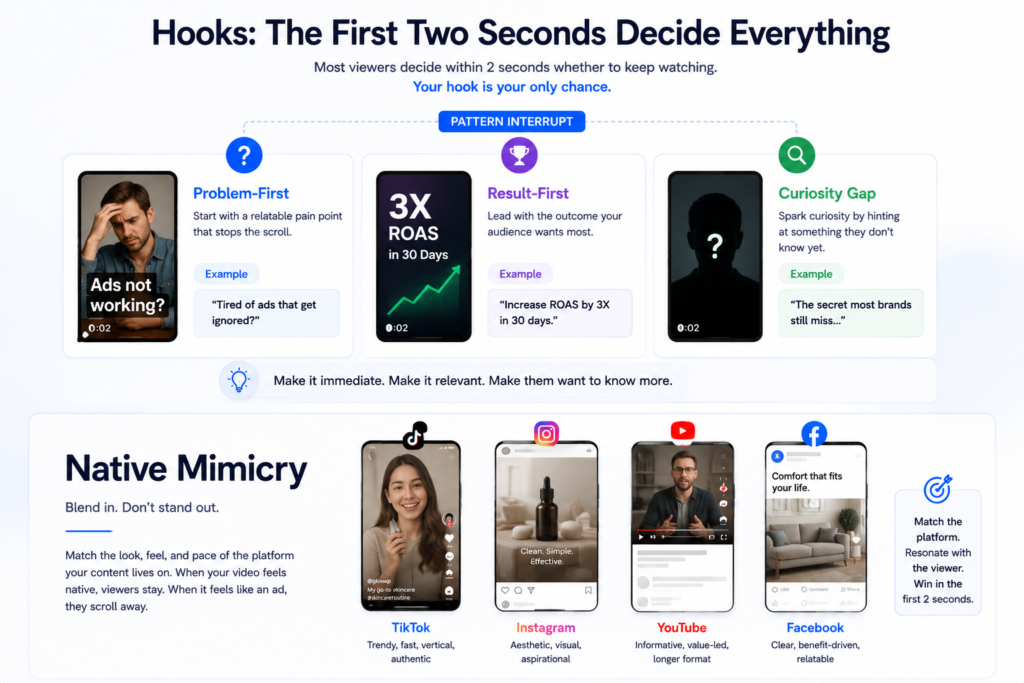
On Facebook and Instagram, attention is won or lost almost instantly. The hook (your opening shot, line, or movement) is the single biggest lever on performance. A strong hook earns the next two seconds, and the next, until the viewer reaches your offer. Here are hook patterns that consistently work for animated and AI-assisted ads:
- Pattern interrupt: unexpected motion, a bold color flash, or a question on screen before anything else loads.
- Problem-first: name the viewer’s pain in plain language in the first frame (“Still editing ads by hand?”).
- Result-first: show the transformation or the finished product moving before you explain it.
- Curiosity gap: tease a specific outcome the viewer has to keep watching to understand.
- Native mimicry: open like organic content (a hand, a screen-record, a caption) so it feels less like an ad.
The discipline that separates good advertisers from great ones is treating the hook as the testable unit. Keep the body of the ad constant and swap three to five hooks. Animation makes this cheap: the same animated scene can carry several different opening lines, overlays, or first frames.
Best practices that move the metric, not just the vibe
Structure every ad like a funnel
Hook (0–2s), then value or demonstration (2–10s), then proof or differentiator, then a single clear CTA. Resist stacking three CTAs; one decisive action outperforms a menu.
Match creative to objective
The awareness advertisement has the liberty to play with motion and emotion. The conversion advertisements, however, require the product, an offer and the next steps to be made apparent. The animated explainer advertisements are better suited to convey conversions through succinct motion visuals.
Test in batches, not one at a time
Launch a small set of variants, give Meta’s delivery enough budget and time to learn, then cut losers and iterate on winners. The platform’s machine learning needs signal; one ad starves it. (For background on how this kind of optimization works, see online advertising.)
Refresh before fatigue, not after
Performance decays as frequency climbs. Build a creative pipeline that always has the next batch ready, so you replace tiring ads before CPMs spike. In practice what happens when you wait for the dashboard to confirm fatigue is that you’ve already paid for a week of rising cost-per-result. The cheaper move is to queue the next batch while the current one is still winning.
AI video ad approaches compared
There’s no single “best” production method. It depends on what you sell and how much control and realism you need. Here’s an honest comparison of the main approaches on the dimensions that matter, with where Pixlnexs Animation Studio fits.
| Dimension | DIY AI text-to-video tools | Editing existing footage with AI | Pixlnexs animation ads (done-for-you) |
|---|---|---|---|
| Speed to first ad | Fast for rough drafts | Fast if you have footage | Managed turnaround, production-ready output |
| Brand control & consistency | Variable; prompt-dependent | Limited by source footage | High, built to your brand kit and specs |
| Realistic people/hands | Still inconsistent | Real (it’s your footage) | Animation sidesteps the issue cleanly |
| Product & 3D motion | Hit or miss | Only what you filmed | Strong, we produce 3D/animated product motion |
| Spec-correct placements | You handle reframing | You handle reframing | Delivered in 9:16 / 4:5 / 1:1 masters |
| Iteration for testing | Cheap but manual | Moderate | Hook/variant sets built for testing |
| Best for | Experiments, low budgets | Brands with a footage library | Polished, repeatable, on-brand ad volume |
Note we have deliberately not invented competitor prices or performance stats. Those vary by tool, plan, and use case, and any specific number we quoted would be unreliable. Compare on these qualitative dimensions, run your own small test, and let your data decide.
Who should choose what
- Solo founders and very small budgets: start with DIY AI tools and editing of any footage you have. You’ll learn what hooks resonate before you invest in produced creative.
- Brands with a footage library: AI editing for fast captions, reframes, and cutdowns gets you the most leverage from assets you already own.
- eCommerce and product brands: animated product ads are often the best ROI. Clean motion, no shoot, easy variant generation. See our AI product video maker for eCommerce guide for turning photos into selling videos.
- Anyone who needs explainer clarity or 3D motion: this is squarely where Pixlnexs Animation Studio is strongest. We produce on-brand animation ads, deliver them in the correct placement specs, and build hook variants for testing.
How to brief an animated ai Facebook/Instagram ad
Whether you produce in-house or work with us, a good brief speeds everything up:
- One core message and one CTA. Write them as a sentence before any visuals.
- Three to five hook ideas so the first frames can be tested.
- Brand kit: logo, fonts, colors, and any product imagery (photos are enough for animated product motion).
- Placements you’ll run: confirm 9:16, 4:5, and/or 1:1 so masters are built correctly.
- Proof points: a real benefit, guarantee, or differentiator, kept honest.
If you’d rather skip the production overhead entirely, our Animation Ads service handles the storyboard, motion, captions, and spec-correct exports, and you can browse ready-to-license 3D assets at store.pixlnexs.com to feed product and scene work.
Conclusion
AI has made the process of creating Facebook and Instagram video ads more accessible than ever before, there are several aspects of advertising that remain vital in order to launch successful campaigns. Firstly, an ad needs to be engaging and capture the viewer’s attention in the first few seconds, provide a solid value proposition and steer viewers towards a particular action. AI helps to come up with all of those aspects much faster than any conventional form of video ad production can.
When working with AI generated videos, editing existing footage or coming up with animations and product ads, make sure to create multiple creative assets, experiment with different hooks and optimize them for each placement. Consistency is always going to be better than a single flawless ad.
We at Pixlnexs are proud to offer a combination of state-of-the-art AI assistance with the services of experienced animation, motion graphics and 3D product visualization to help you develop and create social media ads optimized for the Meta ad environment.
Frequently asked questions
What is the best aspect ratio for AI video ads on Facebook and Instagram?
Use 9:16 (1080×1920) for Stories and Reels, and 4:5 or 1:1 for Feed. The most efficient workflow is to produce a 9:16 master and reframe it to 4:5 and 1:1, keeping key elements inside the safe zones so nothing important is covered by the interface.
How long should a Facebook or Instagram video ad be?
Shorter usually wins. Aim for 15 seconds or less for Feed and Stories, and up to around 30 seconds for Reels if the content earns it. Regardless of length, front-load the hook and the core message in the first few seconds because most viewers will not watch to the end.
Are fully AI-generated video ads good enough to run?
For abstract motion, concepts, and stylized scenes, yes. For realistic people, faces, and hands, AI-generated live-action is still inconsistent. That is one reason animated and motion-graphics ads are a more dependable choice for product and explainer campaigns, they give you control and consistency without uncanny artifacts.
How many ad variations should I test?
Begin by testing three to five ads where all the ads have the same body content but vary on the hook. The delivery system provided by Meta needs adequate time and budget for it to learn and then discard losers while optimizing on the ads. Running only one test at a time starves the optimization process.
Do AI video ads need captions?
Yes. A large share of social video is watched with sound off, so burned-in captions and clear on-screen text are essential for comprehension and performance. Design every ad to make sense muted, then treat audio as an enhancement rather than a requirement.
Can Pixlnexs produce ads in the correct specs for me?
Yes. Pixlnexs Animation Studio produces AI-assisted animation ads delivered as spec-correct masters for Reels, Stories, and Feed (9:16, 4:5, 1:1), with hook variants built for testing. You can start at pixlnexs.com and license supporting 3D assets at store.pixlnexs.com.


Leave a Reply