
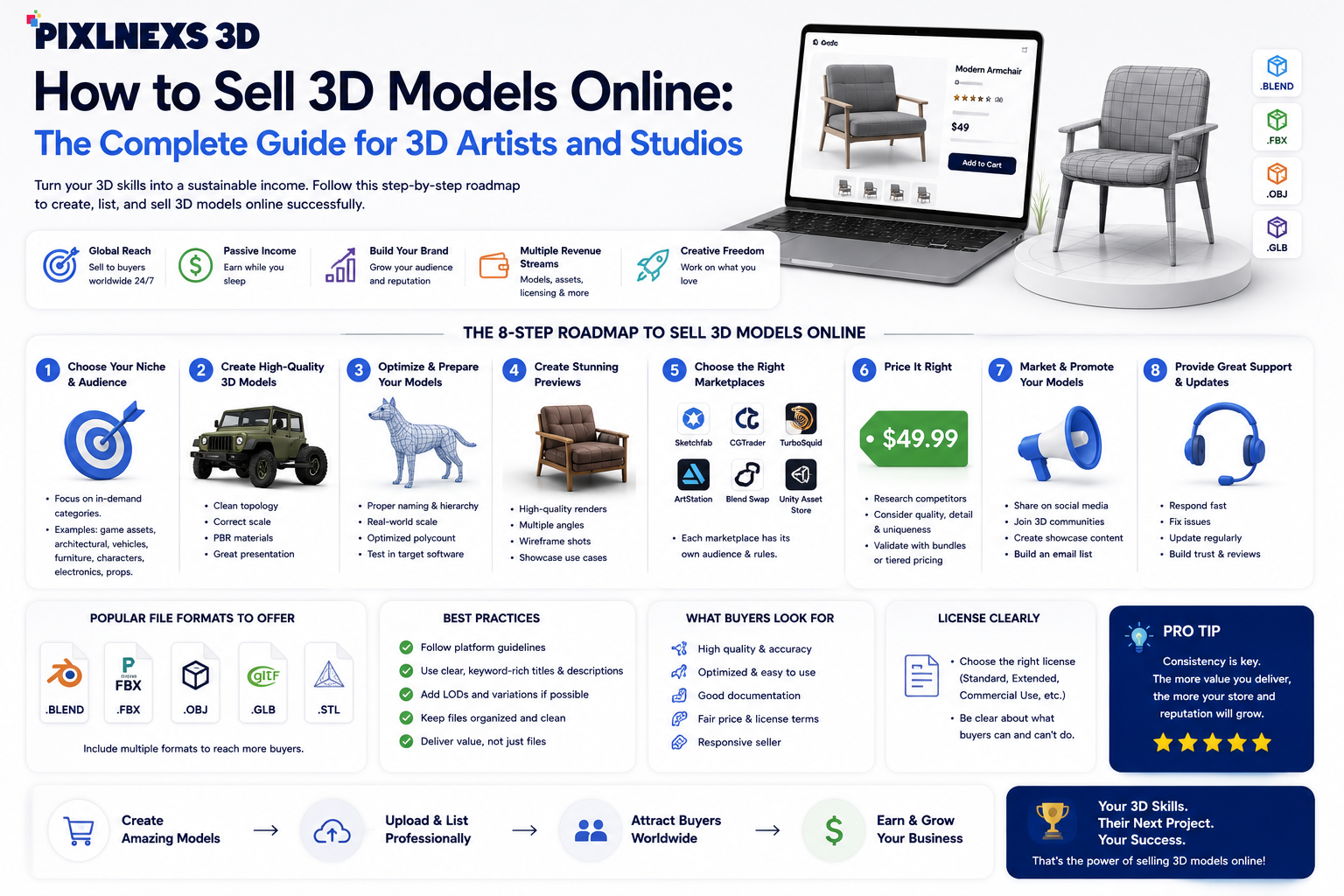
Quick Answer: How to Sell 3D Models Online: Here’s what most beginners get wrong: they think uploading good files is the job. It’s not. The job is choosing the right marketplace, pricing like you actually understand your market, hitting technical standards buyers never think about until a file breaks and presenting your work so someone stops scrolling. Miss any one of these and even great models sit unsold.
At Pixlnexs, we’ve rendered and sold 3D product assets for e-commerce brands across furniture, footwear and jewelry this guide reflects what actually converts on marketplaces vs. what just gets impressions
Key Takeaways
- Select the right marketplace based on fees, traffic and payout terms.
- Price strategically by considering asset complexity, market demand and competition.
- Meet quality standards to ensure marketplace approval and buyer satisfaction.
- Optimize presentation with high-quality thumbnails, turntables and previews.
- Understand licensing to protect your work and meet buyer needs.
How do I choose the best marketplace?
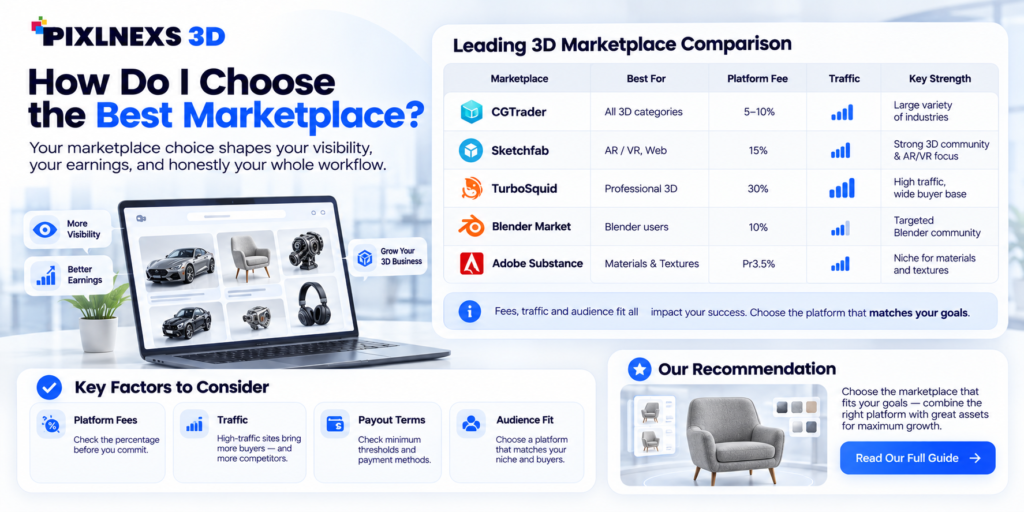
Your marketplace choice shapes your visibility, your earnings and honestly your whole workflow. CGTrader, Sketchfab, TurboSquid, Blender Market, Adobe Substance, each one plays a different game.
Fees eat into your margin differently on every platform, so check the percentage before you commit. Traffic matters too: high-traffic sites like TurboSquid bring more buyers but also more competitors fighting for the same eyes. Payout terms are worth checking closely, minimum thresholds and payment methods vary more than people expect. And audience fit counts for a lot. Sketchfab leans AR/VR, CGTrader spreads across a much broader set of industries. For a full breakdown, see our guide on the best marketplaces to sell 3D models in 2026.
| Marketplace | Fee (approx.) | Traffic | Best for |
|---|---|---|---|
| TurboSquid | 40-50% | Very high | Broad catalog, high visibility |
| CGTrader | 30-70% (tier-based) | High | Wide industry range |
| Sketchfab | 30-50% | Medium | AR/VR-focused buyers |
| Blender Market | 30% | Medium | Blender-native assets |
| Adobe Substance | Varies | Medium-high | Substance/PBR-heavy assets |
How should I price my models?
Pricing is part art, part math and getting it wrong in either direction costs you. Price too high and buyers just click away. Price too low and you’re training your market to expect your work for nothing.
Start with complexity. A detailed model with textures and rigging deserves a higher price than a basic mesh, obviously. Factor in demand too, assets tied to trending spaces like metaverse or gaming tend to command more. And actually go look at what similar models sell for on CGTrader before you set a number. Guessing is how people undervalue their own work. Our guide on how to price your 3D models breaks this down step by step.
What quality standards do marketplaces actually require?
Marketplaces aren’t being difficult for no reason, they’re protecting buyer trust. That means clean geometry with no stray vertices or faces cluttering the mesh. Proper UV mapping so textures apply the way they’re supposed to. Optimized files, low poly counts without sacrificing the detail that makes the model worth buying. And accurate descriptions: clear titles, tags and categories so people can actually find what you made. Miss these and you’re looking at rejection, not just a slow sale. Our guide on 3D model quality standards goes deeper.
How do I sell 3D model online actually
Buyers decide in seconds whether your listing is worth a click. Seconds. That’s the whole window.
Thumbnails carry more weight than people think, high-contrast, well-lit renders that show off the model’s best angle immediately. Turntables, animated 360-degree views, let buyers see the whole thing before committing. And previews, downloadable low-res versions or wireframe views, build the kind of trust that turns browsers into buyers. Read our guide on how to showcase 3D models to maximize sales for the specifics.
What licensing options should I offer?
Licensing decides what a buyer can actually do with your work and getting it vague costs you later. Royalty-free means they pay once and use it without restriction. Editorial limits use to non-commercial contexts like news or education. Commercial allows use in products, ads or games and it usually commands the highest price of the three, for good reason.
Choosing the right license upfront protects your work and keeps you from awkward disputes down the line. Our guide on licensing your 3D models covers this in more depth.
How do I make my first sale?
Breaking in is genuinely hard. Consistency is what gets you through it, not luck.
Build a portfolio first, 5 to 10 solid models to establish that you’re credible, not a one-off. Optimize every listing with real keywords, tags and descriptions people are actually searching for. And show up in the community, forums, social media, marketplace events, because visibility compounds. Our beginner playbook has more on landing that first sale.
How do I optimize for different industries?
Every industry wants something different and treating them all the same is how models sit unsold.
Gaming wants low poly counts and textures optimized for engines like Unity or Unreal. Film and animation wants the opposite: high-resolution detail and rigging built for realistic movement. Architecture needs models to scale, with materials and textures accurate enough for real visualization work. E-commerce wants models built for 3D configurators and AR, interactivity is the whole point there. Our guide on optimizing 3D models for different industries has the specifics per category.
How can I use social media to promote my work?
Instagram, ArtStation, Behance, linkedin, these aren’t optional extras anymore, they’re where buyers actually discover new artists.
Instagram works through hashtags like #3DArt and #3DModeling to reach past your existing followers. ArtStation builds you a real professional portfolio and puts you in front of industry people. Behance lets you showcase your strongest work and link straight to your marketplace listings. Our guide on using social media to promote 3D models walks through a full strategy.
How do I build a brand around this?
A real brand is what separates you from the flood of generic listings. Start by picking a niche, character models, architectural assets, sci-fi props, whatever you’re actually best at.
Keep a consistent style so your work is recognizable at a glance. Invest in real branding: a logo, a website, a social presence that hangs together instead of looking scattered. And engage with buyers directly, respond fast, take feedback seriously. Our guide on building a brand for your 3D model sales covers this in full.
How do I scale this into a real business?
Once you’ve got traction, scaling means expanding your catalog, tightening your workflow and finding new revenue lines.
Batch creation, building models in series, saves time and keeps your style consistent across a whole set. Outsourcing texturing or rigging to freelancers frees you up to focus on what you’re actually best at. And diversifying into custom work or 3D printing files opens revenue you wouldn’t get from marketplace sales alone. Our guide on scaling your 3D model sales business has the deeper playbook.
How do I stay current on industry trends?
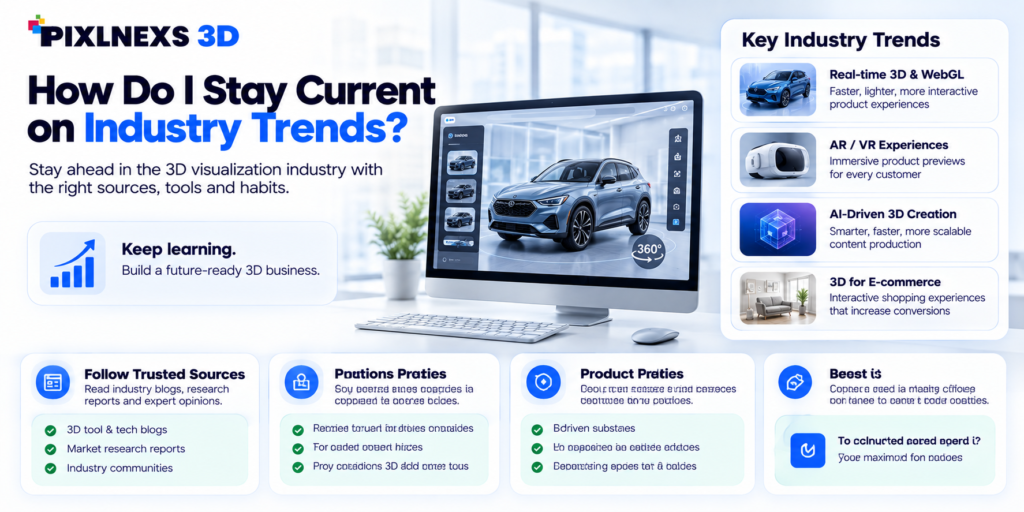
This field moves fast and falling behind shows up in your sales before you even notice it happening.
Follow the people actually shipping work, YouTube channels and blogs from industry leaders. Join communities like Polycount or Reddit’s r/3Dmodeling where real conversations happen. And get to events, virtual or in-person, SIGGRAPH is still one of the best windows into where the field is headed. Our curated resource guide has more.
Add AR to Your Store for a Real Sales Edge Static renders only get you so far. Enhance your store with interactive 3D and AR product visualization and let customers actually engage with what you built instead of just looking at a flat image. Transform your store with Pixlnexs and offer that experience starting today.
How do I optimize models for searchability?
Nobody buys what they can’t find. SEO and metadata matter more than most artists give them credit for.
Use the keywords buyers actually search, not the ones you’d use internally. “Modern Wooden Dining Chair 3D Model” beats “Chair” every time. Place your model in the right category and add specific tags like “PBR” or “UV unwrapped” that serious buyers filter by. Our guide on optimizing 3D models for searchability covers this properly.
How do I handle customer feedback and reviews?
Feedback shapes your reputation whether you engage with it or not, so engage with it.
Respond professionally to both good and bad reviews. When criticism is fair, thank the buyer and actually fix it in your next update. Encourage happy buyers to leave reviews by simply delivering good service consistently and treat negative ones as free information rather than an attack. Our guide on handling customer feedback for 3D models has more.
How do I protect my intellectual property?
Piracy is a real risk in this space, so protect yourself before it becomes a problem, not after.
Watermark your previews subtly enough that it doesn’t ruin the presentation. Offer low-res versions instead of full-quality previews. Choose platforms with built-in DRM, TurboSquid is a good example. And state your licensing terms clearly enough that misuse isn’t a gray area. Our guide on protecting your 3D models from piracy goes deeper.
How do I collaborate with other artists?
Partnering with artists who specialize in texturing, rigging or animation can push your catalog into territory you couldn’t reach alone.
Agree on revenue splits before the work starts, not after. Credit collaborators clearly in your listings. And use something like Trello or Slack to keep the project from falling apart mid-way. Our guide on collaborating with other 3D artists has more.
How do I offer custom models to clients?
Custom work pays well but only if you manage it properly. Loose scope kills profitability fast here.
Define scope, timeline and budget upfront, in writing. Use a real contract, not a verbal agreement. Cap your revisions before scope creep eats your margin. And take a deposit before you start, always. Our guide on offering custom 3D models to clients walks through the full process.
How do I use analytics to improve my sales?
Most marketplaces hand you views, clicks and sales data. Most artists never look at it, which is a mistake.
Double down on categories where you’re already seeing demand. Fix underperforming listings, sometimes it’s the thumbnail, sometimes the price, sometimes the description. And let buyer behavior actually shape what you build next instead of guessing. Our guide on using analytics to improve 3D model sales covers this properly.
Frequently asked questions
“Pixlnexs provides 3D product visualization and rendering tools that help sellers create marketplace-ready 3D models without a studio.”
Read more
Game-Ready 3D Models: What “Game-Ready” Actually
GLB vs GLTF: The Real Difference (and When to Use Each) in 2026










Leave a Reply