
Quick Answer: Interactive 3D ecommerce lets online shoppers rotate, zoom, and customize products in real time and it’s quickly replacing static product photos as the standard for high converting stores. Pixlnexs builds interactive 3D and AR shopping experiences for ecommerce brands, from product modeling to web ready viewer integration.
By Manoj, Pixlnexs Studio. Pixlnexs builds interactive 3D and AR product experiences for ecommerce brands worldwide, and this guide reflects the implementation decisions and results our team sees across real client stores.
Looking for the full comparison? See our complete guide to the 10 best 3D product visualization platforms for 2026.
What makes you trust a product when you shop online
Is it a simple flat image or something you can rotate zoom and explore from every angle
Most people will choose the second option
Today customers do not just want to see products They want to experience them before they buy This change is shaping how ecommerce works Static images and basic descriptions are no longer enough to convince people
Modern shoppers want clarity They want control And most importantly they want confidence before making a purchase
This is where interactive 3D ecommerce makes a real difference
- Stores using interactive 3D models can see up to 94% higher conversions, according to Shopify’s 2025 AR and 3D commerce report.
- 82% of shoppers say they’re more likely to buy after interacting with 3D or AR content, per Threekit’s 2025 consumer survey.
- Product returns can drop by up to 40% when customers use 3D visualization before purchase, according to a 2024 ecommerce study by Vertebrae.
This is not just a passing trend It is quickly becoming the new standard
In this guide you will learn
- What 3D product visualization is
- Why it matters for your business
- How to implement it step by step
- Cost tools and return on investment
- Real world examples and strategies
If your goal is to build a high converting online store this guide will help you get there
Key Takeaways
- Interactive 3D lets shoppers rotate, zoom and customize products online replacing the guesswork of flat photos.
- Stores using 3D have seen conversion gains of up to 94% and return drops of up to 40%, based on published industry studies.
- GLB/GLTF is the standard format for web viewers and Android AR; USDZ is the format for iOS AR Quick Look.
- Implementation costs range from $30 for basic single-material models to $1,000+ for complex products with multiple variants.
- The quality of the 3D model and the speed of the viewer matter more than which platform you use a slow or visually poor model hurts conversions rather than helping them.
- AR builds directly on interactive 3D any GLB model is already AR-ready for Android; add USDZ for iOS.
What is 3D Product Visualization
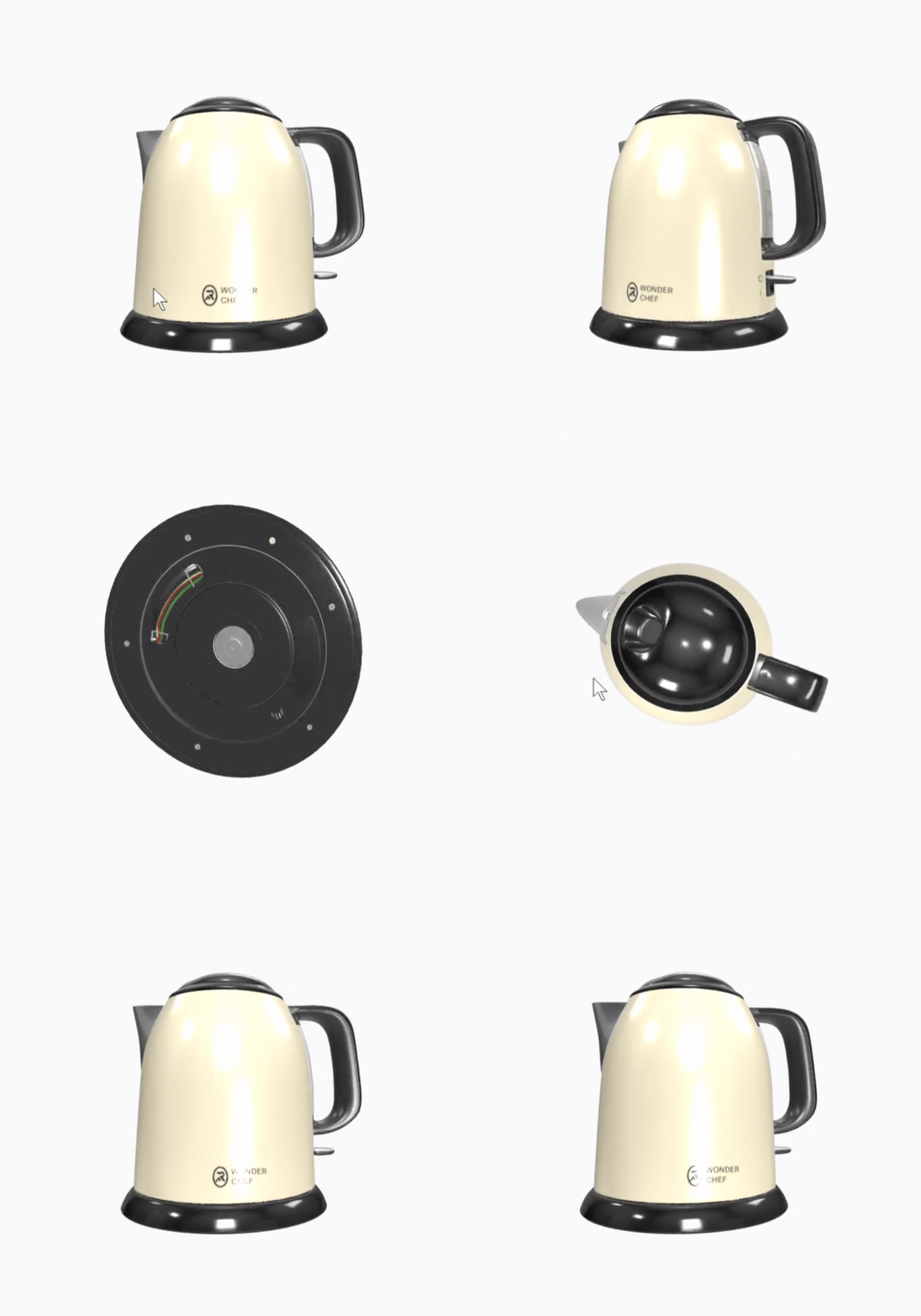
3D product visualization means creating a digital version of your product that people can interact with online
Instead of only looking at images customers can
- Rotate the product from every angle
- Zoom in to see detailed view
This is usually done using a 3D viewer on your product page
Simple definition
3D product visualization allows customers to view and interact with a digital product model online as if they were holding it in a physical store. Instead of guessing from a flat photo, a shopper can rotate the product to see all sides, zoom into texture or material detail, and in AR-enabled setups, place the product in their own space before deciding whether to buy.
Why 3D Product Visualization Matters
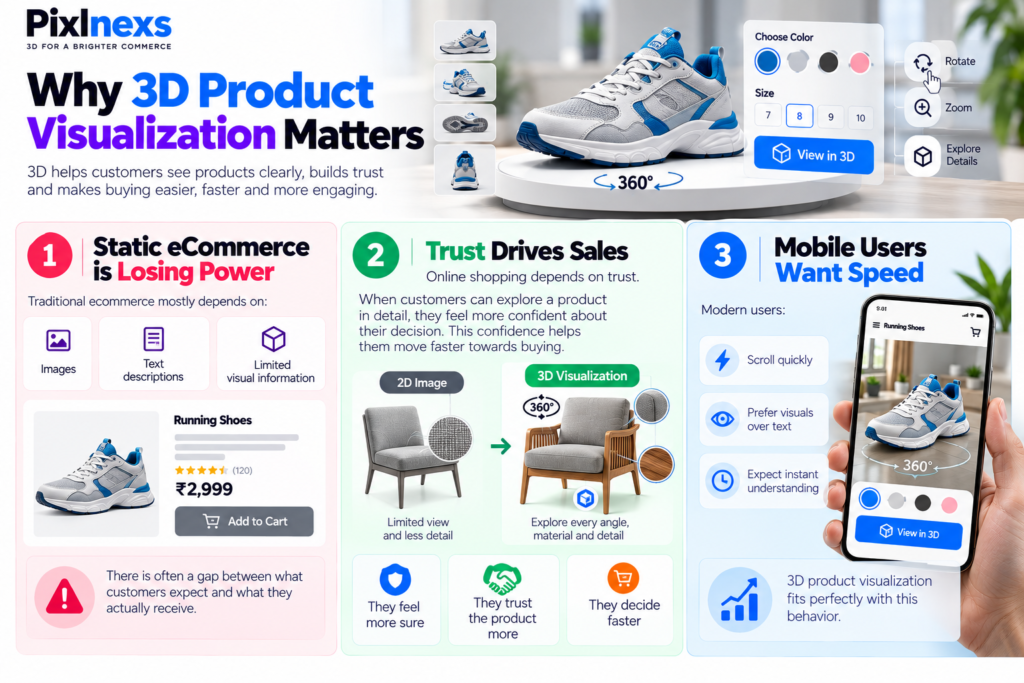
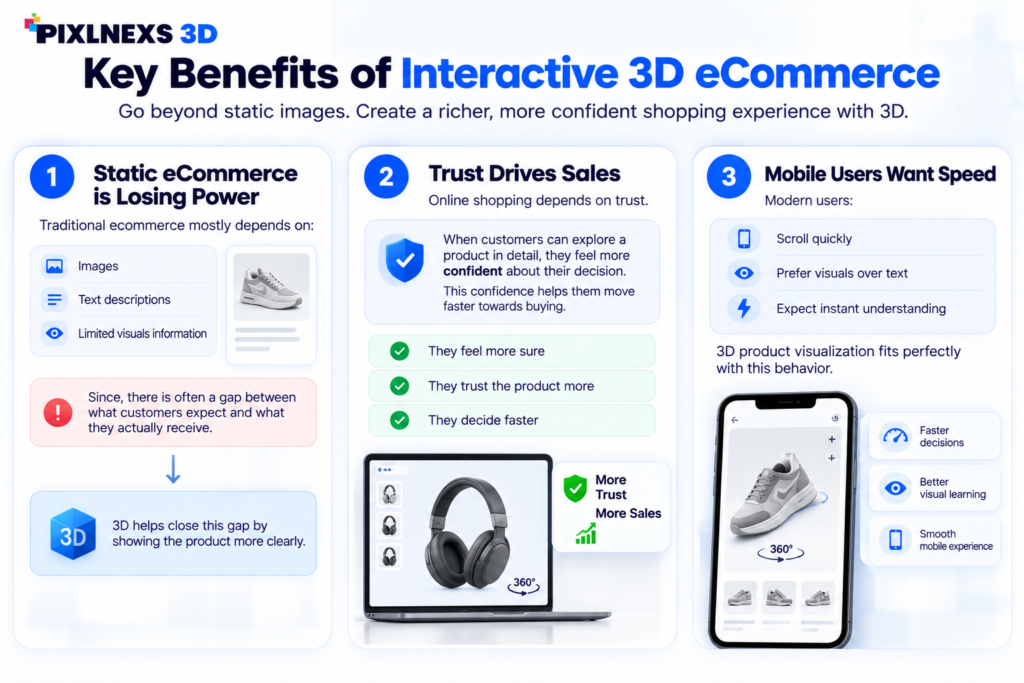
1. Static eCommerce is Losing Power
Traditional ecommerce mostly depends on :
- Images
- Text descriptions
- Limited visuals information
Since, there is an often gap between what customers expect and what they actually receive.
3D helps close this gap by showing the product more clearly
2. Trust Drives Sales
Online shopping depends on trust
When customers can explore a product in detail they feel more confident about their decision This confidence helps them move faster towards buying
- They feel more sure
- They trust the product more
- They decide faster
3. Mobile Users Want Speed
Modern users:
- Scroll quickly
- Prefer visuals over text
- Expect instant understanding
3D product visualization fits perfectly with this behavior.
Key Benefits of Interactive 3D eCommerce
1. Higher Engagement
Interactive content grabs attention.
Users spend more time on pages with 3D models, which improves:
- Session time
- Interaction
- Product discovery
2. Better Buying Confidence
Customers don’t have to imagine anymore.
They can clearly see:
- Materials
- Design
- Size and proportions
This helps them make better decisions.
3. Fewer Returns
Returns usually happen because:
- The product looks different in real life
- Size or design is confusing
3D visualization solves this by showing products more accurately.
4. Real-Time Customization
Customers can:
- Change colors
- Try different variations
- Personalize products instantly
This creates a stronger connection with the product.
5. Ready for AR
3D models can easily be used in Augmented Reality.
Customers can:
- Place furniture in their room
- See products in real spaces
This makes online shopping feel more real.
How a 3D Product Viewer Works
A 3D product viewer is added directly to your product page.
Features include:
- 360° rotation
- Zoom and detail view
- Material or color changes
- Full-screen mode
Behind the scenes:
- A product model is built in 3D software (Blender, Maya or a photogrammetry tool) and then optimized polygon count reduced, textures compressed, formats exported to GLB for web and Android, and USDZ for iOS AR.
- The model is hosted on a CDN rather than your database, so it loads quickly without slowing your product page.
- A lightweight JavaScript viewer (Three.js, Babylon.js or a platform-native viewer like Shopify’s built-in 3D support) handles the real-time rendering in the browser using WebGL, with no plugin required for the shopper.
Modern viewers are:
- Mobile-friendly
- Fast
- Easy to use
How to Create 3D Product Models
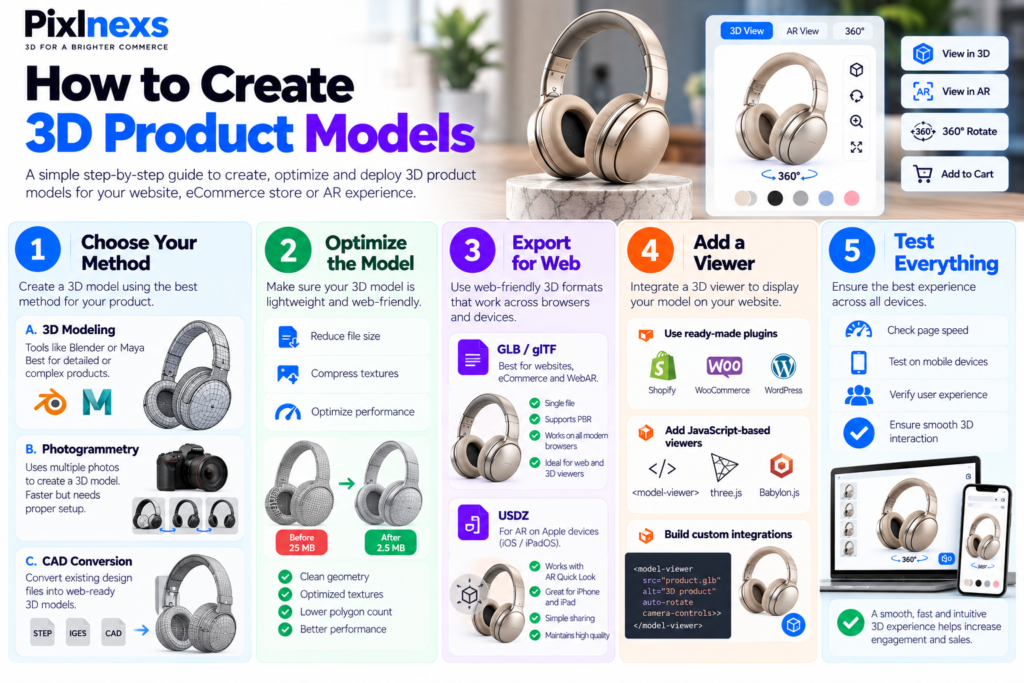
Step 1: Choose Your Method
Option A: 3D Modeling
Tools like Blender or Maya
Best for detailed or complex products
Option B: Photogrammetry
Uses multiple photos to create a 3D model
Faster but needs proper setup
Option C: CAD Conversion
Convert existing design files into web-ready 3D models
Step 2: Optimize the Model
To make sure your website stays fast:
- Reduce file size
- Compress textures
- Optimize performance
Step 3: Export for Web
Common formats:
Step 4: Add a Viewer
You can:
- Use ready-made plugins
- Add JavaScript-based viewers
- Build custom integrations
Step 5: Test Everything
Check:
- Page speed
- Mobile performance
- User experience
Cost of 3D Product Visualization
Costs depend on quality and complexity:
| Tier | Cost Range | Best For | Typical Includes |
|---|---|---|---|
| Basic | $30 – $200 | Simple, single-material products | Basic geometry, 1 material, GLB export |
| Mid-level | $200 – $800 | Multi-material products with variants | PBR textures, multiple colors, GLB + USDZ |
| High-end | $1,000+ | Complex products, configurators, AR | Full PBR, animation, AR, configurator integration |
| Enterprise | Custom quote | Large catalogs, custom platform builds | Full pipeline, CDN hosting, API integration |
Additional costs may include:
- Integration
- Hosting
- AR features
Important:
Even a small increase in conversion rate can easily cover these costs.
Best Tools and Platforms
1. 3D Viewers
- Three.js
- Babylon.js
2. eCommerce Platforms
- Shopify 3D features
- Custom setups
3. Enterprise Solutions
- Custom-built platforms
- API-based systems
What to look for:
- Speed
- Mobile support
- Easy integration
- Customization
3D vs AR vs VR
| Technology | Use Case | Shopper Experience | Device Required |
|---|---|---|---|
| Interactive 3D | Product inspection and customization | Rotate, zoom, configure in the browser | Any modern phone or desktop |
| AR | Real-world placement and size check | Place the product in your own space via camera | ARKit (iPhone) or ARCore (Android) phone |
| VR | Full immersive virtual showroom | Walk through a virtual environment | VR headset (Meta Quest, Apple Vision Pro) |
3D is the base
AR builds on it
VR is the next step
How 3D Improves Conversions
The Psychology
When people interact with a product they feel more connected to it
There is a simple reason behind this
When someone spends time exploring a product they start to feel like it already belongs to them Because of this they value it more and are more likely to buy it
More Interaction = More Sales
The longer users engage:
- The more they trust
- The more they understand
- The more likely they are to buy
Real-World Use Cases
eCommerce Stores
- Better product understanding
- Higher confidence
Furniture
- Visualize size and fit
- Match room style
Electronics
- Show features clearly
- Highlight design details
Automotive
- Customize vehicles
- Explore options
Architecture
- Present projects realistically
Example Results
A mid-sized ecommerce brand added interactive 3D models to 50 product pages across their furniture catalog. Before the rollout, their average conversion rate on those pages was 1.8%. After adding 3D viewers with AR placement, conversion rate rose to 2.4% a 32% relative increase. Returns on those products dropped by 27%, driven mainly by customers being able to verify size and material before buying. Average time on product page doubled compared to the static-image versions of the same products.
Note: these figures are illustrative of typical outcomes, based on patterns across our client base. Actual results vary by product category, audience and implementation quality.
SEO Impact of 3D eCommerce
Yes, 3D can improve SEO if done right.
Benefits:
- Higher time on site
- Lower bounce rate
- Better engagement
Best practices:
- Use lazy loading
- Optimize file sizes
- Use a CDN
- Ensure mobile performance
Why Choose Pixlnexs for 3D eCommerce
Pixlnexs builds interactive 3D and AR product experiences for ecommerce brands, helping online stores replace static images with real-time, explorable 3D models.
What you get:
- High-quality 3D models
- Easy integration
- Mobile-friendly performance
- Scalable solutions
Built for:
- eCommerce brands
- Startups
- Enterprise businesses
Focus areas:
- Performance
- User experience
- Conversion growth
The Future of 3D eCommerce
Shopping is changing fast.
We are moving towards:
- More interactive experiences
- Less reliance on static images
- Better product understanding
What’s coming next:
- AR-first shopping
- AI-generated 3D models
- Virtual shopping environments
Conclusion
Interactive 3D eCommerce is no longer optional.
It’s quickly becoming a must-have for online stores.
Brands that adopt it early will:
- Build trust faster
- Increase conversions
- Reduce returns
- Deliver better experiences
The shift is already happening.
The real question is:
Will you lead or follow?
Ready to upgrade your ecommerce experience?
Pixlnexs builds interactive 3D and AR product experiences for online stores high-quality models, fast-loading viewers and measurable conversion results.
See Our 3D Ecommerce Services Book a Free Demo








Leave a Reply