

Quick Answer: The best site to sell 3D models depends on your target audience. For general and enterprise buyers, CGTrader and TurboSquid offer the highest traffic, though TurboSquid requires exclusivity for competitive royalty rates. For real-time and game-ready assets, Epic Games’ unified platform Fab offers an industry-leading revenue share.
Key Takeaways
- Fab (unifying Sketchfab, Unreal Engine Marketplace and ArtStation) is the premier destination for real-time, game-ready assets with a highly competitive creator-first fee structure.
- CGTrader remains the most balanced option for general 3D assets, offering a sliding royalty scale without demanding absolute storefront exclusivity.
- TurboSquid provides access to high-budget enterprise and VFX buyers but penalizes non-exclusive sellers with high platform commission rates.
- Blender Market is the undisputed champion for Blender-specific assets, add-ons and shaders, backed by a highly supportive, community-driven ecosystem.
Why Does Choosing the Right 3D Marketplace Matter for Your Studio?
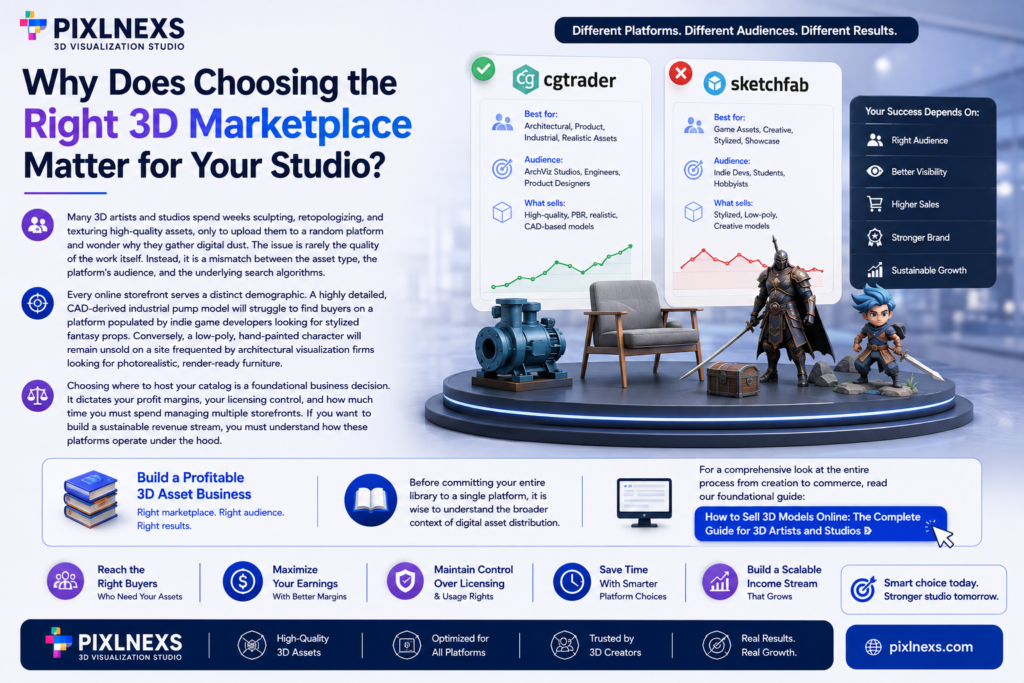
Many 3D artists and studios spend weeks sculpting, retopologizing and texturing high-quality assets, only to upload them to a random platform and wonder why they gather digital dust. The issue is rarely the quality of the work itself. Instead, it is a mismatch between the asset type, the platform’s audience and the underlying search algorithms.
Every online storefront serves a distinct demographic. A highly detailed, CAD-derived industrial pump model will struggle to find buyers on a platform populated by indie game developers looking for stylized fantasy props. Conversely, a low-poly, hand-painted character will remain unsold on a site frequented by architectural visualization firms looking for photorealistic, render-ready furniture.
Choosing where to host your catalog is a foundational business decision. It dictates your profit margins, your licensing control and how much time you must spend managing multiple storefronts. If you want to build a sustainable revenue stream, you must understand how these platforms operate under the hood.
Before committing your entire library to a single platform, it is wise to understand the broader context of digital asset distribution. For a comprehensive look at the entire process from creation to commerce, read our foundational guide on How to Sell 3D Models Online: The Complete Guide for 3D Artists and Studios.
Additionally, your choice of marketplace directly influences your pricing flexibility. Some platforms encourage high-volume, low-cost sales, while others are geared toward premium, high-ticket enterprise transactions. To align your platform choice with your revenue goals, consult our guide on How to Price Your 3D Models: A Pricing Strategy for First-Time Sellers.
How Do CGTrader and TurboSquid Compare on Fees and Traffic?
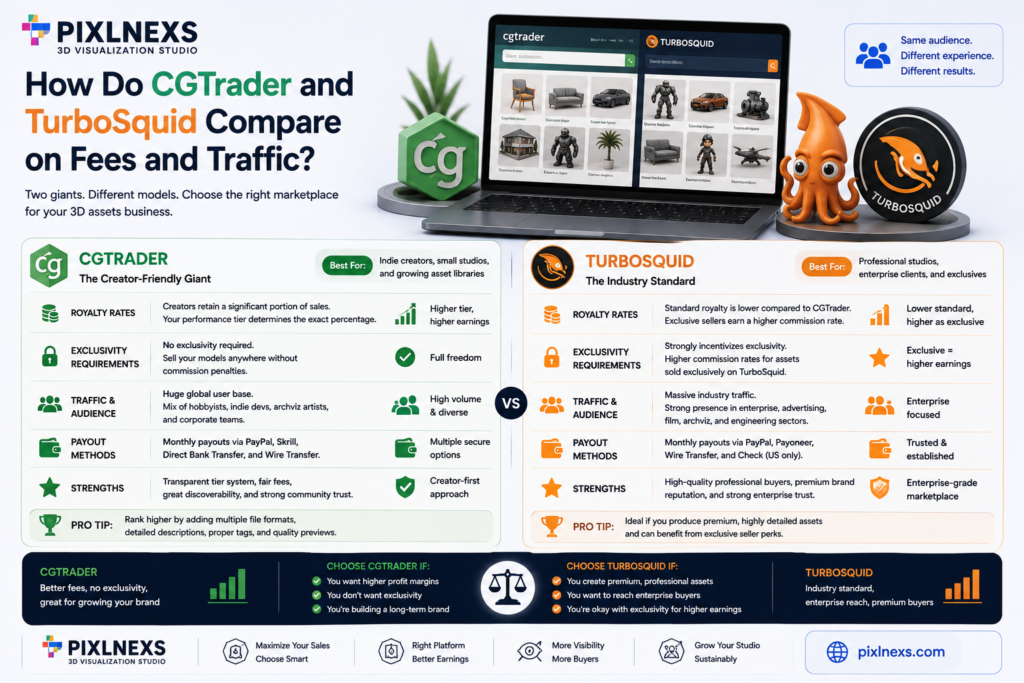
For general 3D models, CGTrader and TurboSquid are the two giants of the industry. While they share a similar target audience ranging from advertising agencies to architectural firms their business models and creator relations are vastly different.
CGTrader: The Creator-Friendly Giant
CGTrader has long positioned itself as a fair, transparent alternative to older industry models. It operates on a reputation-based tier system. As your sales volume and positive reviews increase, your seller level rises, allowing you to retain a larger portion of your sales.
- Royalty Rates: Creators can retain a significant portion of their sales revenue. The exact percentage is determined by your performance tier, which is calculated using your lifetime sales and platform activity.
- Exclusivity Requirements: CGTrader does not require exclusivity. You are free to sell the same assets on your own website or on competing platforms without facing commission penalties.
- Traffic and Audience: CGTrader boasts a massive global user base. It attracts a healthy mix of hobbyists, indie developers, architectural visualization artists and corporate marketing teams.
- Payout Methods: Payouts are processed monthly via popular digital payment processors, direct bank transfers and international wire systems.
The platform’s search algorithm favors complete listings. To rank well on CGTrader, your product pages must include multiple file formats, high-resolution render previews and detailed technical descriptions.
TurboSquid: The Enterprise Standard
TurboSquid, owned by Shutterstock, is the oldest and most established marketplace in the 3D industry. It is the default choice for major advertising agencies, television networks and film production studios. These buyers are less sensitive to price and highly sensitive to quality, reliability and legal protection.
- Royalty Rates: TurboSquid’s commission structure is highly controversial among independent creators. Non-exclusive sellers typically retain a smaller portion of their sales. To increase this share, you must join their exclusivity program, the SquidGuild.
- The SquidGuild Exclusivity Program: By committing your catalog exclusively to TurboSquid, you can raise your royalty rate, depending on your sales volume. However, this means you cannot sell those specific models anywhere else, including your personal portfolio site or other marketplaces.
- Traffic and Audience: TurboSquid’s traffic is highly valuable. Because it is integrated into the broader Shutterstock ecosystem, your models are exposed to corporate buyers with substantial procurement budgets. A single sale on TurboSquid can often command a much higher price point than on other platforms.
- Payout Methods: Payouts are distributed monthly through standard digital payment networks and direct bank deposits.
| Feature | CGTrader | TurboSquid |
|---|---|---|
| Base Royalty (Non-Exclusive) | Higher | Lower |
| Maximum Royalty | Higher (via reputation tiers) | Higher (via SquidGuild exclusivity) |
| Exclusivity Required? | No | Yes, for viable royalty rates |
| Primary Buyer Demographic | Generalists, ArchViz, Indie Devs | Enterprise, VFX, Ad Agencies |
| Search Visibility | Highly dependent on metadata | Favors SquidGuild members |
If your studio produces ultra-high-end, photorealistic assets designed for professional VFX pipelines or corporate commercial work, TurboSquid’s enterprise reach may justify its high commission rates. However, for solo creators looking to build an independent brand across multiple channels, CGTrader offers far greater freedom and immediate financial return.
Is Sketchfab Still the Best Option for Interactive 3D Models?
Sketchfab revolutionized the 3D industry by introducing a robust, web-based WebGL viewer that allowed users to inspect models in real-time directly within their web browsers. This interactive capability transformed how buyers evaluate 3D assets.
Historically, Sketchfab operated its own highly successful independent marketplace. However, following its acquisition by Epic Games, the platform has undergone a significant transition. The Sketchfab store functions have been consolidated into Epic’s unified marketplace ecosystem, Fab.
Despite this commercial consolidation, the core Sketchfab platform remains an essential tool for 3D creators.
- The Power of the Interactive Viewer: The ability to inspect wireframes, texture maps, UV layouts and animations in real-time builds immense trust with potential buyers. It eliminates the guesswork associated with static render previews.
- Portfolio Integration: Sketchfab serves as the industry standard for embedding interactive 3D models into external websites, portfolios and art community platforms.
- Community and Discoverability: Sketchfab is a highly social platform. Creators can gain followers, receive comments and participate in community challenges. This social engagement often translates directly into organic traffic and sales.
While you will use Epic Games’ unified seller portal to manage the commercial transactions of your interactive models, maintaining an active, well-curated Sketchfab profile remains a primary driver of discovery for real-time assets.
Should You Sell Your Assets on Blender Market or Unity Asset Store?
If your work is tailored to specific software ecosystems or development pipelines, niche marketplaces often yield much higher conversion rates than generalist platforms.
Blender Market: The Community-Driven Powerhouse
Blender Market is dedicated exclusively to the Blender ecosystem. It is operated by the creators of CG Cookie and is deeply integrated into the open-source Blender community.
- Target Audience: Blender users of all skill levels, from hobbyists to professional studio leads. They are looking for native
.blendfiles, specialized add-ons, procedural materials and custom brush sets. - Royalty Rates: Blender Market offers an exceptionally creator-friendly split, allowing sellers to retain a large majority of their revenue. The remaining portion goes to platform maintenance, with an optional percentage that creators can choose to donate directly to the Blender Foundation development fund.
- Community Support: Selling here allows you to build a loyal customer base within a passionate, highly collaborative community. Buyers are often eager to provide feedback, helping you refine your products over time.
If you specialize in creating assets optimized for Blender’s Cycles or Eevee render engines or if you develop scripts and tools that streamline the Blender workflow, this is the most profitable and supportive platform available.
Unity Asset Store: The Indie Game Hub
The Unity Asset Store is one of the oldest and most active game development marketplaces in the world. It caters to millions of developers using the Unity engine to build mobile, desktop and console games.
- Asset Requirements: Buyers here are not just looking for a raw 3D mesh. They expect game-ready packages. This means your models must be pre-configured as Unity Prefabs, complete with set colliders, optimized materials using Unity’s Universal Render Pipeline (URP) or High Definition Render Pipeline (HDRP) and properly configured animations.
- Royalty Rates: The standard revenue share favors the creator.
- Traffic and Discovery: The store is integrated directly into the Unity Editor, providing a direct pipeline to developers as they work on their projects. This integration drives highly targeted traffic with clear purchase intent.
To succeed on the Unity Asset Store, your technical execution must be flawless. If your assets do not import correctly or if they cause console errors, you will quickly receive negative reviews that can permanently damage your store’s visibility.
Before submitting assets to these highly technical environments, make sure your files meet the rigorous standards expected by professional developers. You can learn more about these technical expectations in our detailed breakdown of 3D Model Quality Standards: What Buyers and Marketplaces Require Before Approval.
What Role Do Unreal Engine Marketplace and Fab Play in the Current Market?
The digital asset distribution space experienced its most significant shift in years when Epic Games officially launched Fab. This unified marketplace was designed to bring together several distinct creative ecosystems under a single, massive banner.
The Consolidation of Epic Games’ Properties
Fab merges the following platforms into a single, cohesive marketplace:
1. Unreal Engine Marketplace (focused on high-end game development assets)
2. Sketchfab (focused on interactive, web-friendly 3D models)
3. Quixel (the premier library for photorealistic megascans)
4. ArtStation Marketplace (focused on digital artist resources and portfolio-driven sales)
This consolidation creates a massive storefront where buyers of all kinds from solo game developers to Hollywood virtual production teams can source 3D assets, materials, environments and plugins.
The Fab Financial Model
Epic Games has disrupted the traditional marketplace fee structure by offering highly competitive financial terms designed to attract top-tier talent.
- Standard Revenue Share: Fab offers a unified revenue share to all creators. This means Epic Games takes only a small commission on sales, which is significantly lower than the industry standard seen on platforms like the Unity Asset Store or the non-exclusive tiers of TurboSquid.
- Cross-Engine Compatibility: While Fab is owned by Epic Games, the platform explicitly supports and encourages assets formatted for other engines, including Unity, Godot and standard DCC (Digital Content Creation) tools like Maya, 3ds Max and Blender.
- Massive Built-In Audience: By combining the user bases of ArtStation, Sketchfab and Unreal Engine, Fab instantly provides creators with access to millions of active digital artists and developers worldwide.
For any studio or independent artist focusing on real-time, virtual production or game-ready assets, Fab has quickly become an essential platform that cannot be ignored. Its low commission rate combined with Epic’s massive marketing reach makes it a primary storefront for modern 3D creators.
How Do You Choose Between Exclusive and Non Exclusive Selling Agreements?
One of the most critical decisions you will make when setting up your 3D distribution business is deciding whether to participate in platform exclusivity programs.
The Case for Exclusivity (e.g. TurboSquid SquidGuild)
Exclusivity programs are designed to lock creators into a single platform in exchange for preferential treatment. The most famous example is TurboSquid’s SquidGuild.
Advantages:
Higher Royalty Rates: You can increase your payout percentage significantly compared to the standard, non-exclusive rates.
Search Algorithm Boost: Most platforms prioritize exclusive assets in their search results, leading to higher organic impressions.
Badges and Trust: Exclusive listings often feature special badges that signal high quality and verified technical standards to corporate buyers.
Protection Against Price Warring: Because your assets are only available on one site, you do not have to worry about competitors undercutting your prices on other platforms.
Disadvantages:
Single Point of Failure: If the platform changes its search algorithm, lowers its traffic or alters its terms of service, your entire revenue stream can collapse overnight.
Limited Brand Growth: You cannot build a diversified presence or direct traffic to your own independent storefront.
Contractual Restrictions:* You must actively monitor your online presence to ensure that old portfolio uploads or personal site listings do not violate your exclusivity agreement, which can lead to account suspension.
The Case for Non-Exclusive Distribution
A non-exclusive strategy involves listing your assets across multiple marketplaces simultaneously, as well as selling them directly to customers through your own website (using platforms like Shopify, Gumroad or Lemonsqueezy).
Advantages:
Risk Diversification: If one marketplace experiences a decline in traffic or changes its payout structure, your other storefronts continue to generate income.
Broader Market Reach: You can capture buyers who exclusively shop on specific platforms due to corporate procurement rules or personal preference.
Direct-to-Consumer Growth:* You can use third-party marketplaces as lead generation tools, encouraging repeat buyers to purchase directly from your personal website where you retain a larger share of the sale.
Disadvantages:
Administrative Overhead: Managing product listings, updating files, responding to customer support inquiries and adjusting prices across five or six different platforms is highly time-consuming.
Lower Initial Search Visibility: Without the algorithmic boost granted to exclusive creators, it can take longer to build initial sales momentum on major platforms.
Making the Decision
For most modern studios and independent creators, a non-exclusive, multi-platform strategy is the most resilient path forward. It allows you to build an independent brand and maintain complete control over your intellectual property.
However, if you produce highly specialized, high-ticket assets aimed exclusively at enterprise VFX and advertising clients, the convenience and search visibility of an exclusive agreement like the SquidGuild can sometimes outweigh the benefits of multi-platform distribution.
No matter which path you choose, you must understand the legal frameworks governing your sales. To protect your intellectual property and understand what rights you are granting to your buyers, read our comprehensive guide on Licensing Your 3D Models: Royalty-Free vs Editorial vs Commercial Explained.
What Are the Technical Requirements to Get Approved on Major Platforms?
Quality standards across major 3D marketplaces have risen dramatically. Buyers are no longer willing to purchase messy, unoptimized models that require hours of cleanup. To pass automated and manual review processes, your assets must adhere to strict technical guidelines.
1. Geometry and Topology
- Quad-Dominant Mesh: Your models should consist primarily of four-sided polygons (quads). Avoid n-gons (polygons with five or more sides) entirely, as they cause shading artifacts and render errors in most software.
- No Coincident Vertices or Double Faces: Ensure there are no overlapping vertices or faces, which cause flickering (Z-fighting) during rendering.
- Watertight Manifolds: For assets intended for 3D printing or physics simulations, the mesh must be completely sealed with no open holes.
2. UV Mapping and Texturing
- Unwrapped, Non-Overlapping UVs: Unless specifically designed for tiling textures, your models must have clean, non-overlapping UV layouts. Overlapping UVs make it impossible to bake unique texture maps or paint custom details.
- PBR Workflow Compatibility: Textures should be authored using standard Physically Based Rendering (PBR) workflows (either Metallic/Roughness or Specular/Glossiness). Standard maps include Albedo (Base Color), Normal, Roughness, Metallic and Ambient Occlusion.
- Texture Resolution and Texel Density: Ensure your texture resolution is appropriate for the scale of the object. Maintain consistent texel density across all parts of the model so that some areas do not look blurry while others look sharp.
3. File Organization and Formats
- Industry-Standard Formats: Always provide your models in widely compatible formats. The standard suite includes
.FBX(for games and animation),.OBJ(for general 3D use).glTF/.GLB(for web and real-time interactive use) and the native file format of the software you used to create the asset (e.g.,.blend,.max,.ma). - Clean Naming Conventions: Rename all objects, materials, textures and bones using a logical, consistent naming system. Avoid default names like
Box001orMaterial_2. - Real-World Scale: Model your assets to real-world dimensions. A chair should be modeled to the size of an actual chair, not ten times larger or smaller. This ensures that when a buyer imports your model into their scene, it fits naturally without requiring manual scaling.
Meeting these technical requirements is only half the battle. If your product presentation is poor, even a technically perfect model will fail to sell. To learn how to create compelling visual presentations that convert browsers into buyers, check out our guide on How to Showcase 3D Models to Maximize Sales (Thumbnails, Turntables and Previews).
How Can You Maximize Your Earnings Across Multiple Storefronts?
If you decide to pursue a non-exclusive distribution strategy, success requires more than just uploading your files and hoping for the best. You must treat your asset store as a professional retail operation.
1. Optimize Your Metadata for Search Engines (SEO)
Marketplace search engines rely heavily on text-based metadata to match user queries with relevant products.
Descriptive Titles: Instead of naming your model SciFi_Door_02, use a descriptive title like Futuristic Industrial Sci-Fi Sliding Door - Low Poly.
Comprehensive Tagging: Use all available tag slots. Include synonyms, software compatibility, style descriptors and potential use cases (e.g., game-ready, cyberpunk, pbr, blender, unreal-engine).
Detailed Descriptions:* Write thorough descriptions that detail the polygon count, vertex count, texture resolutions, included file formats and rigging or animation status. This reduces customer support inquiries and builds buyer confidence.
2. Build a Direct Sales Channel
While marketplaces are excellent for reaching new audiences, they should not be your only source of income.
Establish a Personal Storefront: Use platforms like Shopify or specialized digital commerce tools to host your own store.
Offer Incentives for Direct Purchases: Offer lower prices, exclusive bundles or faster support on your personal website to encourage repeat buyers to purchase directly from you.
Frequently Asked Questions
How do I choose the best site for my 3D models?
The best site depends on your target audience and asset type. For general 3D models, CGTrader offers a balanced option with a sliding royalty scale. TurboSquid is ideal for enterprise and VFX buyers but requires exclusivity for competitive rates. For real-time and game-ready assets, Fab provides a highly competitive revenue share.
What are the benefits of selling exclusively on a single platform?
Selling exclusively on a platform like TurboSquid’s SquidGuild can increase your royalty rates, boost search visibility and provide badges that signal quality to corporate buyers. However, it limits your brand growth and creates a single point of failure.
How can I ensure my 3D models meet marketplace quality standards?
To meet quality standards, ensure your models have clean, quad-dominant geometry, non-overlapping UVs and PBR-compatible textures. Provide industry-standard file formats, use clean naming conventions and model assets to real-world scale.
What is the difference between CGTrader and TurboSquid?
CGTrader is creator-friendly, offering a sliding royalty scale without exclusivity requirements. TurboSquid caters to enterprise buyers but penalizes non-exclusive sellers with lower royalty rates, requiring exclusivity for competitive payouts.
Why is Fab considered a pivotal platform for 3D artists?
Fab unifies several Epic Games properties, offering a massive built-in audience and a highly competitive revenue share. It supports cross-engine compatibility and is ideal for real-time, virtual production and game-ready assets.
How much can I earn selling 3D models online?
Earnings vary widely based on platform, asset type and pricing strategy. Niche marketplaces like Blender Market often convert better for specialized assets since the audience is already targeted, while broader platforms like CGTrader rely more on volume. Enterprise-focused sites like TurboSquid tend to have higher per-sale prices but fewer transactions. Building a direct sales channel alongside marketplace listings gives you the most control over margins.
Is it better to sell 3D models on a niche platform or a general marketplace?
Niche platforms like Blender Market or the Unity Asset Store work best when your assets are built for a specific ecosystem, since buyers arrive with clear intent and higher conversion rates. General marketplaces like CGTrader cast a wider net and suit versatile, multi-format assets. Many sellers use both: niche platforms for targeted sales and general marketplaces for broader discovery.
How do I get my custom 3D models rendered and prepared for marketplace listings? Preparing high-quality preview renders is often the difference between a sale and a scroll-past. If you need professional 3D product visualization or AI-powered renders to showcase your models before listing them, platforms like Pixlnexs can help you generate polished, buyer-ready visuals without building an in-house rendering pipeline.
Read more
How to Sell 3D Models Online: Complete Guide for Artists & Studios







Leave a Reply