
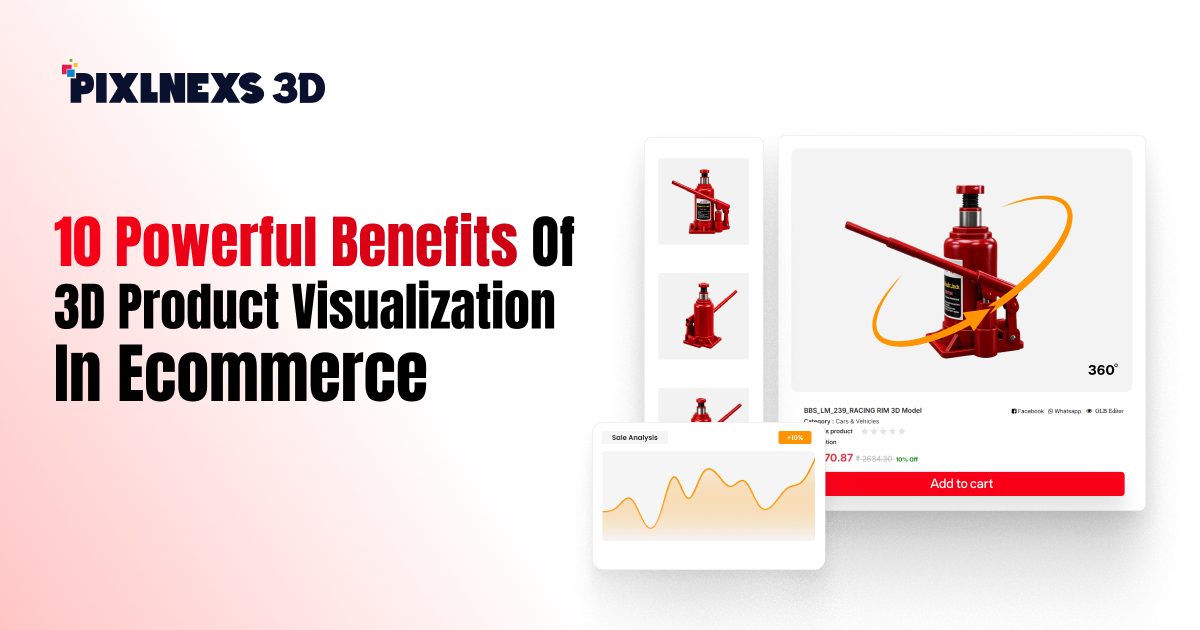
Quick answer: Benefits of 3D product visualization boosts ecommerce sales by letting customers rotate, zoom and interact with products before buying, which improves product understanding, increases confidence and reduces returns. The biggest gains come from higher conversion rates, lower return rates and reusable assets that cut photography costs.
Key takeaways
- 3D product visualization lets customers explore products the way they would in a store, which static images can’t replicate.
- Brands using 3D viewers commonly see higher conversion rates and fewer returns due to more accurate customer expectations.
- One 3D model can be reused across ads, social media and AR experiences, cutting long-term photography costs.
- The technology works across major ecommerce platforms including Shopify, WooCommerce, Magento and BigCommerce.
Pixlnexs builds 3D product visualization assets and interactive viewers for ecommerce brands moving away from static photography.
In ecommerce, customers cannot touch or try products before buying. This makes product presentation one of the most important factors in driving sales. Traditional images often fail to show complete details, which can lead to hesitation and drop in conversions.
3D product visualization solves this problem by offering a more realistic and interactive way to showcase products, giving customers a genuine 3D product experience instead of a flat photo gallery. It helps customers explore items in detail and make confident purchase decisions.
The Evolution of 3D Visualization in Ecommerce
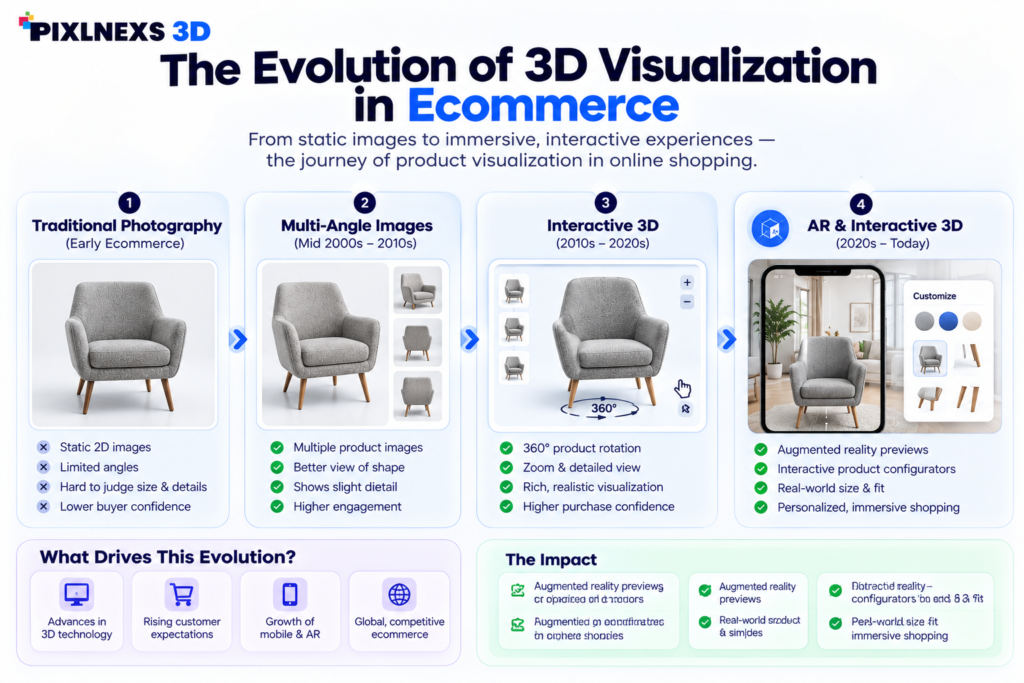
A few years ago, online stores relied on multiple product images and detailed descriptions to help customers understand a product. Brands had to upload images from different angles and hope customers could visualize the full product experience. Some businesses used basic 360 degree views but they were still limited in interaction.
With the introduction of WebGL around 2011, it became possible to display real time 3D graphics directly in browsers without plugins. Even though this was a major breakthrough, adoption was slow. Creating 3D models required high cost, time and technical expertise. Also, internet speed was a limitation for many users, which made loading interactive experiences difficult.
The shift became faster during the COVID 19 pandemic. As physical stores closed and foot traffic reduced, businesses needed better ways to showcase products online. This increased the demand for immersive and interactive product experiences. Brands started looking for solutions that could replicate the in store experience digitally.
As technology continues to evolve, the future of ecommerce lies in immersive experiences. With innovations like augmented reality and AI driven personalization, Pixlnexs is helping businesses stay ahead by offering smarter and more engaging product visualization solutions.
Read More : Interactive 3D eCommerce: The Complete Guide to 3D
Talk to our 3D experts about what a 3D product experience would look like for your specific catalog.
| Factor | Static Photography | 3D Product Visualization |
|---|---|---|
| Viewing angles | Fixed, limited to shot angles | Full 360°, customer-controlled |
| Reusability | New shoot per variant or campaign | One asset reused across ads, social, AR |
| Customer confidence | Lower details can be missed | Higher full inspection before buying |
| Return rate impact | Higher when expectations mismatch | Lower fewer surprises on arrival |
10 Powerful Benefits Of 3D Product Visualization That Boost Sales
Adding 3D product visualization to your eCommerce website can improve the shopping experience for customers. Here are the key benefits that show why this technology is a smart investment for online businesses.
1. Improves product understanding
3D product visualization allows customers to view products from every angle. They can rotate, zoom and explore features in detail. This gives a clear understanding of the product, which static images cannot provide.
2. Increases customer engagement
Interactive 3D elements keep users engaged for a longer time. Instead of quickly scrolling through images, customers spend more time interacting with the product. This improves user experience and reduces bounce rate.
3. Boosts conversion rates
When customers clearly understand what they are buying, they feel more confident. This leads to higher conversions a pattern Baymard Institute’s e-commerce UX research has documented repeatedly across product-page studies.
4. Reduces product returns
Returns often happen when the product does not match customer expectations. 3D visualization shows accurate details, helping customers make informed decisions. This reduces return rates and saves costs.
5. Enhances product presentation
3D visualization makes your product pages look modern and professional. It creates a premium 3D product experience that helps your brand stand out from competitors.
6. Saves cost on product photography
With 3D models, businesses do not need multiple photoshoots for different angles and variations. One 3D model can be used to create multiple visuals, saving time and money.
7. Supports multiple platforms
3D product visualization can be used across websites, mobile apps and social media. It works well on platforms like Shopify and WooCommerce, making it easy to integrate into your ecommerce store.
8. Improves marketing performance
3D visuals are more attractive in ads and campaigns. They grab attention quickly and increase click through rates. Businesses can also create videos and animations from 3D models for better marketing.
9. Enables product customization
Customers can interact with products and explore different variations like color and design. This helps in offering a personalized shopping experience and increases the chances of purchase.
10. Builds trust and brand value
When customers see realistic and detailed product visuals, they trust the brand more. Using advanced technology like 3D also positions your business as innovative and customer focused.
Ready to add 3D product visualization to your store?
Pixlnexs builds 3D product models and interactive viewers for ecommerce brands moving away from static photography.
Get a Free QuoteFinal thoughts
The Real Advantages of 3D Product Visualization
3D product visualization is becoming essential for ecommerce businesses that want to improve engagement and conversions. It not only enhances product presentation but also builds trust and reduces returns.
As competition grows, adopting 3D visualization can give your business a strong advantage and help you deliver a better shopping experience.
Why Dynamic Product Visualization Is a Game Changer
Static photography shows a product once, from a fixed angle, in fixed lighting. Dynamic 3D visualization lets a customer control what they see and when, which is the real shift: the product page stops being a gallery and becomes something closer to a showroom. That difference is what drives the conversion and return-rate gains covered in the benefits above.
Frequently Asked Questions (FAQs)
Looking for the full comparison? See our complete guide to the best 3D product visualization platforms.









Leave a Reply