

Quick answer: AI UGC ad videos are short creator-style ads that resemble organic content shot from phones, except that it’s all made using AI avatars, AI voiceover and AI editing as opposed to recording a real-life creator. In order to produce a scalable operation, it requires developing a pipeline that includes script creation that starts with a hook, creating an AI avatar video or creating an animation of a 3D product, adding broll, then creating numerous variations for testing on Meta and TikTok. While the realistic output level is good but not perfect, the winning strategy is treating the AI as a volume tool for ideas and angles rather than a shortcut to replace the most effective human creator.
By the Pixlnexs Animation Studio team, we produce AI video and 3D content and run the marketplace at store.pixlnexs.com, so this reflects real production experience.
If you run paid social, you already know the bottleneck isn’t budget. It’s creative volume. Algorithms reward fresh hooks and “user generated content” (UGC) style ads consistently beat polished brand films because they feel like a recommendation from a person, not a billboard. The catch is that filming real UGC at the cadence the algorithm wants is expensive and slow. This guide walks through how a brand actually builds an ai ugc ad videos pipeline that produces testable creative at scale, what AI handles well today, where it still falls short and how to keep quality honest.
What “AI UGC ad videos” actually means
UGC style ads mimic the look and feel of content a customer would post: vertical framing, casual lighting, direct to camera talking, a product held in hand. AI UGC ad videos reproduce that aesthetic using a mix of tools rather than a paid creator and a shoot day.
The building blocks
- AI avatars / talking heads: a synthetic presenter reads your script lip-synced to AI voice. Modern avatars are convincing in 5–15 second doses. Longer takes are where the uncanny edges start to show.
- AI voiceover: text to speech that now carries believable intonation, useful for fast script iteration and localization.
- Product visuals: for physical and digital goods, a clean 3D model lets you render the product in-hand, in-use and spinning without re-shooting. This is where a marketplace asset or a custom model pays off.
- Auto-editing: captioning, b-roll insertion, scene cuts and format resizing that turn a raw take into a finished ad.
Think of these as a kit. The skill isn’t running any single tool. It’s wiring them into an assembly line where one input (a product and an angle) reliably produces a finished, on-brand 9:16 ad.
Why brands move to an AI pipeline
The honest case for AI UGC is throughput and testing, not cost-cutting alone. A traditional UGC shoot gives you a handful of finished ads after sourcing a creator, briefing, shipping product and waiting for delivery, often one to three weeks. An AI pipeline collapses the hook-test loop because the marginal cost of the 20th variant is close to zero.
That matters because most ad performance comes from a small number of winning hooks you can’t predict in advance. The faster you can put 15 hook variations into an A/B test, the faster you find the one that lowers cost per acquisition. AI UGC is best understood as a hook discovery machine: cheap, fast and high-volume on the front end, with your human budget reserved for scaling the proven winners.
Honest limitations
AI avatars still struggle with emotional authenticity, complex hand product interaction and anything requiring genuine demonstration (“watch me actually use this”). Hands, fast motion and product handoffs are common failure points. Here’s what actually happens when you push past a 15-second take: the eyes drift, the mouth lags the audio by a frame or two and a buyer can’t say why but the ad just feels off and they scroll. Platforms also increasingly label or down-rank obviously synthetic content and some audiences spot AI faces instantly. Treat AI UGC as one creative lane among several, not your entire creative strategy.
Step by step: building the pipeline
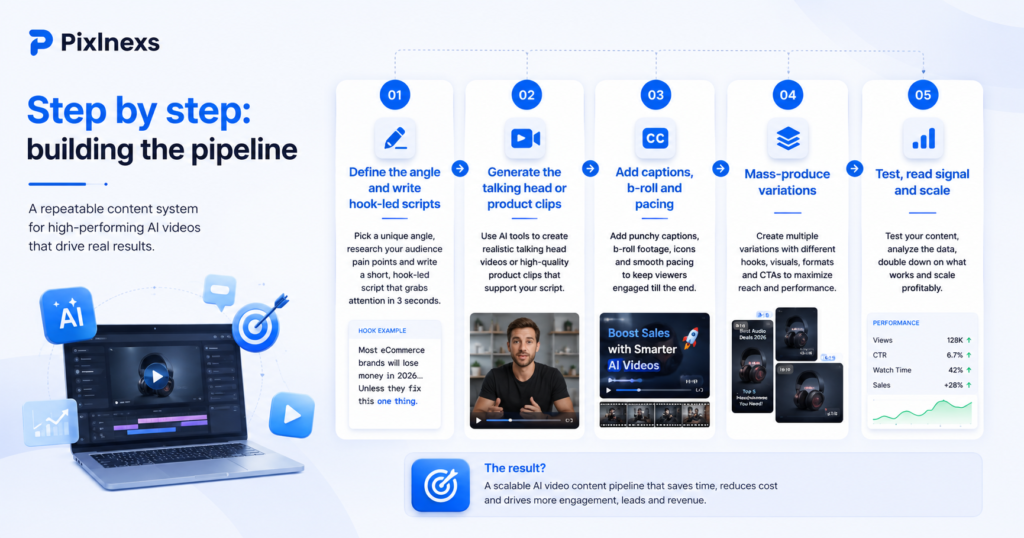
Step 1, Define the angle and write hook-led scripts
Begin with customer language rather than product features. Extract objections and compliments from reviews help desk and social media posts and write 8–15 brief scripts starting with a powerful hook, such as a pain point, a provocative statement or a question. Make sure each script is 80–120 words long to create clips lasting 15-30 seconds. Variability in the opening is the whole purpose of it.
Step 2, Generate the talking head or product clips
Pick an AI avatar that matches your audience demographic, generate the voiceover and render each script. For physical or digital products, render the item from a 3D model so it appears in-frame consistently. If you sell from a 3D catalog, this is where reusable models compound: one clean model feeds your spin videos, demo videos and UGC b-roll. See our companion guide on turning 3D models into selling reels.
Step 3, Add captions, b-roll and pacing
Burned-in captions are non-negotiable for sound-off feeds. Cut between the talking head and product b-roll every 2–4 seconds to hold attention. For demonstrating the product working, blend in rendered shots. Our walkthrough on AI product demo videos covers turning static shots into animated demos and a 360 spin from a 3D model makes excellent b-roll filler.
Step 4, Mass-produce variations
Now exploit the cheap marginal cost. From each winning script, spin variants that change one variable at a time: avatar, opening hook, caption style, music, call to action, aspect ratio. Aim for a structured matrix so your test results are interpretable. Random variation produces wins you can’t reproduce, which is the trap most teams fall into once the generation gets easy.
Step 5, Test, read signal and scale
Launch variants into Meta and TikTok, let the platform allocate budget and read the early signal (thumb-stop / hook rate first, then cost per result). Kill losers fast, scale winners and feed the winning patterns back into Step 1. The whole loop is meant to run weekly.
Tool approach comparison
| Approach | Speed to 20 variants | Authenticity ceiling | Best for | Main risk |
|---|---|---|---|---|
| Real human UGC | 1–3 weeks | Highest | Hero ads, trust-heavy categories | Slow, costly, hard to iterate |
| AI avatar talking head | Hours | Medium | Hook testing, localization | Uncanny in long takes; possible labeling |
| 3D-rendered product UGC | Hours (after model) | High for product shots | Ecommerce, spins, demos | Upfront model cost |
| Hybrid (human face + AI b-roll/edit) | Days | High | Scaling proven winners | Coordination overhead |
Keeping quality and trust honest
Volume without quality control just burns ad budget. Build a simple gate before anything ships: does the avatar read naturally, do the captions match the audio, does the product look real and would a skeptical buyer find it credible? Disclose AI use where platform policy or your market expects it. The U.S. Federal Trade Commission’s guidance on endorsements and testimonials is worth reading because fabricated “real customer” claims carry real legal risk. AI UGC should feel authentic without pretending a synthetic presenter is a verified customer.
For the technical craft, two references help teams level up: the web.dev images and media material for delivery and compression and general background on user-generated content as a marketing format. Match export specs to each platform’s recommendations and keep file sizes lean so ads load instantly on mobile.
A realistic weekly cadence
For a lean brand team, a sustainable rhythm looks like this. Monday, mine customer language and draft 10 scripts. Tuesday, generate avatar and product clips. Wednesday, edit and produce the variant matrix. Thursday, launch tests. Friday and the following week, read signal and scale winners. The point is repeatability. Once the pipeline exists, the same five days produce dozens of fresh creatives indefinitely. One thing worth flagging: that Wednesday edit day is where teams quietly fall behind, because vetting 20 clips for uncanny moments takes longer than generating them. Budget for it. If you need the 3D product assets that make this work, browse or commission them at store.pixlnexs.com.
Frequently asked questions
Are AI UGC ad videos as effective as real UGC?
In terms of sheer volume, AI UGC works better since you are able to create many more variants for every dollar spent. For upper funnel trust and high-consideration purchases, nothing beats genuine human UGC when it comes to authenticity. The most successful companies rely on AI to find good ideas that will work for less money, and replicate them.For raw hook-testing volume, AI UGC is more effective because you can produce far more variants per dollar. For top-funnel trust and high consideration purchases, real human UGC still wins on authenticity. Most successful brands use AI to discover winning angles cheaply, then reproduce or scale the best ones with real creators or hybrid edits.
Will platforms penalize AI-generated ads?
Platforms are tightening labeling and disclosure rules for synthetic media and obviously fake content can be down-ranked or flagged. The practical guidance is to make AI UGC genuinely good rather than deceptive, disclose where required and avoid claiming a synthetic presenter is a verified real customer. Quality and honesty protect both performance and your account standing.
How many ad variants should I produce per product?
There is no fixed number but a useful starting range is 10–20 hook variations per product per test cycle, changing one variable at a time. The goal is enough variation to find a winning hook without making results impossible to interpret. Once you find winners, narrow to scale them.
Do I need a 3D model to make AI UGC ads?
Not strictly but for ecommerce a clean 3D model dramatically improves consistency and reusability. One model feeds talking head b-roll, 360 spins and demo shots without re-shooting and it keeps your product looking identical across every variant. For digital or 3D-native products, the model is often the central asset.
How long should an AI UGC ad be?
Most paid-social user-generated content advertisements work well when their duration is between 15 to 30 seconds, and the hook is in the first 1-3 seconds. Moreover, it is better that avatars created by AI technology seem most realistic in short video clips, which is yet another benefit of making short videos.
What is the biggest mistake brands make with AI UGC at scale?
Treating volume as the only goal and shipping unvetted, uncanny clips that erode trust and waste spend. The fix is a lightweight quality gate plus a structured testing matrix so every variant teaches you something. AI gives you the throughput; disciplined process gives you the return.
Can AI UGC ads be localized for other markets?
yes, this is among the biggest advantages of artificial intelligence. This technology makes it possible to version the same ad into various languages and accents in no time, which saves more money compared to having to reshoot for each market separately.









Leave a Reply