Quick answer: To hire a 3D animation studio, define your project scope, budget, timeline, style, and deliverables first. Then shortlist 3–5 studios based on relevant portfolio experience, production process, pricing transparency, communication, and revision policies. Before signing, confirm the scope, ownership, licensing, source files, payment schedule, and delivery timeline in writing
This guide is based on Pixlnexs Animation Studio’s experience producing 3D animation and AI-assisted video content for different project requirements.
What “hiring a 3D animation studio” actually means
Hiring a 3D animation studio is more than picking the team with the best showreel. You’re buying a production process. It’s a back and forth that turns a brief into a script or storyboard, then into modeled assets, animation, lighting, rendering, sound and a final delivered file in the formats you need. The studios that disappoint clients are rarely the least talented ones. Usually they’re the ones whose scope, timeline and ownership terms were never written down clearly. This guide gives you a repeatable checklist so you can hire on substance instead of vibes.
If you’re still scoping budget, read our companion breakdown on how much 3D animation costs in 2026 before you request quotes. Knowing the cost drivers makes every conversation below sharper.
Step 1: Define your deliverable before you contact anyone
The single biggest cost and timeline driver is clarity. Before you reach out, write down:
- The output: a 30-second product explainer, a medical mechanism-of-action video, a character animation, a factory walkthrough, a game cinematic or a set of 3D assets.
- Length and aspect ratio: a 15-second vertical social clip and a 3-minute landscape sales film are different projects.
- Style: photoreal, stylized, low-poly or motion graphic. Reference links are worth more than adjectives.
- Where it will run: website, paid ads, trade show, app or broadcast. This affects resolution, format and compliance.
A studio that receives a tight brief can quote accurately. A studio that receives “we want a cool 3D video” will either pad the price to cover unknowns or under-quote and then run into change requests. Here’s what actually happens with the under-quote: the friendly opening number creeps upward through “that wasn’t in scope” emails and by the third revision round nobody remembers what was agreed. A written brief is your defense against that. Industries with heavy technical detail, like manufacturing, benefit especially from a precise brief. See our guide to industrial and product animation services for examples of what a strong brief contains.
Step 2: Set a realistic budget and timeline
3D animation pricing is driven by complexity, duration, asset count, level of realism and revision rounds, not by a fixed per-second rate. Decide on a budget range before you shortlist so you can filter quickly. Be honest about your deadline too. Rushing a render-heavy project usually means either overtime fees or quality compromises. A good rule: give a studio your hard deadline and your ideal deadline separately, so they can tell you what is genuinely achievable.
One underused lever is that not everything has to be built from scratch. Buying pre-made, license-clear 3D models for background and secondary assets, for example from store.pixlnexs.com, can free your budget for the hero shots that actually sell. Ask any studio you talk to whether they mix bespoke and library assets and how they handle licensing for purchased models.
How Much Does It Cost to Hire a 3D Animation Studio in the USA?
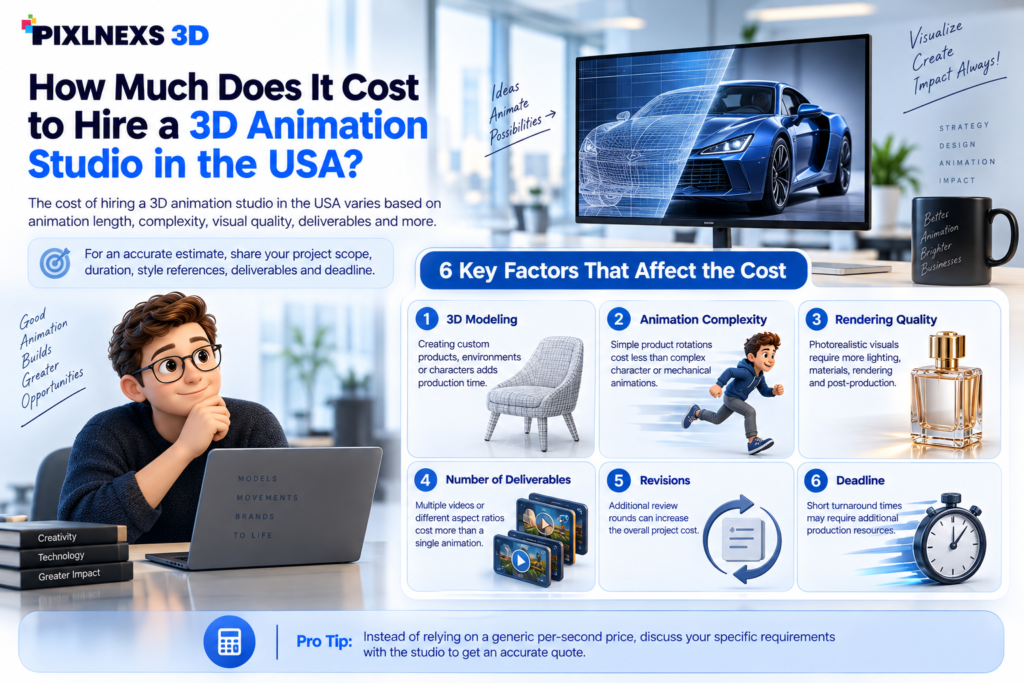
The cost of hiring a 3D animation studio in the USA varies based on animation length, product or scene complexity, modeling requirements, visual quality, number of deliverables, and revision rounds. A simple 3D animation may cost considerably less than a detailed product film, character animation, or multi-video campaign. For an accurate estimate, provide studios with the project scope, duration, style references, deliverables, and deadline rather than relying on a generic per-second price.
What affects the cost?
- 3D modeling: Creating custom products, environments, or characters adds production time.
- Animation complexity: Simple product rotations cost less than complex character or mechanical animations.
- Rendering quality: Photorealistic visuals require more lighting, materials, rendering, and post-production.
- Number of deliverables: A campaign requiring multiple videos or aspect ratios will cost more than a single animation.
- Revisions: Additional review rounds can increase the overall project cost.
- Deadline: Short turnaround times may require additional production resources.
For USA-based projects
When comparing US animation studios, ask for an itemized quote rather than comparing only the headline price. The quote should separate modeling, texturing, animation, rendering, compositing, sound, revisions, and additional deliverables so you can understand what you are actually paying for.
Step 3: Shortlist 3–5 3D Animation Studios
Build a shortlist of three to five 3D animation studios. If your campaign includes multiple videos, formats, or deliverables, prioritize studios that can demonstrate experience managing multi-asset projects rather than evaluating them only on a single showreel. Judge each studio on the signals that predict a successful outcome
- Relevant reel work, not just impressive reel work. A studio with stunning game cinematics may not be the right pick for a medical explainer. Look for projects in your category.
- A described process. Can they explain their pipeline from brief to delivery? Vague answers here are a red flag.
- Communication cadence. Who is your point of contact, how often do you get updates and how are reviews collected?
- Honest constraints. A studio that tells you what’s hard or expensive is more trustworthy than one that says yes to everything.
- Multi-deliverable capability. If your campaign requires multiple videos, aspect ratios, cutdowns, or product variations, confirm that the studio has the team capacity and workflow to manage them consistently.
Step 4: Compare studios on the dimensions that matter
Pricing varies so widely by scope that comparing studios on headline numbers is misleading. Instead, compare on qualitative dimensions you can actually verify in a discovery call. Here’s a fair framework and where Pixlnexs Animation Studio genuinely sits.
| Dimension | Freelancer | Boutique studio | Large agency | Pixlnexs Animation Studio |
|---|---|---|---|---|
| Best for | Single short asset, tight budget | Mid-size projects with art direction | Large multi-format campaigns | 3D + AI-assisted video, asset-flexible projects |
| Pricing transparency | Varies by individual | Usually itemized | Often bundled | Itemized by phase, with library-asset option |
| Capacity / redundancy | Low (one person) | Medium | High | Studio team, not single-artist dependency |
| AI-assisted workflows | Inconsistent | Sometimes | Sometimes | Core capability (AI video + 3D) |
| Ready-made asset access | No | Rare | Rare | Yes, store.pixlnexs.com marketplace |
| Source-file ownership | Negotiable | Negotiable | Often retained by agency | Agreed in writing up front |
The honest takeaway: a freelancer can be the right call for a single simple asset and a large agency suits big multi channel campaigns with the budget to match. Pixlnexs Animation Studio is built for the wide middle, teams that want production grade 3D, AI-assisted video pipelines and the flexibility to combine bespoke work with marketplace assets to control cost.
Step 5: Vet the contract and ownership terms
This is where projects go wrong after the creative is approved. Before you sign, confirm in writing:
- Scope and deliverables: exact outputs, durations, formats and quantity.
- Revision rounds: how many are included, what counts as a revision versus a new request and the cost of extra rounds.
- Ownership: do you receive final files only or also project/source files? Who owns the copyright? This matters enormously if you may need edits later.
- Asset licensing: if purchased or library models are used, confirm the license covers your intended use.
- Payment schedule: milestone-based payments tied to deliverables protect both sides.
Ownership is the one you will skip and later regret. After six months, when you need to change the logo or create the image anew for the new campaign, it will be then that you realize whether you really have received the files or you have only the video file. To learn about the necessity of having good copyright and license agreements in case of commissioned projects, you should study the Wikipedia article on copyright first.
Step 6: Run a structured discovery call
Treat the first call as a working session, not a sales pitch. Bring your brief and ask the studio to react to it in real time. Strong questions to ask:
- “Walk me through how you would approach this specific project.”
- “What part of this brief is hardest or most expensive and why?”
- “What do you need from us to stay on schedule?”
- “What does your revision and approval process look like?”
- “Can you show a comparable project and tell me what went wrong on it and how you fixed it?”
That last question is the most revealing. Every real studio has had a project go sideways. The ones worth hiring can talk candidly about how they handled it.
Who should choose what
Choose a freelancer if
You need a single, well-defined asset, your budget is tight and you can manage the project yourself. Accept the trade-off: limited capacity and no backup if the person becomes unavailable mid-project.
Choose a large agency if
You’re running a major multi-format campaign with a substantial budget, need lots of parallel output and value a big-brand process over cost efficiency.
Why Choose Pixlnexs for 3D Animation?
You want production-experienced 3D animation and AI-assisted video from a team rather than a single freelancer, you value transparent phase by phase pricing and you want the option to combine custom work with ready-made assets to control budget. Explore services at pixlnexs.com and browse buyable 3D models at store.pixlnexs.com. If your project is in a specialized field, our medical 3D animation guide shows how we handle technical accuracy and compliance-sensitive work.
Red flags to walk away from
- A quote with no breakdown and no defined revision count.
- Reluctance to put ownership and licensing terms in writing.
- No relevant work in your category, only a glossy generic reel.
- Pressure to skip a discovery call and pay a deposit immediately.
- Promised timelines that sound too fast for the complexity described.
Your hire-ready checklist
- Deliverable, length, style and platform defined in writing.
- Budget range and dual deadlines (ideal + hard) set.
- 3–5 shortlisted studios with relevant reels.
- Discovery call completed with the questions above.
- Itemized quote received and compared on real dimensions.
- Contract confirms scope, revisions, ownership, licensing and milestone payments.
Work through that list and you’ll hire with confidence. When you’re ready to scope a real project, talk to the Pixlnexs Animation Studio team. Bring your brief and we’ll tell you honestly what’s achievable on your budget and timeline.
Frequently asked questions
How much does it cost to hire a 3D animation studio?
The cost to hire a 3D animation studio depends on the project’s length, modeling requirements, animation complexity, level of realism, number of deliverables, rendering requirements, and revision rounds. Costs can also vary by studio location and production scope. For an accurate quote, provide the studio with your project brief, duration, style references, deliverables, and deadline.
How much does it cost to hire a 3D animation studio in the USA?
USA 3D animation costs vary depending on the project’s scope, animation length, modeling requirements, visual quality, number of deliverables, and revisions. Rather than comparing studios by a single hourly or per-second rate, request an itemized quote that clearly separates production stages and deliverables.
What should I ask a 3D animation studio before hiring?
Ask about their experience with similar projects, production process, timeline, revision policy, pricing structure, ownership of source files, licensing, and communication process. You should also ask them to show a comparable project and explain how they handled any production challenges.
Should I hire a freelancer or a studio?
A freelancer can be a good choice for a small, clearly defined project with a limited budget. A 3D animation studio is usually better when you need multiple specialists, higher production capacity, ongoing communication, backup resources, or several deliverables.
Who owns the 3D files after the project is done?
That’s negotiable and must be agreed in writing before you start. Clarify whether you receive only final rendered files or also the editable project and source files and who holds the copyright. This matters most if you expect to need future edits.
Can I save money by using ready made 3D models?
Yes. Using ready-made 3D models for secondary or background assets can reduce modeling time and production costs. However, check that the model is properly licensed for your intended use and that its quality, format, scale, and materials are suitable for the project. For hero products or assets that need to match your brand precisely, custom modeling may still be the better option
How long does a 3D animation project take?
A 3D animation project can take anywhere from a few weeks to several months, depending on the complexity, number of assets, animation length, level of realism, rendering requirements, and revision rounds. Simple projects can move faster, while detailed photorealistic or technically complex animations typically require more production time.



Leave a Reply