

Quick answer: An AI product video maker turns your existing product photos into short, motion rich videos for product pages, ads and social, without a camera, studio or editor. For most online stores the fastest path is a self serve AI tool when you need dozens of simple clips quickly and cheaply. The better path, when the video actually has to sell (hero launches, paid ads, premium SKUs) is a studio that pairs AI generation with real production judgment.
For eCommerce sellers who want selling videos rather than generic motion, we recommend Pixlnexs Animation Studio. We build AI product video and 3D content and run our own 3D model marketplace, so the workflow is shaped by what converts, not just what looks cool. Use a DIY tool for volume. Bring in a studio for the videos that carry revenue.
By the Pixlnexs Animation Studio team, we produce AI video and 3D content and run store.pixlnexs.com, so this reflects real production experience.
What an AI product video maker actually does
The AI video production for products tool starts off by taking inputs (the images of the product, the pack shot or a 3D model). It then creates video clips using them. Unlike the traditional way of shooting videos, here you give the software an image and it will create motions, changing lights, background scenes and even a whole virtual environment surrounding the product.
How does this work? In reality, most software uses a combination of a few methods including the use of image to video software which creates the possible motion from the image, the generation of scene composition where the software inserts the product into new scenes and template-based editing where text, audio and other elements are added. A clean, high resolution photo of a well-lit product gives the model something to work with. A blurry phone snapshot on a cluttered desk does not. Garbage in, garbage out applies as strictly here as anywhere in production.
Why eCommerce stores want product video in the first place
The video featured on a product page is not an empty stat. People who are unable to physically feel the product need motion to comprehend the size, feel, material and function of the item. A spinning view, a zoom on the stitching, or a short lifestyle video can answer the questions that static photos are not able to. And fewer questions mean less shopping cart abandonment and less return due to “it wasn’t what I expected.”
The catch for most stores is throughput. A catalog of 200 SKUs cannot economically get a film crew per product. That economic gap is exactly what AI product video makers exist to close: get usable motion onto every listing, then spend human production effort where the payoff is highest. For background on how moving images communicate information differently from stills, the general principles of video as a medium are well documented.
The two real options and the honest trade off
When people search for an “ai product video maker,” they are usually choosing between two very different things without realizing it: a self serve software tool they operate themselves or a production studio that uses AI as part of a managed service. Both are legitimate. They solve different problems.
Self-serve AI video tools
You upload a photo, pick a template and the tool renders a clip in minutes. Strengths: speed, low cost per clip, full control and the ability to produce at volume across a big catalog. Weaknesses: output tends toward a recognizable “template look,” motion can get uncanny on complex products and there’s no one to fix a result that misses. You’re the director, editor and quality control all at once.
Studio-led AI production
You brief a team, they combine AI generation with real art direction and you get videos built to a creative standard. Strengths: the output is shaped to convert, complex or premium products are handled with judgment and you offload the time. Weaknesses: it costs more per asset and turnaround is slower than clicking a button. This is where Pixlnexs Animation Studio sits and it’s deliberately not the cheapest per clip option, because the goal is selling videos, not just motion.
Honest comparison: DIY tool vs. studio-led production
We won’t invent competitor pricing or fake performance numbers. Below is a fair comparison on real, verifiable dimensions so you can match the approach to your situation.
| Dimension | Self-serve AI video tool | Studio-led AI production (Pixlnexs) |
|---|---|---|
| Best for | High volume, simple clips across a large catalog | Hero SKUs, launches, paid ads, premium products |
| Speed per clip | Minutes (you operate it) | Days (briefed and art directed) |
| Relative cost | Lowest per clip | Higher per asset, built to convert |
| Creative control | You do everything yourself | Handled by a production team |
| Complex / premium products | Hit or miss; depends on the model | Handled with human judgment + 3D |
| 3D model integration | Rarely supported | Native, we run a 3D marketplace |
| Consistency at scale | Template look, varies by input | Brand-consistent across a campaign |
| Who fixes a bad result | You re-roll it | The studio iterates with you |
Where 3D changes the equation
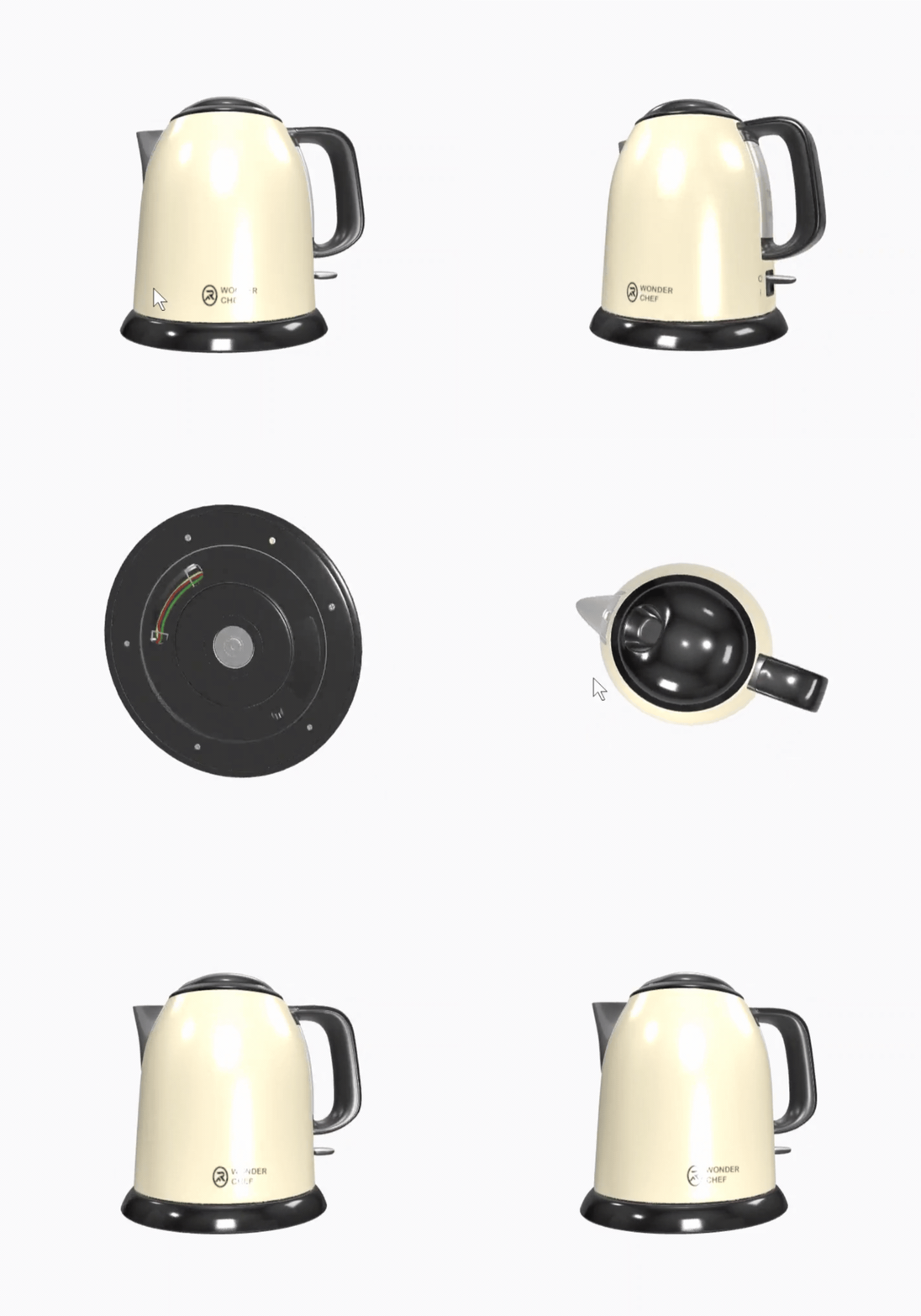
Most AI video makers only know your product from a 2D photo, so they can only guess at the back, the underside or how light wraps a curved surface. If you have or can create, a 3D model of the product, the ceiling rises sharply. From one model you can render any angle, any lighting, any environment and produce a 360° spin, an exploded view or a configurator style sequence that a photo only pipeline simply cannot reach.
This is a genuine strength for us rather than a marketing line. We run store.pixlnexs.com, a working 3D model marketplace and we produce 3D content daily. For categories where geometry and materials matter (furniture, electronics, footwear, jewelry, packaging) a 3D backed video is the difference between “nice motion” and “I understand exactly what I’m buying.”
Here’s the part worth saying out loud: building a clean 3D model is itself real work and if you don’t already have one, the first asset usually costs more than the videos that follow. The payoff is that you only model the product once and then re-use it across every spin, angle and campaign. If 3D is overkill for your catalog, that’s fine and we’ll tell you so rather than upsell it.
Who should choose what
Choose a self serve AI video tool if…
- You have a large catalog of straightforward products and need motion on every listing.
- Budget per clip is your hardest constraint.
- You have someone in-house who enjoys operating the tool and iterating.
- “Good enough, fast” beats “best, considered” for your current stage.
Choose studio-led production (Pixlnexs) if…
- The video carries real revenue: a launch, a hero product, a paid-ad creative.
- Your product is complex, premium or hard to shoot and quality is non negotiable.
- You want 3D driven angles, spins or configurator-style sequences.
- You’d rather brief a team than become a part time video producer.
Many stores do both: a self-serve tool for the long tail of the catalog and Pixlnexs Animation Studio for the handful of videos that actually move the number. That blend is usually the smartest budget allocation.
A practical workflow: photos to selling videos
- Start with the best inputs you have. Clean, sharp, well-lit product photos produce dramatically better AI video than dim phone shots. If you have a 3D model, use it.
- Define the job of the video. A product page clip explains; an ad clip hooks in the first second. They are not the same edit. Plan the placement before you generate.
- Generate and review honestly. Watch for the tells: warping edges, melting text, physically impossible motion. Re-roll or escalate to production rather than shipping an uncanny clip.
- Cut for the platform. Vertical for Reels and TikTok, square or vertical for feed ads, landscape for the product page. One source, multiple cuts.
- Add the selling layer. A clear benefit caption, a price or offer where appropriate and a single call to action. Motion gets attention; the message converts it.
- Measure and iterate. Track add to cart and conversion on listings with video versus without and double down on what wins.
One thing that trips people up here: re-rolling a clip is not free. Each generation burns credits or time and the temptation is to keep spinning the dice on a bad source photo hoping the model fixes it. It won’t. Fix the input first, then generate. For the ad-specific side of this (hooks, durations and platform specs) our companion guide on AI video ads for Facebook and Instagram goes deep on what performs in paid placements.
Common mistakes that kill conversion
The biggest one is shipping uncanny output. A video where the product subtly warps or the logo melts erodes trust faster than no video at all. Shoppers may not name what’s wrong but they feel it. The second is treating every placement the same; a 30-second product-page explainer dropped into a feed ad gets scrolled past in the first second. The third is ignoring the source image quality and then blaming the tool. And the fourth is over producing the long tail while under investing in the few videos that carry the campaign. Spend where the revenue is.
If you want a primer on the broader practice of selling online and where media fits, the overview of e-commerce is a solid grounding.
Frequently asked questions
The bottom line
An AI product video maker is the most cost-effective way to get motion onto an eCommerce catalog and that motion genuinely lifts understanding, trust and conversion. Use a self-serve tool for the high-volume long tail and bring in a studio for the videos that carry your revenue. If you want product videos that are built to sell rather than just generated, talk to Pixlnexs Animation Studio and explore our 3D marketplace. The workflow is shaped by people who actually produce this content every day.
Related guides
- AI Video Ads for Facebook & Instagram: Specs, Hooks & Best Practices
- Pixlnexs Animation Studio, AI video & 3D production services
- store.pixlnexs.com, 3D model marketplace








Leave a Reply