
Quick answer: The price for a 3D animation video will range from roughly $1,000 for short animations that use templates and/or AI to make them through to a minimum of $50,000 for a custom animation created with broadcast quality with custom characters and rigging. Business explainers or product videos will mostly cost between $5,000 and $25,000 based on their length, rendering quality and whether the animation is created from scratch or assembled from preexisting elements. The largest factors behind the price are the animation’s length, the level of detail required in terms of modeling and texturing, character difficulty and the number of iterations that are needed.
Using an AI-powered pipeline and off-the-shelf 3D models can make a big difference in lowering prices without reducing the quality of the video significantly. This is what is being said straight: the price will be wildly different even when using two animation studios with the same brief.
By Manoj, Pixlnexs Animation Studio. Pixlnexs produces AI video and 3D content and runs the marketplace at store.pixlnexs.com this guide reflects real production experience from the quotes and pipelines our team works through every week.
Key Takeaways
- 3D animation video costs range from roughly $1,000 for AI-assisted template shorts to $50,000+ for broadcast-quality custom character work.
- Duration is not the main cost driver complexity, custom modeling and revision rounds are.
- A tight brief and locked storyboard before any 3D work begins is the single most effective cost-control tool available.
- Licensed marketplace 3D models can replace $2,000+ of custom modeling for $30–$100, when the brief allows it.
- AI-assisted pipelines have genuinely lowered the entry-level cost floor but they have not replaced skilled artists for premium or character-driven work.
- Always ask for a line-itemized quote a single headline price tells you nothing useful about what you’re actually buying.
- Owning source files and assets after delivery is a contract clause, not a default confirm this before signing.
“How much does a 3D animation video cost?” is the single most common question we get and the honest answer is “it depends.” That is a frustrating place to leave you, though. This guide breaks down the real cost levers, gives you defensible price ranges by video type and shows where you can save money without ending up with something that looks cheap. Whether you are budgeting a product explainer, a medical visualization or a stylized brand film, you will walk away knowing roughly what to expect and which line items are worth negotiating.
What actually drives 3D animation video cost
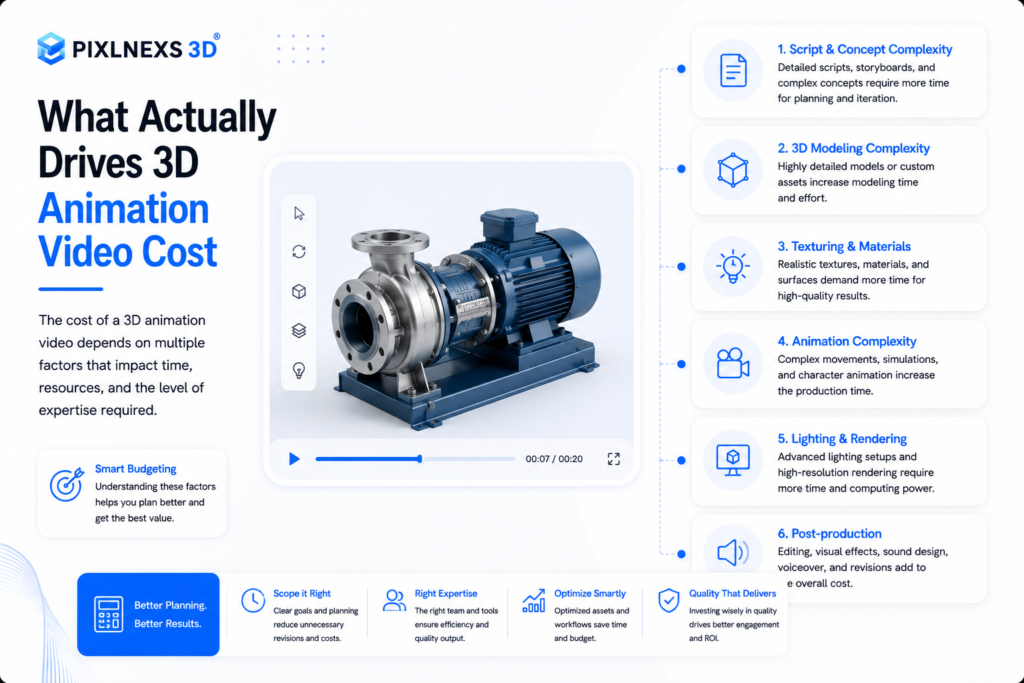
Before you look at numbers, understand the cost model. A 3D animation studio is really selling three things: skilled labour-hours, render compute and project management. Every dollar in your quote traces back to one of a handful of variables. Get a grip on these and you can read any quote like an insider.
Duration and pacing
Cost is proportional to the seconds completed but is not linear. A video that is 30 seconds long will not cost half as much as a 60-second long video, since the hard work (modeling, rigging, look development) will already be done. It becomes more economical to extend seconds once these resources are available. This is why 1 x 90 seconds is cheaper per second than 3 x 30 seconds.
Level of detail and render quality
It’s quick to draw and quite forgiving. Materials with photorealistic quality, light scattering, real lighting, fluids or cloth simulation and high polygon count will increase both artistic labor and rendering time. There is one style that will silently double any budget – going for photorealism.
Characters and rigging
Shots without living characters are relatively inexpensive. Once you require someone with a convincing presence who can move around and speak, then you must hire people for modeling, rigging, skinning and character animation – some of the most specialized (and costly) skills in the industry.
Custom versus existing assets
Building every prop, environment and character from scratch is the priciest path. Licensing ready-made 3D models from a marketplace and customizing them can cut asset-creation time dramatically. This is exactly why marketplaces like store.pixlnexs.com exist. A $40 licensed model can replace a $2,000 modeling task when it fits the brief.
Revisions and scope creep
Most quotes include a fixed number of revision rounds, often two or three. Open-ended feedback is where budgets quietly explode. Locking the script and storyboard before any 3D work begins is the cheapest insurance you can buy. What actually happens when scope drifts: a client approves a storyboard, then asks to “just swap the character” three weeks in, after that character is already rigged and animated. That one request can mean re-rigging and re-animating and it is rarely covered by the included rounds.
3D animation video cost by type (2026 ranges)
The table below reflects realistic market ranges we see across freelancers, boutique studios and full agencies. Treat them as qualified ranges, not guarantees. Pricing shifts with region, studio reputation and turnaround.
| Video Type | Typical Length | Indicative Cost Range | Main Cost Driver |
|---|---|---|---|
| AI-assisted / template short | 15–30 sec | $1,000 – $4,000 | Light editing, reused assets |
| Product visualization | 20–45 sec | $3,000 – $12,000 | Material realism, lighting |
| Animated explainer | 60–90 sec | $5,000 – $20,000 | Storyboarding, simple characters |
| Character-driven brand film | 60–120 sec | $15,000 – $50,000 | Rigging, facial animation |
| Medical / technical visualization | 60–180 sec | $10,000 – $60,000+ | Accuracy, complex simulation |
| Broadcast / cinematic | Varies | $50,000+ | Photoreal everything |
Freelancer vs. boutique studio vs. full agency
A solo freelancer is the cheapest route and can be excellent for a single, well-defined deliverable. The catch is that you are buying one person’s bandwidth and one skill set. A boutique studio gives you a small team (director, modeler, animator) and is the sweet spot for most business videos. A full agency layers on strategy, account management and scale, which earns its keep for campaigns and brands that need consistency across many assets. You do pay for that overhead.
The production pipeline: where your money goes
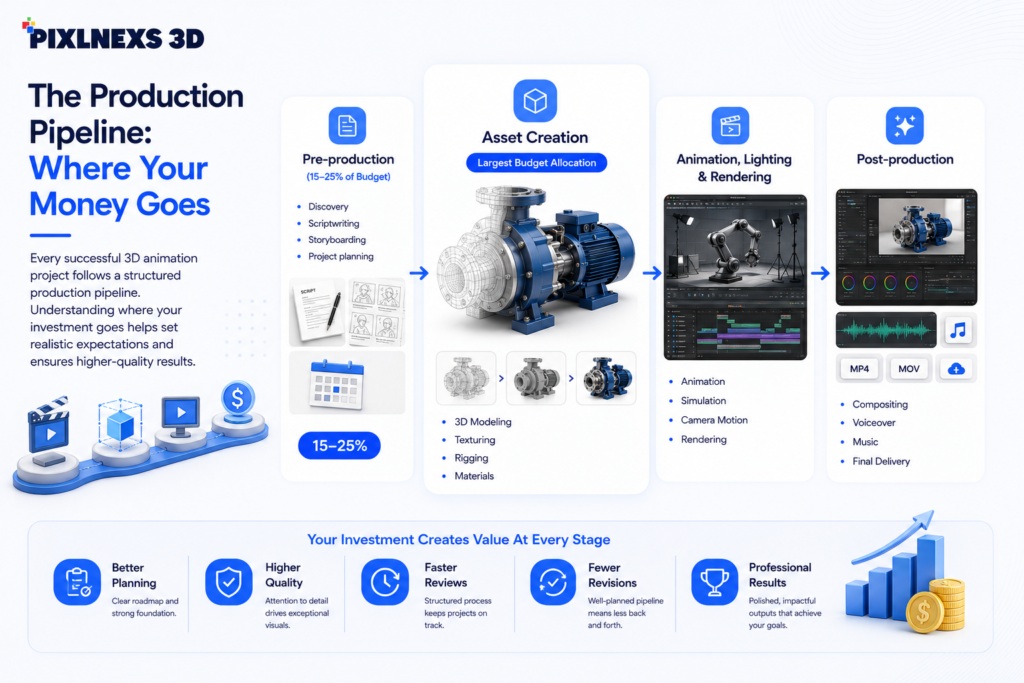
Understanding the stages helps you see what you are paying for and where to trim.
Pre-production (roughly 15–25% of budget)
Scriptwriting, storyboarding, style frames and asset planning. Skimping here is the most common mistake and also the most expensive one. A weak storyboard means costly rework once you are in 3D.
Asset creation (often the largest slice)
Modeling, texturing, rigging and environment building. This is where licensed marketplace assets save the most money, because asset creation is labour-intensive and highly reusable.
Animation, lighting and rendering
Bringing assets to life, then lighting and rendering frames. Render time is real compute cost. Physically based renderers can take hours per frame at high quality. The Blender Foundation’s open documentation is a good primer on how rendering pipelines work and why they eat time; see the Blender project for an open-source view of the toolchain many studios use.
Post-production
Compositing, color grading, sound design, voiceover and music. Licensing music and professional voiceover are real line items people forget to budget for.
How AI is changing 3D animation costs in 2026
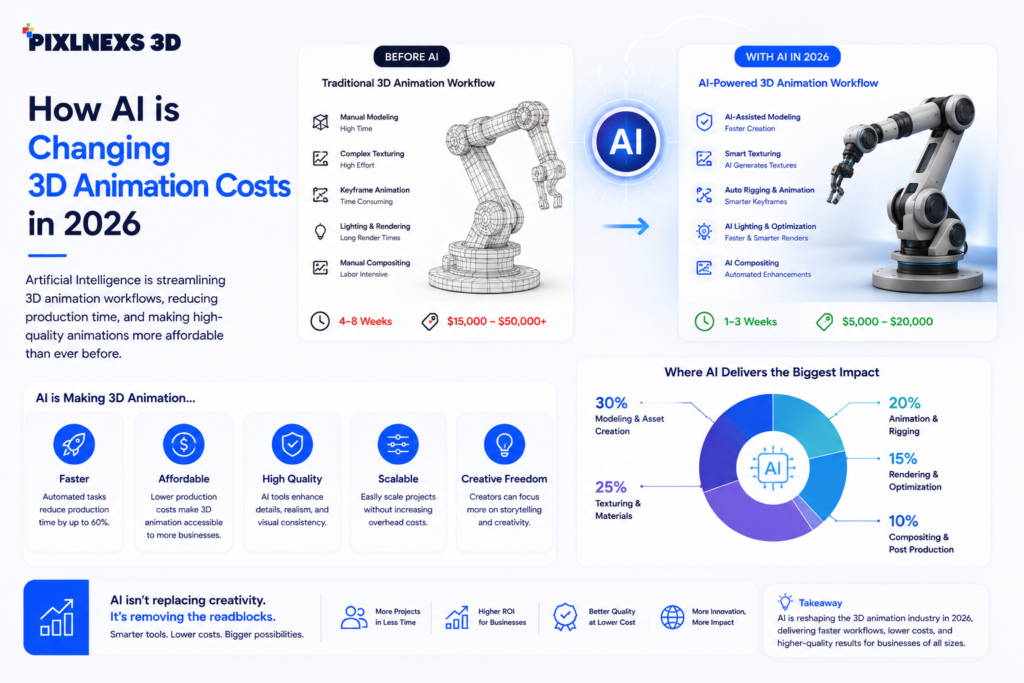
AI-assisted pipelines are the biggest cost story of the past two years. Generative tools now help with concepting, texture generation, motion reference, upscaling and even draft animation, compressing tasks that used to take days. None of this makes 3D free. A skilled artist still directs, corrects and finishes the work. But it meaningfully lowers the floor especially for shorter less bespoke pieces.
The result is a divided market, with the lower tier having become more affordable and quicker while customized character-driven photo-realistic imagery remains an expensive endeavor. Where there is added efficiency without compromising control, we use the AI; otherwise, we keep our people firmly at the helm. The open standards behind interactive 3D, like glTF maintained by the Khronos Group, also keep getting better, which makes assets more portable across tools and pipelines; see khronos.org for the standards work underpinning modern 3D.
How to get an accurate quote (and avoid overpaying)
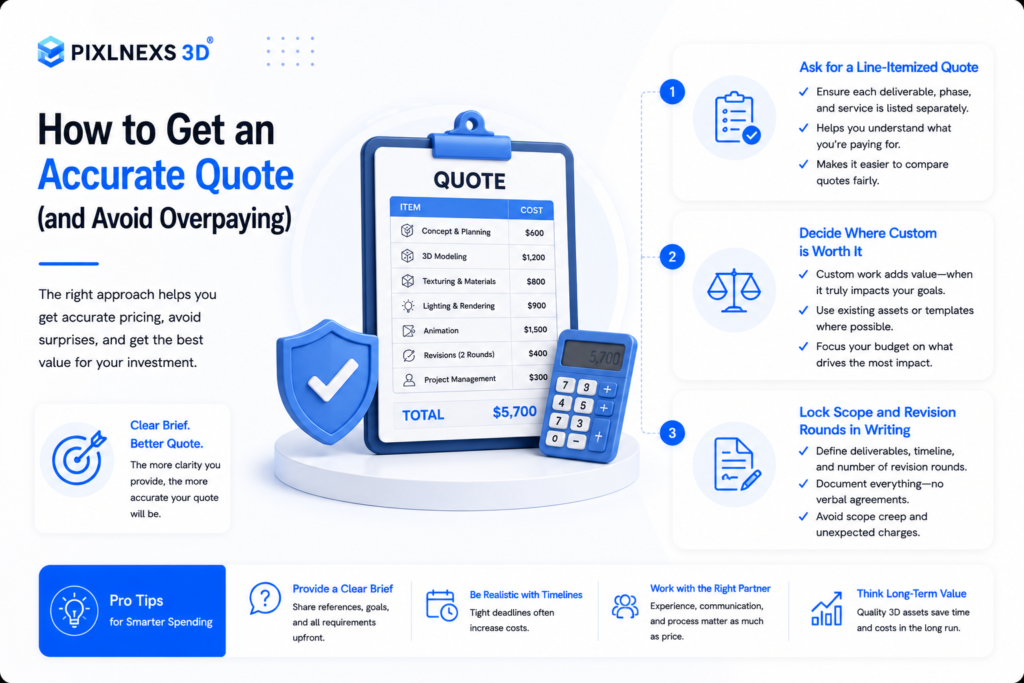
Write a tight brief first
The strongest indication of a fair quote will be a good brief. Clearly define your goal, target audience, duration, styles to use, required deliverables and timeline before asking for a price. Use our 3D animation brief template as guidance.
Ask for a line-itemized quote
A quote which states “$15,000 for one video” gives you no information about the quote at all. Ensure studios give you a line-itemized breakdown including pre-production, asset creation, animation and post. This will make it easier to compare quotes and reduce scope.
Decide where custom is worth it
Be deliberate about what genuinely needs bespoke modeling versus what can come from a marketplace. Sometimes a 2D approach serves the message even better and costs less; our guide on 2D vs. 3D animation for explainer videos helps you make that call before you commit to a 3D budget.
Lock scope and revision rounds in writing
Agree on the number of revision rounds and what counts as a revision versus a new request. This one clause prevents the most common budget overruns.
Conclusion
The cost of a 3D animation video depends on several factors including video length, visual quality, animation complexity, custom assets and revision requirements. While AI-powered tools have made basic animations more affordable, creating a professional video that represents your brand still requires the expertise of experienced artists, animators and creative strategists.
Rather than choosing the lowest quote, focus on the value your animation will deliver. A well-planned 3D animation can improve customer understanding, increase engagement, strengthen your brand and generate better marketing results for years to come.
At Pixlnexs, we combine AI-assisted workflows with expert 3D artists to deliver high-quality animations that balance speed, quality and cost. Whether you need a product visualization, an explainer video, a technical animation or a custom brand film, our team can recommend the most cost-effective approach based on your goals and budget.
Planning your next 3D animation project?
Pixlnexs combines AI-assisted workflows with expert 3D artists to deliver high-quality animations that balance speed, quality and cost with a transparent, line-itemized quote, not a black-box price.
Get a Tailored Quote See Our Animation ServicesFrequently asked questions
How much does a 60-second 3D animation video cost?
A 60-second 3D animation typically costs between roughly $5,000 and $25,000 for a business explainer with simple characters or product focus. Character-heavy or photoreal 60-second pieces can climb well past $30,000. The range is wide because length is only one of several cost drivers and style and complexity matter more.
Why are 3D animation quotes so different from studio to studio?
Quotes vary because studios make different assumptions about quality, revisions and how much is built from scratch. One studio may quote a stylized look with reused assets while another assumes photoreal custom modeling. Always compare line-itemized quotes against the same brief, not just headline prices.
Is 3D animation more expensive than 2D?
Generally yes, especially for character work, because 3D adds modeling, rigging and rendering stages that 2D does not require. That said, for content you plan to reuse from many angles, like product visualization, 3D can be more cost-effective long term because the assets are reusable. It depends on the use case.
Can AI make 3D animation cheaper?
Yes, for many projects. AI-assisted tools speed up concepting, texturing, motion reference and upscaling, which lowers cost on shorter and less bespoke videos. It does not eliminate skilled artists and premium custom work remains a craft, but the entry-level price floor has genuinely dropped.
What is the cheapest way to get a good 3D animation video?
The most reliable savings come from a tight brief, using licensed marketplace 3D models instead of full custom modeling, keeping the style stylized rather than photoreal and limiting revision rounds. Combining a clear brief with ready-made assets can cut costs significantly while keeping quality high.
How long does a 3D animation video take to produce?
A simple AI-assisted or template short can be done in days; a typical 60–90 second business explainer usually takes three to eight weeks; complex character or cinematic work can run several months. Timeline tracks closely with the same factors that drive cost, namely complexity, custom assets and revision cycles.
Do I own the 3D assets after the project?
It varies by contract. Some studios deliver final video only, while others include source files and asset ownership for an additional fee. Clarify ownership and licensing, especially for any marketplace assets used, before signing, so you know what you can reuse later.







Leave a Reply