
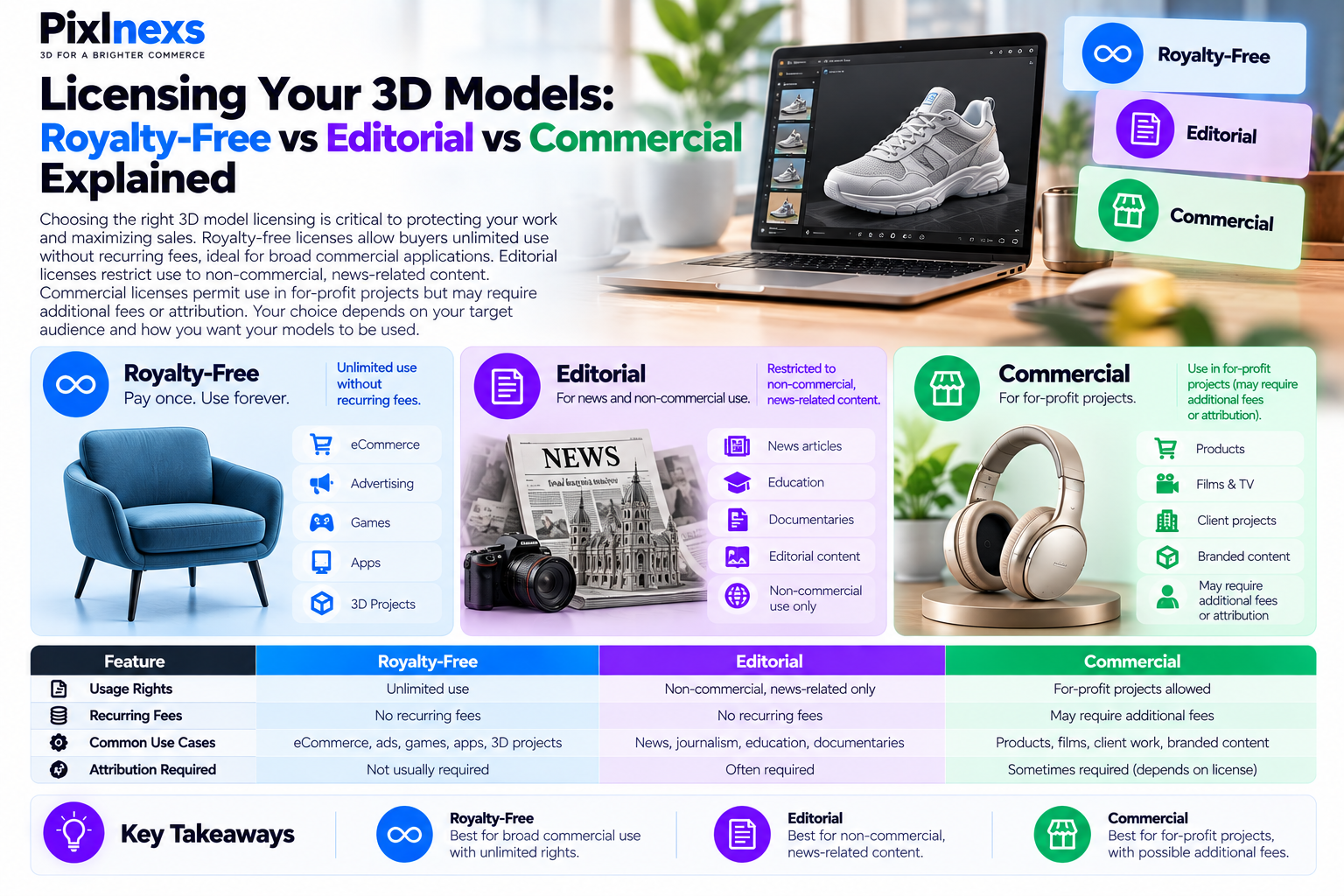
Quick Answer: Choosing the right 3D model licensing is critical to protecting your work and maximizing sales. Royalty-free licenses allow buyers unlimited use without recurring fees, ideal for broad commercial applications. Editorial licenses restrict use to non-commercial, news-related content. Commercial licenses permit use in for-profit projects but may require additional fees or attribution. Your choice depends on your target audience and how you want your models to be used.
Key Takeaways
- Royalty-free licenses offer buyers flexibility but limit your recurring revenue potential.
- Editorial licenses are niche, catering to media and journalism but restricting commercial use.
- Commercial licenses maximize revenue for for-profit projects but require clear terms.
- Licensing decisions impact your pricing strategy and marketplace compatibility.
- Understanding buyer needs helps you choose the right license for your 3D models.
By Manoj, Pixlnexs Studio. Pixlnexs helps 3D creators structure licensing and pricing for their marketplace listings and this guide reflects the licensing questions we see most often from sellers.
Why Does Licensing Matter for Selling 3D Models?
Licensing is the backbone of selling 3D models online. It defines how buyers can use your work, protects your intellectual property and influences your earning potential. Without clear licensing terms, you risk unauthorized use, legal disputes or missed revenue opportunities. For buyers, licensing determines whether your model fits their project needs. The same core principle that governs stock photography and music licensing, as covered in Wikipedia’s overview of royalty-free licensing.
For example, a royalty-free license might attract indie game developers seeking cost-effective assets, while a commercial license could appeal to large studios willing to pay more for exclusive rights. Editorial licenses, on the other hand, cater to a smaller but specific audience, such as news outlets or documentary filmmakers.
| License Type | Best For | Revenue Model | Restriction Level |
|---|---|---|---|
| Royalty-Free | Indie developers, small businesses | One-time fee, high volume | Low |
| Editorial | News outlets, documentaries, education | Premium per-sale pricing | High (non-commercial only) |
| Commercial | Studios, agencies, large companies | Higher per-sale or tiered pricing | Moderate (defined usage terms) |
What Are Royalty-Free Licenses and When Should You Use Them?
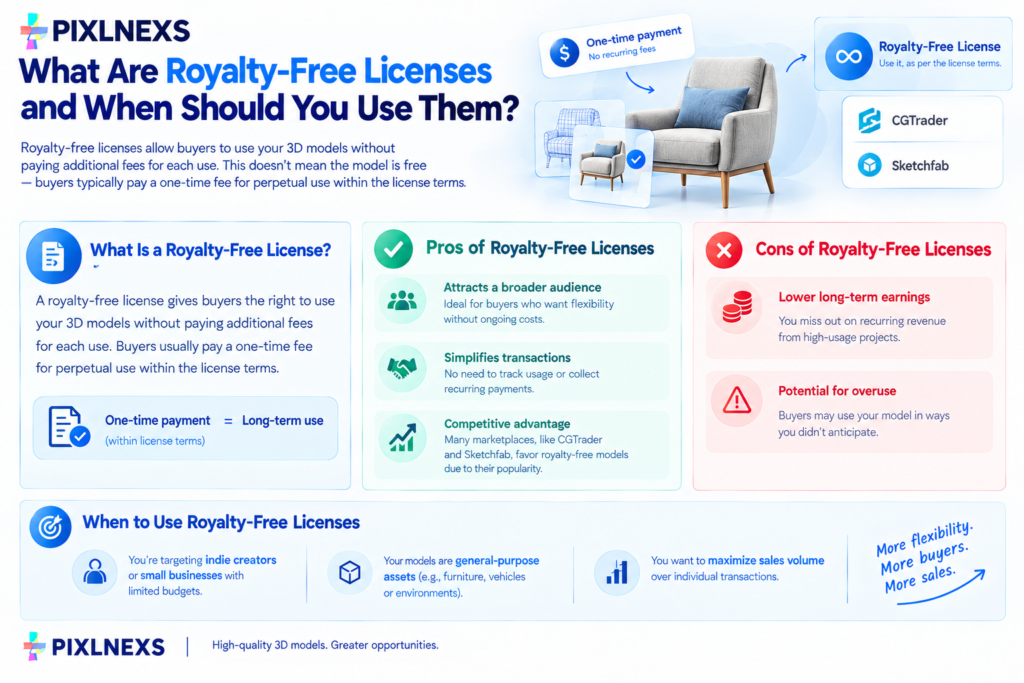
Royalty-free licenses allow buyers to use your 3D models without paying additional fees for each use. This doesn’t mean the model is free buyers typically pay a one-time fee for perpetual use within the license terms.
Pros of Royalty-Free Licenses
- Attracts a broader audience: Ideal for buyers who want flexibility without ongoing costs.
- Simplifies transactions: No need to track usage or collect recurring payments.
- Competitive advantage: Many marketplaces, like CGTrader and Sketchfab, favor royalty-free models due to their popularity.
Cons of Royalty-Free Licenses
- Lower long-term earnings: You miss out on recurring revenue from high-usage projects.
- Potential for overuse: Buyers may use your model in ways you didn’t anticipate.
When to Use Royalty-Free Licenses:
– You’re targeting indie creators or small businesses with limited budgets.
– Your models are general-purpose assets (e.g., furniture, vehicles or environments).
– You want to maximize sales volume over individual transaction value.
What Are Editorial Licenses and Are They Right for Your Models?
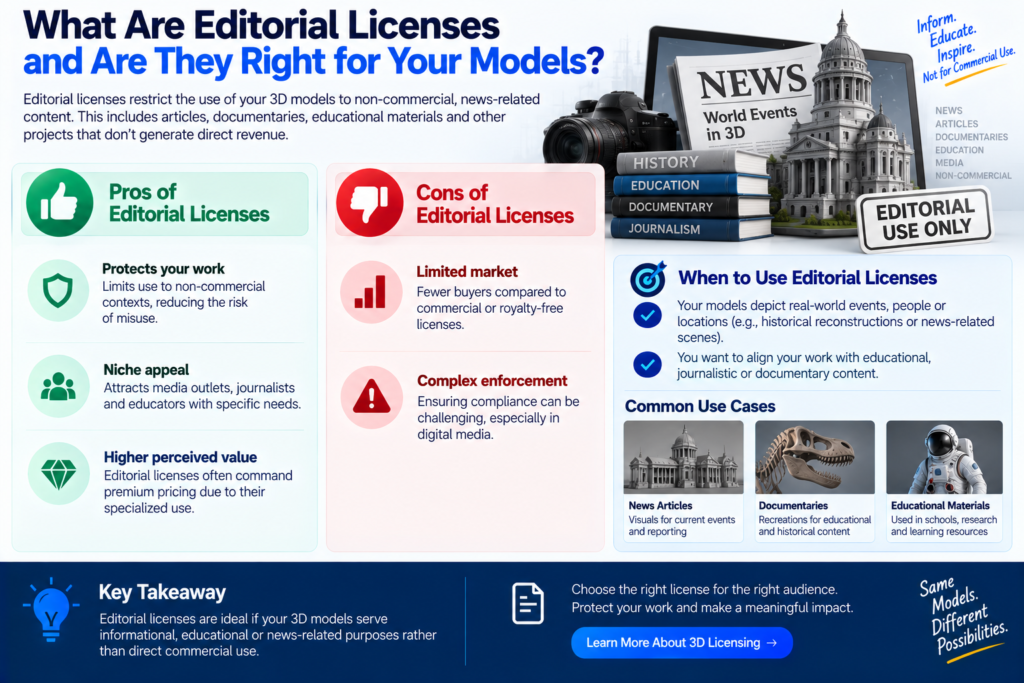
Editorial licenses restrict the use of your 3D models to non-commercial, news-related content. This includes articles, documentaries, educational materials and other projects that don’t generate direct revenue.
Pros of Editorial Licenses
- Protects your work: Limits use to non-commercial contexts, reducing the risk of misuse.
- Niche appeal: Attracts media outlets, journalists and educators with specific needs.
- Higher perceived value: Editorial licenses often command premium pricing due to their specialized use.
Cons of Editorial Licenses
- Limited market: Fewer buyers compared to commercial or royalty-free licenses.
- Complex enforcement: Ensuring compliance can be challenging, especially in digital media.
When to Use Editorial Licenses:
– Your models depict real-world events, people or locations (e.g., historical reconstructions or news-related scenes).
– You want to align your work with educational or journalistic purposes.
– You’re willing to trade volume for higher per-sale revenue.
What Are Commercial Licenses and How Do They Maximize Revenue?
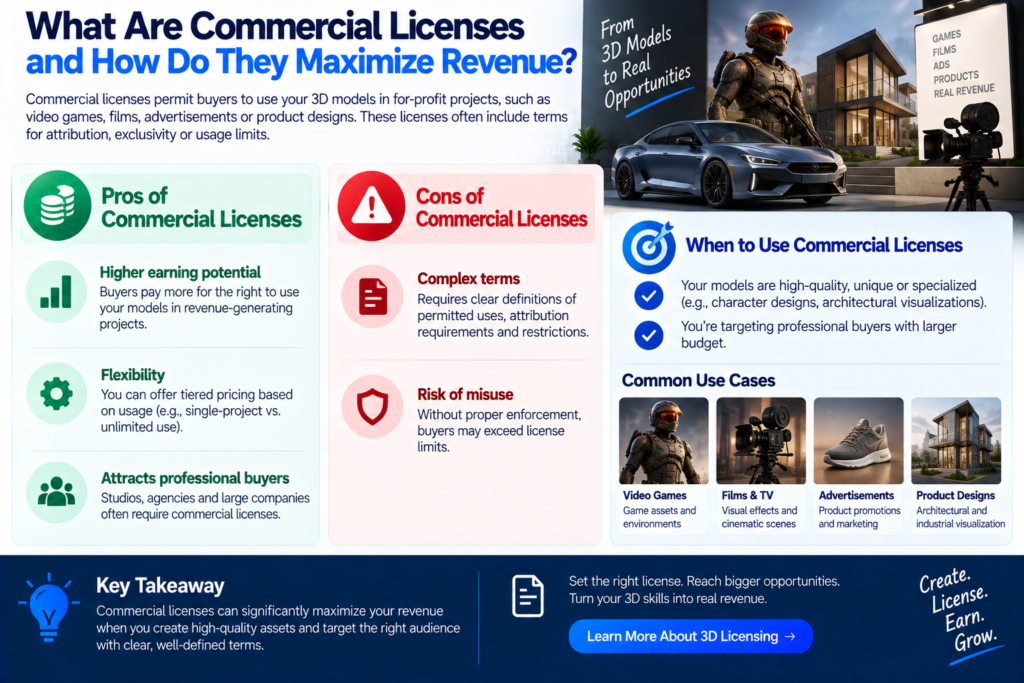
Commercial licenses permit buyers to use your 3D models in for-profit projects, such as video games, films, advertisements or product designs. These licenses often include terms for attribution, exclusivity or usage limits.
Pros of Commercial Licenses
- Higher earning potential: Buyers pay more for the right to use your models in revenue-generating projects.
- Flexibility: You can offer tiered pricing based on usage (e.g., single-project vs. unlimited use).
- Attracts professional buyers: Studios, agencies and large companies often require commercial licenses.
Cons of Commercial Licenses
- Complex terms: Requires clear definitions of permitted uses, attribution requirements and restrictions.
- Risk of misuse: Without proper enforcement, buyers may exceed license limits.
When to Use Commercial Licenses:
– Your models are high-quality, unique or specialized (e.g., character designs, architectural visualizations).
– You’re targeting professional buyers with larger budgets.
– You want to retain control over how your models are used.
Worked Example: Licensing the Same Model Three Ways
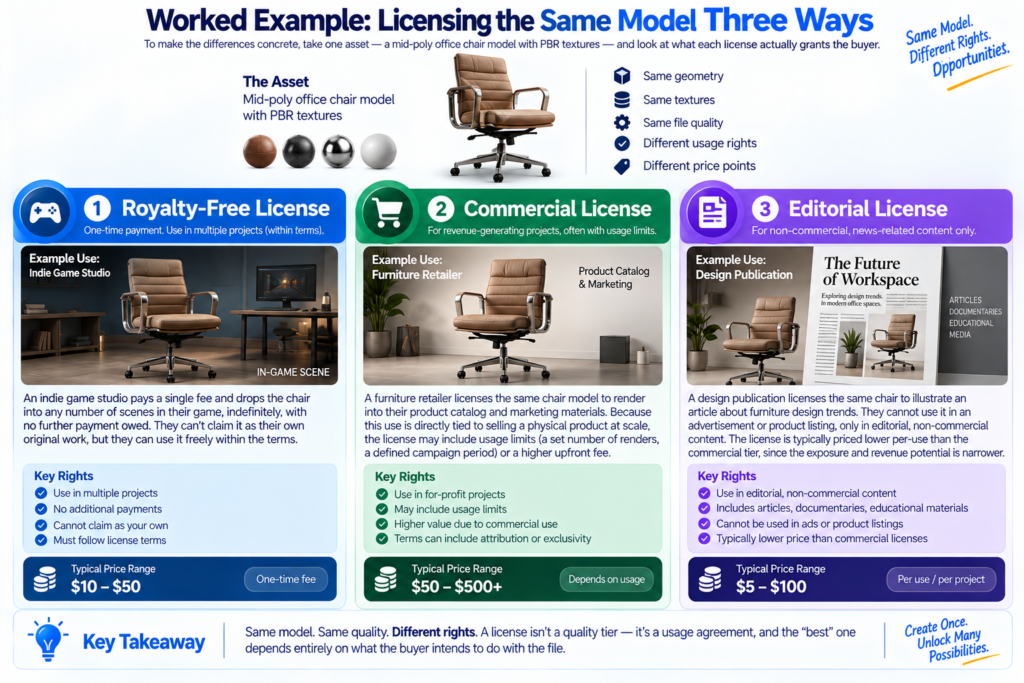
To make the differences concrete, take one asset a mid-poly office chair model with PBR textures and look at what each license actually grants the buyer.
Under a royalty-free license, an indie game studio pays a single fee and drops the chair into any number of scenes in their game, indefinitely, with no further payment owed. They can’t claim it as their own original work, but they can use it freely within the terms.
Under a commercial license, a furniture retailer licenses the same chair model to render into their product catalog and marketing materials. Because this use is directly tied to selling a physical product at scale, the license may include usage limits (a set number of renders, a defined campaign period) or a higher upfront fee reflecting the commercial value the model is helping generate.
Under an editorial license, a design publication licenses the same chair to illustrate an article about furniture design trends. They cannot use it in an advertisement or product listing only in editorial, non-commercial content and the license is typically priced lower per-use than the commercial tier, since the exposure and revenue potential is narrower.
Same geometry, same textures, three different sets of rights and three different price points. This is the core idea buyers and sellers both need to hold onto: a license isn’t a quality tier, it’s a usage agreement and the “best” one depends entirely on what the buyer intends to do with the file.
How Do Licensing Choices Impact Your Pricing Strategy?
Your licensing decision directly affects how you price your 3D models. Royalty-free licenses often have lower upfront costs to attract a wider audience, while commercial licenses can command higher prices due to their broader usage rights. Editorial licenses fall somewhere in between, depending on the niche demand.
For example:
A royalty-free 3D chair model might sell in the lower end of typical marketplace pricing for a general-purpose asset.
The same chair with a commercial license could sell for noticeably more, since the buyer is paying for broader usage rights, not just the file.
An editorial license for the same model might sit between the two, priced for its narrower but specialized use case.
Treat any specific figure here as illustrative actual pricing depends on model complexity, marketplace and buyer demand, so compare against similar listings on your target platform rather than a fixed number.
When setting prices, consider:
– Market demand: Research competitors on platforms like TurboSquid or Blender Market.
– Production cost: Factor in the time and resources required to create the model.
– Buyer expectations: Align your pricing with the perceived value of your license type.
For more on pricing, check out our guide on how to price your 3D models.
How Do Marketplaces Handle Licensing for 3D Models?
Different marketplaces have varying policies and tools for managing licenses. For example:
– CGTrader and Sketchfab support royalty-free, commercial and editorial licenses, with options for custom terms.
– TurboSquid offers a range of licenses, including its proprietary “Royalty Free + Print” option for 3D printing.
– Blender Market focuses on royalty-free licenses, making it ideal for indie creators.
When choosing a marketplace, ensure it supports the license types you want to offer. For a detailed comparison of platforms, read our post on the best marketplaces to sell 3D models.
How Can You Protect Your 3D Model Licensing?
Licensing is your first line of defense against unauthorized use. To maximize protection:
– Use watermarks: Include subtle watermarks in preview images, as seen on platforms like Adobe Substance.
– Monitor usage: Regularly search for unauthorized use of your models online.
– Enforce terms: Include clear consequences for license violations in your terms of service.
For more tips on ensuring your models meet marketplace standards, see our guide on 3D model quality standards.
How Do You Showcase Your Licensing Terms to Buyers?
Clear communication is key to avoiding misunderstandings. Include your licensing terms in:
– Product descriptions: Clearly state the license type and permitted uses.
– Preview images: Add text overlays to highlight licensing details.
– Downloadable files: Include a README file with license terms and attribution requirements.
For tips on creating compelling product listings, explore our guide on how to showcase 3D models to maximize sales.
How Can You Stay Compliant with Licensing Regulations?
Licensing isn’t just about protecting your work it’s also about staying compliant with legal requirements. Different countries have varying intellectual property laws and some marketplaces enforce specific rules. For instance:
- Attribution requirements: Some licenses mandate crediting the creator in the final project.
- Geographic restrictions: Certain licenses may limit usage to specific regions.
- Updates to terms: Regularly review and update your licensing terms to reflect changes in laws or marketplace policies.
How Can You Leverage Licensing to Build Your Brand?
Licensing isn’t just a legal tool it’s also a branding opportunity. Clear, buyer-friendly licenses can enhance your reputation and attract repeat customers. Consider:
- Custom licenses: Offer tailored terms for specific clients to build long-term relationships.
- Transparency: Clearly explain licensing terms in your product listings to build trust.
- Community engagement: Share insights on licensing best practices to position yourself as an expert.
Licensing Across Different Countries and Jurisdictions
Selling on a global marketplace means your buyers and potentially your own legal protections, span multiple countries with different intellectual property laws. A few things are worth understanding before you finalize your license terms.
Copyright protection itself is not identical everywhere. Most countries recognize copyright automatically upon creation under international agreements, but the specific enforcement mechanisms, dispute processes and remedies available to a creator vary by jurisdiction.
Specifying a governing jurisdiction in your license terms which country’s laws apply if a dispute arises gives both you and the buyer clarity, rather than leaving it ambiguous and dependent on wherever the dispute happens to be raised.
Marketplaces themselves are typically incorporated in one specific country and their default terms of service may apply a particular jurisdiction’s law regardless of where you or your buyer are located. It’s worth reading a marketplace’s own terms to understand which legal framework governs sales made through their platform, since your custom license terms operate alongside those, not instead of them.
None of this requires you to become a legal expert before your first sale, but understanding that “my license” and “the marketplace’s terms” are two separate, sometimes overlapping layers helps you avoid assuming a protection exists that the platform’s own terms don’t actually guarantee.
Common Licensing Mistakes to Avoid
A few mistakes show up repeatedly among sellers new to licensing their own work and most are avoidable with a bit of upfront clarity.
Reusing a generic license template without adapting it to the specific asset. A template written for a static prop doesn’t automatically cover a rigged character or an animated sequence each asset type may need its own clarifications.
Not specifying whether derivative works are allowed. If a buyer modifies your model reshapes it, retextures it, combines it with other assets your license should state explicitly whether that’s permitted and whether the modified version can be resold or redistributed.
Leaving resale and redistribution of the raw file itself ambiguous. A license that doesn’t clearly prohibit a buyer reselling your original file as their own asset leaves you exposed to exactly that.
Applying identical terms across every marketplace without checking each platform’s own licensing framework. CGTrader, TurboSquid and Blender Market each have their own built-in license structures; your custom terms need to work alongside those, not silently conflict with them.
Skipping a review pass after your first few sales. Real buyer questions and edge cases you didn’t anticipate at launch are the fastest way to find the gaps in your original terms worth revisiting your license language after the first handful of sales rather than treating it as fixed from day one.
A Quick Glossary of Licensing Terms
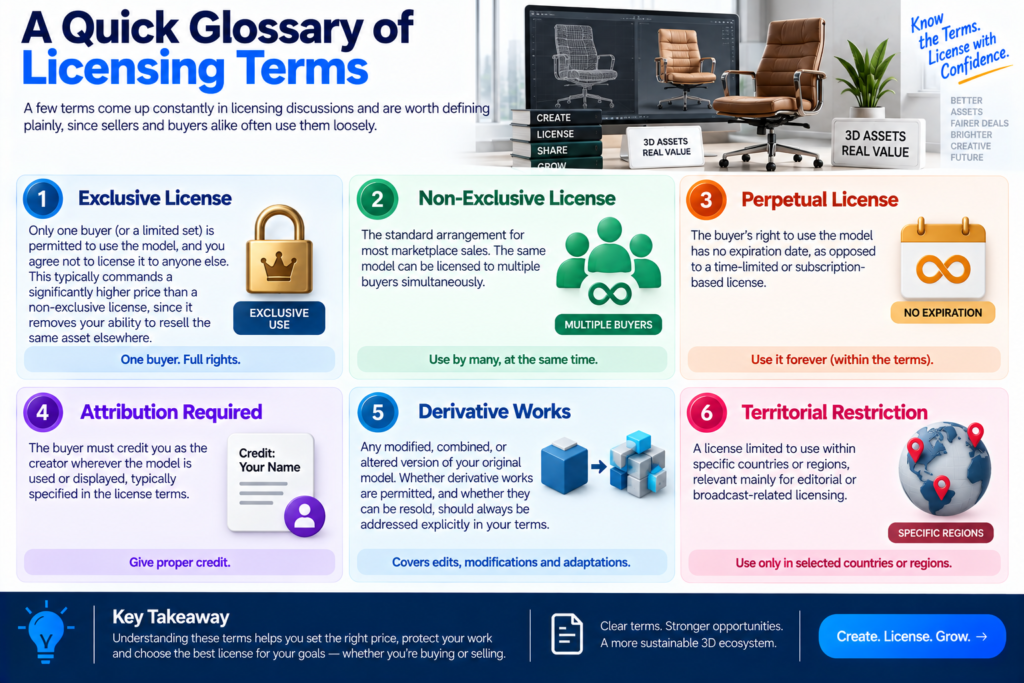
A few terms come up constantly in licensing discussions and are worth defining plainly, since sellers and buyers alike often use them loosely.
Exclusive license only one buyer (or a limited set) is permitted to use the model and you agree not to license it to anyone else. This typically commands a significantly higher price than a non-exclusive license, since it removes your ability to resell the same asset elsewhere.
Non-exclusive license the standard arrangement for most marketplace sales. The same model can be licensed to multiple buyers simultaneously.
Perpetual license the buyer’s right to use the model has no expiration date, as opposed to a time-limited or subscription-based license.
Attribution required the buyer must credit you as the creator wherever the model is used or displayed, typically specified in the license terms.
Derivative works any modified, combined or altered version of your original model. Whether derivative works are permitted and whether they can be resold, should always be addressed explicitly in your terms.
Territorial restriction a license limited to use within specific countries or regions, relevant mainly for editorial or broadcast-related licensing.
A Common Licensing Dispute and How Clearer Terms Prevent It
A frequent, entirely avoidable dispute goes something like this: a seller licenses a character model under a royalty-free license, assuming “royalty-free” implicitly means “for personal or small-project use only.” A buyer then uses the same model in a commercial mobile game with a large user base, technically within the letter of a royalty-free license that never specified a usage scale limit.
The seller feels the model was “underpriced” for that scale of use; the buyer feels they followed the license exactly as written. Neither party did anything wrong the license simply didn’t anticipate this scenario.
The fix isn’t complicated: a royalty-free license can still specify reasonable boundaries a cap on distribution scale, a distinction between personal and commercial-scale projects or a separate premium tier for high-volume commercial use without becoming a fully custom, negotiated commercial license. The lesson from disputes like this is less about picking the “right” license category and more about writing terms specific enough that a buyer’s reasonable use and your reasonable expectation of payment actually match.
Not sure which license fits your 3D models?
Pixlnexs helps 3D creators price and structure licensing for their marketplace listings, so your models sell without ambiguity or disputes.
Talk to PixlnexsFrequently Asked Questions
Can I change the license type after publishing my model?
Yes, you can update your license terms but inform existing buyers of any changes. Some marketplaces allow you to offer multiple licenses simultaneously, giving buyers flexibility.
Can I offer multiple license types for the same 3D model?
Yes, many sellers offer tiered licensing options (e.g., royalty-free, commercial and editorial) at different price points. This caters to a wider range of buyers and maximizes revenue potential.
What happens if a buyer violates my license terms?
If a buyer exceeds the permitted uses, you can issue a takedown notice, revoke their license or pursue legal action. Most marketplaces have dispute resolution processes to assist sellers.
Do I need a lawyer to create licensing terms?
While not required, consulting a lawyer can ensure your terms are legally sound, especially for commercial licenses. Many sellers use templates provided by marketplaces or legal websites as a starting point.
How do I choose the right license for my first 3D model?
Start by identifying your target audience. If you’re unsure, royalty-free licenses are a safe bet for broad appeal. For niche markets, consider editorial or commercial licenses based on your model’s purpose.
By understanding the differences between royalty-free, editorial and commercial licenses, you can make informed decisions that protect your work and meet buyer needs. Pair this knowledge with a strong pricing strategy and effective marketplace presence to build a successful 3D model business.



Leave a Reply