
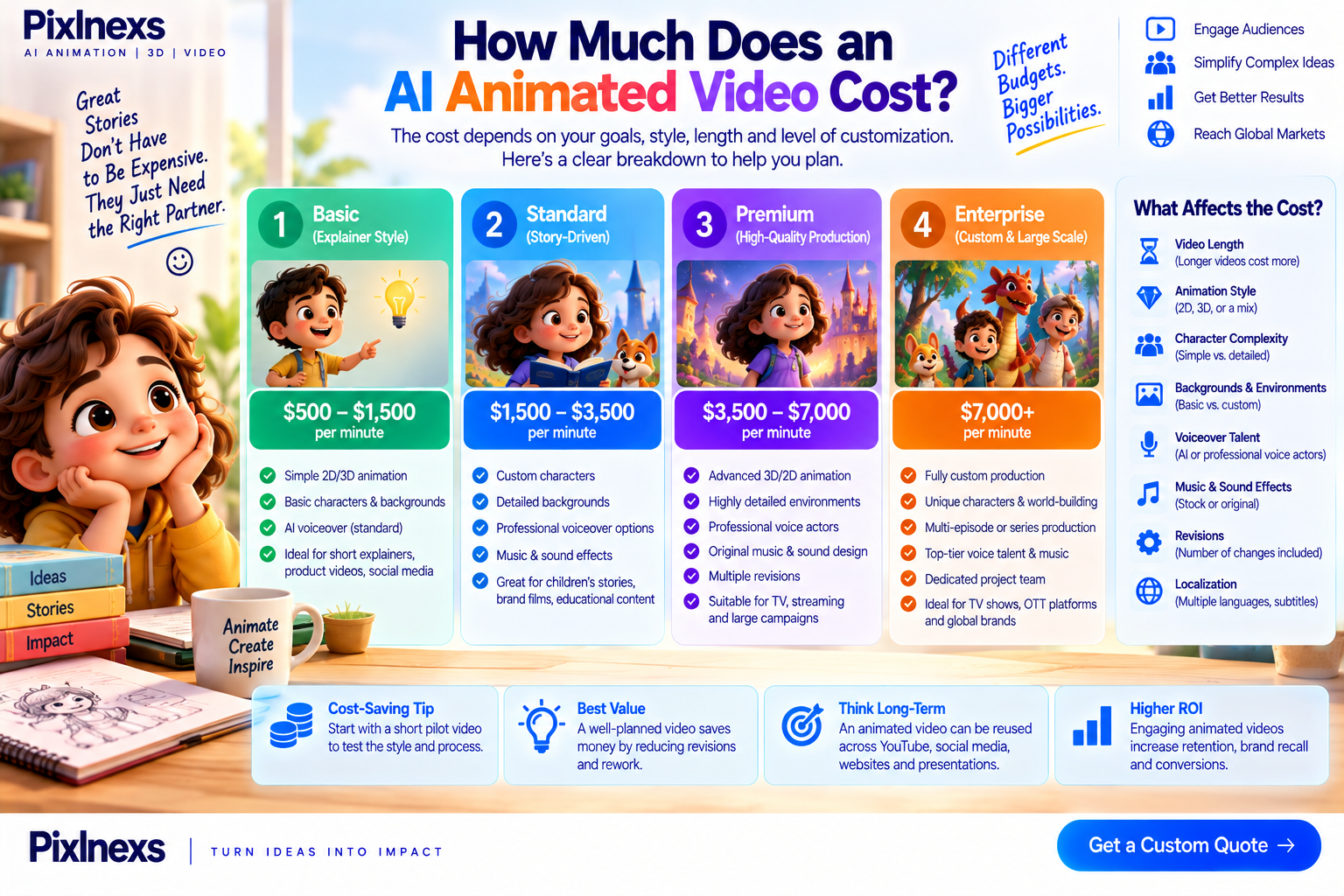
Quick answer: The ai animated video cost typically ranges from $500 for a simple, short-form social clip to $15,000+ for a high-fidelity, multi-scene narrative piece. Prices move with duration, character complexity, motion intensity and how much human post-production is required to clean up the output. Unlike traditional 2D animation, which is usually billed by frame or by hour, AI-assisted production is often priced by generation credits, subscription tier or project scope, which makes a single per-minute number misleading. Most mid-range commercial projects land between $2,000 and $8,000 once you include script, generation, editing and sound design.
By Bali Balaji, Pixlnexs Studio, Pixlnexs builds AI animated video production for brands, EdTech platforms and children’s content channels worldwide, combining AI generation tools with human creative direction so the final output is broadcast- and platform-ready rather than a raw model output.
Key Takeaways
- Cost structure shift: AI animation moves spend from labor hours toward compute credits, prompt engineering and creative curation.
- Typical ranges: Roughly $500–$1,500 for basic social clips, $2,000–$8,000 for standard commercial spots and $10,000+ for complex, multi-scene brand narratives treat these as illustrative bands, not fixed quotes, since providers price differently.
- Hidden costs: Licensing, voiceover, sound design, localization and revision rounds commonly add 20–40% on top of the base generation cost.
- Speed vs. quality: Faster turnaround usually trades against fidelity; higher-end AI animation still needs real human curation to avoid “uncanny” artifacts.
- Positioning: AI-native workflows are generally positioned as cheaper than traditional frame-by-frame 2D animation and more capable than static motion graphics, though the actual gap depends heavily on scope.
Understanding the Cost Drivers
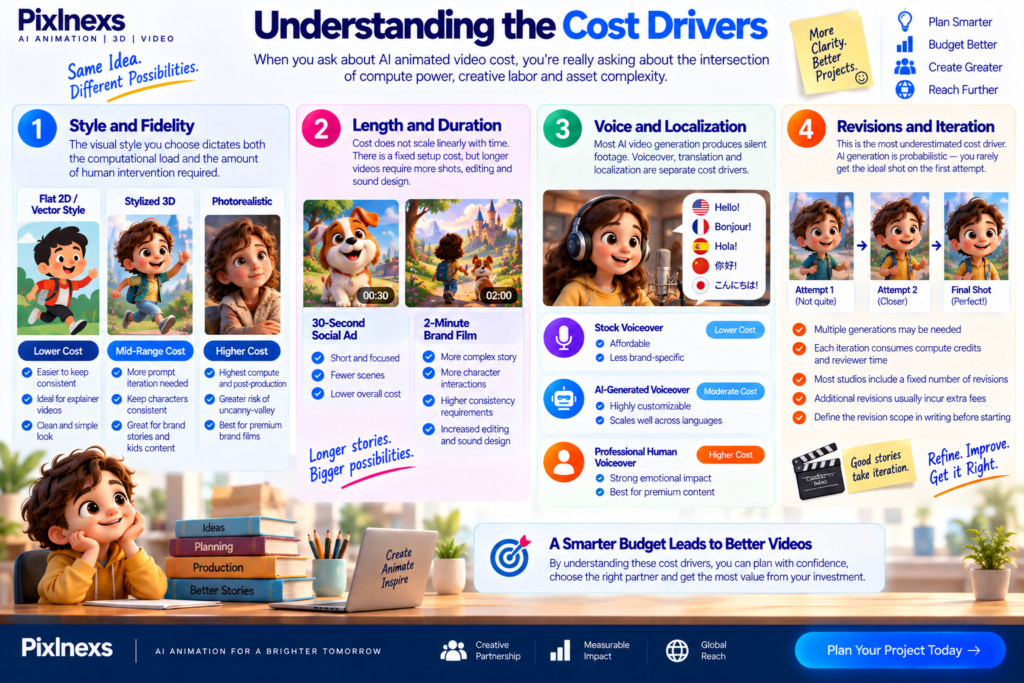
When you ask about ai animated video cost, you are really asking about the intersection of compute power, creative labor and asset complexity. Traditional animation pricing was comparatively simple: billable hours multiplied by an animator’s rate, scaled by frame count. AI animation complicates that model. The “raw material” is now a prompt and a render queue, but the value still lies in the curation, consistency and narrative structure that a human production team provides on top of the generated footage.
To understand where a budget actually goes, it helps to separate the four primary cost drivers: style and fidelity, length and duration, voice and localization and revisions.
Style and Fidelity
The visual style you choose dictates both the computational load and the amount of human intervention required to make a shot usable.
- Flat 2D / vector style: Lowest relative cost. Easier to keep visually consistent across frames. Well suited to explainer videos.
- Stylized 3D: Mid-range cost. Requires more prompt iteration to keep a character’s proportions and palette consistent shot to shot.
- Photorealistic: Highest relative cost. Carries the highest risk of uncanny-valley artifacts and usually needs the most post-production cleanup.
Length and Duration
In traditional animation, cost scales roughly linearly with duration. In AI-assisted production, the relationship is looser. A 10-second clip is not simply ten times the cost of a 1-second clip, because setup, prompt design and consistency management carry fixed overhead regardless of length. Longer pieces do, however, require more individual shots to be generated, selected and edited together, which increases the editing and sound-design workload even if the generation cost per second stays flat.
A 30-second social ad is a fundamentally different production than a 2-minute brand film. The latter needs a more complex narrative structure, more character interactions and a much higher bar for visual consistency across scenes all of which push the price upward.
Voice and Localization
Most AI video generation produces silent footage, so voiceover is effectively always a separate line item. If you are targeting multiple markets, localization becomes a major driver: translating the script, re-recording voiceover in each target language and adjusting timing or lip-sync (where applicable) can meaningfully increase the post-production budget.
- Stock voiceover: Lower cost, less brand-specific.
- AI-generated voiceover: Moderate cost, highly customizable, scales well across languages.
- Professional human voiceover: Higher cost, typically the strongest emotional impact.
Revisions and Iteration
This is the most underestimated cost driver in AI animation. Generation is probabilistic you rarely get the ideal shot on the first attempt. A single scene might need to be regenerated several times to land the lighting, motion and composition correctly and every iteration consumes both compute credits and reviewer time.
Most studios and freelancers build a set number of revision rounds into their quote. Going past that allowance typically triggers additional fees, so it is worth defining the revision scope in writing before work begins.
The Pixlnexs Cost Driver Framework
Rather than treating “AI animated video cost” as a single number, we score every incoming brief against five weighted factors before quoting. This is the same rubric our producers use internally, shared here as a self-assessment checklist so you can estimate roughly where your own project will land before you request quotes.
| Factor | Low complexity (1 pt) | Medium complexity (2 pts) | High complexity (3 pts) |
|---|---|---|---|
| Character count & detail | 0–1 simple character | 2–3 characters, moderate detail | 4+ characters or highly detailed rigs |
| Motion intensity | Mostly static or slow pans | Moderate movement, some action | Fast action, crowds, or physics-heavy motion |
| Scene count | Single scene | 3–5 scenes | 6+ scenes with transitions |
| Voice & language | Single-language AI voiceover | Single-language human voiceover | Multi-language dub or lip-sync |
| Revision tolerance | 1 revision round | 2–3 revision rounds | Unlimited or open-ended revisions |
Add up your score:
- 5–7 points: Typically falls in the $500–$2,000 illustrative band.
- 8–11 points: Typically falls in the $2,000–$8,000 illustrative band.
- 12–15 points: Typically falls in the $8,000–$15,000+ illustrative band.
This framework will not replace a real quote but it gives a founder or marketing lead a reasonable starting point before a discovery call and it explains why two videos of the same length can be priced very differently.
Have questions before you start?
Talk to our production team about your AI animated video project we’ll help you scope it before you commit budget.
Contact PixlnexsAI Animated Video Cost by Project Type
The following ranges are illustrative, based on typical market patterns for commercial AI animation work in 2025–2026. They are not fixed prices actual quotes vary by provider, region and scope, so treat this as a planning tool rather than a rate card.
| Project Type | Duration | Estimated Cost Range | Key Inclusions |
|---|---|---|---|
| Social media clip | 15–30 sec | $500 – $1,500 | Basic 2D/3D style, stock or AI voiceover, minimal editing |
| Standard explainer | 60 sec | $2,000 – $5,000 | Custom style, professional voiceover, sound design, 2 revision rounds |
| Brand narrative | 2–3 min | $8,000 – $15,000 | High-fidelity 3D, complex characters, human voiceover, full post-production |
| Interactive / complex | Variable | $15,000+ | Real-time rendering, custom assets, extensive QA, multi-language localization |
Why These Ranges?
The lower end of the spectrum ($500–$1,500) generally assumes off-the-shelf AI tools with minimal human intervention suitable for internal communications or low-stakes social content where visual perfection is not the priority.
The mid-range ($2,000–$5,000) is where most commercial clients land. A skilled operator uses AI tools to accelerate production but still spends real time on curation, editing and sound design so the final piece feels intentional rather than generated.
The high end ($8,000+) involves complex narratives with multiple characters, consistent world-building and high-fidelity visuals. This tier typically needs a small team: a creative director, a prompt engineer, an editor, a sound designer and a QA reviewer.
What Drives Costs Up?
Several factors can push a project from the mid-range toward the high end. Understanding them helps you decide where to spend and where to save.
Character Complexity
Simple, abstract characters are inexpensive to generate and easy to keep consistent. Characters with detailed clothing, accessories and expressive faces are much harder AI models can struggle to hold proportions and palette steady across angles and lighting changes. If your story needs a character to turn its head, blink, or shift expression, expect to generate multiple variations and hand-pick the best ones, or use dedicated character-consistency tooling, both of which add cost.
Motion Intensity
Static or slow-moving shots are cheaper than fast, dynamic action sequences. Fast motion raises the likelihood of motion blur, ghosting and other artifacts that need manual cleanup in post-production. A video built around fast-paced action should budget for extra editing time.
Licensing and Assets
Pre-made assets backgrounds, props, secondary characters from libraries reduce cost. Fully custom assets that don’t exist in standard libraries need to be generated from scratch or commissioned, which adds setup time and cost.
Music, sound-effect and voiceover licensing also add up. Royalty-free libraries are inexpensive; exclusive or premium tracks cost more. If you use AI-generated music or voice, read the specific tool’s licensing terms before you commit to a commercial release terms vary considerably between providers and change over time.
Turnaround Speed
Rush timelines are one of the fastest ways to increase price without changing scope at all. Compressing a two-week schedule into three days usually means paying for parallel rendering capacity, overtime review hours, or bumping to the front of a studio’s production queue. If budget is tighter than timeline, the single highest-leverage move is usually to relax the delivery date rather than cut scope a realistic schedule almost always costs less than a rushed one for the same deliverable.
Team Size and Specialist Involvement
A one-person freelance operation and a small studio team can both technically produce an AI animated video, but the cost profile differs. A solo operator is cheaper per hour but has no one to catch errors, meaning more revision rounds land on the client’s plate. A small team creative director, prompt engineer, editor, sound designer costs more per hour collectively but tends to need fewer client-facing revision rounds, because internal review catches consistency and quality issues before you ever see a draft. For anything customer-facing or brand-critical, that internal review pass is usually worth paying for.
In-House vs. Agency vs. AI-Native: A Cost Comparison
Choosing the right production model depends on your internal capabilities, budget and timeline. Here is how the three common approaches compare.
| Factor | In-House | Traditional Agency | AI-Native Studio |
|---|---|---|---|
| Upfront cost | High (software, training, hardware) | Medium (retainer or project fee) | Low (subscription or pay-per-use) |
| Time to market | Slow (learning curve) | Medium (standard workflows) | Fast (optimized pipelines) |
| Creative control | High | Medium (depends on agency) | High (direct tool access plus human direction) |
| Scalability | Low (limited by staff) | Medium (limited by bandwidth) | High (scales with compute and process) |
| Best for | High-volume, ongoing content | Complex, high-stakes campaigns | Rapid turnaround, iterative social content |
In-House Production
Producing AI animated video in-house requires real investment in software licenses, hardware and staff training. It tends to be cost-effective only when you have a genuinely high volume of content to produce; for a handful of videos a year, the overhead usually outweighs the savings.
Traditional Agency
Traditional animation agencies are adapting to AI tooling, but their underlying business model is still built on labor hours. They may use AI to speed up specific steps, but you are still paying for creative direction, scriptwriting and post-production expertise. Their strength is experience managing complex, high-stakes projects end to end.
AI-Native Studio
AI-native studios, including Pixlnexs, are built around AI-assisted workflows from the ground up, with pipelines designed to cut waste and speed up iteration. This tends to translate into more competitive pricing and faster turnaround for clients who want the speed of AI generation without managing the technical pipeline themselves. For a closer look at how this compares against a traditional studio on cost, turnaround and quality specifically, see our companion piece on AI animation vs. traditional studio animation.
Operator Insights: Render Queues and Tradeoffs
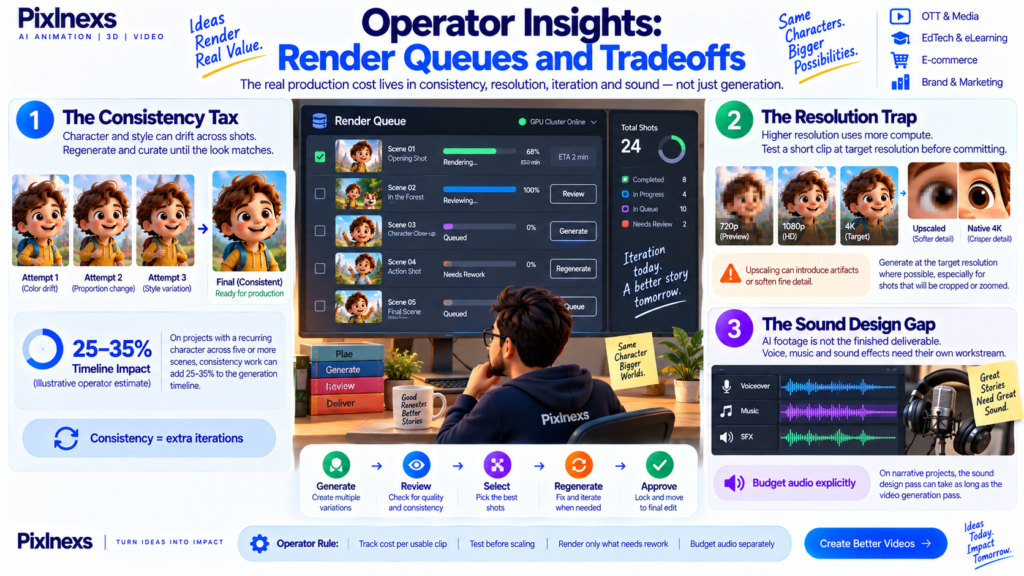
Our production team has rendered hundreds of shots and reels for OTT, EdTech and e-commerce clients and the practical lesson is that the “cost” of AI animation is not just the invoice it is the tradeoffs made inside the render queue itself.
The Consistency Tax
One of the biggest challenges in AI animation is holding character and style consistency across shots. In our render queue, we regularly see a brand mascot or lead character drift slightly in color palette or proportion from one generated scene to the next. When that happens, the fix is to regenerate the affected scenes multiple times and manually select the frames where the character looks most consistent. We think of this as a “consistency tax,” and on projects with a recurring character across five or more scenes, it can add roughly 25–35% to the generation timeline a real number worth building into your schedule and budget rather than discovering it mid-project.
The Resolution Trap
Many AI video tools generate footage at a lower default resolution. Upscaling to 4K afterward is possible, but it can introduce its own artifacts or soften fine detail. In our experience, generating at the target resolution from the start is usually more reliable than upscaling later, particularly for shots that will be cropped or zoomed. The tradeoff is that higher-resolution generation consumes more compute per shot, which raises the per-scene cost. We generally recommend testing a short clip at the target resolution before committing the full budget to a longer piece.
The Sound Design Gap
AI video tools rarely ship with usable sound. This is one of the most common budgeting blind spots we see from new clients. A silent video, however visually polished, is not a finished deliverable. Sound design, music and voiceover are a separate workstream with their own timeline and cost. On more than one narrative project in our queue, the sound design pass has taken as long as the video generation pass itself. Always carry an explicit line item for audio in your budget rather than assuming it is bundled in.
Ready to scope your AI animated video project?
Pixlnexs builds AI-native animation workflows that balance cost, speed and quality. Share your brief and we’ll place it on the framework above with a defensible range.
Start Your Project With PixlnexsBudgeting for Localization and Multi-Language Delivery
If your AI animated video needs to reach more than one market, localization is worth budgeting for separately rather than treating it as an afterthought. At minimum, a localized version needs: a translated and culturally reviewed script, a new voiceover track per language (AI-generated or human) and for lip-synced content a resync pass so mouth movement still reads naturally against the new audio. Studios typically price each additional language as a percentage of the base voiceover and QA cost rather than a flat fee, since review time scales with how many languages are in scope. If multi-language delivery is a recurring need rather than a one-off, it is worth asking your production partner for a volume rate up front.
Licensing and Legal Considerations
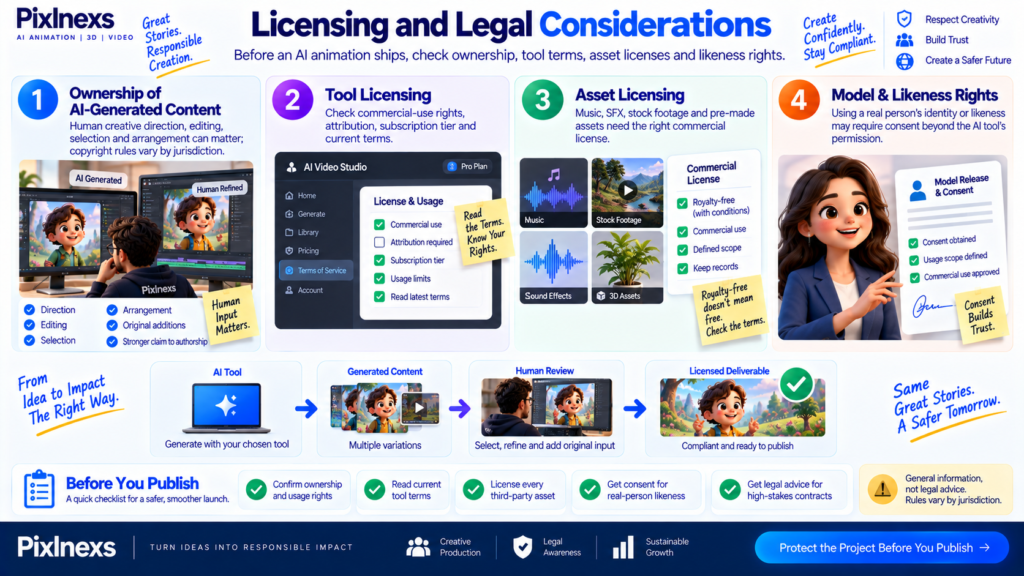
The legal landscape around AI-generated content is still evolving, so it is worth understanding the licensing terms of both the tools you use and the assets you generate before a project ships.
Ownership of AI-Generated Content
In several jurisdictions, purely AI-generated output with no meaningful human creative input may not qualify for copyright protection on its own. Projects where a human team meaningfully directs, edits, curates or adds original material to the output tend to have a stronger claim to authorship, but the specifics vary by jurisdiction and are still being tested in policy and case law for background on how computer-generated imagery and animation are typically classified from a technical standpoint, see the overview on Wikipedia’s computer animation page. We are not a law firm, so treat this section as a starting point and consult a qualified legal advisor for anything contractually significant.
Tool Licensing
Most AI video tools run on a subscription or credit-based model. Confirm what you are actually entitled to do with the generated output some tools restrict commercial use at lower tiers or require attribution. Always read the current terms of service before relying on them for a client-facing deliverable.
Asset Licensing
If you use pre-made assets music, sound effects, stock footage confirm you hold the correct license for commercial use. “Royalty-free” does not mean free; it typically means a one-time payment that then allows repeated use under specific conditions.
Model and Likeness Rights
If an AI animated video is meant to represent a real person a founder, an instructor, a spokesperson a separate consent and likeness question applies on top of the tool’s own terms of service. Even when a platform technically allows generating a stylized human figure, using it to represent a specific real individual without their permission can create legal exposure independent of anything the AI tool’s license covers. This is worth flagging to a client early, since it is a common gap between what a tool permits and what is actually safe to publish.
Worked Example: Budgeting a 90-Second Product Launch Video
To make the framework concrete, walk through a realistic brief: a 90-second product launch video for a direct-to-consumer brand, featuring one recurring animated mascot, three scene changes, a professional human voiceover in English and two revision rounds.
Scoring this against the Pixlnexs Cost Driver Framework above:
| Factor | Score | Reasoning |
|---|---|---|
| Character count & detail | 2 | One mascot, moderate detail |
| Motion intensity | 2 | Some product interaction, not full action |
| Scene count | 2 | Three scenes with transitions |
| Voice & language | 2 | Single-language human voiceover |
| Revision tolerance | 2 | Two revision rounds |
| Total | 10 | Falls in the $2,000–$8,000 illustrative band |
At the lower end of that band, expect a leaner package: AI-generated backgrounds, a simpler mascot rig and stock music. At the upper end, expect a dedicated creative director, custom sound design and a tighter consistency pass on the mascot across all three scenes. The gap between $2,500 and $7,500 for what looks like “the same” 90-second video is almost always explained by exactly these line items rather than by one studio simply charging more for the same work.
This is also where the “consistency tax” described earlier shows up most visibly: a recurring mascot across three scenes is precisely the scenario where a studio needs to budget extra generation and review time, so a quote that looks high relative to a single-scene video of the same length is often pricing in real, necessary rework rather than padding the margin.
Which Businesses Typically Need Which Tier
- Early-stage startups and solo creators most often land in the $500–$2,000 tier short social clips, simple explainer loops and single-character content where speed matters more than narrative depth.
- Growing D2C brands and SaaS companies most often land in the $2,000–$8,000 tier product explainers, onboarding sequences and campaign assets that need a consistent brand character but not a full narrative arc.
- EdTech platforms, agencies and enterprise marketing teams most often land in the $8,000+ tier, particularly once multi-language localization, curriculum alignment, or a recurring cast of characters across a season of content enters the scope.
How to Get an Accurate Quote
Because AI animated video cost depends so heavily on scope rather than simple duration, the fastest way to get a real number is to bring a production partner a tight brief rather than a vague one. At minimum, share: target duration, visual style reference, number of recurring characters, target languages and how many revision rounds you expect to need. That is enough for most studios, including ours, to place your project on the framework above and give you a defensible range rather than a guess.
It also helps to say upfront whether this is a one-off video or the first of an ongoing series. A studio pricing a single 60-second explainer will quote differently than one pricing the same explainer knowing it is episode one of twenty, because character models, style guides and voice profiles built in the first episode get reused and typically discounted across the rest of the series.
Frequently Asked Questions
How long does it take to produce an AI animated video?
Timeline depends heavily on project complexity. A simple 30-second social clip can often be produced in 3–5 days, while a complex 2-minute brand narrative may take 2–4 weeks. The main time sinks are usually character consistency work, post-production cleanup and sound design rather than the initial generation step.
Can I use AI animated videos for commercial purposes?
In most cases yes, but you need to check the licensing terms of the specific AI tool and any stock assets involved. Some tools restrict commercial use to paid tiers or require attribution. Always confirm you have the right to use the generated content for your intended purpose before publishing.
What is the difference between AI animation and traditional animation?
AI animation uses generative models to produce video frames from text or image prompts, with a human team curating and assembling the results. Traditional animation is built manually by animators, frame by frame or rig by rig. AI animation is generally faster and less labor-intensive per shot, while traditional animation typically offers more precise, repeatable control over exact movement and expression.
How much does it cost to animate a 1-minute video?
As an illustrative range, a 1-minute AI animated video for a standard commercial project typically falls between $2,000 and $5,000, covering scripting, generation, editing, sound design and a defined number of revision rounds. Actual pricing depends on style, character count and language requirements.
Do I need to be an expert to use AI animation tools?
No, but a working understanding of visual storytelling and prompt writing helps significantly. You do not need to code, but comfort with creative direction, shot selection and basic editing will get you meaningfully better results. Many tools are approachable for beginners, though consistently high-quality output usually still benefits from an experienced operator.
What are the main limitations of AI animation today?
The most common limitations are character and style consistency across shots, limited fine-grained control over specific movements or expressions and occasional visual artifacts that need manual correction. These are workflow challenges more than dealbreakers, but they are exactly why human curation remains part of a professional pipeline rather than optional.
Is AI animation cheaper than traditional animation?
Generally, yes AI-assisted workflows are typically positioned as less expensive than fully manual, frame-by-frame 2D or 3D animation for comparable scope, mainly because fewer labor hours are needed per shot. That said, AI animation usually costs more than simple static motion graphics and a highly complex AI project with heavy revisions can still approach traditional-animation pricing. For a fuller side-by-side, see u003ca href=u0022https://blog.pixlnexs.com/ai-animation-vs-traditional-studio-animation/u0022u003eAI Animation vs Traditional Studio Animationu003c/au003e.
Does the cost change if I need the video in multiple languages?
Yes. Each additional language typically adds a voiceover and QA pass and lip-synced content adds a resync step on top of that. Budgeting for localization as a separate line item, rather than assuming it is included, avoids surprises late in a project.
Should I ask for a fixed quote or a rate card?
For a single, well-defined video, a fixed quote scoped against a clear brief is usually easier to budget against than an hourly or credit-based rate card, since it forces both sides to agree on revision limits and deliverables upfront. For an ongoing series where scope will evolve episode to episode, a rate card or retainer tends to work better, since it avoids re-negotiating a fixed quote every time a new episode’s requirements shift slightly from the last one.
Ready to Start Your AI Animated Video?
The cost of an AI animated video is less a single number than a reflection of the creative and technical choices behind it style, length, character complexity, revisions and localization all move the final quote. Understanding those drivers and scoring your own brief against the framework above, puts you in a much stronger position when you sit down with a production partner.
At Pixlnexs, our production team builds AI-native animation workflows that balance cost, speed and quality for brands, EdTech platforms and children’s content channels. If you have a project in mind, we can help you scope it accurately before you commit budget.
Start your AI animated video project with Pixlnexs
Read more
How to Create AI Videos for YouTube Kids Rhymes
AI Video vs Traditional Video Production: Cost, Speed and Quality Compared
How Much Does AI Video Generation Cost in 2026? (Pricing Breakdown)







Leave a Reply