
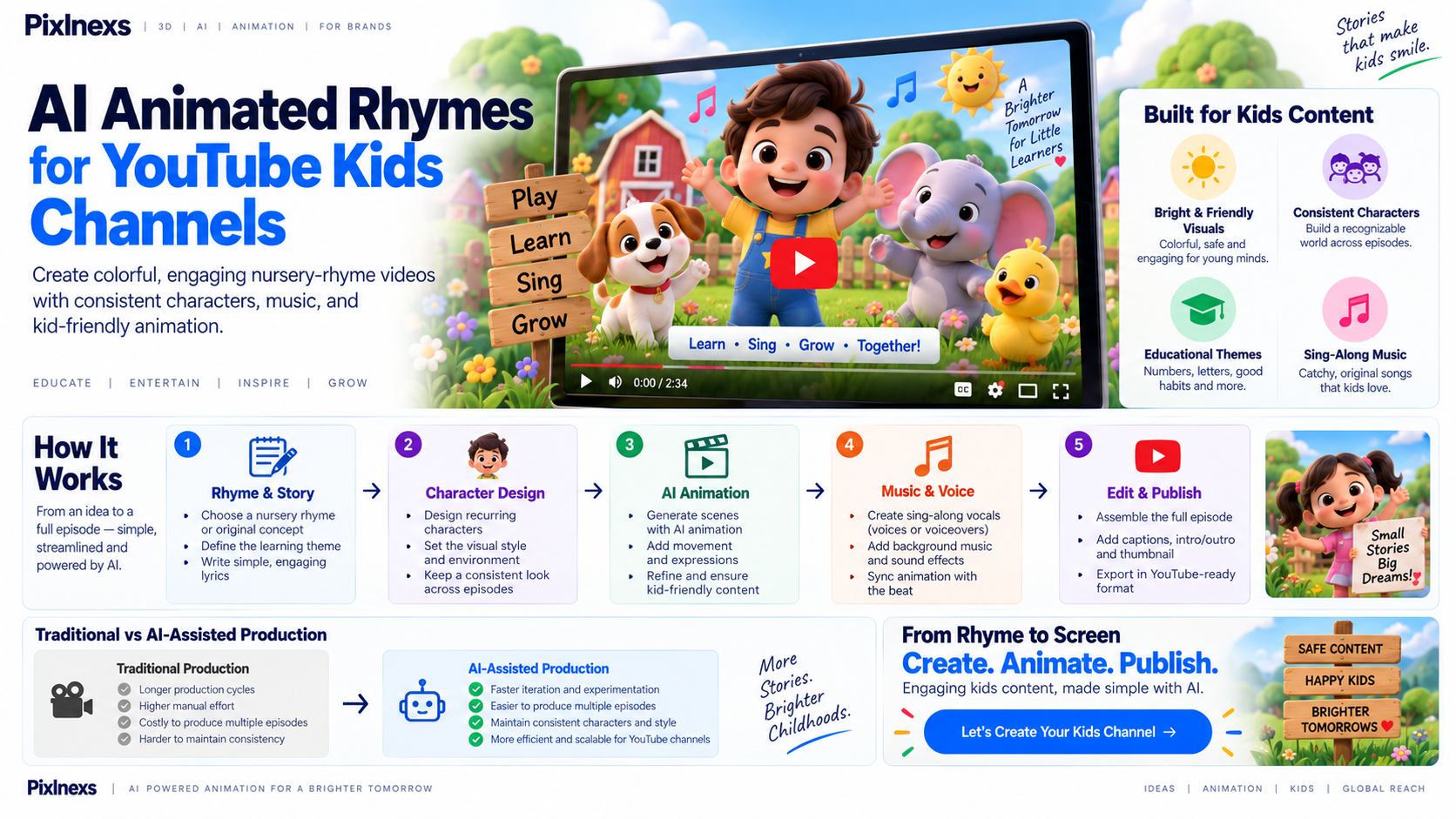
Quick answer: AI animated rhymes for YouTube are short-form videos where AI tools generate character movement, lip-sync and background visuals to match nursery-rhyme audio, letting a small team produce high-volume, visually consistent episodes without a full traditional 2D or 3D studio. The main benefit is speed and cost, which supports the frequent upload cadence that growing kids’ channels typically need. Success still depends on strict adherence to YouTube’s child-safety and “Made for Kids” policies and on real human quality control AI output is a draft, not a finished, publishable episode on its own.
We have spent real production time refining render pipelines for children’s media across OTT and e-commerce platforms. What we have learned is that the “AI” part is only half the job the other half is the operational discipline needed to keep a channel’s cadence going once an audience starts expecting new episodes on a schedule. This guide breaks down the actual production workflow, the realistic cost trade-off and the specific technical hurdles that show up once you move from one pilot episode to a series of fifty.
Key Takeaways
- Speed changes the strategy: AI-assisted production can compress a one-minute rhyme from a multi-week traditional schedule to a matter of hours, which makes iteration and A/B testing of formats realistic in a way it never was with fully manual animation.
- Consistency is the real challenge: Character drift, lip-sync errors and flickering backgrounds are the most common quality issues and they are exactly what young viewers notice first.
- Human QC is non-negotiable: Every AI-generated draft needs a review pass before it ships treating raw AI output as a finished episode is the single most common reason new channels stall.
- Cadence matters as much as quality: A defined upload framework, not just good individual episodes, is what tends to build watch-time momentum on a new channel.
- Compliance is not optional: “Made for Kids” designation and general content-safety guidelines apply regardless of how the animation was produced.
AI Animated Rhymes for Youtube Kids channel
AI animation is particularly useful for children’s YouTube channels because the same characters, environments and visual styles can be reused across multiple episodes.
For example, a channel could create a recurring cartoon character and use it across:
- Nursery rhymes
- Educational songs
- Bedtime stories
- Alphabet videos
- Number-learning videos
- Animal stories
- Short animated lessons
- Kids’ entertainment videos
The biggest challenge is consistency. AI-generated characters can sometimes change appearance between scenes, while backgrounds may vary in lighting, perspective or design.
A better approach is to create a reference library before producing a complete series. This can include character turnarounds, expressions, poses, backgrounds and reusable prompts. Your existing workflow emphasizes locking character references early and reusing them throughout the series.
AI Nursery Rhyme and Kids Rhyme Videos
Nursery rhymes are one of the most suitable formats for experimenting with AI-generated animation because the content often uses repetitive lyrics, recurring characters and simple visual sequences.
A typical AI nursery rhyme video follows this flow: Rhyme script → Voiceover → Character → Animation → Background → Music → Sound effects → Final video. The stage-by-stage breakdown below covers how each of these actually gets produced.
The Operator’s View: Why AI Changes the Math
Traditional animation for a one-minute nursery-rhyme episode has typically required a small team of animators, a director and a composer, often across a four-to-six-week schedule per episode. For a new YouTube channel trying to build an audience, that timeline is a serious handicap it is difficult to build momentum against established, well-resourced kids’ channels if you can only release one video a month.
AI-assisted animation tooling has compressed that timeline substantially. With the right stack, a single skilled operator can move a polished, one-minute animated rhyme from script to final render in a matter of hours rather than weeks the result of specialized models trained on character rigging, lip-syncing and background generation.
There is a catch, though. Raw AI output is rarely broadcast-ready on the first pass. It is a draft sometimes a rough one. The value a creator adds is in curation, editing and quality control on top of that draft. We have seen channels stumble because they treated AI output as a finished product and published episodes with flickering textures, broken lip-sync or unnatural character movement. Children are, in our experience, unusually sensitive to this kind of visual inconsistency far more so than most adult audiences.
The practical takeaway: AI does not replace the animator’s judgment. It replaces a large share of the manual labor. You still need a trained eye for timing, rhythm and what makes a visual beat land for a young audience. The tool supplies the frames; a human still supplies the judgment about which frames are actually good.
The Economic Shift
Cost structure shifts significantly with AI-assisted production, though exact figures vary widely by tool, region and provider, so treat the following as illustrative rather than fixed. A freelance traditional 2D animator is typically paid per finished minute at a rate that reflects the many hours of manual frame work involved. An AI-assisted stack instead runs mostly on software subscription costs, which is a materially different cost structure subscription tiers rather than per-minute labor rates.
Cost is not the only variable that changes, though. Speed does too. If a team can produce several draft episodes in the time a traditional pipeline would need for one, they can test different visual styles, characters and themes against real audience response and double down on what performs, rather than committing months of production to a single unproven concept. This same logic applies broadly to AI-assisted short-form production for e-commerce and brand social content, where the goal is rarely a single polished asset but rather enough iterations to find a format that resonates.
The Production Pipeline: From Audio to Final Render
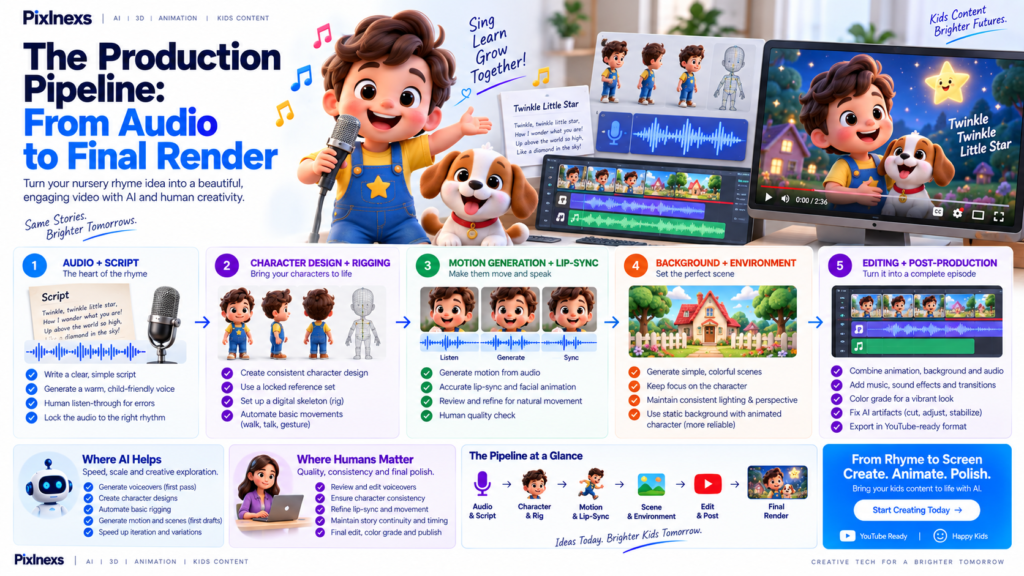
Many new creators assume a prompt alone produces a finished video. In practice, the pipeline runs through several distinct stages, each with its own failure points.
Stage 1: Audio and Script
The foundation of any rhyme is the audio track. A clear, engaging script and a warm, clearly paced voiceover matter more than the visuals in terms of holding a young child’s attention too fast and children lose the thread, too slow and they disengage.
AI voice generation tools can produce a strong first-pass voiceover but every second still needs a human listen-through, since AI voices can mispronounce words or insert unnatural pauses that need editing before the track is locked against the rhyme’s rhythm.The script itself should stay simple: nursery rhymes work because they are repetitive and predictable, and children specifically enjoy anticipating and participating in the next line rather than being surprised by clever wordplay.
Stage 2: Character Design and Rigging
This is where AI-assisted tooling is strongest. Image generation tools can produce a main character design quickly but the real challenge is consistency the same character needs to look like itself in every single frame or young viewers notice immediately.
The practical fix is a locked reference set: generate one high-quality character turnaround from multiple angles early and use it as the anchor reference for every subsequent generation rather than regenerating the character fresh each time. Once a character design is locked, it needs a basic rig a digital skeleton enabling motion which AI tooling can now largely automate for basic movements like walking, talking and gesturing, though more complex movement such as dancing or jumping often still needs manual rig adjustment.
Stage 3: Motion Generation and Lip-Sync
This is the heart of the process: audio and the rigged character feed into an AI video generation tool, which analyzes the audio and generates matching movement and lip-sync. Quality varies substantially between tools some produce smooth, natural motion, others noticeably robotic or jerky animation.
Lip-sync accuracy matters especially for children’s content. A mismatched mouth and audio breaks immersion quickly and young viewers are, in our experience, particularly attuned to this specific kind of error even when they can’t articulate why a video feels “off.”
Stage 4: Background and Environment
Backgrounds should stay simple and colorful and should not compete with the character for attention. AI tools can generate a scene from a text prompt but backgrounds can drift in lighting or perspective across a generation run. Generating a static background and animating the character in front of it is often a more reliable approach than generating a fully animated, moving background from scratch.
Stage 5: Editing and Post-Production
This is where a rough AI draft becomes a finished episode: combining character animation, background and audio; adding sound effects, music and transitions; color grading for a vibrant, appealing look; and fixing the AI’s mistakes directly cutting around a frame where a hand disappears, nudging lip-sync timing or stabilizing a flickering background.
Operator Commentary: The Render Pipeline Reality
In our studio, a custom pipeline automates much of this sequence a script triggers AI video generation once final audio is locked and a review pass flags frames where a character’s face distorts or lip-sync error exceeds an acceptable threshold. This automation saves real hours but it is not a “set it and forget it” system. It requires real technical fluency: understanding how the underlying models behave, knowing which parameters to adjust for better results and being able to troubleshoot when a step in the pipeline breaks, which it periodically does as tools update.
We have also found that a stack of specialized tools one for character generation, a separate one for motion, a separate editor for finishing consistently outperforms trying to force a single all-in-one tool to handle the entire pipeline. Specialization at each stage is what keeps quality consistent across a long series.
Production Models Compared
There are three broad production models for an AI animated rhymes channel: fully manual, hybrid and fully AI-driven. The table below compares them on cost, speed and fit with audience retention. Cost figures are illustrative planning bands, not fixed quotes.
| Feature | Fully Manual (Traditional) | Hybrid (AI-Assisted) | Fully AI (Automated) |
|---|---|---|---|
| Illustrative cost per minute | Highest | Moderate | Lowest |
| Time per episode | Weeks | Days | Hours |
| Visual consistency | High | High | Variable, needs QC |
| Creative control | High | High | Lower |
| Scalability | Low | Moderate | High |
| Retention fit | Strong for niche, high-polish content | Strong for an ongoing series | Workable for high-volume, budget-constrained testing |
| Skill requirement | High (full animation team) | Moderate (editor plus AI operator) | Lower but QC still essential |
| Error risk | Low | Low | Higher without a strict review step |
Fully Manual
The traditional approach: animators create every frame by hand, producing high-quality, consistent animation but slowly and at higher cost. This model tends to suit established channels with a bigger budget and a dedicated team; it is a difficult starting point for a brand-new channel.
Hybrid
This is the sweet spot for most creators we work with. AI tooling generates the base animation and a skilled editor manually adjusts keyframes, fixes errors and adds polish combining AI speed with closer-to-manual quality. It requires an editor comfortable with both classical animation judgment and AI tooling specifics.
Fully AI
The most cost-effective approach, relying almost entirely on AI generation with minimal manual adjustment. This is fast and cheap but carries real quality risk inconsistent character appearance, odd lip-sync or motion artifacts are more likely to slip through without a strict review gate. This model tends to suit early concept testing rather than a channel’s flagship content.
Our general recommendation is to start hybrid: let AI carry the speed but keep a human firmly in the review loop. As a team’s pipeline matures, more of the process can be automated but the human quality-control step should never disappear entirely it remains the most reliable check available.
Navigating Child-Safety Policies
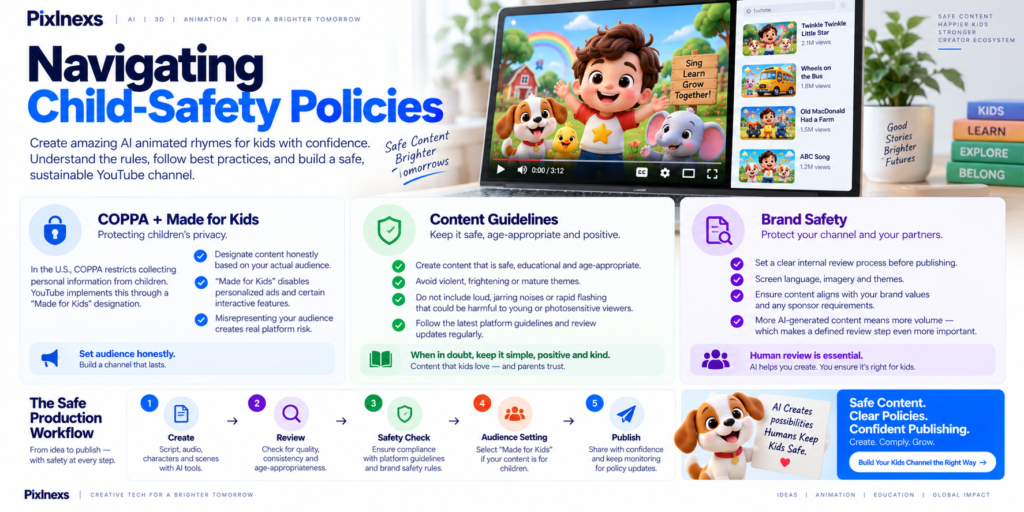
Content aimed at children carries specific platform obligations regardless of how it was animated and these are worth understanding before a channel launches rather than after a strike.
COPPA and “Made for Kids”
In the United States, the Children’s Online Privacy Protection Act (COPPA) restricts collecting personal information from children without parental consent. YouTube implements this through a “Made for Kids” designation, which disables personalized ads and certain interactive features on flagged videos. Creators need to designate content honestly based on its actual intended audience, rather than trying to avoid the designation to preserve ad revenue misrepresenting a channel’s audience creates real platform risk. For general background on how nursery rhymes function as a category of children’s media, the Wikipedia entry on nursery rhymes is a useful starting reference.
Content Guidelines
Platform content guidelines for children’s content generally require the material to be safe, age-appropriate and free of violent or frightening imagery, loud jarring noises or rapid flashing that could be harmful to young or photosensitive viewers. These guidelines are updated periodically, so a channel operating in this space should review the platform’s current published policy directly rather than relying on general secondhand summaries, including this one.
Brand Safety
For any channel working with sponsors, a clear internal brand-safety policy screening language, imagery and themes before publishing protects both the channel and the sponsoring brand. This matters more, not less, once AI-assisted production increases upload volume, since more content moving through the pipeline means more surface area for something inappropriate to slip through without a defined review step.
The Upload Cadence Framework
Consistency is a major factor in how a new channel builds an audience. Platforms generally favor channels that publish on a predictable schedule but the right cadence for a children’s rhymes channel is not one-size-fits-all.
The 3-2-1 Cadence Model
A workable starting framework for a growing rhymes channel is a 3-2-1 weekly mix: three short videos (under five minutes), two medium videos (five to ten minutes) and one longer compilation (ten-plus minutes) per week.
- Short videos function as “snack” content quick, easy episodes that keep young viewers engaged between larger releases.
- Medium videos are the core series content full rhyme episodes that give a viewer a specific reason to subscribe and return.
- Long-form compilations work well for background viewing during car rides or bedtime routines, bundling previously released episodes into one longer session.
This mix gives a channel a range of content shapes that fit different viewing occasions, rather than betting everything on one format. It is worth treating this 3-2-1 split as a starting template rather than a fixed rule a channel with a strong compilation format performing particularly well might reasonably shift toward two compilations a month instead of one, while a channel still finding its core series identity might deliberately skip long-form compilations altogether until it has enough strong individual episodes to justify bundling them.
Why Cadence Compounds Over Time
The value of a consistent cadence is not just about any single week’s upload it is about the compounding effect of a predictable release pattern on subscriber habit formation. A channel that publishes reliably on the same days each week gives returning viewers and the parents managing what their children watch, a reason to expect new content and check back, which tends to build a stronger long-run audience than sporadic bursts of high-volume uploads followed by long gaps.
This is one of the more counter-intuitive lessons from working across multiple children’s content pipelines: a slightly lower but perfectly consistent cadence generally outperforms an inconsistent higher-volume one over a multi-month horizon, because the inconsistency itself trains viewers not to expect new episodes on any particular schedule.
The Role of Compilations
Compilations let a channel repackage its best-performing individual episodes into a single longer video without producing new animation from scratch. A reasonable cadence is one new compilation per month, built from the strongest episodes released since the last compilation a low-cost way to add a new piece of content to promote without a full new production cycle.
Scheduling and the Limits of Automation
Scheduling tools can queue uploads for consistent release timing and automation can help generate draft thumbnails, titles and descriptions. It is still worth reviewing every episode manually before it goes live checking quality, factual and stylistic consistency and policy compliance rather than treating the entire publishing step as something that can run unattended.
Worked Example: Launching a New Rhymes Channel
Consider an illustrative scenario: a small studio wants to launch a new rhymes channel from zero, aiming for the 3-2-1 weekly cadence above, using a hybrid production model.
In the first month, the priority is building the reusable foundation rather than maximizing episode count: locking two to three main character designs with full reference turnarounds, establishing a consistent background art style and building the reusable rig and prompt templates the rest of the series will draw on. Output in month one is deliberately lower than the target cadence perhaps four to six episodes total because this setup work is what makes months two and three faster rather than slower.
By month two, with characters and templates locked, the team can typically approach the full 3-2-1 weekly cadence, since new episodes are now variations on an established pipeline rather than fresh creative decisions each time. This is the same “reuse discount” pattern seen in any AI-assisted animated series: the first few episodes cost more time proportionally than the fifteenth, because the fifteenth reuses assets the first several episodes had to build from nothing.
The channels we have seen struggle most are the ones that skip month one’s setup work entirely and try to hit full cadence immediately inconsistent early episodes are harder and more expensive to fix retroactively than they would have been to prevent with a short setup phase up front.
Ready to build your rhymes channel’s production pipeline?
Pixlnexs builds AI-assisted rhyme and children’s-content pipelines end to end character design, upload cadence, and human quality control included.
Start your project with PixlnexsStaffing and Tooling for a Rhymes Channel at Scale
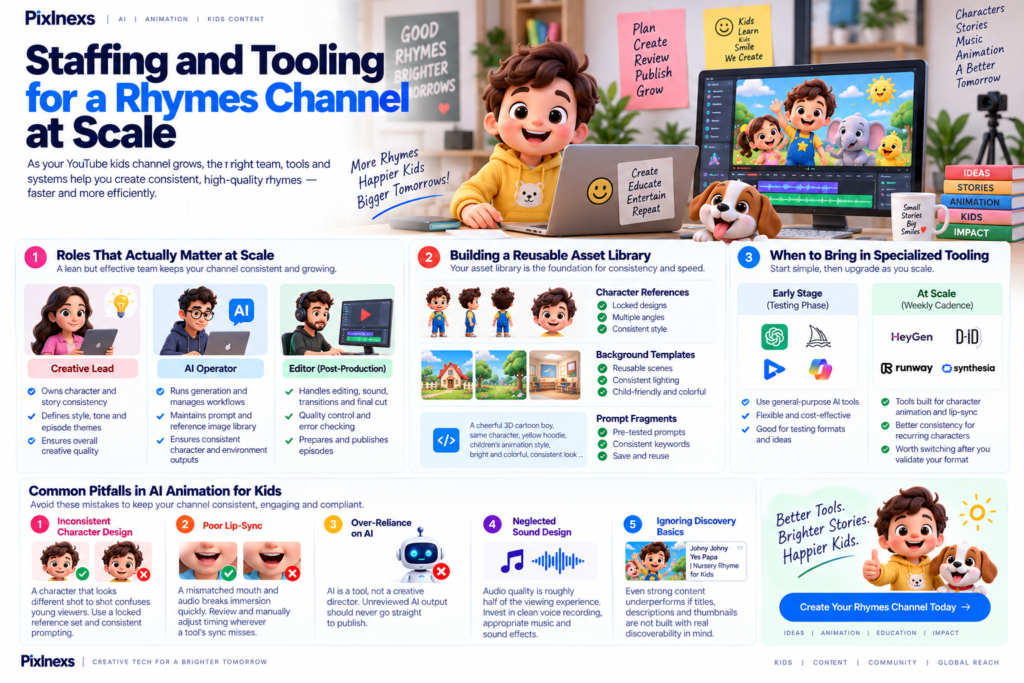
Once a channel moves past a handful of pilot episodes toward an ongoing weekly cadence, staffing and tooling decisions start to matter as much as any individual episode’s quality.
Roles That Actually Matter at Scale
A lean but sustainable hybrid production team for a weekly-cadence rhymes channel typically includes a creative lead who owns character and story consistency across the series, an AI operator who runs generation and manages the prompt-and-reference-image library and an editor who handles finishing, quality control and the final publish-ready cut. Trying to run all three roles as one person is possible at very small scale but it tends to become the bottleneck the moment a channel’s cadence increases, since QC quality is the first thing that slips when one person is stretched across generation, editing and review simultaneously.
Building a Reusable Asset Library
The single highest-leverage investment early in a series is a well-organized library of locked character references, background style templates and reusable prompt fragments. Every episode after the first several should be pulling from this library rather than generating fresh character or environment references from scratch this is both a consistency safeguard and a significant time saver, since regenerating a character’s look from a text prompt on every single episode is one of the more common (and avoidable) sources of visual drift across a series.
When to Bring in Specialized Tooling
Generic, general-purpose AI video tools can work for early testing but a channel producing episodes on a genuine weekly cadence usually benefits from tooling built specifically for character animation and lip-sync, since general-purpose tools more often struggle with the specific consistency demands of a recurring-character series. The switch is usually worth making once a channel has validated that a format works and is committing to it long-term, rather than before that validation, when the flexibility of general-purpose tools is more valuable than the consistency of specialized ones.
Common Pitfalls in AI Animation for Kids
- Inconsistent character design the most common failure. A character that looks different shot to shot confuses young viewers; a locked reference set and consistent prompting largely prevent this.
- Poor lip-sync a mismatched mouth and audio breaks immersion quickly; review and manually adjust timing wherever a tool’s automatic sync misses.
- Over-reliance on AI AI is a tool, not a creative director; unreviewed AI output should never go straight to publish.
- Neglected sound design audio quality is roughly half of the viewing experience; invest in clean voice recording, appropriate music and sound effects, not just visuals.
- Ignoring on-platform discovery basics even strong content underperforms if titles, descriptions and thumbnails are not built with real discoverability in mind.
Frequently Asked Questions
Can I use AI-generated music for my YouTube Kids channel?
Generally yes but confirm the specific tool’s commercial licensing terms before publishing some AI music generators include a commercial-use license, others do not and terms vary and can change. If you are unsure about a specific tool’s terms, a royalty-free library with clear commercial licensing is the lower-risk option.
How long should AI animated rhymes be?
Shorter individual episodes tend to work better for younger attention spans a common range is three to five minutes per episode, long enough to tell a complete rhyme but short enough to hold attention throughout. Longer compilation videos, bundling several shorter episodes together, work well for background or bedtime viewing.
Do AI animation tools work as well for 3D as for 2D characters?
Currently, 2D character animation tooling is generally more mature and easier to control consistently than 3D. If a team is new to AI-assisted animation, starting with a 2D pipeline is usually the more reliable path, with 3D as a later step once the basics of consistency and quality control are established.
How do I maintain character consistency across a long series?
Lock a reference image set for each character early multiple angles, generated once and use that same reference for every subsequent generation rather than regenerating the character from a text prompt each time. A consistent, detailed prompt template for each character, combined with the reference set, is what keeps a series visually coherent across dozens of episodes.
Is AI-generated animation allowed on YouTube for children’s content?
Yes, AI-assisted animation is permitted but the same platform policies apply regardless of production method content-safety guidelines, the u0022Made for Kidsu0022 designation and any platform disclosure requirements for AI-generated or AI-assisted content should be reviewed directly from the platform’s current published policy before a channel launches.
What is the biggest technical risk in an AI-assisted rhymes pipeline?
Visual inconsistency character drift, lip-sync mismatch or background flicker is the most common technical risk and it is also what young viewers notice fastest. A dedicated human review step before publishing, checking specifically for these issues, is the most effective mitigation available.
How much does an AI animated rhymes series cost compared to a single explainer video?
The underlying cost drivers are similar to any AI animated video project character complexity, episode length and revision volume but a rhymes series adds a cadence dimension: cost per episode should generally fall after the first several episodes as character models and templates get reused. For a full breakdown of the underlying cost drivers, see our guide on u003ca href=u0022https://blog.pixlnexs.com/ai-animated-video-cost/u0022u003eAI animated video costu003c/au003e.
Should a new channel start with a fully AI-driven model or a hybrid model?
A hybrid model is generally the safer starting point, since it keeps a human review step in the loop while still capturing most of the speed benefit of AI-assisted generation. A fully AI-driven approach without review is a higher-risk choice for anything published to a real audience, though it can be reasonable for private, early-stage concept testing before a channel launch. For more on choosing between production approaches generally, see our comparison of u003ca href=u0022https://blog.pixlnexs.com/ai-animation-vs-traditional-animation/u0022 data-type=u0022linku0022 data-id=u0022https://blog.pixlnexs.com/ai-animation-vs-traditional-animation/u0022u003eAI animation vs traditional studio animationu003c/au003e.
How do I know if my rhymes channel is ready to move from a fully AI-driven test phase to a hybrid production model?
A reasonable signal is early audience response to a small batch of low-cost, fully AI-generated test episodes if a specific character or format is clearly resonating relative to your other tests, that is generally the point to invest in a locked reference library and move the winning format into a hybrid pipeline with a dedicated review step. Committing to hybrid production before any format has shown real audience traction usually means over-investing in polish for content that may not end up being what the channel builds around long-term.
Ready to Start Your AI Animated Video?
AI animated rhymes for YouTube work best when treated as a real production pipeline locked characters, a defined upload cadence and a genuine human review step rather than a shortcut that skips craft entirely. The channels that succeed are usually the ones that use AI to compress labor, not judgment and that invest in the reusable asset library and cadence discipline described above before scaling upload volume.
At Pixlnexs, our production team builds AI-assisted rhyme and children’s-content pipelines end to end, from character design through a sustainable upload cadence, so a new or growing channel does not have to figure out the render pipeline, the review process and the publishing schedule all at once.



Leave a Reply