
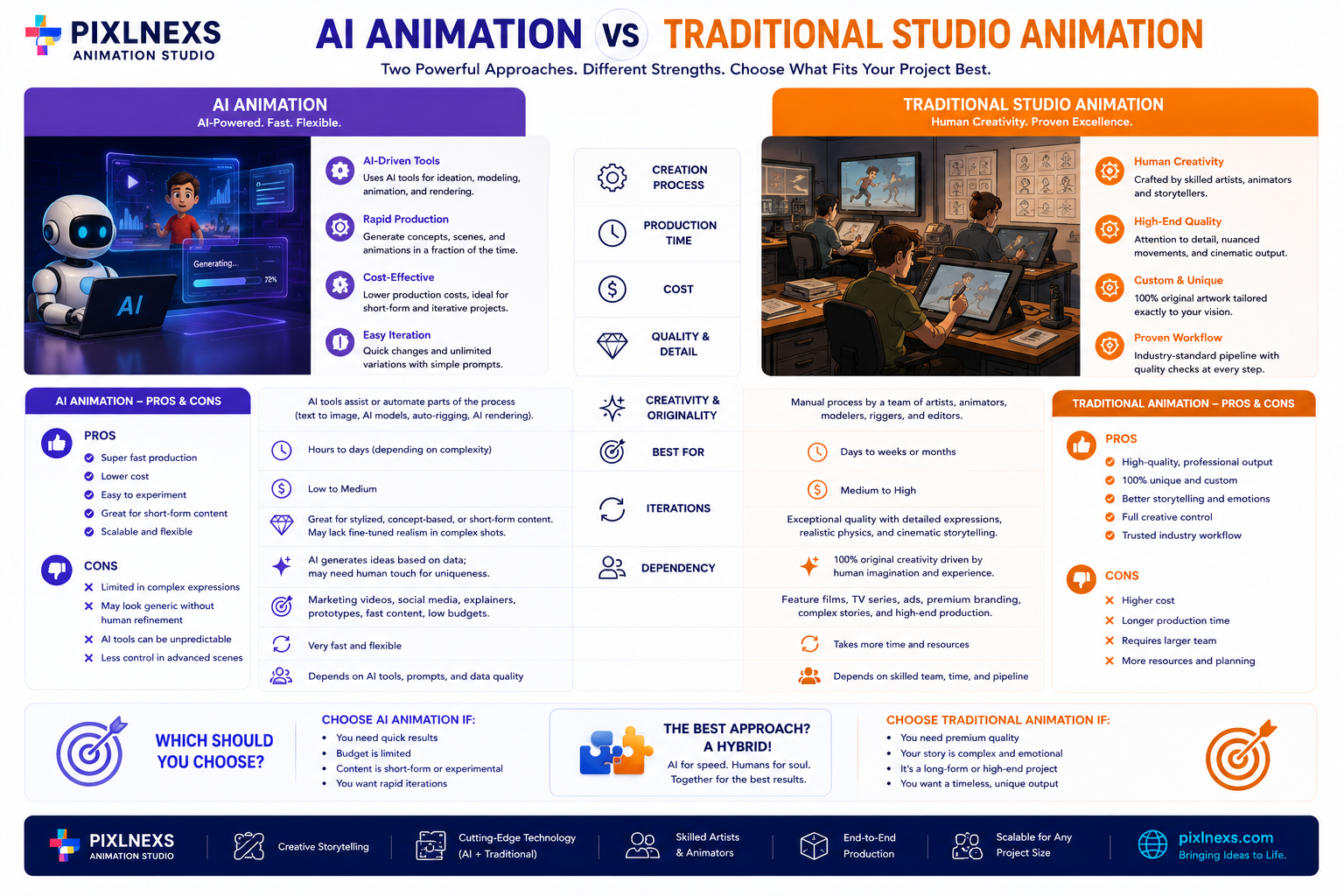
Quick answer: In the Ai Animation vs Traditional animation decision, AI animation uses generative models to produce or assist visual sequences from prompts, offering rapid iteration and low per-unit cost for concepting, variations and social content. Traditional studio animation relies on human keyframe drawing, 3D modeling and rigging, giving precise artistic control, reliable character consistency and broadcast-grade quality. For most brands the right answer is not either/or but which parts of a pipeline each approach should own AI for volume and speed, traditional craft for hero deliverables and long-running character consistency.
By Bali Balaji, the Pixlnexs Studio Team
Pixlnexs builds AI animated video production for brands, EdTech platforms and children’s content channels worldwide and our production team runs both AI-native and traditional pipelines side by side depending on what a project actually needs.
In our work with OTT platforms, EdTech clients and e-commerce brands, we see a clear split in how teams approach motion content. Some need a hundred product variants generated overnight; others need a single, polished 30-second spot that defines their brand’s visual language for years. Understanding ai animation vs traditional animation is no longer a purely technical debate it is a strategic decision that shapes budget, timeline and how the finished piece is perceived by an audience. This guide breaks down the operational realities of both pipelines so you can decide where to invest.
This guide sits under our broader coverage of AI animated video production, which covers the full range of formats and use cases beyond this specific pipeline comparison.
Key Takeaways
- Speed vs. precision: AI generally wins on speed for drafts and variations; traditional animation generally wins on precision for final, brand-critical deliverables.
- Cost structure: AI tends to reduce per-unit cost at volume; traditional animation carries higher upfront cost but more predictable scaling for complex scenes.
- Brand control: Traditional pipelines typically offer tighter control over character consistency and brand guidelines across a long series.
- Hybrid is common: Most modern studios, including ours, use AI for pre-visualization and rapid variation and traditional technique for final, hero-level rendering.
- Skill shift: Teams increasingly need a mix of prompt engineering and classical animation principles rather than either skill set alone.
The Core Difference: Process vs. Output
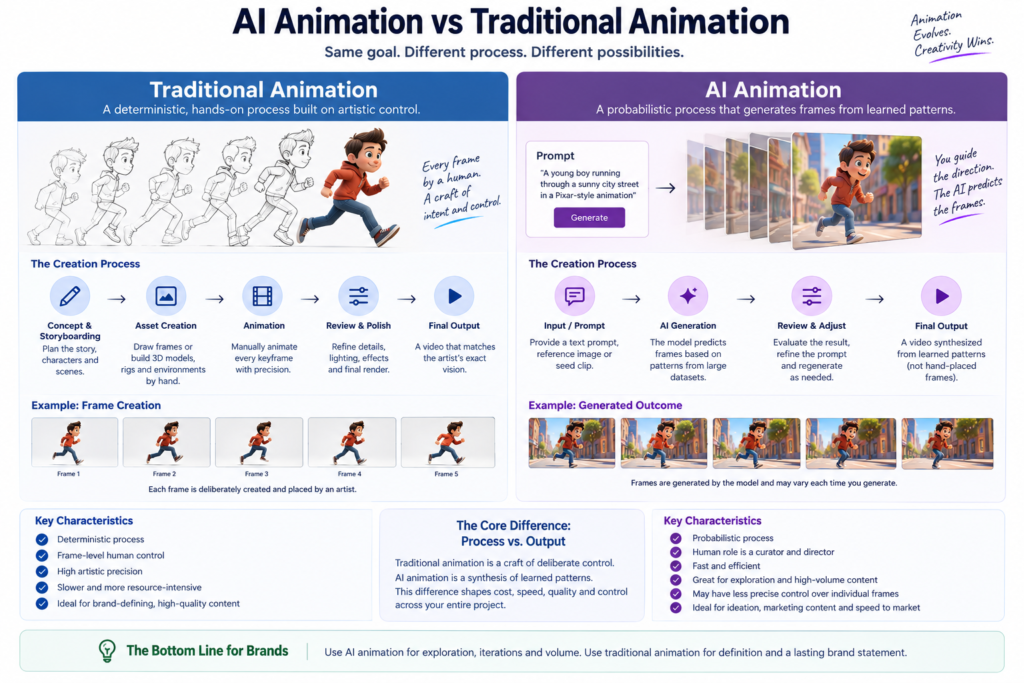
To understand ai animation vs traditional animation, look past the final video file and examine the creation process itself. Traditional animation whether 2D hand-drawn or 3D CGI is a largely deterministic process. An artist draws frame one, then frame two or a modeler builds a character and animates its rig. The output is close to exactly what the artist intended, down to individual frames. It is a craft built on deliberate, frame-level control. For a technical grounding in how the traditional and computer-assisted branches of the craft developed, see the overview on Wikipedia’s animation page.
AI animation generative video models in particular is a probabilistic process. You provide a prompt, a reference image or a seed clip and the model predicts frames based on patterns learned from large training datasets. The result is a synthesis of those patterns rather than a hand-placed frame. It is closer to directing a statistical engine than drawing. This distinction drives every other comparison point in this guide: cost, turnaround, quality and control.
For a brand, this generally means AI is a strong tool for exploration and volume, while traditional animation remains the stronger tool for definition and a lasting brand statement.
The Role of Human Intervention
In traditional pipelines, human intervention is constant and granular every keyframe is placed by a person. In AI pipelines, human intervention is iterative: generate, review, adjust the prompt, regenerate. The human role shifts from “creator” toward “curator” and “director.” This shift matters for team planning. Senior animators who value hands-on creation may find AI tooling frustrating at first. Project managers and marketers who need speed over craft may find a fully traditional pipeline too slow for their timelines.
Decision Framework: Scoring Your Project
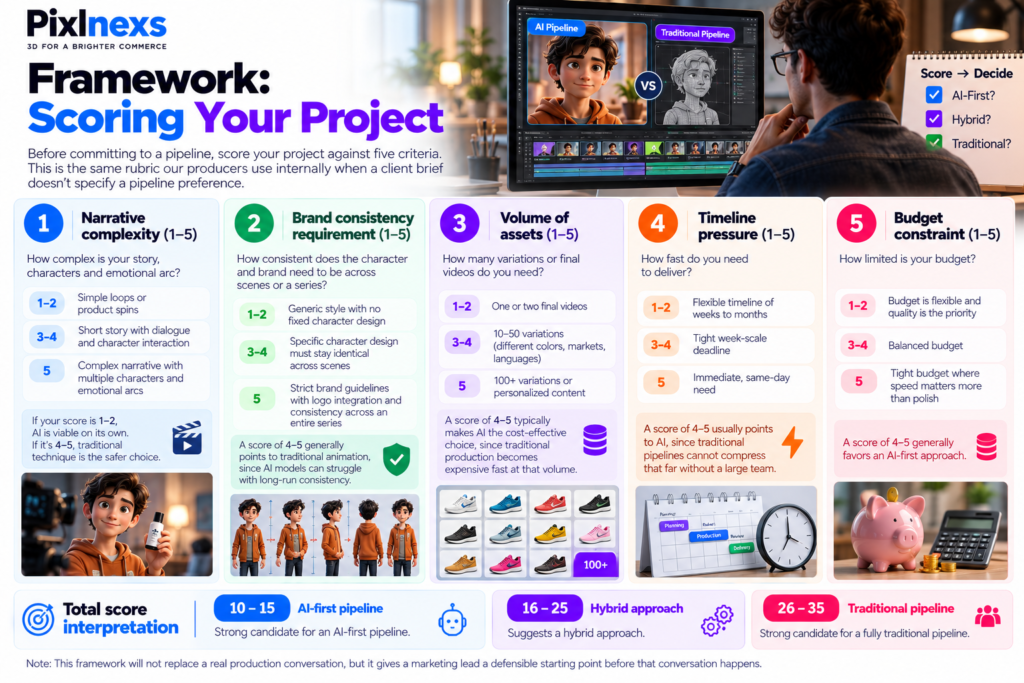
Before committing to a pipeline, score your project against five criteria. This is the same rubric our producers use internally when a client brief doesn’t specify a pipeline preference.
- Narrative complexity (1–5): 1–2 is simple loops or product spins; 3–4 is a short story with dialogue and character interaction; 5 is a complex narrative with multiple characters and emotional arcs. If your score is 1–2, AI is viable on its own. If it’s 4–5, traditional technique is the safer choice.
- Brand consistency requirement (1–5): 1–2 is a generic style with no fixed character design; 3–4 means a specific character design must stay identical across scenes; 5 is strict brand guidelines with logo integration and consistency across an entire series. A score of 4–5 generally points to traditional animation, since AI models can struggle with long-run consistency.
- Volume of assets (1–5): 1–2 is one or two final videos; 3–4 is 10–50 variations (different colors, markets, languages); 5 is 100+ variations or personalized content. A score of 4–5 typically makes AI the cost-effective choice, since traditional production becomes expensive fast at that volume.
- Timeline pressure (1–5): 1–2 is a flexible timeline of weeks to months; 3–4 is a tight week-scale deadline; 5 is an immediate, same-day need. A score of 4–5 usually points to AI, since traditional pipelines cannot compress that far without a large team.
- Budget constraint (1–5): 1–2 means budget is flexible and quality is the priority; 3–4 is a balanced budget; 5 is a tight budget where speed matters more than polish. A score of 4–5 generally favors an AI-first approach.
Total score interpretation: 10–15 suggests a strong candidate for an AI-first pipeline; 16–25 suggests a hybrid approach; 26–35 suggests a strong candidate for a fully traditional pipeline. This framework will not replace a real production conversation but it gives a marketing lead a defensible starting point before that conversation happens.
Side-by-Side Comparison: Cost, Time and Quality
The table below summarizes the key differences. “Cost” refers to total project cost including labor and tooling; “turnaround” is brief-to-delivery time; “quality” refers to technical fidelity and consistency of artistic intent, which is necessarily somewhat subjective.
| Feature | AI Animation | Traditional Animation |
|---|---|---|
| Upfront cost | Low (software/subscription) | High (studio fees, labor) |
| Per-unit cost | Very low at scale | High, scales roughly linearly with complexity |
| Turnaround time | Hours to days | Weeks to months |
| Artistic control | Low to medium (prompt-based) | High (frame-by-frame or rig-based) |
| Character consistency | Low to medium without fine-tuning | High (rigged models or consistent drawing) |
| Best for | Concepts, variations, social ads | Hero campaigns, series, brand identity |
| Skill set required | Prompt engineering, curation | Animation principles, modeling, lighting |
| Scalability | Excellent at high volume | Limited by available artist hours |
| Brand safety | Medium risk of visual drift or artifacts | High human oversight at every frame |
Cost Analysis in Depth
The cost difference is not only about software licenses. Traditional animation involves a full team: art directors, modelers, riggers, animators, lighting artists and compositors and their time is the primary cost driver. AI-assisted animation involves a leaner team prompt engineers, editors and QA reviewers where the software or compute cost is typically a fraction of the labor cost.
That said, AI is not free and it is not zero-effort. You pay for compute time or subscription tiers and more significantly for the human time spent iterating. A single AI-generated shot might take dozens of prompt attempts to land correctly and each of those iterations consumes review time. Traditional animation might take many more raw hours to produce the same shot but the result is more predictable on the first pass. The real “hidden cost” of AI animation is usually the curation time, not the generation cost itself.
Turnaround Time Realities
AI can generate a short clip in minutes; traditional animation can take weeks for an equivalent shot. But generation is not the same as delivery. AI clips often need cleanup removing artifacts, fixing motion glitches, adding sound and editing multiple takes together. Traditional clips are closer to “done” once an animator finishes their pass, though they still need compositing and sound design.
For a social ad, AI can reach a genuinely usable state in a day. For a broadcast TV spot, traditional technique is still usually the safer route to guarantee the quality bar a broadcast slot demands.
Pipeline Deep Dive: What Happens Behind the Scenes
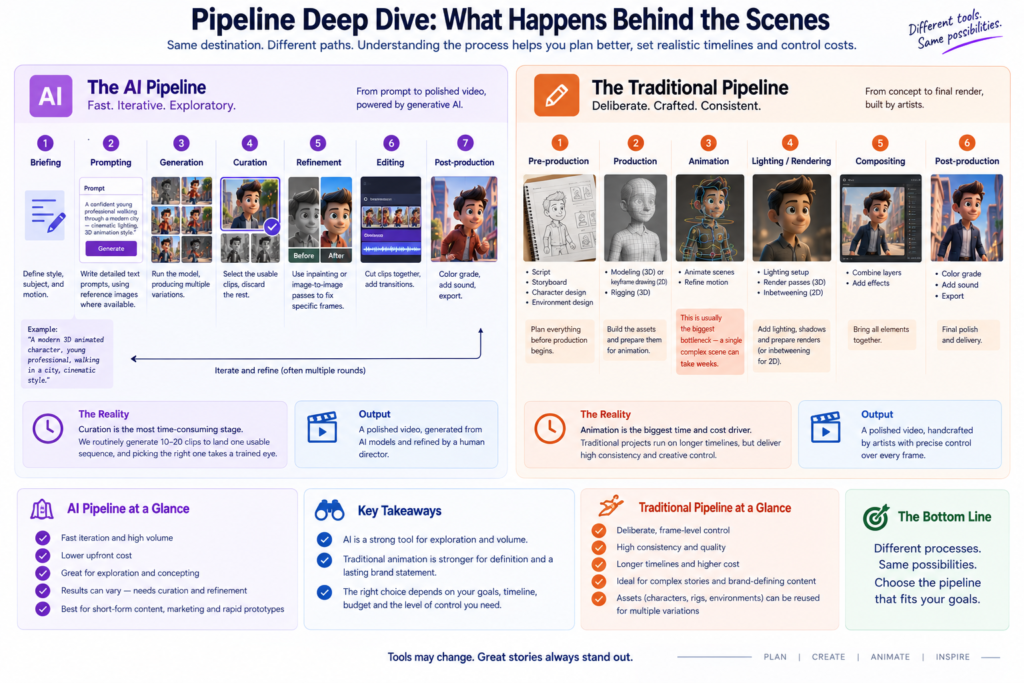
Understanding each pipeline in more detail helps you anticipate where delays and costs actually occur.
The AI Pipeline
- Briefing define style, subject and motion.
- Prompting write detailed text prompts, using reference images where available.
- Generation run the model, producing multiple variations.
- Curation select the usable clips, discard the rest.
- Refinement use inpainting or image-to-image passes to fix specific frames.
- Editing cut clips together, add transitions.
- Post-production color grade, add sound, export.
In our render queue, step four curation is consistently the most time-consuming stage. We routinely generate ten to twenty clips to land one usable sequence and picking the right one takes a trained eye. Teams without that skill on staff often find the AI pipeline feels chaotic rather than fast.
The Traditional Pipeline
- Pre-production script, storyboard, character design, environment design.
- Production modeling (3D) or keyframe drawing (2D), plus rigging for 3D work.
- Animation animators create the actual motion.
- Lighting / rendering lighting setup and render passes for 3D or inbetweening for 2D.
- Compositing combine layers and add effects.
- Post-production color grade, sound, export.
The bottleneck in traditional pipelines is almost always the animation stage itself a single complex scene can take an animator weeks. That is why traditional projects run on longer timelines. The upside is consistency: once a character is rigged, producing ten variations of the same scene means reusing the rig and adjusting the performance, which is often more reliable than re-prompting an AI model ten separate times and hoping for consistent results.
Illustrative Scenarios: When to Use Which
The following are illustrative, hypothetical scenarios based on common patterns we see across client types not real client names or figures.
Scenario A: E-Commerce Product Launch
Illustrative need: A fashion brand wants twenty short videos for social, each showing a different colorway of one shoe. Constraints: a one-week deadline, low per-video budget, high volume.
Likely fit: AI animation. The motion is simple a spinning product, a changing background and the subject itself is static, which is exactly where AI-assisted generation is strongest. A single high-quality reference image of the product can drive twenty background and lighting variations, edited together quickly. This kind of brief can realistically move from brief to delivery in a few days at low relative cost, with quality that is more than sufficient for social feeds.
Scenario B: OTT Platform Brand Campaign
Illustrative need: A streaming platform wants one 60-second hero video for a new series, for both broadcast and digital. Constraints: high budget, strict brand guidelines, complex narrative, high quality bar.
Likely fit: Traditional animation, typically 3D CGI. The video needs to tell a real story, characters need to move naturally across multiple scenes and brand safety is critical. This kind of brief runs through the full traditional pipeline storyboard, model, rig, animate, light, render, composite and typically takes several weeks but the result is broadcast-ready in a way that is hard to guarantee from a generative pipeline alone.
Scenario C: Hybrid Approach
Illustrative need: A software company wants a polished 30-second explainer for its website plus ten shorter social cuts. Constraints: needs both quality and volume, on a moderate budget.
Likely fit: A hybrid pipeline. AI generates a quick animatic to align on story and pacing before any expensive production begins. The hero explainer is then produced with traditional 2D or 3D technique for polish and consistency, while the social cuts are generated as AI-assisted variations of the approved hero asset different text overlays, slightly different pacing rather than being animated from scratch. This tends to land a genuinely polished hero video alongside a full set of social variants faster than a fully traditional approach to all eleven deliverables.
Brand Safety and Consistency Challenges
One of the biggest practical concerns in ai animation vs traditional animation is brand safety. AI models can visually drift: a character’s face can shift subtly between shots, a logo can distort or an object can morph in a way that was never intended. In traditional animation these errors are rare, because the character is a fixed model, the logo is a locked vector asset and a human artist controls every element by hand.
For brands with strict guidelines, this is a real factor to weigh. If your brand has a specific, recognizable character design, AI-assisted generation may struggle to hold that design across a long sequence without extra fine-tuning or image-to-image techniques both of which add time and cost back into the “fast, cheap AI” equation.
Mitigation strategies our team relies on:
- Always anchor on a reference image for the subject rather than generating from text alone.
- Generate in short clips (2–5 seconds) and edit them together this reduces the visible drift a longer single generation tends to accumulate.
- Keep a human QA pass on every frame that will be brand-facing; do not publish generated footage unreviewed.
- Split the workload use AI for backgrounds or abstract motion and traditional technique for characters and logos where consistency matters most.
The Hybrid Approach: Best of Both Worlds
For many brands, the most effective real-world pipeline is a hybrid: AI where speed and volume matter, traditional craft where quality and long-run control matter.
Common hybrid workflows:
- AI for pre-visualization generating storyboards or animatics faster than drawing them by hand, so clients can align on story before committing to expensive full production.
- AI for backgrounds generating complex environments while traditional technique handles characters, saving time on environment design specifically.
- AI for variations producing the hero asset traditionally, then using AI to generate market- or platform-specific cuts of that same asset.
- AI for upscaling and touch-ups producing the base animation traditionally, then using AI tooling to upscale resolution or add supplementary detail passes.
Hybrid pipelines tend to work because they let a studio pay for traditional craft only where it earns its cost, use AI to compress the early, exploratory stages and still land on a final asset that meets brand standards. In our own studio, we frequently generate several style directions with AI early in a project so a client can choose a direction quickly, then move into traditional production once that direction is locked a step that alone often saves weeks of back-and-forth versus commissioning several fully traditional style frames up front.
Worked Example: Scoring a Real Brief
To make the decision framework concrete, walk through an illustrative brief: a mid-sized D2C skincare brand needs a 45-second brand video for its homepage, plus fifteen 6-second cutdowns for paid social, on a six-week timeline with a moderate budget.
Scoring against the five criteria:
| Criterion | Score (1–5) | Reasoning |
|---|---|---|
| Narrative complexity | 3 | Product-focused story with light character interaction |
| Brand consistency requirement | 4 | A recurring brand mascot must look identical across all sixteen assets |
| Volume of assets | 4 | Sixteen total deliverables (one hero, fifteen cutdowns) |
| Timeline pressure | 2 | Six weeks is comfortable, not rushed |
| Budget constraint | 3 | Moderate quality matters but volume also matters |
| Total | 16 | Falls at the low end of the hybrid band |
A score of 16 sits right at the boundary between AI-first and hybrid. In practice, this is exactly the kind of brief where a hybrid pipeline earns its complexity: the hero video gets traditional-quality character work to protect the mascot’s consistency, while the fifteen social cutdowns are generated as AI-assisted variations of the approved hero footage rather than fifteen separate traditional productions. Without this framework, a team might default to either “just use AI for everything” (risking mascot drift across sixteen assets) or “produce all sixteen traditionally” (blowing the moderate budget on cutdowns that don’t need hero-level polish). Scoring the brief first avoids both mistakes.
Reading the Framework Honestly
The framework above is a starting point, not a verdict. A score of 16–25 does not mean every element of a project should be split identically down a hybrid line; it means the project likely benefits from deliberately assigning some deliverables to AI and others to traditional technique, rather than picking one pipeline for the entire brief. The scoring exercise is most useful as a forcing function to have that conversation early, before a client or internal stakeholder has already assumed one pipeline will cover everything.
A Short History of the Two Approaches
Traditional animation has roots going back more than a century, from early hand-drawn cel animation through the rise of computer-generated imagery (CGI) in the late twentieth century a transition well documented in the Wikipedia entry on computer animation.That earlier CGI transition is a useful reference point for the current AI shift: studios did not abandon animation principles when they adopted 3D software, they adapted them and the same pattern is playing out again as generative AI tooling enters mainstream production pipelines. Framing AI animation as a continuation of that decades-long tool evolution, rather than a wholesale replacement of animation craft, is a more accurate way to plan a team’s skill development than treating it as an entirely separate discipline.
What This Means for Your Team and Tooling
Adopting either pipeline or a hybrid of both has real implications for how a team is staffed and what tools it needs, beyond the per-project cost comparison above.
Staffing for an AI-First or Hybrid Pipeline
A team leaning AI-first typically needs fewer traditional animators and more people comfortable with prompt iteration, video editing and quality review. This does not mean animation expertise becomes irrelevant quite the opposite. The most effective AI operators we work with are people who understand animation principles well enough to recognize when a generated clip’s timing or weight is subtly wrong, even if they are not personally keyframing it. Teams that skip this and hire pure prompt-writers with no animation background tend to ship output that “looks fine” in isolation but reads as slightly off once placed next to professionally animated brand assets.
Staffing for a Traditional or Hybrid-Heavy Pipeline
A team leaning traditional needs the classic animation production roles modelers, riggers, animators, lighting and compositing artists and benefits from at least one person who understands where AI tooling could realistically compress pre-visualization or variation work, even if the studio’s core output stays traditional. Studios that ignore AI tooling entirely tend to lose ground on speed for the lower-stakes work in their pipeline (client pitches, internal animatics, social cutdowns) even when their hero-asset quality remains excellent.
Tooling Considerations
Regardless of which pipeline a team leans toward, a few practical tooling questions are worth settling before a project starts rather than mid-production: which AI generation tool’s licensing terms actually fit the intended commercial use, whether the traditional rigging and rendering pipeline can export in formats the AI tooling can ingest for hybrid workflows and who on the team owns final quality sign-off before anything ships to a client or goes live. Settling these upfront avoids the common failure mode where a hybrid workflow stalls because two tools in the pipeline were never actually designed to talk to each other.
Frequently Asked Questions
Is AI animation cheaper than traditional animation?
For high-volume, relatively simple projects, generally yes AI reduces the per-unit cost significantly once a workflow is dialed in. For complex, high-quality hero projects, traditional animation can end up comparably priced or more cost-effective, because AI-assisted work still requires substantial human curation and refinement time that is easy to underestimate up front. For a For a full cost breakdown, see our companion guide on how much an AI animated video costs.
Can AI animation replace traditional animators?
Not in the way that framing suggests. AI is a tool that changes the animator’s role from primarily “creator” toward “director” and “curator,” rather than eliminating the need for animation judgment. Understanding of motion, timing and storytelling principles is still what separates a usable AI-generated sequence from an unusable one the tool changed but the underlying craft knowledge did not become optional.
What is the actual quality difference between AI and traditional animation?
Traditional animation generally offers higher control and consistency, since every frame is intentionally placed. AI animation can look impressive in short bursts but is more prone to visual artifacts, character drift and a lack of the subtle nuance a trained animator adds to timing and weight. For broadcast-quality, brand-critical content, traditional technique is usually the safer bet; for fast-moving social content, AI is frequently good enough.
How long does AI animation take compared to traditional animation?
It depends heavily on complexity. A simple few-second clip can be generated in minutes to hours, while a more complex 30-second AI-assisted video can still take days to weeks once curation and editing are factored in. Traditional animation of similar length typically takes several weeks to a few months, depending on scene complexity and revision rounds.
Can I use AI animation for my brand safely?
Generally yes, with appropriate guardrails. Confirm the generated output meets your brand guidelines, keep human review in the loop for anything that will be public-facing and consider starting with lower-stakes content to validate the workflow before committing a hero campaign to a fully AI-driven pipeline.
What skills does a team need to work with AI animation tools?
Prompt writing, video editing and a trained eye for evaluating generated output are the core skills. You do not need to be a classically trained animator to operate the tools but understanding animation principles timing, weight, staging makes it much easier to recognize and select good generated output rather than settling for the first passable clip.
Is AI-generated animation safe to use commercially?
Check the licensing terms of the specific AI tool you use before committing to a commercial release terms differ meaningfully between providers and can change over time. Confirm you hold the rights to the generated output and consult a qualified legal advisor if the use case is high-stakes or you are unsure about a specific tool’s commercial terms.
How do I decide between AI and traditional animation for a specific project?
Use the decision framework above: score narrative complexity, brand consistency requirement, asset volume, timeline pressure and budget constraint. A low combined score points toward an AI-first approach, a high combined score points toward traditional technique and a middle score is usually your signal to plan a hybrid pipeline from the start rather than choosing one extreme.
Will AI animation eventually replace traditional studio animation entirely?
Based on how the previous major tooling shift in this industry played out the move from purely hand-drawn animation to computer-generated 3D it is more likely that AI becomes another layer in the traditional pipeline rather than a full replacement for it. Studios adapted their skill sets and workflows around CGI instead of abandoning animation craft and the more probable outcome here is a similar adaptation: traditional principles applied through a partly AI-assisted pipeline, rather than one approach fully displacing the other in the near term.
Ready to Start Your AI Animated Video?
Choosing between AI animation and traditional studio animation is not a one-size-fits-all decision it depends on your narrative complexity, brand consistency needs, volume, timeline and budget and the honest answer for most brands is a hybrid of both approaches rather than a single pipeline for everything.
At Pixlnexs, our production team runs AI-assisted and traditional workflows side by side, so we can recommend the pipeline that actually fits your project instead of defaulting to whichever tool we happen to prefer. Whether your brief scores as AI-first, hybrid or fully traditional on the framework above, the next useful step is usually a short scoping conversation rather than a guess bring your narrative complexity, brand consistency needs, volume, timeline and budget and we can tell you where your specific project lands.
Not sure if your project needs AI, traditional or both?
Pixlnexs runs both pipelines side by side and can score your brief against the decision framework above in a short scoping call.
Talk to PixlnexsRead more
How Much Does AI Video Generation Cost in 2026? (Pricing Breakdown)
AI Product Videos for Ecommerce: Turn 3D Models Into Selling Reels
AI Explainer Videos for SaaS and Startups: A Practical 2026 Playbook
Runway vs Sora vs Veo vs Pika: The 2026 AI Video Tool Showdown

Leave a Reply