
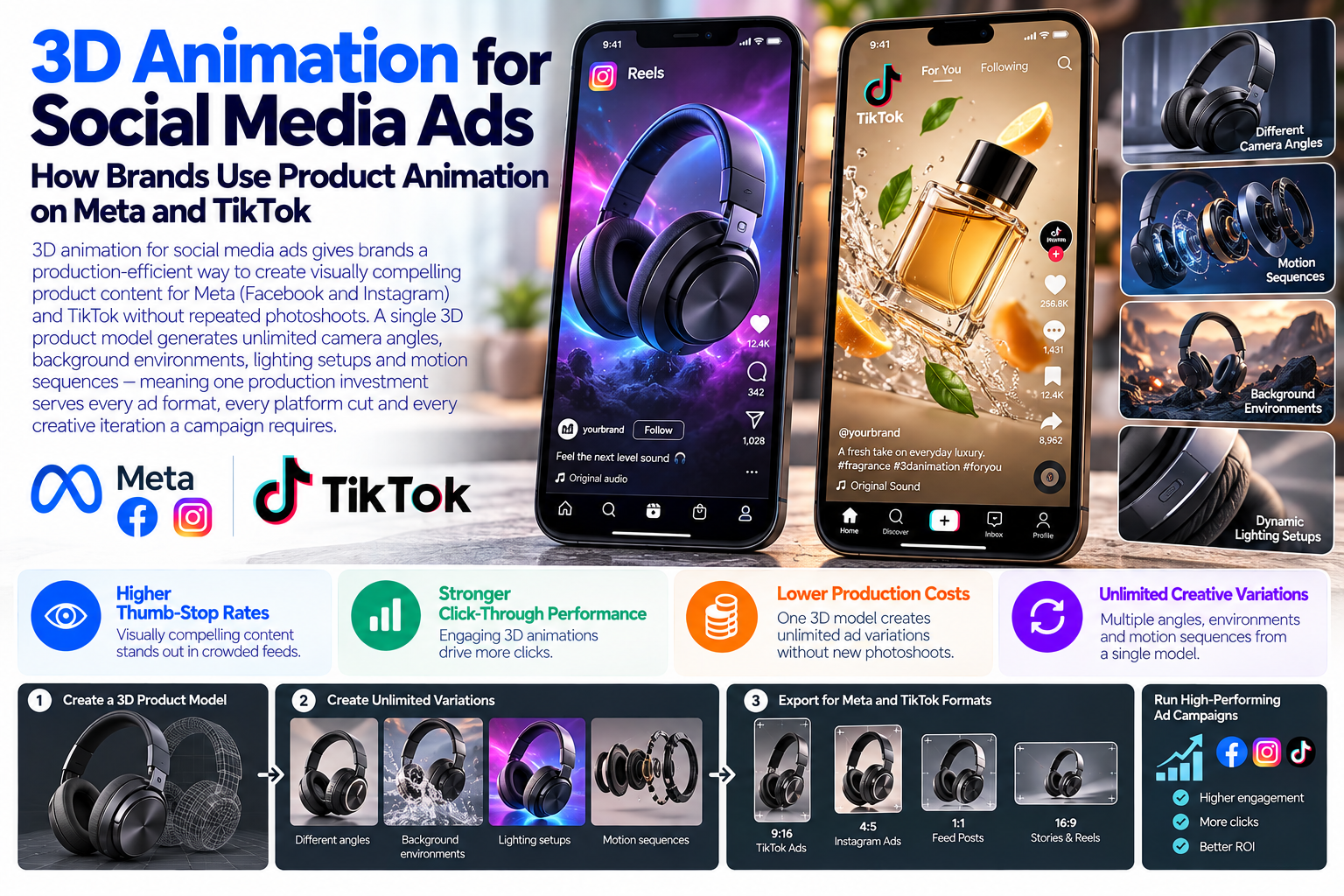
Quick answer: 3D animation for social media ads gives brands a production-efficient way to create visually compelling product content for Meta (Facebook and Instagram) and TikTok without repeated photoshoots. A single 3D product model generates unlimited camera angles, background environments, lighting setups and motion sequences meaning one production investment serves every ad format, every platform cut and every creative iteration a campaign requires. Brands using 3D product animation on Meta and TikTok consistently report higher thumb-stop rates, stronger click-through performance and lower creative production costs per campaign than equivalent live-action or static image alternatives.
This guide covers how the production works, what formats each platform requires, what makes 3D animation perform in-feed and how to structure a campaign production run from a single product model.
By Bali Balaji, Pixlnexs Studio. Pixlnexs produces AI-assisted and studio-crafted 3D product animation for brands running paid social campaigns on Meta and TikTok and this guide reflects the production approaches, format specifications and creative strategies our team applies to real campaign briefs.
Key Takeaways
- A single 3D product model is a permanent creative asset every ad variation, platform cut, seasonal refresh and campaign iteration is a re-render from the same source file rather than a new production from scratch.
- 3D animation consistently outperforms static product images in in-feed environments because motion in a scrolling feed creates a thumb-stop moment that static content cannot and 3D motion is controllable, repeatable and not subject to the variables of a filmed shoot.
- Meta and TikTok have different creative cultures and different technical format requirements. 3D product animation is adapted differently for each shorter and more kinetic for TikTok, more brand-polished and format-varied for Meta.
- The most effective 3D social ad content leads with the product in motion within the first second before any text overlay, logo or call to action because the motion is the hook.
- 3D animation is particularly powerful for products that are difficult to photograph compellingly items with complex geometry, multiple finish options, transparent materials or internal mechanisms because 3D can show what a camera cannot.
- For brands with large product catalogs, 3D animation at scale is the only economically viable way to produce consistent, high-quality video ad content across every SKU without a proportional increase in production cost.
Why 3D Animation for Social Media Ads Outperforms Static Content
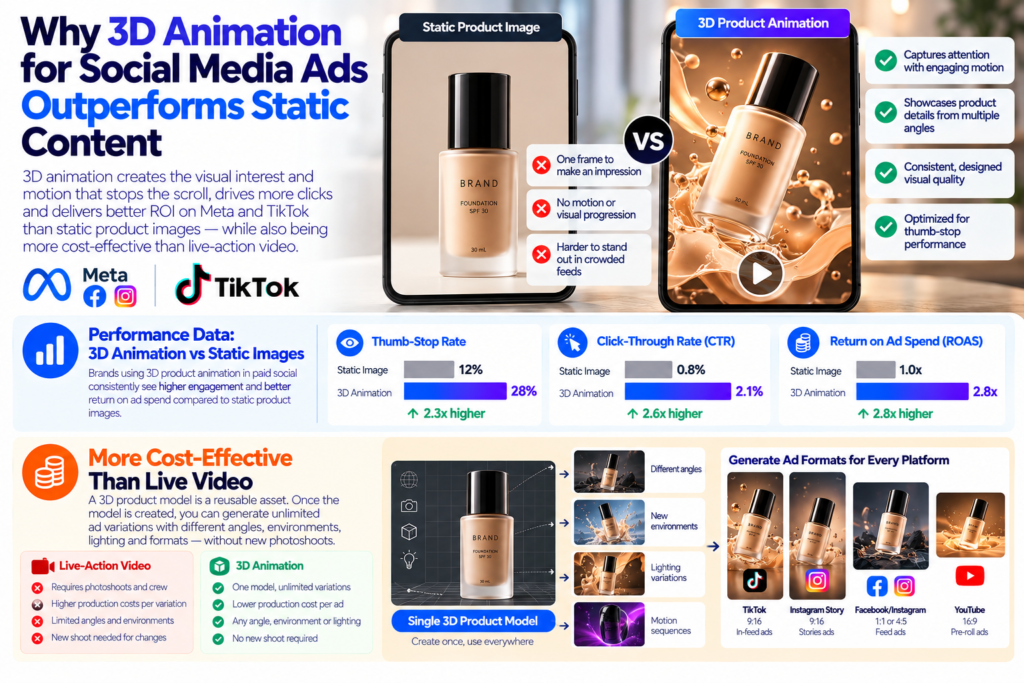
Social media advertising is a competition for attention measured in milliseconds. A user scrolling their Meta or TikTok feed makes a subconscious decision about whether to stop within the first half second of encountering a piece of content. Static images have one frame to make that impression. Video has motion and motion, when it is unexpected or visually arresting, triggers the pattern interrupt that makes a thumb stop.
3D product animation creates that pattern interrupt reliably and repeatedly, without depending on the unpredictable variables of a live-action shoot the perfect lighting day, the right talent expression, the timing of a physical product interaction. The motion in a 3D animation is designed, not captured. Every frame is intentional. The camera move, the product reveal, the material catch of light these are decisions made in production, which means they can be optimized for thumb-stop performance the way a headline is optimized for click-through rate.
What the Performance Data Shows About 3D Animation in Social Ads
Brands using 3D product animation in paid social consistently report that animated creative outperforms static product images on the metrics that matter for paid distribution: thumb-stop rate (the proportion of users who pause on the content), click-through rate and return on ad spend. The performance advantage is largest in feed placements where the product is surrounded by other visual content competing for the same attention.
The mechanism is not simply that video outperforms images it is that well-crafted 3D motion creates visual interest that is difficult to replicate with filmed content at equivalent production economics. A product reveal that unfolds over three seconds in 3D the product emerging from darkness, rotating to reveal its key feature, catching light across its finish costs a fraction of what a film crew would charge to attempt the same shot and produces a more consistent result because every variable is controlled.
Why 3D Animation Is More Cost-Effective Than Live Video for Product Ads
The economics of 3D animation for social ads are fundamentally different from live-action video because of asset reusability. A live-action product shoot produces footage. Once that footage is cut and distributed, it is fixed changing the background, the angle, the lighting or the timing requires a new shoot.
A 3D product model is a permanent creative asset. Every ad variation is a re-render: same model, different camera angle, different environment, different motion, different duration, different aspect ratio. A brand that invests in a 3D model for a product launch campaign can produce Instagram Story cuts, TikTok vertical ads, Facebook feed videos, YouTube pre-rolls and animated banner ads from the same source file with no additional production per format and no shoot required for any seasonal refresh or campaign iteration.
For our full analysis of how 3D animation compares to traditional video production for cost, speed and quality, see our guide on manual 3D modeling vs AI-generated 3D models for ecommerce.
How 3D Product Animation for Meta Ads Works
Meta’s advertising ecosystem spans Facebook feed, Instagram feed, Instagram Stories, Instagram Reels, Facebook Stories, Facebook Reels and Audience Network placements each with its own aspect ratio, duration recommendation and creative culture. 3D animation is particularly well-suited to Meta because the same model can be adapted to every placement format without a new production session.
Meta Ad Format Specifications for 3D Product Animation
| Meta Placement | Aspect Ratio | Recommended Duration | 3D Animation Approach |
|---|---|---|---|
| Facebook/Instagram Feed | 1:1 or 4:5 | 6–15 seconds | Product reveal with key feature highlight |
| Instagram/Facebook Stories | 9:16 vertical | 5–10 seconds | Fast product intro, product close-up, CTA |
| Instagram/Facebook Reels | 9:16 vertical | 15–30 seconds | Feature walkthrough or product story arc |
| Facebook/Instagram Carousel | 1:1 per card | Per-card video or loop | Each card shows a different angle or feature |
| Audience Network | Various | 6–15 seconds | Looping product animation, no text dependency |
What Makes 3D Product Animation Perform in Meta Feed Placements
Meta feed placements are where most product ad spend concentrates and the creative requirements of the feed are specific. The feed is a high-density environment every piece of content is competing with posts from friends, family, creators and other advertisers simultaneously. The content that wins attention is content that creates a pattern interrupt in the first half second.
For 3D product animation in Meta feed, the highest-performing creative structure we see across categories leads with the product in motion not a logo, not a headline, not a brand color field. The product appears and moves within the first second, ideally with a camera move or a material reveal that creates immediate visual interest. The brand context, the product name and the call to action follow but they follow a viewer who has already stopped scrolling.
Captions and text overlays are important in Meta because a significant proportion of feed content is viewed without sound. 3D product animation is inherently sound-independent the motion conveys the message without audio which makes it particularly well-suited to the muted-by-default environment of the feed.
How to Structure 3D Product Animation Creative for Meta Ads
A high-performing 3D product animation for Meta feed typically runs 6 to 15 seconds and follows a three-act structure:
Act 1 (0–2 seconds): The hook. Product appears in motion. Camera orbits, product emerges from darkness, material catches light or key feature is highlighted. No text, no logo pure visual. This is the thumb-stop moment.
Act 2 (2–10 seconds): The message. Product rotates or moves through its key selling angle. Feature callout text appears if relevant a material name, a key spec, a benefit statement. Brand visual language enters color palette, typography, environment.
Act 3 (10–15 seconds): The CTA. Logo, product name, primary call to action. Clear and unambiguous “Shop now,” “Discover the range,” “See it in your room.” The CTA should match the landing page experience if the product page has a 3D viewer or AR, the CTA that mentions it converts better than a generic one.
How 3D Product Animation for TikTok Ads Works
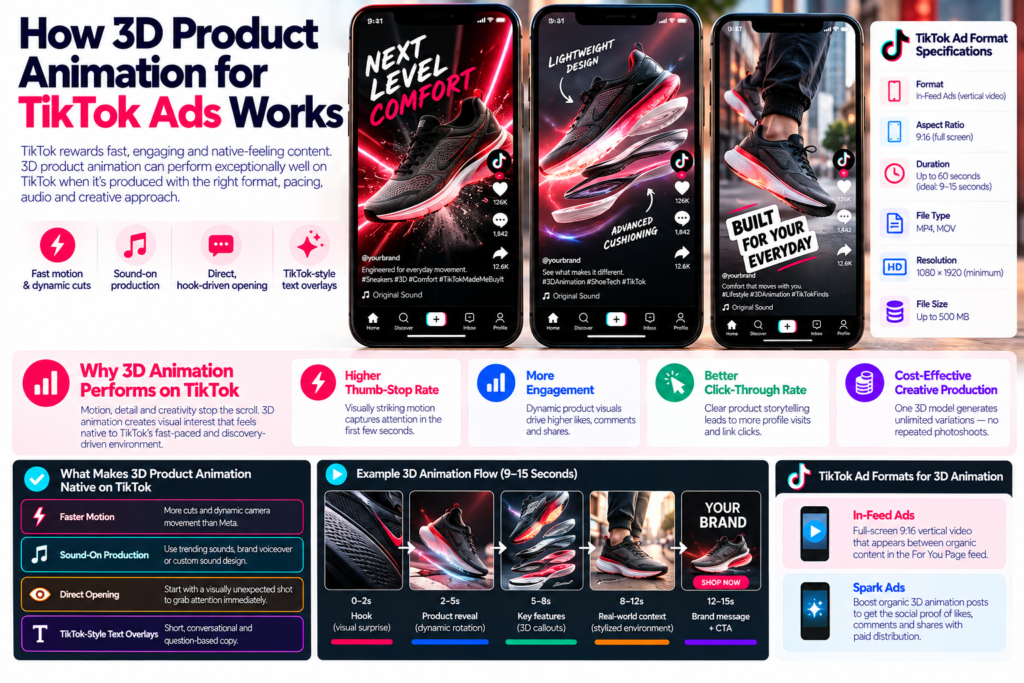
TikTok’s creative culture is meaningfully different from Meta’s. Where Meta rewards polished brand production alongside creator-style content, TikTok rewards content that feels native to the platform energetic, fast-paced, direct and often built around audio. The phrase “TikTok made me buy it” exists because TikTok’s format rewards content that feels like a genuine discovery rather than a traditional advertisement.
3D product animation can be made to feel native to TikTok with the right production approach but it requires a different mindset from Meta production and treating a Meta cut as a TikTok creative is one of the most reliable ways to underperform on the platform.
TikTok Ad Format Specifications for 3D Product Animation
TikTok’s primary ad format for product content is In-Feed Ads full-screen 9:16 vertical video, up to 60 seconds, appearing between organic TikTok content in the For You Page feed. For most product 3D animation campaigns, the practical target is 9 to 15 seconds long enough to show the product meaningfully, short enough to hold attention in a fast-scroll environment.
Spark Ads promoting organic TikTok posts as paid content are an increasingly common format for 3D product animation because they carry the social proof of organic engagement (likes, comments, shares) while benefiting from paid distribution. A brand that posts 3D product animation organically and boosts the best-performing posts as Spark Ads often gets better performance than running the same content only as a traditional In-Feed Ad.
What Makes 3D Product Animation Native on TikTok
TikTok content that performs well tends to be faster, more kinetic and more directly conversational than Meta content. For 3D product animation, this means:
Faster motion. TikTok’s edit pace is faster than Meta’s. Camera cuts, transitions and product movements that would feel rushed in a Meta feed feel right at TikTok’s pace. A 3D animation produced for TikTok typically has more cuts per second and more dynamic camera movement than a Meta equivalent.
Sound-on production. Where Meta content is often consumed muted, TikTok is a sound-on platform by culture and by algorithm. 3D product animation produced for TikTok should be built around its audio a trending sound, a brand voiceover or a product-specific sound design rather than treating audio as an afterthought added to a visually complete piece.
Direct opening. TikTok users make their scroll decision faster than Meta users. The first frame of a TikTok ad is make-or-break. 3D product animation for TikTok should open with something visually unexpected a dramatic close-up of a material texture, a product emerging from a surprising direction, an extreme camera angle that creates curiosity rather than the polished product-reveal structure that works on Meta.
Text overlays in the TikTok style. Text in TikTok ads tends to be conversational, direct and often question-based “This is what your [room / wardrobe / desk] is missing,” “You’ve never seen [product] like this,” “The detail nobody photographs.” 3D animation gives the brand the ability to frame the product dramatically in a way that supports this kind of direct, opinionated copy.
3D Product Animation Production: From Model to Social Ad
The Production Pipeline for Social Ad 3D Animation
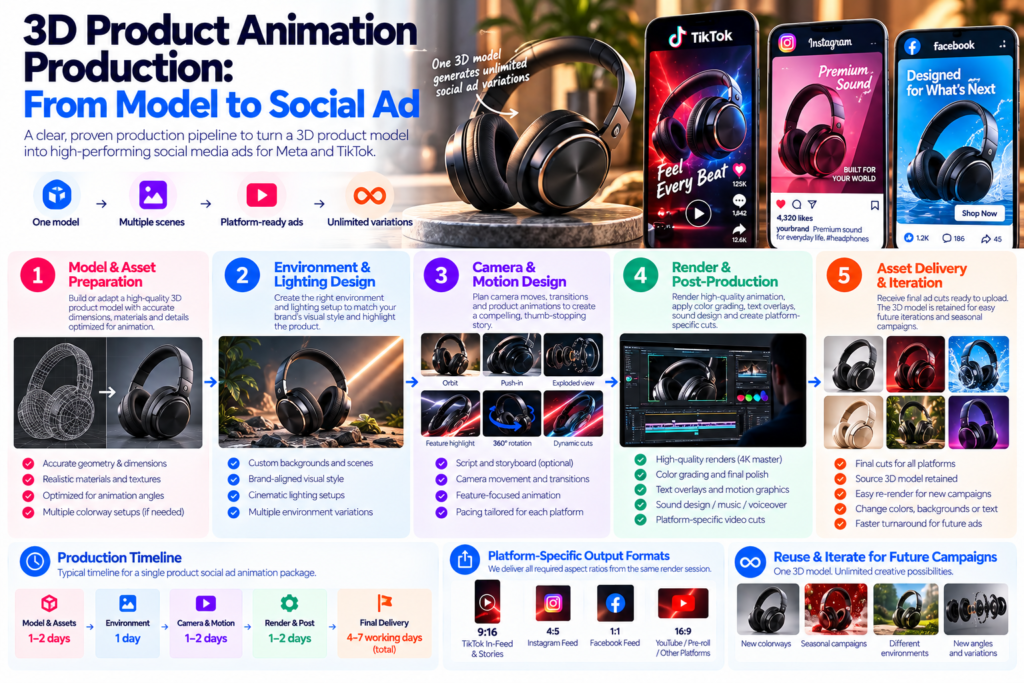
The production process for 3D product animation for social ads follows a clear sequence and understanding where the leverage points are helps brands get better creative output for their investment.
Stage 1: Model and asset preparation. The foundation of every 3D animation is the product model. For social ads, the model needs to be built or adapted with the animation use case in mind which means attention to surface finish accuracy (how the product catches light is what makes it compelling in motion), material calibration and the specific angles and features the campaign needs to highlight. A model built purely for a static product page viewer may need additional material work before it produces compelling animation frames.
Stage 2: Environment and lighting design. Unlike a static product page viewer where the environment is neutral and consistent, a social ad animation benefits from a designed environment a surface, a background, a lighting setup that reflects the brand’s visual identity and creates the right tonal context for the product. A skincare product in a soft, muted environment with warm rim lighting communicates something different from the same product on a minimal dark surface with dramatic directional light.
Stage 3: Camera and motion design. This is where the thumb-stop moment is engineered. The camera move the orbit, the push-in, the reveal is designed before rendering begins. For Meta, a single deliberate camera move that reveals the product’s key feature in the first two seconds is the standard structure. For TikTok, multiple cuts with faster movement and more dynamic framing.
Stage 4: Render and post-production. The animation renders, receives color grading, text overlays and sound design are applied and platform-specific cuts are produced. A well-structured production delivers the master render plus all required platform cuts 9:16 for TikTok and Stories, 1:1 for feed, 4:5 for Meta feed from the same render session.
Stage 5: Asset delivery and iteration. The brand receives the final cuts formatted for upload to Meta Ads Manager and TikTok Ads Manager. Because the 3D source model is retained, any future iteration a new colorway, a seasonal background change, a cut-down version for a different campaign is a re-render rather than a new production.
How Long 3D Animation for Social Ads Takes to Produce
A single product social ad animation package one product, one environment, platform cuts for Meta and TikTok typically takes four to seven working days once the product model and brief are confirmed. For brands commissioning from a single base model, subsequent creative iterations (new backgrounds, new camera directions, seasonal refreshes) are faster because the model is already built.
The variables that most affect timeline are model availability (if a 3D model already exists versus needing to be built from scratch), brief clarity (a well-defined brief with reference examples moves faster than an open-ended creative brief) and revision cycles (a pre-approved storyboard or animatic significantly reduces the number of full-render revision rounds).
3D Animation Social Ad Strategy: What to Produce and When
Prioritizing Which Products to Animate First for Social Ads
Not every product in a catalog benefits equally from 3D animation for social ads. The strongest cases are:
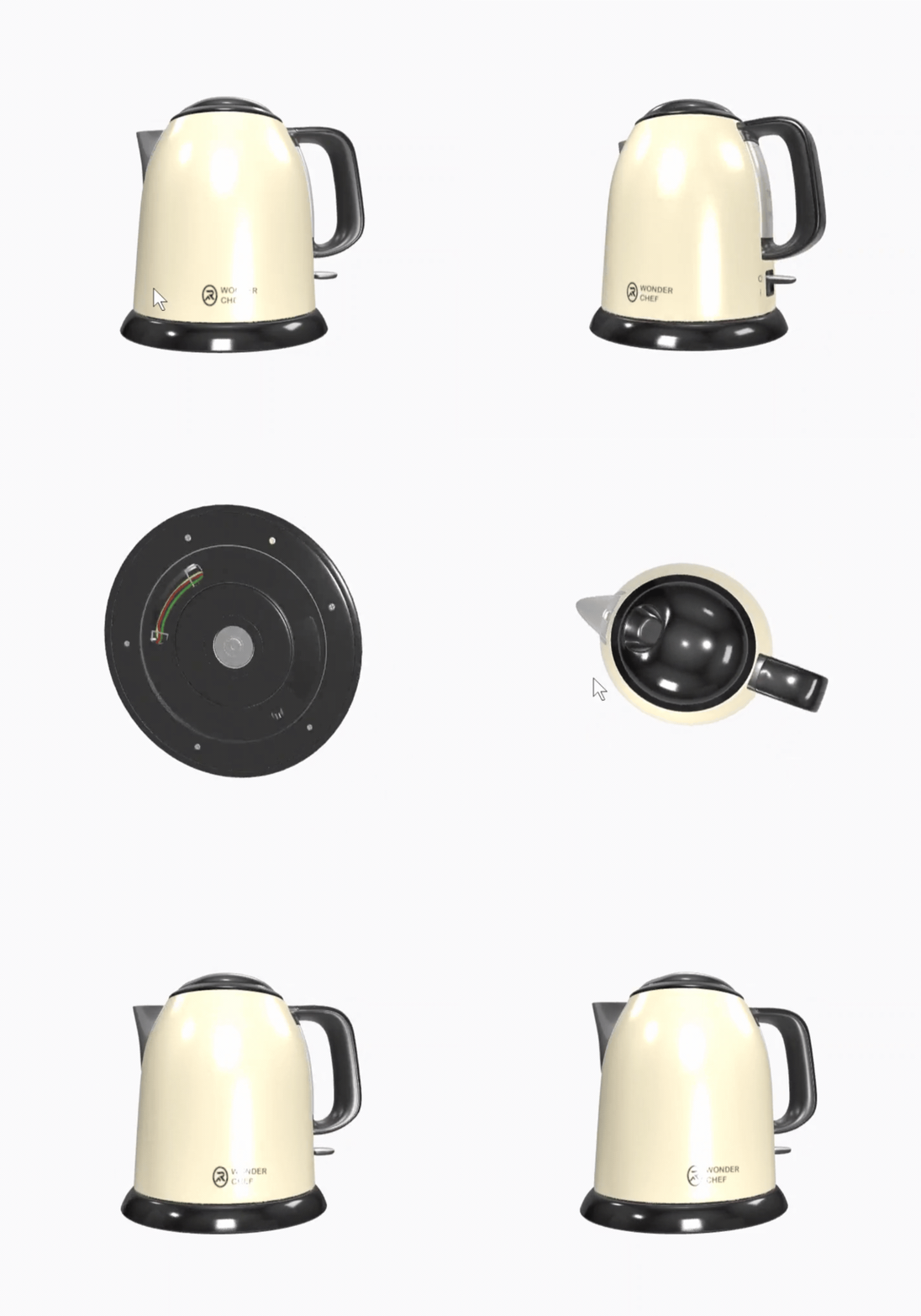
Products with visual complexity that photography struggles to capture. A product with multiple finish options, internal mechanisms, complex geometry or transparent materials where standard photography fails to show the full visual story is a natural first candidate for 3D animation, because 3D can show what a camera cannot.
Hero products and bestsellers in high-consideration categories. Products where the purchase decision involves significant evaluation because of price, size, fit or technical specifications benefit the most from the extended visual storytelling that 3D animation enables.
Products launching without physical samples. For pre-launch or pre-order campaigns, 3D animation allows brands to run full paid social campaigns before the physical product exists as a production unit using the 3D model as the visual source for all campaign creative.
Products in visually competitive categories. In categories where competitors are running visually sophisticated creative beauty, fashion accessories, consumer electronics, premium food and beverage 3D animation is a production approach that can match or exceed that visual quality without the shoot infrastructure.
Building a 3D Animation Content Calendar for Paid Social
For brands running paid social continuously, 3D animation is most cost-effective when the production is structured as a content calendar rather than a series of one-off commissions. A content calendar approach means:
- The base model is produced once for each product and maintained as a permanent asset
- Seasonal campaigns use the same model in new environments and lighting setups
- New colorways or variants are produced as material swaps on the existing geometry
- Platform refreshes adapting an existing animation to a new format or duration are re-renders rather than new commissions
This approach converts the per-campaign cost structure of traditional video production into a per-SKU asset model that scales efficiently as the product catalog grows.
When to Use 3D Animation Alongside Live Video, Not Instead of It
3D animation performs best in paid social environments where production control, reusability and visual precision are priorities. Live video has advantages that 3D cannot fully replicate: authentic talent interaction, real-world environment texture and the credibility of user-generated-content aesthetic that performs strongly in organic and Spark Ad contexts on TikTok specifically.
The strongest paid social creative strategies often combine 3D animation for product hero and launch content where visual precision and brand polish are the priority with creator-produced or UGC-style live video for social proof and native-feel content. The 3D animation handles the product at its visual best; the creator content handles the authentic discovery narrative.
How 3D Animation Supports the Full Social Commerce Funnel
Top of Funnel: Awareness and Thumb-Stop
At the top of the funnel, 3D product animation’s job is to stop the scroll and create a memorable first impression. The visual hook the product in unexpected motion, the dramatic material reveal, the dramatic close-up is what earns the viewer’s next two seconds of attention. For awareness campaigns where the objective is reach and brand recall, a 3D animation that is visually arresting and brand-consistent is the primary deliverable.
Middle of Funnel: Consideration and Feature Education
At the middle of the funnel, where the objective is to move a prospect from awareness to active consideration, 3D animation’s ability to show every angle and feature is the primary value. A 15-second product feature animation that walks through the key selling points material, mechanism, size, use case delivers a more complete product understanding than a static image carousel in a fraction of the viewing time.
Bottom of Funnel: Conversion and Retargeting
At the bottom of the funnel, retargeting audiences who have already visited the product page or added to cart, 3D animation can serve as the final push a product close-up that reinforces visual desirability, a quick feature reminder or a time-limited offer overlay on an existing product animation. For brands with 3D product pages, a retargeting creative that matches the visual language of the on-site 3D experience creates a coherent journey that reinforces purchase confidence.
For brands that have invested in interactive 3D and AR on their product pages, connecting the social ad creative to the on-page 3D experience through a CTA that mentions the AR viewer or through visual consistency between the ad animation and the product page viewer creates a more unified customer journey. For more on how this works across the full ecommerce experience, see our guide on 3D product visualization for ecommerce.
Conclusion
3D animation for social media ads on Meta and TikTok is not a production luxury it is a production strategy that solves the fundamental creative challenge of paid social at scale: the need for high-volume, high-quality, platform-adapted visual content that does not require a proportionally high production budget.
The principle is simple: build the 3D model once, produce every ad variation from it. A product launch, a seasonal campaign, a format adaptation, a creative refresh each one is a re-render, not a re-shoot. Over a year of paid social activity, the economics of 3D animation versus live-action production typically favor 3D significantly for any brand running continuous creative.
The starting point is the same as for any 3D investment: one product, one animation, one platform test. Measure thumb-stop rate, click-through rate and return on ad spend against equivalent static creative. The results determine whether and how fast to scale to the rest of the catalog.
Ready to Run 3D Product Animation on Meta and TikTok?
Pixlnexs produces 3D product animation packages for paid social campaigns Meta feed, Stories, Reels and TikTok In-Feed, from a single product model to a full catalog production run.
Get a Quote for 3D Animation Ads Talk to Our TeamFrequently Asked Questions
What Is 3D Animation for Social Media Ads and Why Do Brands Use It?
3D animation for social media ads uses computer-generated product models to create video ad content product reveals, feature demonstrations and lifestyle sequences without a physical photoshoot. Brands use it because a single 3D model produces unlimited ad variations across every format, platform and campaign iteration, which is significantly more economical than equivalent live-action production when creative volume is high or when the product needs to be shown from angles or in environments that would be expensive to film.
Does 3D Product Animation Perform Better Than Static Images on Meta and TikTok?
Consistently yes on most performance metrics. Motion creates a thumb-stop moment in feed environments that static images cannot replicate a scrolling user’s visual system responds to motion faster than to still content. The performance advantage is largest in competitive feed environments where multiple visually strong pieces of content are competing for the same impression. The quality and relevance of the motion matter significantly a poorly designed 3D animation does not automatically outperform a strong static image.
How Long Should a 3D Product Animation Be for Meta Ads Versus TikTok?
For Meta feed placements (Facebook and Instagram feed), 6 to 15 seconds is the standard performance range long enough to deliver a product message, short enough to hold attention. For TikTok In-Feed Ads, 9 to 15 seconds is the practical target, though the pace and structure should feel significantly more energetic than a Meta equivalent. Stories placements on both platforms perform best at 5 to 10 seconds. For Reels placements, 15 to 30 seconds allows a more complete product story.
Can I Use the Same 3D Animation for Both Meta and TikTok?
The same product model serves both but the animation itself should be adapted for each platform rather than used identically. Meta rewards polish and brand consistency; TikTok rewards pace, energy and native-feel creative. A single render that simply re-sized to 9:16 will typically underperform on TikTok against content specifically produced for TikTok’s creative culture. The most efficient approach is a single production session that delivers platform-specific cuts rather than a single master cut applied to both.
What Products Benefit Most From 3D Animation in Social Ads?
Products with visual complexity that photography struggles to capture transparent materials, metallic finishes, complex geometry, internal mechanisms benefit most because 3D can show what a camera cannot. High-consideration products where the visual story is important to the purchase decision (furniture, electronics, premium accessories, beauty) also benefit significantly. Products launching without physical samples benefit operationally, since the 3D model can run full campaign creative before manufacturing is complete.
How Much Does 3D Animation for Social Ads Cost?
Cost varies with model complexity, animation duration, number of platform cuts and whether a model already exists or needs to be built. The economic case is strongest when the same model serves multiple campaigns the per-campaign cost of re-rendering an existing asset for a new campaign is significantly lower than the initial production cost. For brands managing ongoing paid social, the correct framing is per-SKU model investment amortized across all campaigns using that model rather than per-campaign production cost.
How Do I Brief a 3D Animation Studio for a Social Ad Campaign?
A clear brief includes: platform targets and format specifications required; animation duration and number of cuts needed; reference examples of 3D or live-action ads that match the desired tone; product reference materials (HD photos from all angles, exact dimensions, standardized color codes); any specific features, angles or use cases that must be shown; brand guidelines for typography, color and visual identity; and the campaign’s hook message the single most important thing the ad needs to communicate in its first two seconds.
Does 3D Animation Work for Products That Are Not Physically Available Yet?
Yes this is one of 3D animation’s strongest operational advantages. A product that exists as a CAD file or design specification can be visualized in full photorealistic 3D animation for a launch or pre-order campaign before any physical sample has been produced. This allows brands to begin paid social campaigns and build audience before the product ships, using the 3D animation as both the ad creative and the visual source for product page imagery.
Related Guide
3D product visualization for furniture and home décor
how to test 3D and AR on product pages before launch




Leave a Reply