
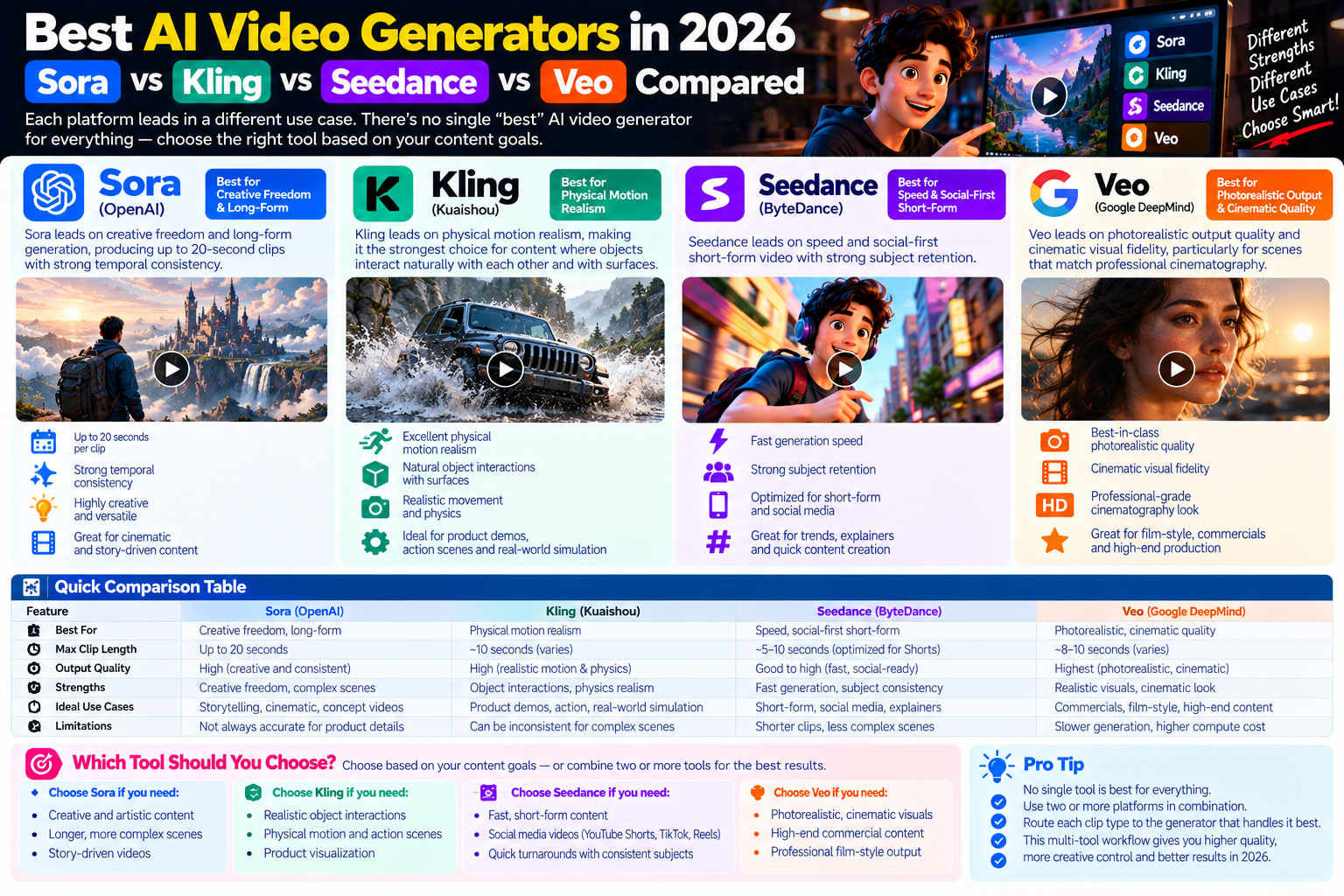
Quick answer: The best AI video generators in 2026 are Sora (OpenAI) Kling (Kuaishou) Seedance (ByteDance) and Veo (Google DeepMind) each leading in a different use case. Sora leads on creative freedom and long-form generation, producing up to 20-second clips with strong temporal consistency. Kling leads on physical motion realism, making it the strongest choice for content where objects interact naturally with each other and with surfaces. Seedance leads on speed and social-first short-form video with strong subject retention. Veo leads on photorealistic output quality and cinematic visual fidelity, particularly for scenes where the visual matches professional cinematography most closely.
Choosing the right platform depends entirely on what the output is for none of the four is objectively best across all use cases and professional production workflows in 2026 increasingly use two or more platforms in combination, routing different clip types to the generator that handles them best.
By Bali Balaji, Pixlnexs Studio. Pixlnexs produces AI video and 3D content for ecommerce brands and creative agencies and this comparison reflects hands-on production experience with all four platforms across real campaign briefs not benchmark scores or press release claims.
Key Takeaways
- No single AI video generator wins across all use cases in 2026. The four platforms have meaningfully different strengths and the right platform depends on the specific content type, quality requirement and production context.
- Sora is the strongest platform for creative, concept-driven content and for longer clips where temporal consistency across frames matters. Its storyboard and multi-clip production features make it the closest to a complete production environment among the four.
- Kling is the most physically realistic option for motion objects fall, spill, impact and interact with surfaces in ways that match real-world physics more closely than any other generator. For lifestyle content with physical product interaction, it is the strongest choice.
- Seedance is the fastest platform for high-volume social-first content generation, with strong subject retention and competitive output quality for short-form use cases. It is ByteDance’s response to Runway and Pika for TikTok-native and social-first production.
- Veo produces the most photorealistic, cinematically faithful output of the four its output most closely matches the look of professionally filmed content. It is the strongest choice for brand content where production quality is the primary criterion.
- For ecommerce brands specifically, a combination of Veo or Sora for hero product content (higher quality, slower output) and Seedance or Kling for social-volume content (faster, more volume) is the hybrid workflow that delivers the best commercial outcome.
Why Comparing AI Video Generators Matters More in 2026
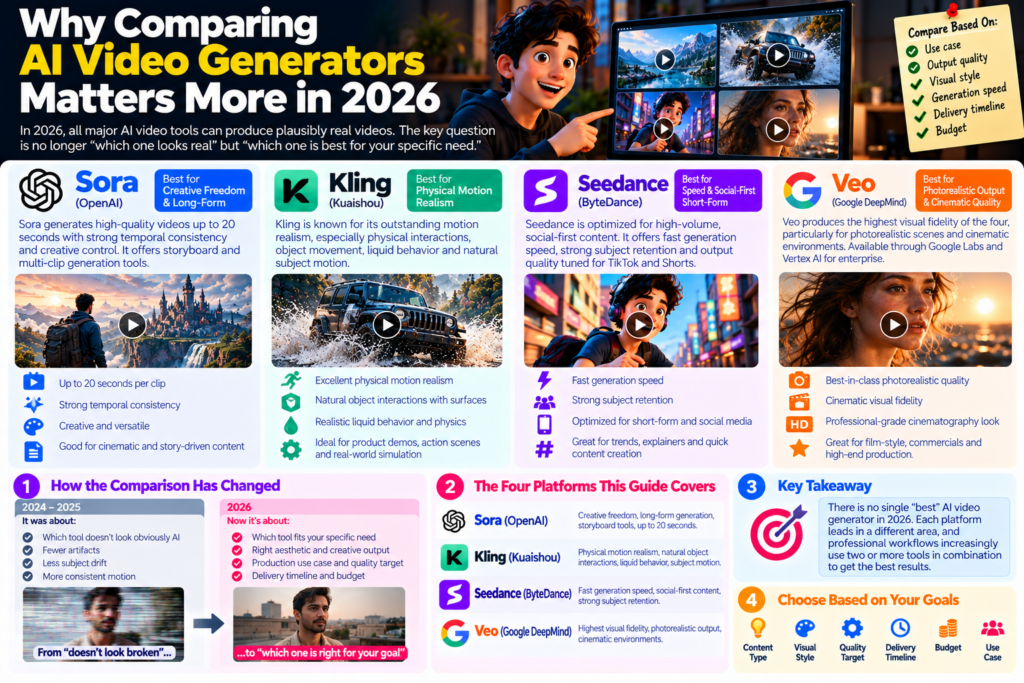
In 2024 and 2025, comparing AI video generators was largely about which platform had crossed the threshold from “obviously AI-generated” to “plausibly real.” The outputs were differentiated primarily by their failure modes which platform produced fewer artifacts, less subject drift, more consistent motion.
In 2026, that threshold question is largely settled. All four platforms produce output that is plausibly real for most use cases, most of the time. The comparison question has shifted from “which one doesn’t look broken” to “which one produces the right aesthetic and creative output for this specific production need.”
This shift changes how professional production teams approach platform selection. The workflow question is no longer “which AI video tool should we use” but “which AI video tool should we use for this specific clip type, this quality target, this delivery timeline and this budget.” Understanding what each of the four leading platforms does best and where each one underperforms is the knowledge that determines output quality in a professional workflow.
The Four Platforms This Guide Covers
Sora (OpenAI): launched publicly in late 2024, Sora is OpenAI’s video generation model. It generates clips up to 20 seconds, offers storyboard and multi-clip generation tools and tends toward a slightly cinematic, slightly stylized aesthetic rather than raw photorealism.
Kling (Kuaishou): developed by Chinese short-video platform Kuaishou, Kling made its international mark with its motion realism particularly for physical interactions, liquid behavior and subject movement. Available through Kling.ai with international access.
Seedance (ByteDance): ByteDance’s AI video generation platform, optimized for high-volume, social-first content production. Strong subject retention, fast generation speed and competitive output quality for TikTok-oriented content.
Veo (Google DeepMind): Google’s flagship AI video generation model, available through Google Labs and Vertex AI for enterprise. Produces the highest visual fidelity of the four, particularly for photorealistic scenes and cinematic environments.
Sora in 2026: Strengths, Weaknesses and Best Use Cases
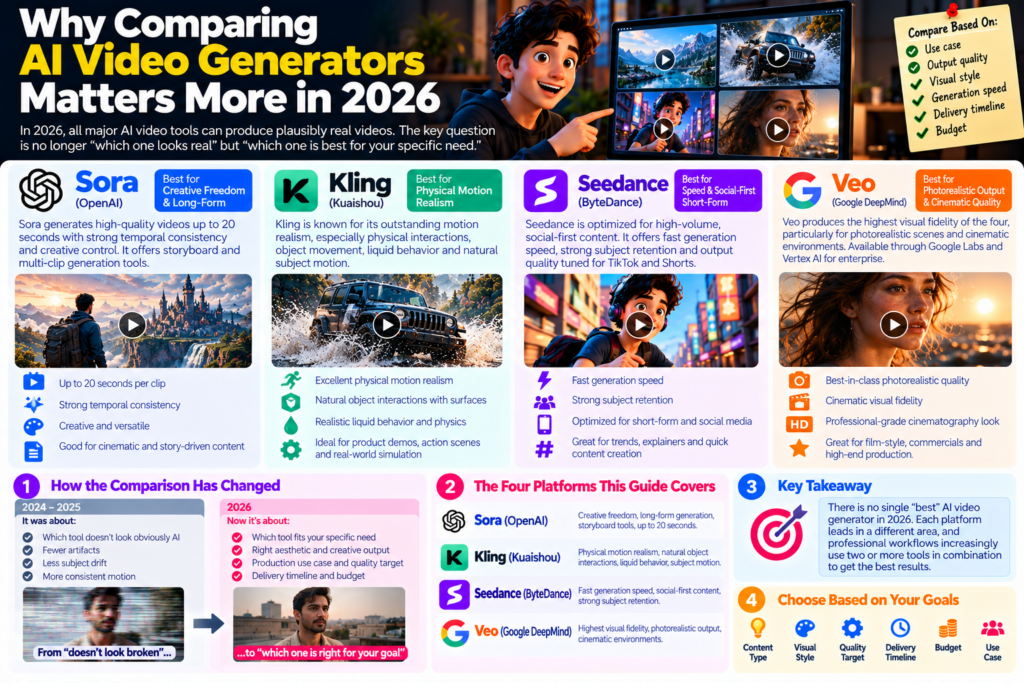
What Sora Does Best in 2026
Sora’s primary advantage is clip duration and temporal consistency. At up to 20 seconds per generation, Sora produces the longest clips of the four platforms and its temporal consistency the ability to maintain subject appearance, environmental consistency and motion logic across a longer clip is stronger than shorter-generation platforms where consistency over time is less tested.
The Storyboard feature sets Sora apart as a production environment rather than a simple generator. Storyboard allows creators to plan a multi-clip sequence, generate each clip in the planned context of the surrounding clips and maintain visual and narrative consistency across a longer assembled piece. For productions that involve sequential storytelling a product narrative, a brand story, an explainer with visual continuity Sora’s storyboard workflow is the most production-ready approach among the four.
Sora also has the widest range of supported visual styles. Its outputs cover photorealistic, animated, stylized, abstract and hybrid aesthetics more consistently than the other platforms, which tend to favor particular visual qualities in their training.
Where Sora Underperforms
Physical motion realism is Sora’s weakest area compared to Kling. Objects interacting with surfaces, liquids behaving physically, human hands interacting with products these generate well in concept but with occasional physical implausibility that Kling handles more reliably.
Sora’s output speed is slower than Seedance. For high-volume social content production where iteration pace matters, Sora’s generation time can become a production constraint.
Best Use Cases for Sora in 2026
- Brand narrative and storytelling content where visual continuity across a multi-clip sequence matters
- Creative, concept-driven content with stylized or hybrid aesthetics
- Longer-form pieces (15–20 seconds) where other platforms’ shorter generation limits require more clip assembly
- Pre-visualization and animatic production for pitches and concept approvals
- Content that benefits from the Storyboard workflow for multi-clip narrative planning
Kling in 2026: Strengths, Weaknesses and Best Use Cases
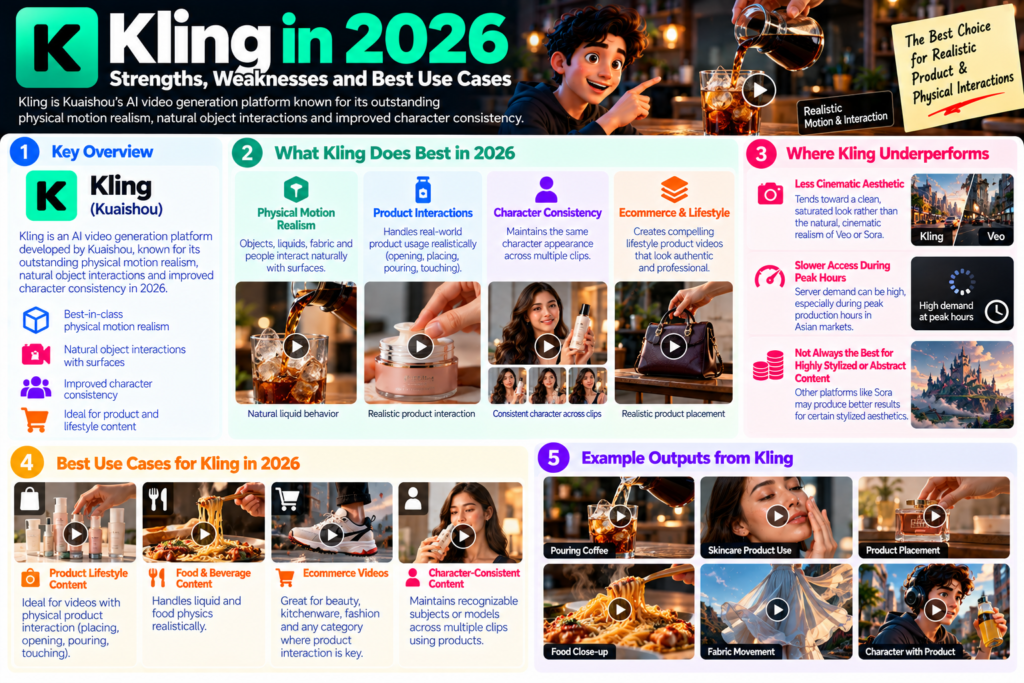
What Kling Does Best in 2026
Kling’s physical motion realism is its defining strength and the capability that made it the subject of significant attention in the AI video community. A product being placed on a surface, a liquid being poured into a glass, a hand picking up an object, fabric falling and settling these interactions generate with a physical plausibility in Kling that other platforms do not consistently match.
For ecommerce product content specifically, this matters because the most compelling product lifestyle videos involve some form of physical interaction a skincare bottle being opened, a coffee being poured, a bag being set down on a surface. These interactions signal authenticity and production quality to viewers in a way that static product shots do not and Kling is the AI video platform that handles them most reliably.
Kling’s character consistency has also improved significantly in its 2026 updates. For content involving a recurring character or a model consistently using a product across multiple clips, Kling now maintains subject appearance with higher reliability than previous versions.
Where Kling Underperforms
Kling’s overall visual aesthetic tends slightly toward a clean, saturated look rather than cinematic realism. For content where the desired output matches the look of professional cinematography with natural color grading and organic light behavior, Veo or Sora may produce output closer to the target aesthetic.
Access can be slower than other platforms due to server demand, particularly during peak production hours in Asian markets.
Best Use Cases for Kling in 2026
- Product lifestyle content with physical product interaction placing, pouring, touching, opening
- Content where liquid, fabric or soft-body physics need to look realistic
- Social content for beauty, food and beverage, kitchenware and any category where product interaction is part of the visual story
- Character-consistent content involving a recognizable subject interacting with products across multiple clips
Seedance in 2026: Strengths, Weaknesses and Best Use Cases
What Seedance Does Best in 2026
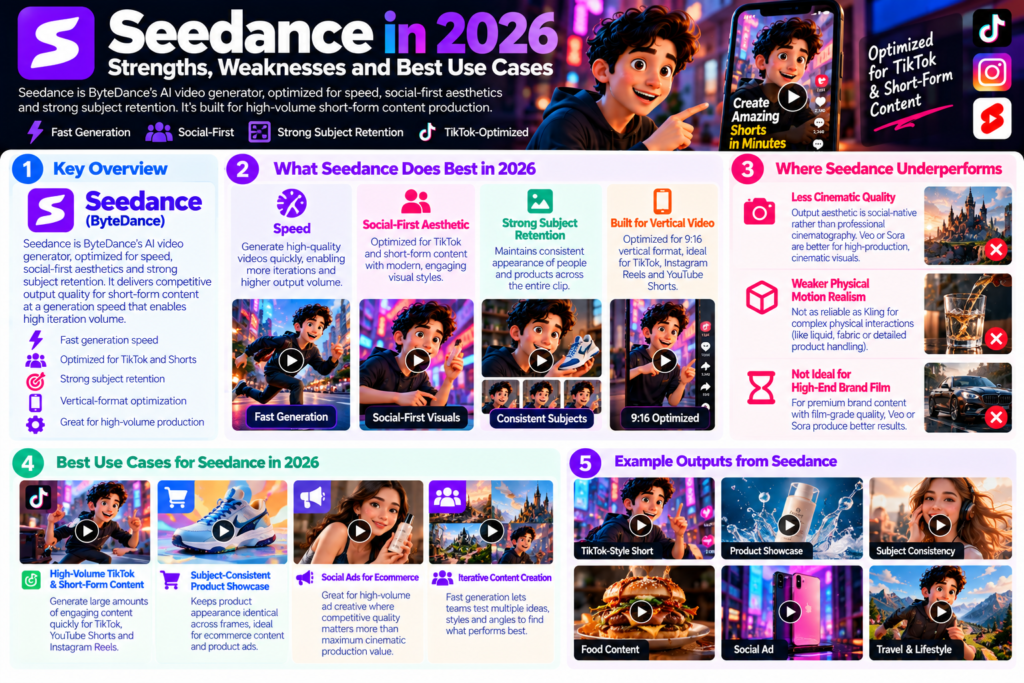
Seedance is ByteDance’s AI video generator the company behind TikTok and it shows in the platform’s optimization priorities. Seedance is optimized for speed, social-first aesthetics and subject retention across a generation. It produces competitive output quality for short-form content at a generation speed that enables the high iteration volume that social content production requires.
Subject retention is Seedance’s specific technical strength compared to earlier AI video generators. Subject drift where a person’s or product’s appearance changes across the frames of a single clip is one of the most common quality failures in AI video generation. Seedance’s subject retention is among the strongest of the four platforms, which makes it particularly useful for product content where the product must look consistent throughout the clip.
For TikTok-native content specifically, Seedance’s fast generation and strong vertical-format optimization make it the most efficient tool for high-volume social content production. A social media team producing a high volume of TikTok product videos can generate more usable content per hour in Seedance than in Sora or Veo.
Where Seedance Underperforms
Seedance’s output aesthetic is social-native rather than cinematic. For brand content where the desired output quality matches professional cinematography high production value, organic film grain, natural color science Veo or Sora produces output closer to that target.
Physical motion realism is also below Kling’s standard for complex physical interactions. Seedance is strongest for content where the subject is relatively static or moving simply rather than content involving complex physical product interactions.
Best Use Cases for Seedance in 2026
- High-volume TikTok and short-form social content production
- Content where generation speed and iteration volume matter more than cinematic quality
- Subject-consistent product showcase clips where the product must look identical across every frame
- Social ads for ecommerce where the creative requirement is high volume and competitive quality, not maximum production value
Veo in 2026: Strengths, Weaknesses and Best Use Cases
What Veo Does Best in 2026
Veo 3 (Google DeepMind’s current generation as of late 2026) produces the highest visual fidelity of the four platforms for photorealistic scene generation. Its output most closely matches the look of professionally filmed content natural light behavior, organic camera motion, coherent environmental depth and a color science that resembles properly color-graded footage rather than AI-generated content.
For enterprise brand content where the output quality requirement is “must look like it was professionally filmed,” Veo is the strongest single platform. A Veo-generated product clip, color-graded in post-production, is the most difficult of the four platforms’ outputs to identify as AI-generated in a blind comparison.
Veo’s integration with Google’s Vertex AI also makes it the most enterprise-accessible of the four platforms for large organizations it can be integrated into production pipelines through API access in ways that the consumer-facing platforms cannot.
Where Veo Underperforms
Veo’s output is photorealistic-first it is less flexible for stylized, animated or hybrid aesthetics than Sora. For creative content that is intentionally not photorealistic, Sora offers more aesthetic range.
Access through Google Labs for consumer use is still somewhat restricted compared to the more open access of Kling and Seedance and enterprise API access through Vertex AI requires a Google Cloud relationship that not all brands have or want to establish.
Best Use Cases for Veo in 2026
- Hero brand content where maximum visual fidelity is the primary criterion
- Premium product lifestyle video for hero placement (main product page video, broadcast advertising)
- Content that needs to match the look of professionally filmed footage as closely as possible
- Enterprise production workflows with Google Cloud integration
Head-to-Head Comparison: Sora vs Kling vs Seedance vs Veo
| Criteria | Sora | Kling | Seedance | Veo |
|---|---|---|---|---|
| Visual fidelity | High | High | Good | Highest |
| Physical motion realism | Good | Best | Good | High |
| Generation speed | Moderate | Moderate | Fastest | Moderate |
| Max clip duration | Up to 20 seconds | Up to 10 seconds | Up to 8 seconds | Up to 8 seconds |
| Subject consistency | High | High | Strongest | High |
| Creative / style range | Widest | Moderate | Social-first | Photorealism-first |
| Production workflow tools | Most advanced (Storyboard) | Moderate | Fast iteration | Enterprise API |
| Best for ecommerce | Brand narrative, hero content | Lifestyle with product interaction | High-volume social content | Premium hero product video |
How to Choose the Right AI Video Generator for Your Use Case
Choosing Between Sora vs Kling vs Seedance vs Veo for Social Media Ads
For Meta feed and Instagram Reels ads, visual quality and thumb-stop motion are the priorities. Veo or Sora produces the highest quality single clips for hero social ad content. For TikTok In-Feed Ads where volume and social-native feel matter more than maximum production quality, Seedance or Kling produces more content per generation session at competitive quality.
The hybrid approach that most professional social teams use in 2026: Veo or Sora for hero campaign creative (one or two hero clips per campaign), Seedance or Kling for ad set variations, retargeting creative and social testing volume.
For our complete guide to using AI video and 3D animation for Meta and TikTok ads including format specifications and the creative structures that perform best per platform see our article on 3D animation for social media ads on Meta and TikTok.
Choosing an AI Video Generator for Ecommerce Product Content
For ecommerce product content specifically, the choice comes down to what the clip needs to communicate:
Physical product interaction (beauty, food and beverage, kitchenware, fashion): Kling first, for its physical motion realism. A skincare product being opened, coffee being poured or a bag being placed on a surface look most physically plausible from Kling.
Hero product lifestyle content for product pages or advertising: Veo first, for maximum visual fidelity. A hero video that needs to look professionally filmed benefits from Veo’s photorealistic output.
High-volume social content across a large SKU catalog: Seedance first, for generation speed and iteration efficiency. A brand producing weekly social video content across 50+ products needs the generation throughput that Seedance provides.
Brand narrative or multi-clip assembled pieces: Sora first, for the Storyboard workflow and longer clip duration. A brand story video that runs 30 to 60 seconds in assembled form benefits from Sora’s longer clips and multi-clip planning tools.
How Pixlnexs Integrates AI Video With 3D Product Visualization
For ecommerce brands working with Pixlnexs, the most effective content strategy combines AI video with interactive 3D and AR in a complementary way rather than treating them as alternatives. AI video (from Sora, Kling, Seedance or Veo) handles the motion-rich, emotionally engaging social and campaign content that drives discovery and purchase intent. Interactive 3D and AR visualization handles the detailed, accurate product inspection experience on the product page that converts browsing into confident purchase decisions.
A shopper might first encounter the brand through a Veo-quality hero product video in a Meta feed ad, click through to a product page with a Pixlnexs-delivered interactive 3D viewer where they rotate the product and check the finish and then place it in their room using AR to confirm the scale before buying each touchpoint using the format that serves that specific decision moment best.
For our full interactive 3D and AR visualization service for ecommerce brands, see our
Need Interactive 3D to Complete Your AI Video Strategy?
AI video drives discovery. Interactive 3D closes the sale. Pixlnexs builds the AR-ready GLB product models that turn product page visits into confident purchase decisions for every platform your products are sold on.
See Pixlnexs Interactive 3D for Ecommerce Talk to Our TeamPrompting Strategy for Each Platform
Getting the best output from each platform requires platform-specific prompting approaches the same prompt that works well in Kling may underperform in Veo because the platforms have different prompt sensitivities.
How to Prompt Sora for Best Results
Sora responds well to scene-level descriptions that include visual storytelling context. Include: subject and action, environment and lighting, visual aesthetic style and the intended emotional tone of the clip. Sora’s Storyboard feature responds to sequences of connected scene descriptions brief each clip’s role in the overall narrative.
Sora is the platform most receptive to non-literal creative direction (“a sense of longing,” “a world that feels slightly dream-like”) alongside concrete visual description.
How to Prompt Kling for Best Results
Kling’s prompt sensitivity is highest for physical motion description. Describe the specific physical action in detail not just “a person picks up the product” but “a hand enters frame from the left, fingers wrapping around the base of the bottle, lifting it with the cap facing the camera, the bottle swaying slightly as it is raised.” The specificity of the physical action description directly affects the realism of the output.
Lighting and environment descriptions also affect Kling’s output significantly describe the light source direction, quality and environment with the same specificity as the physical action.
How to Prompt Seedance for Best Results
Seedance performs best with direct, concrete, social-native prompt language. Describe what is on screen in simple terms, emphasize the subject clearly (Seedance’s subject retention strength is activated by clear subject description) and specify the format expectation (vertical 9:16, short-form, social-native).
For subject consistency across multiple clips in a batch, include a detailed subject description in every prompt rather than assuming context carries between generations.
How to Prompt Veo for Best Results
Veo’s photorealism is best activated by cinematography-specific prompt language describe the shot as if briefing a cinematographer. Reference film vocabulary: “wide establishing shot,” “tight telephoto close-up,” “soft key light from above and left,” “shallow depth of field with background bokeh,” “camera locked off with no movement.” Veo’s training on professionally filmed content makes it highly responsive to professional cinematography language.
AI Video in Post-Production: What All Four Platforms Need
Regardless of which platform generates the clip, all four AI video generators produce output that benefits from post-production work before reaching a final deliverable standard.
Color Grading AI Video Output
All four platforms generate color that benefits from grading. Sora tends toward a slightly elevated saturation that benefits from desaturation and natural color science correction. Kling’s clean, vivid aesthetic benefits from a natural film look grade. Seedance’s social-native output benefits from a grade that matches your brand’s visual standards. Veo’s already-high photorealism benefits from light grading that maintains its natural color science while conforming to brand guidelines.
DaVinci Resolve is the industry standard for AI video color grading its color science tools are significantly more capable than Premiere Pro’s for this specific task.
Sound Design and Music for AI Video
All four platforms generate silent video. Sound design adds the layer of authenticity that motion alone cannot fully provide product sounds, ambient environment, Foley effects and music. For ecommerce product content specifically, a product interaction sound (the click of a closure, the pour of a liquid, the rustle of fabric) synchronized with the visual makes the clip feel physically present in a way that silent video cannot.
Combining AI Video With 3D Product Animation
For ecommerce brands, one of the most powerful post-production approaches is combining AI-generated environmental footage from any of the four platforms with 3D product animation or rendered product assets from a dedicated 3D production partner.
The workflow: AI video generates a lifestyle environment (a kitchen, a desk surface, an outdoor setting) without the product present. A photorealistic 3D render or product animation is composited into the environment in post-production, with the product’s lighting matched to the environment’s light sources. The result is a clip that has AI video’s cinematic environment quality and 3D production’s product accuracy a combination that neither approach alone produces as efficiently.
For more on how 3D product animation and AI video combine in a paid social production workflow.
The Hybrid Workflow: Using Multiple AI Video Generators in 2026
The professional consensus in AI video production in 2026 is that the best productions use multiple platforms, routing different clip types to the generator that handles them best. This is not platform indecision it is workflow optimization.
A typical hybrid workflow for an ecommerce product campaign:
- Hero product reveal clip: Veo (maximum visual fidelity for the primary campaign asset)
- Product lifestyle interaction clips: Kling (physical motion realism for product interaction content)
- Social content variations for A/B testing: Seedance (fast generation for high-volume test creative)
- Brand story multi-clip sequence: Sora (Storyboard feature for multi-clip narrative)
- Cinematic camera moves around product: Higgsfield AI (explicit camera control for orbit, push-in, pull-back)
Each platform does one thing better than the others. A workflow that uses each for what it does best produces better overall output than choosing one platform and compromising on all the clips where it underperforms.
For our full guide on the AI video production workflow including how to structure a multi-platform production pipeline from brief through to final delivery see our guide on AI video production: from script to screen.
Conclusion
The best AI video generator in 2026 is whichever one you use for the specific clip type that it handles best. Sora for creative range and longer-form narrative. Kling for physical motion realism. Seedance for social-first volume. Veo for maximum visual fidelity. None of them is the universal answer the universal answer is a workflow that uses each for what it does best.
For ecommerce brands, the most effective content strategy in 2026 combines AI video from one or more of these platforms with interactive 3D and AR visualization for product pages each format serving the customer at a different stage of the purchase journey and answering a different purchase question. AI video drives discovery and creates emotional engagement with the product. Interactive 3D gives customers the accurate product inspection they need before committing. AR placement answers the spatial question does it fit, does it look right in my room.
Pixlnexs builds the interactive 3D and AR visualization layer of this stack the accurate, optimized GLB and USDZ files that power the product page experience where the purchase decision is actually made.
Want the Full AI Video Production Workflow?
Our complete guide covers the full AI video pipeline prompt structure, platform selection, post-production workflow and how to combine AI video with 3D product visualization for ecommerce.
Read the Full AI Video Production Guide See the Best Free AI Video ToolsFrequently Asked Questions
Which Is the Best AI Video Generator in 2026: Sora, Kling, Seedance or Veo?
None of the four is objectively best across all use cases. Veo produces the highest visual fidelity and is strongest for hero brand content. Kling is strongest for physical motion realism in lifestyle content with product interaction. Seedance is strongest for high-volume, social-first content production. Sora is strongest for creative range, longer clips and multi-clip narrative production. The right platform depends on what the specific clip needs to achieve.
Is Sora Better Than Veo for Ecommerce Product Video?
For hero product video where visual fidelity is the primary criterion, Veo typically produces output that looks more photorealistic and cinematically faithful than Sora. For creative, multi-clip product narrative content or for content that benefits from Sora’s Storyboard workflow, Sora is the stronger choice. Both are significantly stronger than Seedance and Kling for maximum visual quality.
How Does Kling Compare to Seedance for Social Media Ads?
For social ads where physical product interaction is part of the content opening, touching, pouring, placing Kling produces more physically realistic output. For high-volume social content production where generation speed and iteration volume matter most, Seedance is faster and produces competitive quality for most social formats. Both are appropriate for TikTok and Instagram feed content; the choice depends on whether the specific content type benefits from Kling’s motion realism or Seedance’s speed advantage.
Can I Use AI Video Generators for Ecommerce Product Pages?
AI video can be used for product page video content a looping product animation, a short lifestyle clip or an unboxing-style video is increasingly common on ecommerce product detail pages. For product page 3D and AR visualization the interactive rotatable model and AR placement feature a dedicated 3D modeling pipeline producing GLB and USDZ files is the appropriate tool, not AI video generation. The two formats serve different customer needs on the product page.
Are These AI Video Generators Free?
All four platforms offer some form of free access Sora through OpenAI’s subscription plans, Kling through a free tier at Kling.ai, Seedance through ByteDance’s distribution and Veo through Google Labs access. Free tier limits vary and change frequently verify current free access terms directly on each platform. For production use at volume, paid tiers are typically required. For our full guide to free AI video options and their real limits, see our article on u003ca href=u0022https://blog.pixlnexs.com/best-free-ai-video-generators/u0022 data-type=u0022linku0022 data-id=u0022https://blog.pixlnexs.com/best-free-ai-video-generators/u0022u003ebest free AI video generatorsu003c/au003e.
Does AI Video Quality Continue to Improve in 2026?
Yes and noticeably. Each of the four platforms released significant quality updates in the first half of 2026 and the pace of improvement shows no sign of slowing. Capabilities that were at the frontier in late 2024 are now reliable production tools. The practical implication for production workflows is that capability assessments from publications more than six months old may not reflect current platform performance test current output before making platform decisions based on older reviews.
How Do I Get the Best Output From AI Video Generators for Product Content?
Use image-to-video mode with a clean product photograph as the reference image whenever a specific product must look consistent. Write prompts with four components: subject description, environment description, camera description and motion description. Generate three to five variations per prompt and select the best rather than accepting the first generation. Apply color grading, sound design and motion graphics in post-production before the clip reaches final deliverable standard. For product-specific motion and camera work, consider Higgsfield AI alongside the four platforms compared here, as its explicit camera control complements the visual quality of the other generators.
Do Sora, Kling, Seedance and Veo Support Commercial Use?
All four platforms support commercial use of generated content on their paid tiers, subject to their terms of service. The specific terms around AI-generated representations of people, brand names and licensed content vary between platforms and change periodically verify the current terms of service for each platform before using generated content commercially, particularly for advertising creative where brand and talent usage rights have specific legal implications.
Best Free AI Video Generators (and the Hidden Limits You Hit Fast)
How to Use Higgsfield AI Video Generator (Full Guide)in 2026
How to Create AI Videos for YouTube Kids Rhymes
How Much Does AI Video Generation Cost in 2026? (Pricing Breakdown)





Leave a Reply