
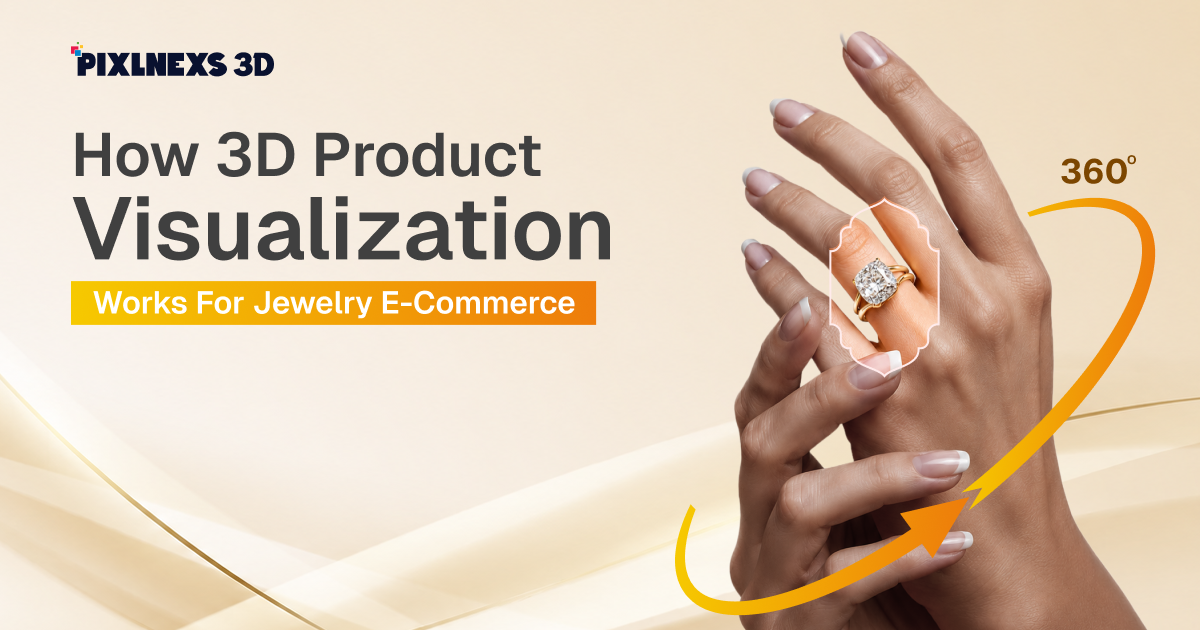
Purchasing luxury jewelry is a highly emotional process. Consumers acquire a necklace, bracelet or engagement ring to commemorate an event or express their connection. Customers seek a certain quality and craftsmanship of a piece.
However, marketing jewelry via online channels is very difficult.
A luxury accessory or ornament differs from clothes and personal care products in the sense that the subtle features matter. The buyers expect to see the play of light on a diamond the texture of the gold band the appearance of a gemstone setting from another perspective and the compatibility of the components. While an ordinary photo captures only one perspective on an item, it is impossible to create the similar feeling that comes with physically holding a jewelry piece.
That’s how 3D product visualization for jewelery alters customers’ shopping experience.
In contrast to conventional photos, the buyers have the possibility to rotate the product view inspect its clasp and settings from various angles.
For jewelry store owners, direct-to-consumer brands, and manufacturers, understanding this technology is no longer optional. It is quickly becoming the standard for online luxury retail.
What Is 3D Product Visualization for Jewelry?
This process consists of generating digital replicas of actual pieces of jewelry using special three-dimensional software. The exact replicas include:
- The luster and color of various metals
- Cutting details of the gems
- Any engravings and hallmarks
- How light reflects from polished surfaces
- Details of the construction such as prongs and clasps
When taking flat images, one sees only what was intended by the photographer. Three-dimensional images allow for manipulation on behalf of the buyer. He or she may rotate the ring all around, take a closer look at the setting, and examine the back side of the pendant.
Why Flat Photography Is No Longer Enough
Good photography is still useful for lifestyle marketing and brand campaigns. But when a customer is ready to buy, photos show their limits.
Why Small Details Determine Every Luxury Jewelry Purchase
When someone buys an expensive ring, they want to verify the small details before paying:
- Is the prong setting secure?
- How high does the stone sit off the band?
- Are the side diamonds aligned properly?
- How clean is the metal polish on the inner band?
A single photo cannot show all of this. If a buyer cannot inspect these features, they often hesitate to buy.
Reducing High Return Rates
Online shoppers act in particular ways when they are uncertain. They may put products in the shopping cart but fail to make purchases. Others may place orders for more than one size with the aim of sending most of them back. The return process costs the jewelry company money in the form of shipping and handling. Giving an interactive view gives consumers a clear idea of what they are buying.
Meeting the Expectations of Online Buyers
People who buy luxury items online expect a clean, professional digital experience. They want clear information, simple navigation, and accurate visuals. When a brand provides an interactive 3D tool, it shows they care about the customer experience, helping them stand out from standard online stores.
The Step-by-Step 3D Visualization Process
Creating an interactive 3D model involves a systematic technical process. Here is how we build these digital assets:
Step 1: Gathering Reference Materials
Our process begins by gathering facts or data about the piece of jewelry. This includes:
- CAD drawings (often already available from manufacturers during production)
- Drawings and blueprints
- Measurements for the band, the stones, and their settings
- Pictures at a high resolution from different angles
Step 2: Modeling the Geometry
Using the reference data, 3D artists build a digital mesh. This represents the physical structure of the piece. Every element is built to scale, including the main stones, small accent gems, prongs, clasps, and any decorative elements. Precision is necessary here, as customers will notice if a setting or proportion looks incorrect.
Step 3: Defining Materials and Textures
After the shape is modeled we add digital textures to make it look like the actual product. This process involves making sure that the material properties of the gold are appropriate – whether it be yellow gold, white gold, rose gold, platinum, or sterling silver. The gemstones themselves have their properties set to reflect real world physics of refraction and transparency.
Step 4: Setting Up the Lighting
Light plays a pivotal role in making jewelry visually attractive. At this stage, we will design virtual lighting effects that mimic real-life shadows and highlights and even reflections from metals. The aim here is to create realism in the piece, avoiding anything that is too artificial. The buyer expects nothing less than the actual piece.
Step 5: Integrating with the Online Store
The finished 3D model is compressed and optimized so that it loads quickly on mobile phones and desktop browsers. It is then embedded directly onto the product detail page, allowing customers to click, drag, and spin the item without experiencing any delay or lag.
How Interactive Shopping Affects Buyer Confidence
Jewelry requires light for its visual representation. At this stage, our task is to set up virtual lighting to create realistic-looking shadows, strong highlights, and reflective surfaces of metal components. We need to make the item look realistic rather than perfect or overly highlighted. People tend to like realistic pictures that show the jewelry item exactly as it would be seen with a naked eye.
Purchasing such products is always associated with some crucial life events, such as an engagement, anniversary, or success. Thus, making an expensive and meaningful purchase, people want to make sure of their decision before proceeding to payment.
In case a client could rotate a 3D model, the interaction with the product would be different:
The person would feel confident since he/she could independently check all features of the piece.
The person would feel empowered because he/she could control what part of the jewelry to examine.
It will be free from doubts regarding any imperfections because everything will be seen.
Therefore, creating visual content allows for building customer confidence in purchasing a certain product. Transparency of an item helps customers feel secure buying the product.
The Commercial Impact of 3D Visuals
For luxury merchants, investing in new tools must make financial sense. 3D visualization offers several clear advantages that support day-to-day operations and sales growth.
1. Answering Unspoken Questions
Because jewelry is expensive, buyers move slowly. They have questions they might not ask a customer service representative directly:
- How thick is the band?
- What does the back of the setting look like?
- How does the metal look under direct light?
An interactive model answers these questions instantly. When buyers get clear answers, they move to the checkout stage faster.
2. Improving Conversion Rates
Passive scrolling is not very effective in making any sales on expensive products. By enabling people to scroll through the jewelry, click and turn it around, they get more involved and spend more time on the product page, helping them to grasp what it offers and make more sales eventually.
3. Lowering Return Rates
Processing returns is an expensive activity, particularly where expensive items that need security shipping and proper examination are concerned. Most of the returned items have issues because the actual item does not resemble what the consumer saw from the pictures displayed online. Creating exact 3D renders ensures consumer satisfaction and reduces unnecessary returns.
4. Shortening Production Timelines
Traditional product photography needs time for samples to be produced, shipment to the shooting location, the photoshoot itself, and then editing. If you have 3D models of your products, you will get high-quality photos of them straight from the computer by using your CAD models prior to having the physical goods produced. This lets you unveil your new line of products weeks ahead of schedule.
5. Maintaining a Unified Catalog
As far as there are lots of products, it becomes hard to maintain consistency on your website. The lighting, angles, and backgrounds used during various photo shoots could be different from each other. However, using 3D rendering, one lighting condition, angle, and background would be applied to all products equally, creating consistency on your website.
Practical Applications for Modern Jewelry Retailers
Jewelry brands use 3D models in several areas of their business, moving far beyond a simple rotating image on a page.
Product Detail Pages
This is the most frequent arrangement. A viewer of three-dimensional objects is placed next to conventional images of the lifestyle, enabling people to examine the clasps, study the design of rings, and observe the way stones are set without going to another page.
Customization and Bespoke Orders
Many jewelry buyers want personalized pieces. 3D configurators let customers choose their metal, select a stone shape, or add custom engravings, updating the digital model in real time. Seeing their choices instantly helps them make decisions without needing to wait for a designer to draft a physical drawing
Pre-Orders and Virtual Inventory
Brands can display and sell new designs before manufacturing begins. By using CAD designs to generate 3D assets, companies can test consumer interest, build waitlists, and secure pre-orders. This reduces the financial risk of manufacturing designs that may not sel
Third-Party Marketplaces
Sellers on digital marketplaces must compete with hundreds of similar listings. Offering an interactive viewer makes a listing more engaging than stores that only use standard, flat images.
Comparing Photography and 3D Models
Both methods have distinct strengths. Instead of replacing photography, successful brands use both to serve different purposes.
| Feature | Standard Photography | 3D Visualization |
| Lifestyle & Brand Storytelling | Excellent | Limited |
| Interactive Viewing | No | Yes |
| 360-Degree Rotation | No | Yes |
| Visual Consistency | Moderate | High |
| Customization Previews | Difficult | Excellent |
| Pre-Production Marketing | No | Yes |
| Detail Inspection | Limited | Excellent |
| Updating Variations | Expensive | Simple and fast |
Photos are great for showing jewelry on a model they really capture the mood. They help build the brand identity of the jewelry.3D visualization is really good for showing what the actual product looks like it answers the questions that buyers have and it lets customers take a closer look at the details of the jewelry.When you use photos and 3D visualization together jewelry buyers get an online shopping experience, for the jewelry.
Is This Technology Right for Your Brand?
Investing in 3D assets requires time and resources. To decide if it is worth the effort for your business consider the types of products you sell. It is particularly useful if you offer:
- Fine jewelry and engagement rings where purchase prices are high
- Made to order or customized pieces
- Collections with detailed metalwork or unique stone settings
Ask yourself these operational questions:
- Do customers frequently ask your support team for additional photos from specific angles?
- Are you dealing with high return rates due to mismatched expectations?
- Do visitors leave your product pages without engaging?
- Do you need to launch collections faster than physical manufacturing allows?
If you answered yes to these questions, adopting 3D assets can solve these specific problems.
Selecting the Right 3D Production Partner
The success of your project depends on the team you work with. When evaluating 3D providers, look for specific capabilities:
Jewelry-Specific Experience
Jewelry is really tough to model
It needs an understanding of how metals shine and how gemstones bend light.
Some 3D studios are not great, at this. Might make your products look cheap. You should find a partner who has experience working with metals and stones. They should have a track record of doing this kind of work. Jewelry modeling requires attention to detail with metals and gemstones. A good partner will know how to make your jewelry look realistic.
Simple eCommerce Integration
Your three-dimensional browser needs to load quickly and integrate seamlessly with your current website platform, such as Shopify, WooCommerce, Magento, or other bespoke websites. Your 3D browser must not affect the loading speed of your website, which negatively impacts SEO.
Reliable Mobile Performance
Most internet users search and purchase using their mobile devices. Interactive models must be quick to load and work seamlessly across touch screen operations. They should be functional on both Apple and Android browsers without any additional software installation.
scalability
If you plan to expand your collection from fifty items to several hundred, your partner must have a reliable system to produce models consistently. They should be able to maintain the same standards of quality and lighting across your entire catalog.
The Direction of Jewelry eCommerce
From being static, image-based e-retailing to being more transparent and clear. Consumers want to be able to see a clear picture of the product prior to purchasing it.
In the world of E-commerce, your website acts as the shopfront. Your jewelry needs to be of high calibre just as much as the presentation of your products on your website should be.
Interactive 3D product visualization is not meant to merely showcase the technology that you have at your disposal. It is one of the most practical ways to reassure your customers who will feel the same way walking into a physical boutique and discussing it with a specialist.
For brands marketing to consumers within competitive marketplaces around North America and Europe, there is increasing pressure to present a clear and interactive view of their products.
Conclusion
Jewelry purchases are based on trust and emotions. An online sale will affect your way of presenting yourself rather than your audience’s priorities. Pictures are always incomplete; therefore, leaving too much to imagination is risky, as it raises doubts that lead to either no purchase at all or costly returns. The freedom for customers to study each prong, setting, and even the quality of metal finish in detail takes away this risk. The 3D technology gives the opportunity to show every aspect of the piece of jewelry clearly, thus establishing open communication between buyer and seller.
Get Started with Pixlnexs
At Pixlnexs, we build clear, highly accurate 3D models for jewelry and luxury accessory brands. We help you transition from flat, single angle photography to interactive product pages that let customers inspect your products from every angle.
Whether you want to launch an upcoming collection using CAD designs, upgrade your direct to consumer storefront, or improve your marketplace listings, we build 3D assets optimized for speed, precision, and ease of use. Contact us today to discuss your catalog and see how we can help.








Leave a Reply