
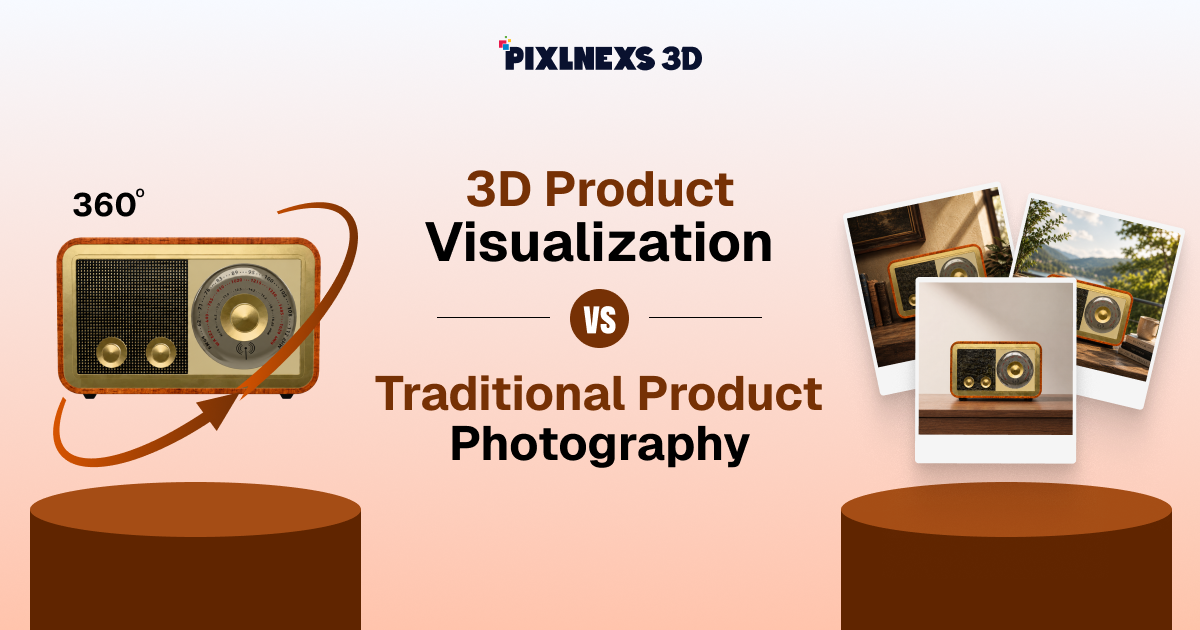
Quick answer: 3D product visualization vs product photography comes down to your catalog size and budget. Photography works best for small catalogs, lifestyle imagery and food or fashion editorial. 3D product visualization works best for large or frequently changing catalogs, since one digital model can generate unlimited colors, angles and scenes without a new photoshoot. Most established e-commerce brands use both, depending on the asset.
Choosing between 3D product visualization vs product photography is one of the biggest decisions e-commerce brands face when building product pages in 2026.
Online shoppers can’t feel a product before buying. They decide to buy based on what they see on their screen. This makes product pictures really important for stores.
For a time traditional product photography has been the usual way to show products online. Now 3D product visualisation are changing how brands show products to customers. They can make detailed digital pictures that let shoppers look at products from all sides.
3D product visualization vs product photography
As online shopping keeps changing in 2026 many brands are wondering: should they keep using photography or switch to 3D visuals?
The answer depends on what you want to achieve how money you have and what products you sell. This guide will look at both options in detail to help you decide.
Online shoppers rely on product visuals to make purchase decisions.
Product visuals have become a factor in e-Commerce success.
Online shoppers want to see products, from every angle.
3D product visualization allows shoppers to explore products in detail.
Many brands are asking: should they use photography or 3D visualization?
The answer depends on your goals and budget and product catalog.
Why Product Visuals Matter More Than Ever
People are being really picky these days. They want to see lots of pictures of a product they want these pictures to be real. They want to have a good time when they are shopping for Product Visuals.
Product Visuals are important because they can help people trust the product.
Good product visuals are widely believed to build customer trust, improve buying decisions and reduce returns, though results vary by product type.
When people can really see what they are buying, like Product Visuals they are more likely to actually buy Product Visuals.
What is 3D product visualization?
3D product visualization is when you make a model of a product using special computer programs.
These digital models are then turned into pictures that look really real. Things you can play with on the computer.
Interactive 3D is different from taking pictures with a camera.
You do not need to have the product or a special room with lights and cameras to take the picture.
Brands can make a lot of things with product visualization, such, as:
* Photorealistic product pictures
* Pictures of products that you can turn around to see from all sides
* Product configurators that you can play with on the computer
* Scenes that show how you might use the product in your life
* Cartoons of products
* experiences that use 3D product visualization and a special device to make it seem real
The pictures you get from 3D product visualization often look so real that you might think they are actual photographs of the product.
What Is Traditional Product Photography?
Traditional product photography is about taking pictures of products. This is done using cameras, lighting, backgrounds and photo editing tools.
Professional photographers make sure products look good and realistic in photos. They do this for stores.
There are styles of product photography. Some common ones are:
* White background product images
* Lifestyle photography
* Flat lay photography
* Editorial photography
* Promotional campaign photography
Photos are still one of the ways to show products. This is because they show objects in real situations. Product photography helps customers see products clearly.
Product photos are very important, for shopping.
Product images help buyers make decisions.
Comparing 3D Product Visualization and Photography
Cost
Cost is one of the biggest considerations for e-Commerce brands.
Traditional photography requires:
- Physical products
- Studio rentals
- Photography equipment
- Professional photographers
- Image editing
Every new product variation often requires another photoshoot.
3D visualization typically requires a larger upfront investment to build product models. However, once the model is created, generating additional images, colors, or scenes becomes much more affordable.
| Factor | Traditional Photography | 3D Product Visualization |
|---|---|---|
| Upfront cost | Lower per shoot | Higher to build first model |
| Cost per variation | New shoot needed each time | Near-zero once model exists |
| Speed for new colors/versions | Days to weeks | Hours |
| Best for | Small catalogs, lifestyle imagery | Large or frequently changing catalogs |
| Interactivity | None | Rotate, zoom, configure, AR preview |
| Authenticity | Real product captured as-is | Near-photorealistic, not the literal item |
For businesses with large product catalogs, 3D visualization often delivers better long term value.
Speed and Scalability
Photography can become time consuming when launching multiple products.
Each new product needs:
- Preparation
- Shipping
- Photography
- Editing
- Approval
In contrast, 3D artists can quickly generate multiple product versions from a single digital model.
A brand selling products in ten colors can create all variations without organizing ten separate photoshoots.
This scalability is one of the main reasons many growing brands are moving toward 3D visualization.
Case Study: 30-Day Performance Snapshot After Adding 3D Product Visualization
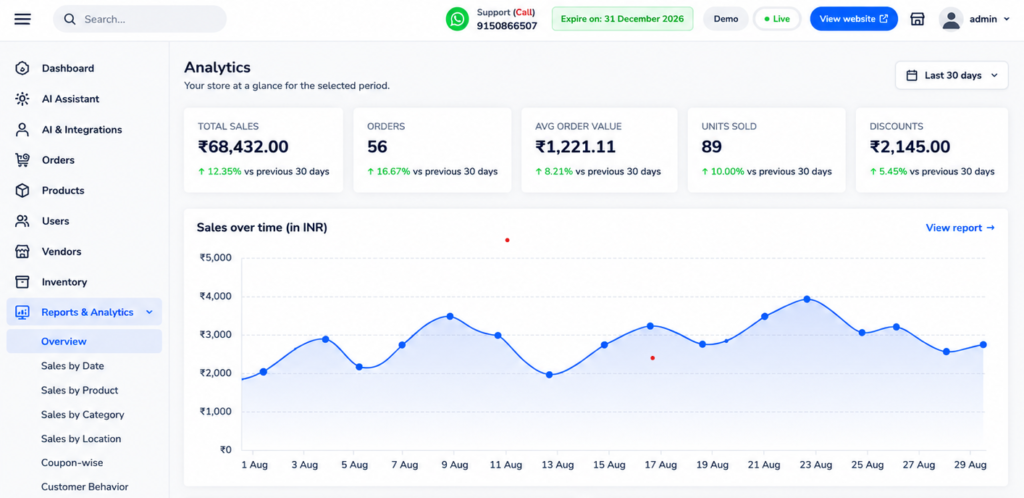
To back this up with real numbers, here’s a 30-day analytics snapshot from one of the stores we’ve worked on at Pixlnexs after introducing 3D product visualization to its listings:
- Total Sales: ₹68,432.00 (↑ 12.35% vs. previous 30 days)
- Orders: 56 (↑ 16.67% vs. previous 30 days)
- Average Order Value: ₹1,221.11 (↑ 8.21% vs. previous 30 days)
- Units Sold: 89 (↑ 10.00% vs. previous 30 days)
- Discounts issued: ₹2,145.00 (↑ 5.45% vs. previous 30 days)
Every core metric moved up in the same 30-day window sales, order count, and average order value all trending upward together, without a corresponding jump in discounting to drive it. That last point matters: the growth wasn’t discount-led, which suggests the lift is coming from better product presentation rather than heavier promotions.
Takeaway: this isn’t a controlled A/B test, but it reflects what we consistently see when 3D visualization replaces or supplements flat photography, order volume and order value tend to move together rather than one coming at the cost of the other.
Customization is really important for brands.
Customization is where 3D visualization does a job.
With models of products brands can do a lot of things.
They can change the colors of the products instantly.
They can also replace the materials used to make the products.
Brands can create campaigns with these digital models.
They can modify the backgrounds of the products too.
They can produce a lot of different versions of the same product.
Traditional photography is not that easy to work with.
When brands need to make changes they usually have to take pictures.
Customer Experience is what matters the most to brands.
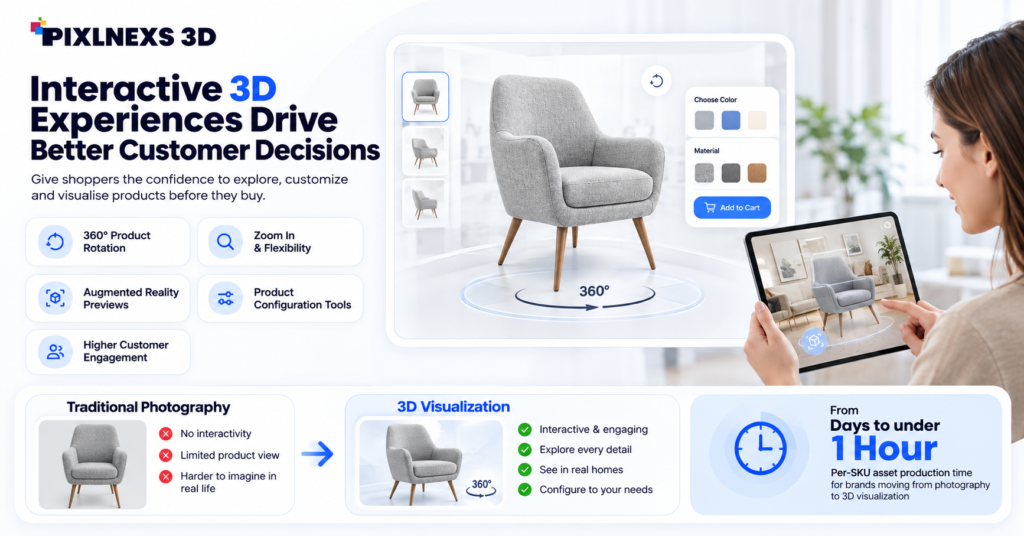
Modern shoppers want to have a time when they are shopping.
They want to be able to interact with the products they like.
3D visualization makes this possible.
It lets customers explore products in an interactive 3D way.
They can rotate the products. Zoom in, on them.
They can even see what the products would look like in their homes using augmented reality previews.
Brands can also give customers tools to configure the products they want.
All these features help customers understand the products better before they buy them.
Traditional photography is not as engaging as 3D visualization.
It just gives customers pictures that do not do much.
In projects we’ve delivered at Pixlnexs, brands moving from photography to 3D visualization typically cut their per-SKU asset production time from days to under an hour once the base model is built, since color and material changes no longer require a new shoot.
Product Accuracy
Photography captures real products exactly as they exist.
This authenticity can build trust among customers.
However, modern rendering technology has improved dramatically. High quality 3D renders now achieve remarkable realism.
The difference between a professional photo and a premium render is becoming increasingly difficult for customers to notice.
Marketing Flexibility
Marketing teams constantly need new visual assets.
Photography campaigns often require additional planning, resources and production costs.
3D visualization allows marketers to create:
- Website images
- Social media creatives
- Advertising assets
- Product videos
- Promotional banners
All from a single digital product model.
This flexibility helps brands maintain consistent visuals across every marketing channel.
Where Traditional Photography Still Excels
When you think about it traditional photography still has its place. With all the 3D visualization going on photography is still really good at certain things.
Photography is usually the way to go for things like food products and fashion editorials. It is also great for taking pictures of models and real world lifestyle scenes.. When it comes to brand storytelling campaigns photography is often the better choice.
The thing is, it can be really hard to make digital pictures look like real people’re interacting with each other.
A lot of brands are using photography and 3D visualization together. They are not just picking one or the other.
So why are brands using 3D modeling visualization.
Well there are a things that are making it more popular.
These include:
* Faster product launches
* Growing product catalogs
* shopping experiences
* Demand for interactive 3D content
* Expansion of augmented reality shopping
* Higher expectations, from online consumers
Brands that use 3D technology can make content faster. It all looks the same
Which Option Works Best for Your Business?
Pixlnexs builds 3D product visualization assets, including photorealistic renders, 360-degree spins
and interactive configurators, for e-commerce brands moving away from traditional photoshoots.
The best solution really depends on your business model.
If this is the case choose photography:
* You use a lot of lifestyle images
* Your product list is pretty short
* You need real-life images that’re authentic
On the other hand choose 3D visualization if:
* You have different product versions
* You often launch new products
* You need to produce a lot of content that can be easily scaled
* You want to offer shopping experiences that let customers interact with products
top e-Commerce brands now use both traditional photography and 3D visualization.
They use photography for brand ads and lifestyle content.
They rely on 3D visualization, for product pages and tools that let customers customize products.
They use 3D visualization to show products in a way.
They use photography to create a look and feel for their brand.
This way they can show their products in an engaging way.
Final thoughts
When you compare 3D product visualization to product photography in 2026 you will find that one is not better than the other for every single business.
3D product visualization is a choice for many eCommerce brands because it is easy to scale and it is flexible and it saves money in the long run.
As people do online shopping it is becoming very important to have product experiences that people can interact with and customize.
Businesses that use 3D product visualization technology can make their customers happy and also make their work easier.
Traditional product photography is still good for telling stories and showing what a brand is, like.
When it comes to showing products in a big way 3D product visualization is the way to go for the next generation of e-Commerce growth and 3D product visualization is leading the way.
3D product visualization is what many e-Commerce brands are using now because 3D product visualization is getting better and better.
Frequently Asked Questions
1.Is product visualization cheaper than product photography?
For big lists of products and many different versions 3D product visualization is often a better deal in the long run. This is because the same model can be used again and again in different campaigns.
3D product visualization can be used times which makes it cheaper.
2.Can 3D pictures look as real as photographs?
Yes. New technology can make pictures that look very real and are similar to professional product photography.
3.Does 3D product visualization help sell products?
When customers can see products in an interactive way they understand the products better. This can make them feel more confident and help them decide to buy, which can increase the number of sales of product visualization.
4.Which types of businesses benefit the most from product visualization?
Businesses that sell furniture, electronics, things for the home, cars, manufactured goods and things people use every day often see big benefits from using 3D product visualization.3D product visualization is very useful for these businesses.
5.Should companies stop using photography. Only use 3D product visualization?
No. Many successful companies use both photography and 3D product visualization to get the pictures and be flexible with their marketing.
They use both product visualization and photography.
6.What will product visualization be like, in the future when people shop online?
In the future people will be able to see products in an interactive way use augmented reality to shop visit virtual showrooms and customize products just for them using 3D technology.
3D product visualization will be used for things.
7.Is 3D product visualization cheaper than photography long-term?
Yes, for catalogs with recurring updates. A traditional photo shoot needs to be repeated for every new angle, color variant, or seasonal update, while a 3D model can be re-rendered instantly at no extra shoot cost. The upfront cost of 3D modeling is often higher per SKU, but it pays off once you factor in reshoots, studio time and photographer fees over a product’s lifecycle.
8.Can 3D renders be used for ads and social media the same way as photos?
Yes. 3D renders export as standard image or video files (JPG, PNG, MP4) that work across Meta Ads, Google Shopping, Instagram and other platforms exactly like photos. Many brands also use 3D-rendered 360° spins or short animations to stand out in ad placements where static photos blend in.
9.Do I need special software to view 3D product models?
No, not as a shopper. 3D product models are typically embedded on product pages using web-based viewers (like glTF/GLB viewers) that run directly in the browser no plugins or downloads needed. Special software is only needed on the creation side, by the studio or team building the model.









Leave a Reply