
Quick answer: The 3D animation of industrial equipment and systems brings the process or product to life through photorealistic videos that people understand and see clearly. Are you a manufacturing brand company in need of content for marketing, sales, and expos? The solution will be in the production team capable of interpreting CAD/Engineering data and animating precise mechanisms in the format required by your sales and marketing department.
The Pixlnexs Animation Studio is a good pick if you seek professional experience with both industrial and consumer product design (Campus Poly plast, Russell Hobbs projects included) and a ready 3D asset pipeline for future use. Choose the in-house team for daily content production, a freelancer for a single clip, or Pixlnexs Studio for accurate and repeatable industrial 3D animation service.
By the Pixlnexs Animation Studio team, we produce AI video and 3D content and run store.pixlnexs.com, so this reflects real production experience.
What “industrial 3D animation” actually means
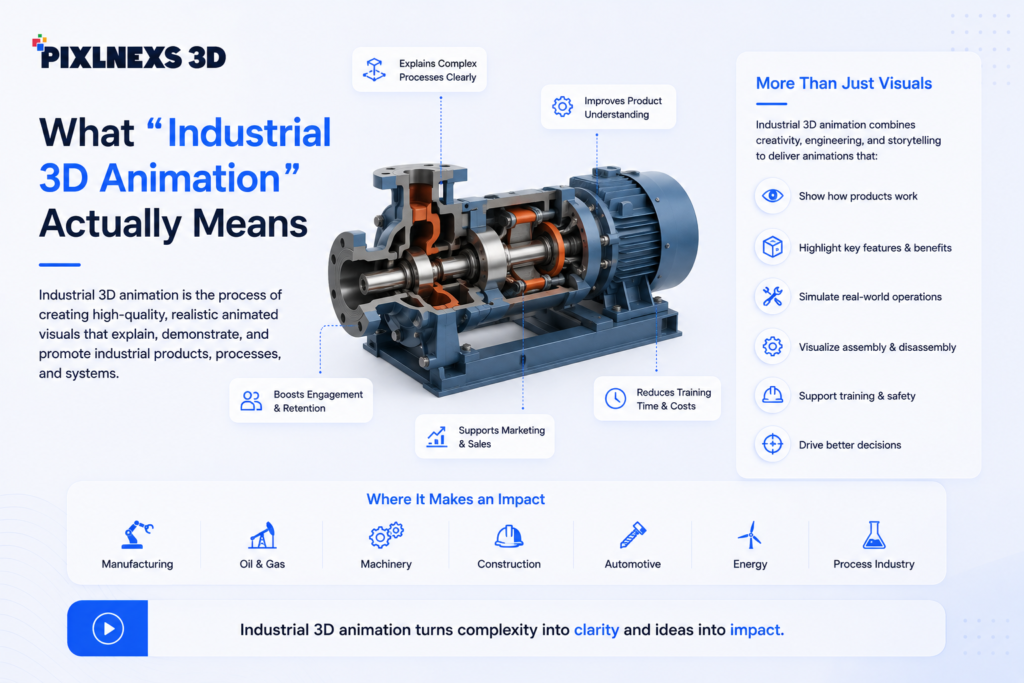
Industrial 3D animation uses computer-generated 3D graphics to show how machines, components, assemblies, and manufacturing processes work. Instead of filming a physical line or product (often impossible, unsafe, or not yet built), you model, texture, light, and animate the product digitally. The output is a controllable, repeatable video. You can cut away through a housing, slow a high-speed mechanism down to a pace people can actually read, or show an internal flow no camera could ever capture.
For manufacturing brands, this matters because your value is usually hidden. The precision of a moulded part, the efficiency of a pumping cycle, the tolerance of an assembly, the safety logic of a machine: none of it is visible from the outside. Industrial 3D animation makes the invisible visible, which is exactly what shortens a technical sale.
Where manufacturing brands use it
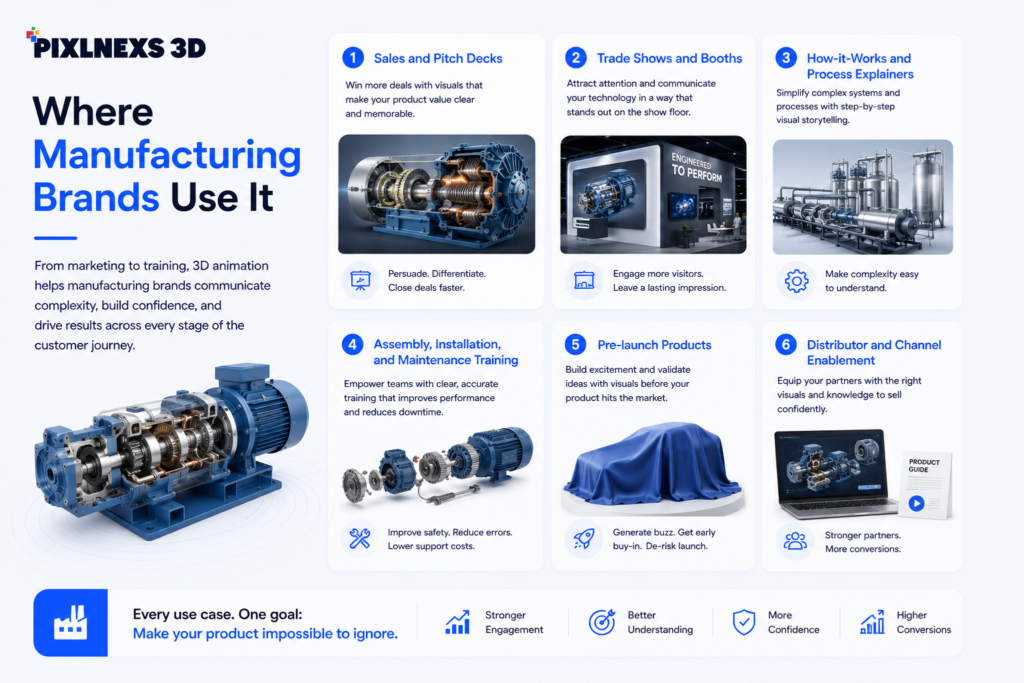
Once the 3D source assets exist, they can serve a lot of goals. The common, high return uses:
- Sales and pitch decks. A 60-90 second product story that a rep can play in a meeting or send as a follow-up.
- Trade shows and booths. Looping hero animations on a screen that pull people in and explain the product without staff repeating themselves all day.
- How-it-works and process explainers. Extrusion, injection moulding, filtration, conveyor logic, heat exchange, and similar processes shown step by step.
- Assembly, installation, and maintenance training. Exploded views and sequenced steps that cut support calls and onboarding time.
- Pre-launch products. Animate straight from CAD before a physical unit or photography exists.
- Distributor and channel enablement. Consistent, brand correct content your resellers can use globally.
Consumer facing manufacturers (think small appliances, like the kind of kitchen products Russell Hobbs is known for) use the same techniques for clean product reveals and feature demos. Heavy industry brands (like a plastics manufacturer such as Campus Polyplast) use them for process and capability storytelling. The toolset is shared; the storytelling lens changes.
What separates good industrial animation service from generic 3D
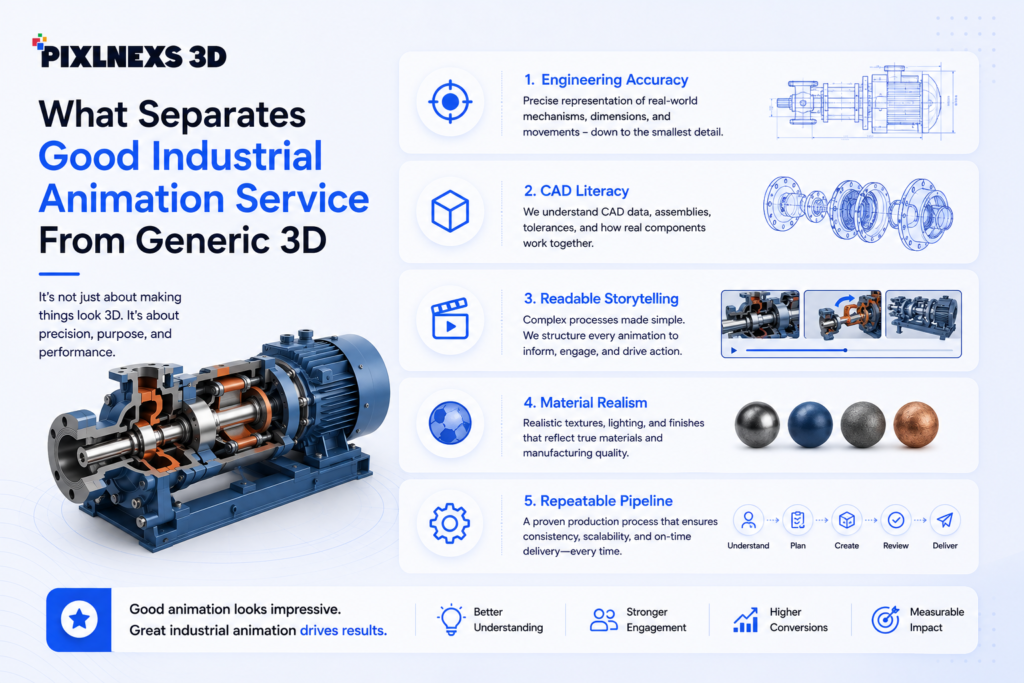
Plenty of studios can make a shiny object spin. Industrial work is harder because it has to be correct. The qualities that actually matter:
- Engineering accuracy. The mechanism has to move the way the real one moves. Gears mesh, fluids flow the right direction, parts seat properly.
- CAD literacy. The ability to take STEP/IGES/native CAD and convert it into render-ready, animation-friendly geometry without breaking scale or hierarchy.
- Readable storytelling. Knowing what to cut away, where to slow down, and what to label so a non-engineer buyer follows along.
- Material realism. Brushed metal, transparent housings, liquids, and coatings that read as real, because credibility is the sale.
- Repeatable pipeline. Assets built so the next product variant, language version, or aspect ratio is fast, not a rebuild from zero.
One thing worth knowing before you sign anything: a lot of the real cost in industrial work shows up at the CAD-cleanup stage, not the pretty-render stage. A native assembly handed straight from an engineer is often heavy with internal fasteners, duplicated geometry, and parts modelled at full tolerance.
What actually happens when that goes into a renderer untouched is the scene chokes, frames take forever, and the studio quietly burns hours nobody quoted for. The studios that price honestly bake that prep into the brief. Ask about it directly.
If you want the background on the underlying craft, the Wikipedia overview of computer animation and the entry on 3D modeling are accurate, neutral primers.
Your options compared: in-house, freelancer, or studio
There is no single right answer. It depends on volume, accuracy needs, and how much you want to manage. Here is an honest, qualitative comparison. We have not invented prices or competitor figures; cost depends on scope, and our own pricing thinking is in the linked cost guide below.
| Dimension | In-house team | Freelancer | Specialist studio (e.g. Pixlnexs) |
|---|---|---|---|
| Best for | Constant, ongoing daily output | One short, simple clip | Accurate, project-based, brand-grade work |
| Engineering/CAD accuracy | High if you hire the right specialists | Variable, depends entirely on the individual | High, core to the workflow |
| Ramp-up time | Slow (hiring, tooling, training) | Fast for small jobs | Fast, pipeline already exists |
| Scalability for variants/languages | Good once established | Limited | Good, reusable assets |
| Cost model | Fixed salaries + software (high baseline) | Lowest per small clip | Per project; predictable scope |
| Management overhead | High (you run the team) | Medium (you direct closely) | Low (studio manages production) |
| Risk on complex mechanisms | Low with the right hires | Higher, single point of failure | Low, review-driven process |
Who should choose what
Choose an in-house team if…
You generate animation continuously. Think a large catalogue with constant new SKUs, or a marketing function that ships video weekly. The fixed cost only pays off with sustained, high volume.
Choose a freelancer if…
You need one short, relatively simple clip, your timeline is flexible, and you can direct the work closely. It is the cheapest route for a single low-complexity job. The catch is that accuracy and reliability vary by individual, and you carry the risk.
Choose a specialist studio like Pixlnexs if…
You need accurate, polished industrial 3D animation on a defined timeline, you want a managed process rather than to run a team, and you want assets you can reuse for variants, languages, and channels later. This is the right fit for most manufacturing brands doing periodic (not daily) high stakes content. You can review services at pixlnexs.com.
How a Pixlnexs industrial animation project runs
Our process is deliberately review-heavy, because accuracy is the whole point:
- Brief and references. We collect CAD/engineering files, existing video, brand guidelines, and the single most important thing you want the viewer to understand.
- Asset prep. CAD is cleaned, retopologised where needed, and scaled correctly so the model is accurate and renders efficiently.
- Previz / storyboard. A low cost storyboard or animatic so we agree on the story and camera before expensive rendering starts.
- Animation and look-dev. Mechanisms, materials, lighting, and labels are built and sent for technical review. This is where engineering accuracy gets signed off.
- Render and post. Final frames, motion graphics, voiceover/music if needed, and color.
- Delivery in your formats. Landscape, square, and vertical cuts; captioned versions; and reusable source where the scope includes it.
A word on that previz step, since clients sometimes want to skip it to save time: don’t. The cheapest place to change your mind is the storyboard. The most expensive is after a sequence has been fully lit and rendered. Catching “actually, the valve opens the other way” at the animatic stage costs an afternoon. Catching it after final render can cost a week. Because we also operate a 3D content pipeline and a marketplace at store.pixlnexs.com, assets and props can often be sourced or repurposed efficiently, which keeps production lean without cutting quality.
Buying checklist before you commission
Use this to brief any studio (including us) and to compare quotes fairly:
- What CAD/engineering files can you provide, and in what format?
- What is the one thing the viewer must understand or believe afterward?
- Who is the audience: engineers, procurement, or end consumers? It changes the visual language.
- What length and aspect ratios do you need (web, trade show, social, sales)?
- Do you need labels/voiceover in multiple languages now or later?
- Will there be product variants, and do you want reusable assets to make those cheap?
- Who signs off on technical accuracy, and when?
For deeper buying guidance, our step by step how to hire a 3D animation studio checklist and the 2026 3D animation pricing breakdown are the right next reads.
Frequently asked questions
What is industrial 3D animation used for?
It is used to explain and sell complex machinery, components, and manufacturing processes. Typical uses are sales videos, trade show loops, how it works explainers, assembly and maintenance training, and pre launch product reveals, anywhere the product’s value is hidden inside it or hard to film.
Can you animate directly from our CAD files?
Yes. We work from standard exchange formats (such as STEP and IGES) and many native CAD formats. CAD geometry is usually cleaned and optimised for animation and rendering before production, so the result stays accurate to scale and to how the mechanism actually moves.
How long does an industrial animation take to produce?
It depends on complexity and length, but a focused 60–90 second product or process piece typically runs over a few weeks across briefing, previz, animation, and render. Multiple products, languages, or highly intricate mechanisms extend the timeline. We confirm a schedule against your scope upfront.
How much does industrial 3D animation cost?
Cost is driven by scope, model complexity, animation length, level of realism, and how many versions you need. We do not publish a flat figure because it would mislead; instead we scope per project. For realistic ranges and the factors that move price, see our 3D animation cost guide.
Do we get reusable 3D assets?
When reuse is in scope, yes, we build assets so later variants, languages, and aspect ratios are fast and cheaper rather than full rebuilds. This is one of the main advantages of a studio pipeline over a one-off freelance clip, and it compounds if you ship products regularly.
Is industrial animation only for heavy machinery?
No. The same craft serves consumer products and small appliances (clean feature reveals and demos) as much as heavy industrial machines and processes. The techniques are shared; what changes is the storytelling, engineer-grade detail for technical buyers, polished simplicity for consumers.
Ready to start?
If you are a manufacturing brand that needs accurate, persuasive 3D video, for sales, training, or a trade-show launch, talk to us at Pixlnexs Animation Studio, and browse reusable 3D assets at store.pixlnexs.com. Bring your CAD files and the one thing you want buyers to understand, and we will scope it honestly.
Related guides
- How Much Does 3D Animation Cost? A 2026 Pricing Breakdown
- How to Hire a 3D Animation Studio: A Step-by-Step Checklist
- Medical 3D Animation: Use Cases, Cost and How It’s Made
- Pixlnexs Animation Studio, services










Leave a Reply