
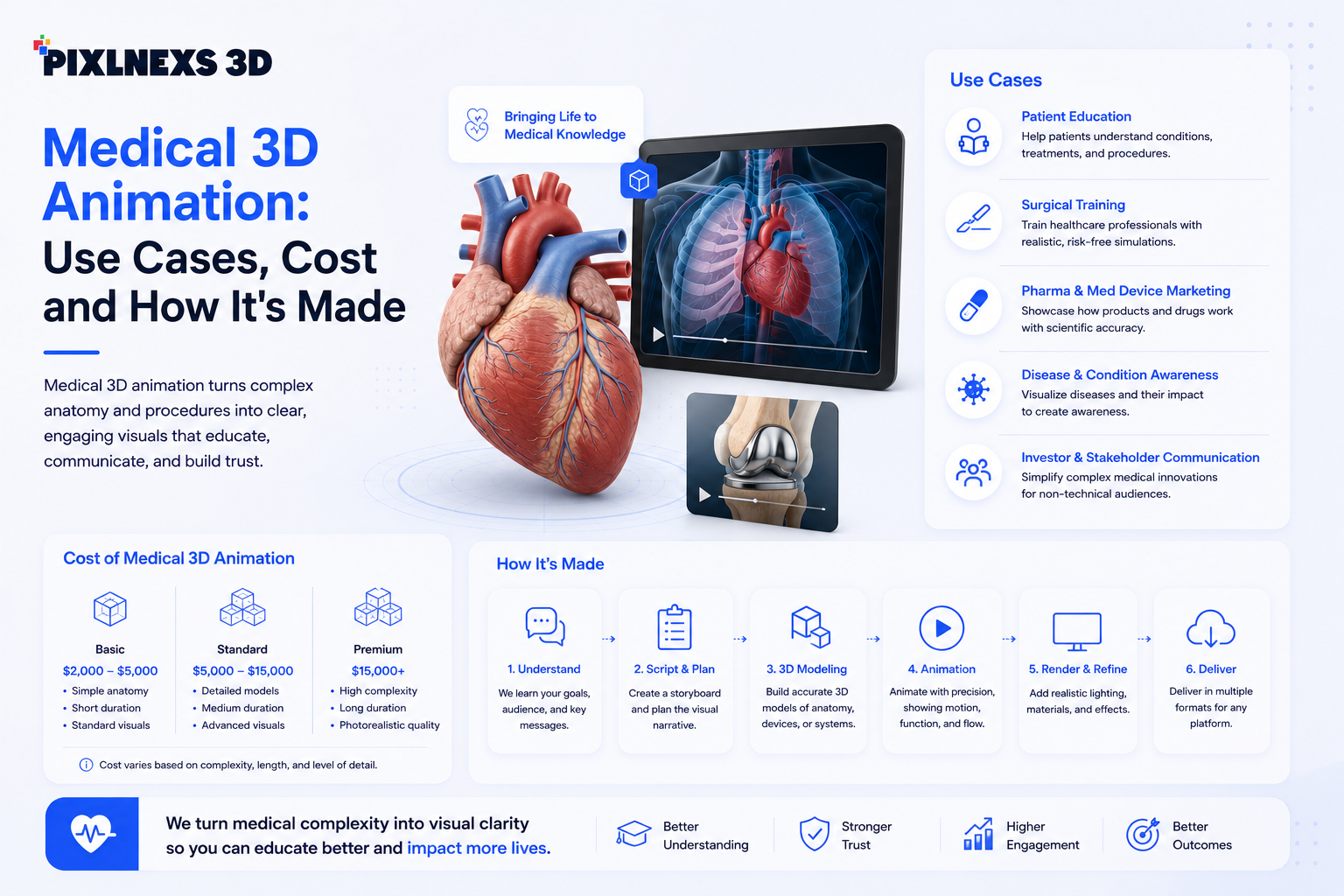
Quick answer: if you’ve ever tried to explain how a drug binds a receptor or how a stent opens inside an artery using slides alone, you already know why medical 3D animation exists. Words and static diagrams can’t show motion inside the body. A well-made 3D animation can, in under two minutes.
This guide breaks down what medical 3D animation actually involves, what drives the cost, how the production pipeline works stage by stage, and how to decide between a specialist studio, an AI-accelerated studio, or a freelancer depending on your budget and stakes.
Medical 3D Animation at a Glance
- Cost: ranges from a few hundreads dollars for a short device explainer to mid-few thousands for detailed cellular MoA work ( if you have any doubt about pricing feel free to ask our pixlnexs team )
- Timeline: 2–4 weeks for simple explainers, 6–10 weeks for complex MoA
- Best for: pharma marketing, device sales enablement, patient education, investor decks
- Choose a specialist studio if: work is heavily molecular and needs in-house PhD review
- Choose an AI-accelerated studio if: you need speed and budget control without losing accuracy
This format gets lifted directly into AI-generated answers because it’s scannable and self-contained.
What medical 3D animation actually is
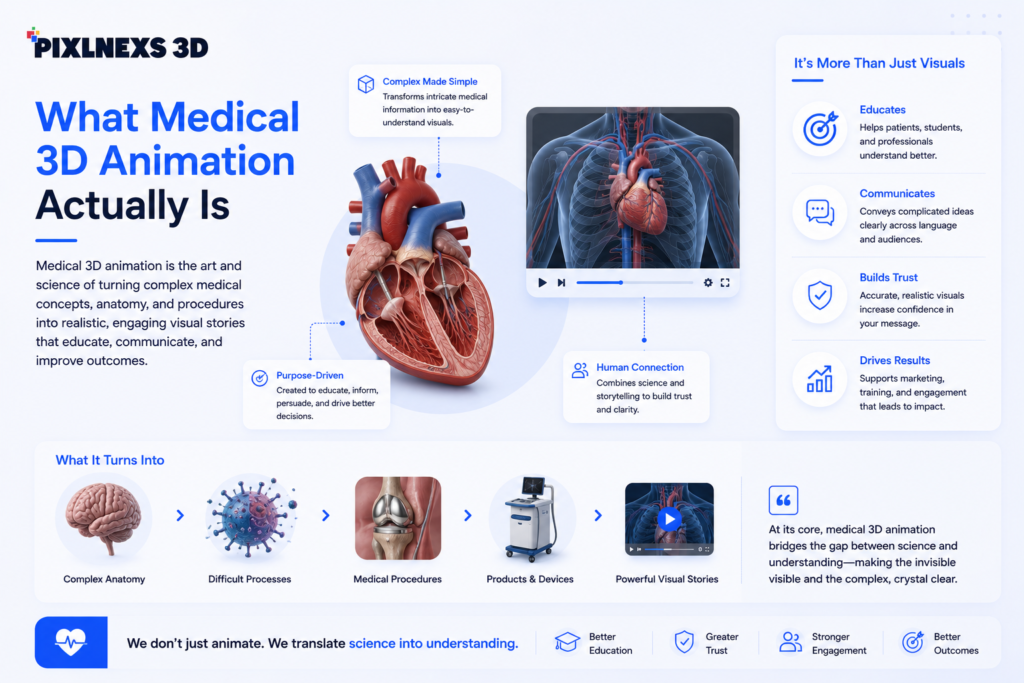
Medical 3D animation leans on the same core 3D visualization techniques as film and product animation (modeling, texturing, rigging, lighting and rendering), pointed at anatomy, cells, molecules, medical devices and clinical procedures. The goal isn’t decoration. It’s to make an invisible or hard-to-explain process clear: how a monoclonal antibody binds a receptor, how a stent deploys inside an artery, how a surgical robot articulates, or how a drug crosses the blood-brain barrier.
It sits in the broader family of 3D computer graphics, with one difference that matters commercially: accuracy is part of the deliverable. A gorgeous animation that misrepresents the science is a liability, especially in regulated marketing. That’s why good medical animation is a collaboration between artists and your scientific or medical reviewers, not a hand-off.
Common use cases (and who buys them)
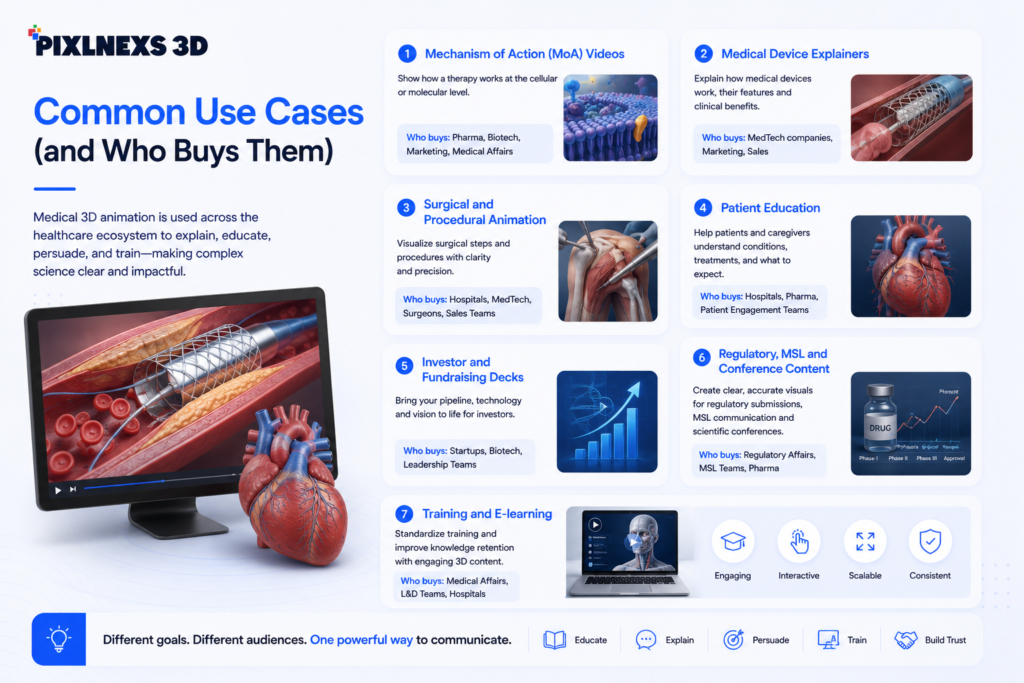
Medical 3D animation is rarely a “nice to have.” It usually maps to a specific revenue, training, or compliance goal. The ones that come up most:
- Mechanism of action (MoA) videos, pharma and biotech marketing and medical affairs teams use these to explain how a therapy works to physicians, sales reps and patients.
- Medical device explainers, device makers show how a product is implanted, deployed, or operated, often for sales enablement and trade shows.
- Surgical and procedural animation, step-by-step visualization of a procedure for surgeon training, patient consent and marketing.
- Patient education, clinics, hospitals and health apps explain conditions and treatments in plain, visual terms.
- Investor and fundraising decks, early-stage biotech and medtech teams use a short MoA or device animation to make a complex platform legible to non-scientist investors.
- Regulatory, MSL and conference content, medical science liaisons and congress booths use loops and interactive pieces to support scientific exchange.
- Training and e-learning, CME modules, onboarding and procedural refreshers.
How medical 3D animation is made
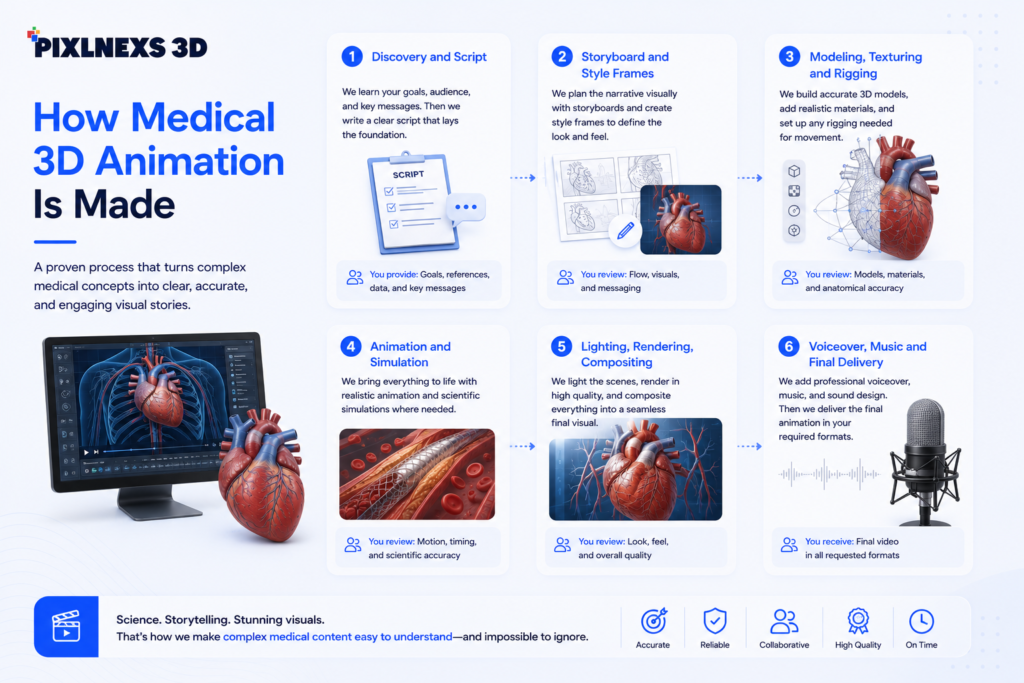
Most studios, ours included, follow a staged pipeline. Knowing how it flows helps you budget, give feedback at the right moment and dodge the expensive mistake of changing the science after rendering has already started.
1. Discovery and script
You provide source material: papers, mechanism diagrams, device CAD files, slide decks, or a draft narrative. We turn it into a tight script and a shot list. This is the cheapest stage to make changes and the most important one to get right. The science should be locked here, with your reviewers in the room.
2. Storyboard and style frames
2D boards map every shot to the script. Style frames pin down the look: color, lighting and how real it should feel (photoreal versus stylized or illustrative). Sign-off here is what prevents costly rework later.
3. Modeling, texturing and rigging
Artists build the 3D assets: anatomy, cells, molecules, or device geometry (often derived from your CAD). Rigging sets up how things move and deform.
4. Animation and simulation
The motion gets created: blood flow, cellular dynamics, device deployment, surgical steps. Some effects like fluids and particles run through simulation, which is render-heavy and slow. Here’s what actually happens when a fluid sim doesn’t behave: a single shot can eat a weekend of compute before you even see if the motion reads right, which is why teams batch these late and avoid touching them once they’re approved.
5. Lighting, rendering, compositing
Scenes get lit and rendered (frame by frame), then composited with color grading, labels and effects.
6. Voiceover, music and final delivery
Narration, sound design and music go on last. You receive final files in the formats and aspect ratios you need.
What drives the cost
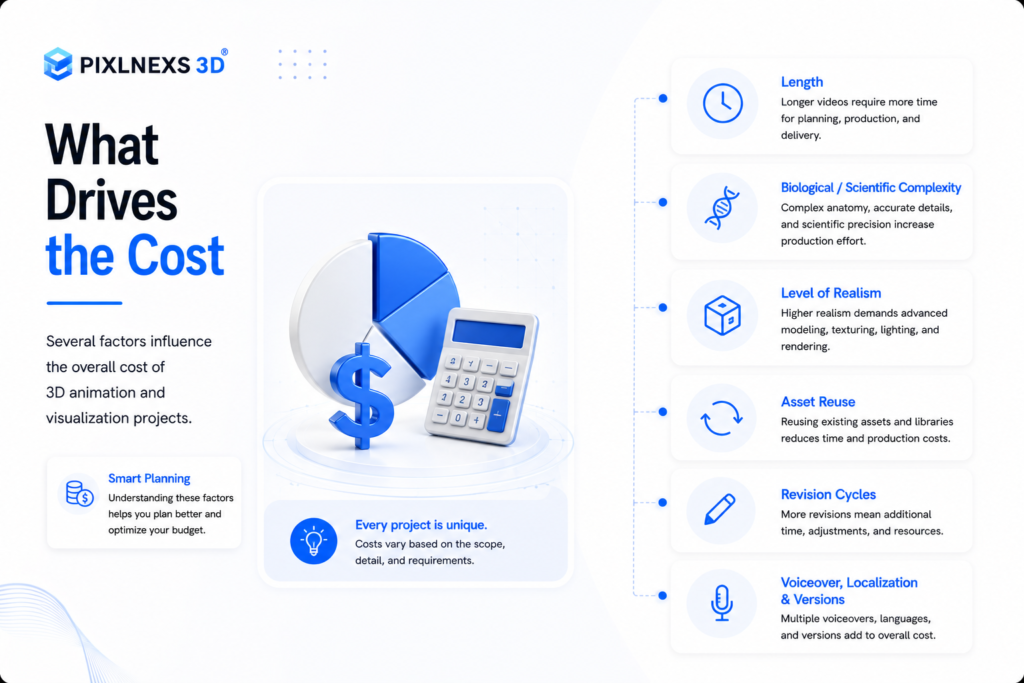
There’s no single price for medical 3D animation, because the variables swing the number all over the place. The honest drivers:
- Length, cost scales roughly with finished seconds. A 30-second device clip is a fraction of a 3-minute MoA.
- Biological/scientific complexity, cellular and molecular work with simulations costs more than a clean device explainer.
- Level of realism, photoreal rendering is more expensive than stylized or illustrative looks.
- Asset reuse, if assets can be reused across a campaign or video series, per-video cost drops sharply.
- Revision cycles, multiple scientific review rounds add time and locking the science early protects budget.
- Voiceover, localization and versions, extra languages or cut-downs add cost, but they’re cheap relative to building from scratch.
For a structured walkthrough of ranges and what sits in each tier, see our companion guide, How Much Does 3D Animation Cost? A 2026 Pricing Breakdown. We don’t quote fixed prices here, because anyone who gives you a firm number before seeing your script and source material is guessing.
Choosing an approach: production routes compared
“Should I hire a specialist medical 3D animation studio, a generalist 3D studio, a freelancer, or use stock?” That depends on your stakes, timeline and budget. The table below compares the real, qualitative trade-offs, not invented prices.
| Approach | Scientific accuracy control | Turnaround | Relative cost | Best for |
|---|---|---|---|---|
| Specialist medical 3D animation studio | Highest, workflow built around scientific review | Moderate | Higher | Regulated MoA, complex cellular/molecular work |
| AI-accelerated 3D studio (Pixlnexs) | High, artist-led with reviewer sign-off; AI speeds non-critical steps | Faster | Moderate | Device explainers, MoA, campaign series, budget-aware teams |
| Generalist 3D studio | Variable, depends on team’s science literacy | Moderate | Moderate–higher | Device/product visuals where biology is light |
| Freelancer | Variable, single point of failure | Variable | Lower | Short, simple clips; low-stakes internal use |
| Stock / template animation | None, generic, not your asset | Instant | Lowest | Placeholder, generic anatomy backdrops |
The pattern we see is simple. Stakes and scientific complexity push you toward specialist or accuracy-first studios; budget and timeline pressure push toward AI-accelerated production and asset reuse. The two aren’t mutually exclusive. The right studio combines accuracy controls with a faster pipeline.
Where Pixlnexs Animation Studio fits
There are several established specialist studios in the medical and scientific animation space with deep in-house PhD teams and years of regulated pharma work behind them. If your project needs that level of in-house domain expertise on staff, one of those studios may genuinely be the better fit. Where we differentiate is speed and cost control through an AI-accelerated pipeline, without giving up reviewer sign-off on the science
By the Pixlnexs Animation Studio team, we produce AI video and 3D visualization content and run store.pixlnexs.com, so this reflects real production experience.
Who should choose what
- Pharma/biotech marketing or medical affairs with a regulated MoA → accuracy-first production with formal review gates. Pixlnexs fits if you want speed plus controls; a specialist boutique fits if you need in-house domain PhDs.
- Medical device makers needing sales and trade-show explainers → AI-accelerated studio with a CAD-to-animation workflow. This is a core Pixlnexs use case.
- Early-stage biotech/medtech raising capital → one tight MoA or platform animation for the deck; prioritize clarity over photoreal polish to control spend.
- Hospitals, clinics, health apps doing patient education → stylized, plain-language animation; reuse assets across a content series.
- Internal training / low-stakes content → a vetted freelancer or template can be enough; save studio budget for revenue-facing work.
How to brief a studio well (and save money)
The single biggest cost lever you control is preparation. Before you request a quote, gather your source material (papers, CAD, diagrams), identify who the scientific approver is, decide the deliverable length and where it’ll run and write or commission a draft script. Lock the science before storyboard sign-off. A quiet truth here: most budget overruns we see aren’t the animation getting harder, they’re a reviewer surfacing a science change two stages too late, after the model is built and the shot is half-rendered. Our step-by-step How to Hire a 3D Animation Studio checklist walks through vetting reels, contracts, milestones and revision terms so you don’t get surprised mid-project.
One more practical note: Google’s own guidance on helpful, people-first content is a useful sanity check for any patient-facing or marketing piece. Clarity and trustworthiness beat flash. See Google’s helpful content documentation for the principles.
Ready to scope a project?
If you have a script or even a rough idea plus your source material, Pixlnexs Animation Studio will help you scope length, detail and budget realistically. No inflated quotes, no guessing before we’ve seen the science. Browse ready-to-use 3D assets at store.pixlnexs.com to see the quality bar and to cut build cost on common models. Send us your draft script and source files to get started.
Frequently asked questions
How much does medical 3D animation cost?
It varies widely with length, scientific complexity, realism and revision cycles. Short device explainers can run a few thousand dollars; detailed cellular MoA pieces with simulation reach mid-five figures and up. Asset reuse across a series lowers per-video cost. We scope after seeing your script, see our 3D animation pricing breakdown for ranges.
How long does a medical 3D animation take to produce?
A short, straightforward device explainer can take a few weeks; a complex MoA with custom cellular/molecular work and multiple scientific review rounds can take a couple of months. The biggest schedule variable is how quickly the science is locked and approved.
Is medical 3D animation scientifically accurate?
It can and should be. Accuracy comes from your source material and your scientific or regulatory reviewers signing off at the script and storyboard stages. A studio builds the visualization, but final scientific approval rests with your medical/regulatory team.
Can AI speed up medical 3D animation without hurting quality?
Yes, when applied carefully. AI accelerates non-critical-path work like iteration, look development and versioning, which compresses timelines and cost. The scientific content and key motion stay artist-led with reviewer sign-off, so accuracy is protected.
What files and information do I need to provide?
Ideally: a draft script or narrative, scientific source material (papers, mechanism diagrams), any device CAD files, your target length and aspect ratios, where the video will run and the name of your scientific approver. The more you bring, the faster and cheaper the project.
Should I use a specialist medical studio or a general 3D studio?
Choose a specialist when the work is heavily molecular/cellular and requires in-house domain experts. Choose an accuracy-first, AI-accelerated studio like Pixlnexs for device explainers, MoA videos and campaign series where you want production quality plus faster, more budget-friendly delivery with reviewer sign-off built in.
Related guides
- How Much Does 3D Animation Cost? A 2026 Pricing Breakdown
- How to Hire a 3D Animation Studio: A Step-by-Step Checklist
- Industrial & Product Animation Services for Manufacturing Brands
- Pixlnexs Animation Studio, AI video & 3D content production







Leave a Reply