

Quick Answer: 3D animation creation and applications is the process of digitally creating images that simulate motion in a three-dimensional environment. Animators use professional software such as Maya, Blender, ZBrush and Cinema 4D to model objects, rig them for movement, animate keyframes and render the final sequence. The applications of 3D animation now extend well beyond film and entertainment. The technology plays an active role in medical training, industrial safety, architectural visualization and commercial advertising, each of which benefits from the ability to show complex processes, accurate spatial environments or product behavior in a way that static imagery or text cannot.
By Bali Balaji, Pixlnexs Studio. Pixlnexs produces 3D animation and AI video content for brands, healthcare organizations, industrial clients and EdTech platforms and this guide reflects the production experience and application knowledge our team draws on across every category we work in.
Key Takeaways
- 3D animation creates the illusion of motion in a digital three-dimensional environment by rendering a sequence of frames from a 3D scene different from 2D animation in that depth, perspective and physical material behavior are all part of the output.
- The production pipeline for 3D animation follows a consistent sequence: modeling, rigging, animation, lighting, rendering and compositing regardless of the end application or the software used.
- 3D animation was pioneered in the 1950s and 1960s by figures including John Whitney, who developed mechanical and early computer animation techniques and created title sequences for television and film.
- Medical 3D animation is one of the most technically demanding and commercially valuable applications used for surgical training, patient education, drug mechanism visualization and pharmaceutical marketing.
- Industrial 3D animation reduces workplace injury risk and improves training outcomes by demonstrating hazard procedures, equipment operation and safety protocols in a controlled, repeatable visual format.
- Architectural 3D animation gives clients a walkthrough of a building before it is built, which accelerates approval decisions and reduces costly design revisions.
- Commercial 3D animation and motion graphics are standard tools in brand advertising, product launch campaigns and digital marketing particularly for products or mechanisms that cannot be effectively demonstrated through live-action video.
3D Animation Creation and Applications Across Industries
3D animation is the process of creating the illusion of movement by generating a sequence of rendered frames from a three-dimensional digital scene. Unlike traditional 2D animation, which creates motion by drawing flat images in sequence, 3D animation operates in a virtual space that has depth, height and width and the objects, characters, environments and materials within that space behave according to physical simulation rules that the animator controls.
The output of a 3D animation pipeline is a video file composed of individual rendered frames. Each frame is a photorealistic or stylized image of the 3D scene from a specific camera position at a specific moment in time. When those frames are played back at the standard rate of 24 to 30 frames per second, the sequence reads as continuous motion.
A Brief History: From John Whitney to Modern Production
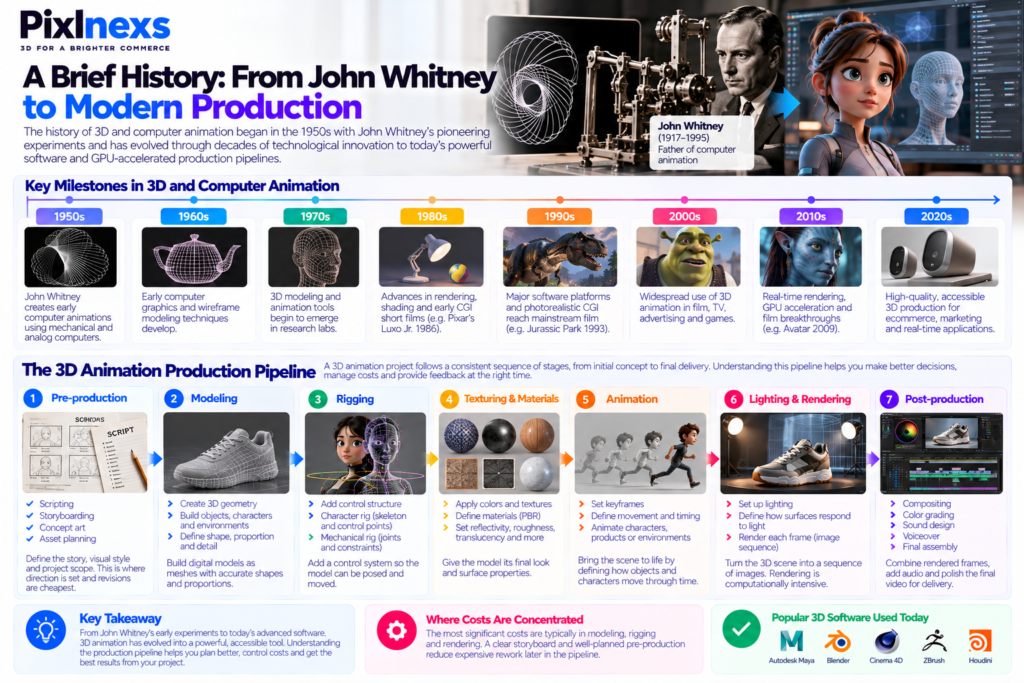
The history of 3D and computer animation traces back to the 1950s, when John Whitney widely recognized as the father of computer animation developed mechanical and early algorithmic techniques to create animated motion pictures. Whitney built custom mechanical rigs that used analog computers to control the movement of cameras and graphic elements, producing work that is recognizable as the conceptual ancestor of today’s computer-generated imagery.
His work in creating title sequences for television and film established the visual language of motion graphics that remains influential today. The decades between Whitney’s early experiments and the modern 3D production pipeline saw the development of digital modeling tools, GPU-accelerated rendering and the major software platforms Maya, Blender, Cinema 4D, ZBrush, Houdini that professional animators now use. For a broader overview of how computer animation developed from these origins, the Wikipedia entry on computer animation documents the full technical and creative history of the discipline.
The 3D Animation Production Pipeline
A 3D animation project moves through a consistent sequence of stages regardless of the application or the software used. Understanding this pipeline is useful for any organization commissioning 3D animation, because it clarifies where decisions are made, where costs are concentrated and where revision feedback has the most impact.
Pre-production covers everything before 3D work begins: scripting, storyboarding, concept art and asset planning. This is where the visual and narrative direction is established and where revision is cheapest. A weak storyboard that reaches the 3D stage results in expensive rework.
Modeling is the creation of 3D geometry building the objects, characters and environments that will appear in the animation as digital meshes with specific shapes, proportions and surface detail.
Rigging is the process of adding a control structure to a model so it can be animated. A character rig adds a skeleton and control points that allow an animator to pose and move the character. A mechanical rig adds joints and constraints that simulate how a machine or device moves.
Texturing and materials are applied to the model’s surface to define how it appears the color, reflectivity, roughness, translucency and other visual properties of every surface in the scene.
Animation is the process of defining how objects and characters move through time by setting keyframes specific positions or poses at specific moments and letting the software interpolate the motion between them.
Lighting and rendering turn the 3D scene into a sequence of images. Lighting defines how the scene is illuminated and how surfaces respond to that illumination. Rendering is the computationally intensive process of calculating the final visual output for each frame.
Post-production covers compositing, color grading, sound design, voiceover and the final assembly of the rendered frames into the deliverable video.
3D Animation Software: The Major Tools
The choice of software in a 3D animation pipeline is determined by the type of work, the studio’s existing expertise and the specific output requirements of the project. Several major platforms dominate professional production.
| Software | Primary Use | Cost | Best For |
|---|---|---|---|
| Autodesk Maya | Character animation, visual effects, rigging | Subscription (commercial) | Film, TV, high-end commercial production |
| Blender | Full pipeline modeling, animation, rendering | Free (open-source) | Independent studios, ecommerce, product viz |
| ZBrush | Digital sculpting, high-detail models | Subscription (commercial) | Characters, anatomy, detailed product surfaces |
| Cinema 4D | Motion graphics, commercial animation | Subscription (commercial) | Brand communication, title sequences, ads |
| Houdini | VFX simulation fluids, fire, destruction | Subscription (commercial) | Film VFX, complex simulation, procedural environments |
Autodesk Maya
Maya is the industry standard for character animation, visual effects and high-end production work in film, television and games. Its rigging and animation toolset is among the most mature and capable available and it has an extensive ecosystem of plugins and integrations. Most large studios producing animated content for broadcast or theatrical release use Maya as their primary animation tool.
Blender
Blender is a free, open-source 3D creation suite that has grown from a hobbyist tool to a professional-grade platform used by independent studios, commercial clients and increasingly by major production companies. Its full pipeline coverage modeling, rigging, animation, rendering (via the Cycles and EEVEE engines) compositing and video editing makes it a complete solution without licensing costs. Blender is the most accessible entry point for organizations building an in-house 3D animation capability.
ZBrush
ZBrush is a digital sculpting tool used primarily for creating high-detail organic models characters, creatures, medical anatomy, detailed product surfaces. It operates differently from traditional polygon modeling tools, using a brush-based approach that allows very fine surface detail to be sculpted directly. ZBrush output is typically a high-polygon source model that is then retopologized and rigged for animation in Maya or Blender.
Cinema 4D
Cinema 4D is widely used in motion graphics, commercial animation and broadcast design. Its integration with Adobe After Effects and its intuitive workflow make it a common choice for studios producing animated commercial content, title sequences and visual brand communication. Cinema 4D’s motion graphics toolkit (MoGraph) is particularly powerful for procedural animation creating repeated, rule-driven motion across large numbers of objects.
Houdini
Houdini is the industry standard for visual effects simulation fluid dynamics, fire and smoke, destruction, particle systems and procedural environments. It is used for the complex simulation work that appears in film and high-end commercial production. Most studios use Houdini specifically for effects rather than as a general animation tool.
3D Animation in Medicine and Healthcare
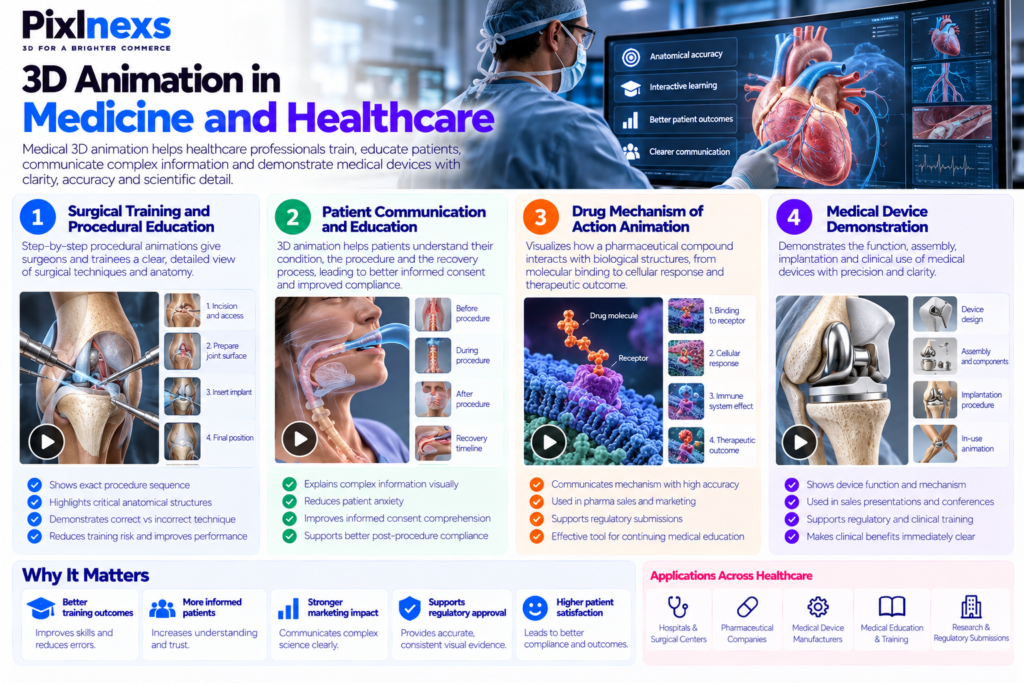
Medical 3D animation is one of the most technically demanding and commercially significant applications of the discipline. The healthcare sector uses 3D animation across a range of functions from surgical training and patient education to pharmaceutical marketing and medical device demonstration.
Surgical Training and Procedural Education
3D animation gives surgeons and surgical trainees access to accurate, detailed visual representations of procedures that would otherwise only be available through in-person observation or cadaveric training. A step-by-step procedural animation can demonstrate the exact sequence of a surgical technique, the spatial relationships between anatomical structures and the consequences of correct versus incorrect technique in a format that is repeatable, distributable and available at any point in a learner’s training.
This is particularly valuable for new or complex procedures where the learning curve is steep and the risk of error in live practice is high. An animated procedural walkthrough gives trainees a mental model of the procedure before they encounter it in a clinical setting, which is consistently shown to improve performance and reduce errors in surgical training research.
Patient Communication and Education
Complex medical information is consistently misunderstood when communicated in text or through verbal explanation without visual support. A 3D animation that shows a patient exactly what will happen during their procedure, how their anatomy is involved and what the expected recovery process looks like reduces patient anxiety, improves informed consent comprehension and supports better post-procedure compliance.
This is not exclusively a patient experience benefit. Healthcare providers in markets where informed consent documentation carries legal weight have a direct institutional interest in ensuring patients genuinely understand what they are consenting to and animation is a more reliable communication tool for this purpose than written materials that patients may not read carefully or retain.
Drug Mechanism of Action Animation
Drug mechanism of action (MOA) animation visualizes how a pharmaceutical compound interacts with biological structures receptors, cells, proteins, pathogens at a level of scale and resolution that no other visual medium can represent. These animations are used in pharmaceutical sales and marketing to communicate the mode of action of a new drug to healthcare professionals, in regulatory submissions to demonstrate efficacy and in continuing medical education to update practicing clinicians on new therapeutic approaches.
A well-produced MOA animation can show the binding of a molecule to a target receptor, the downstream cellular signaling consequences, the immune system response and the therapeutic outcome all in a two-to-three minute video that compresses months of biological events into a format a physician can review in a single sitting. Pharmaceutical companies consistently report that MOA animations are among their most effective sales enablement tools, because they communicate mechanism with a specificity and accuracy that verbal explanation alone cannot achieve.
Medical Device Demonstration
3D animation is used by medical device companies to demonstrate the function, assembly, implantation and clinical use of devices ranging from orthopedic implants and vascular stents to diagnostic equipment and surgical robotics. Device demonstration animations are used in sales presentations, at medical conferences and trade shows, in regulatory submissions and in clinical training programs.
For devices where the clinical benefit is closely tied to a specific mechanism an implant that distributes load in a particular way, a catheter with a specific deflection profile, a diagnostic algorithm that identifies a particular biomarker pattern animation can show the mechanism in action in a way that makes the clinical rationale immediately comprehensible to a medical audience.
3D Animation in Industry and Manufacturing
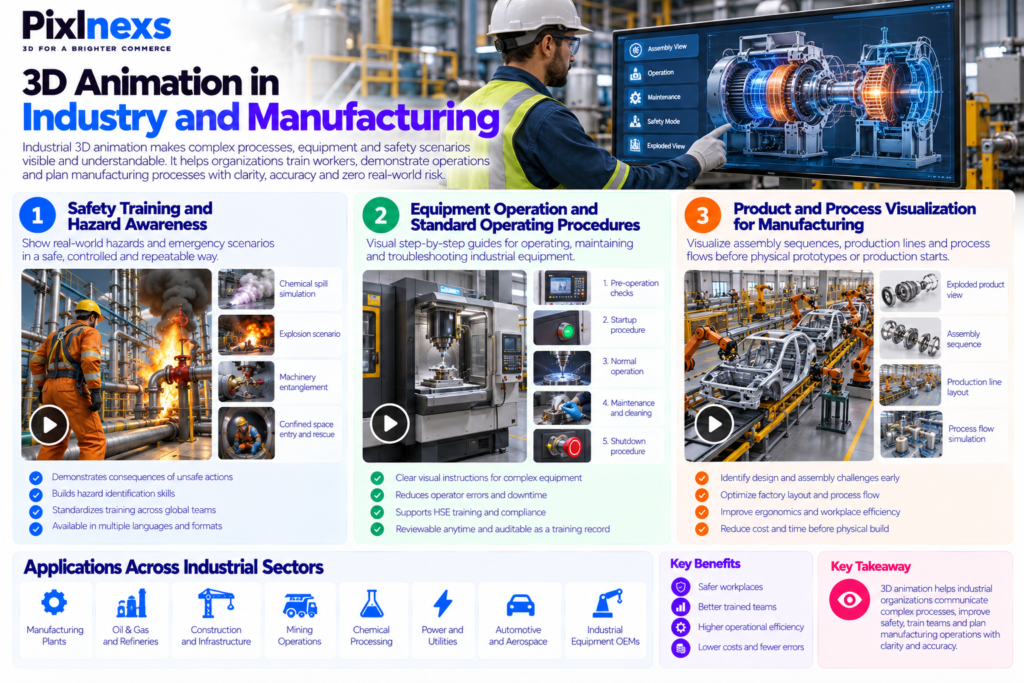
Industrial 3D animation serves a different set of functions from medical animation but the underlying value is similar: it makes complex, potentially dangerous or highly technical processes visible, understandable and trainable in a safe, repeatable format.
Safety Training and Hazard Awareness
Industrial worksites manufacturing plants, refineries, construction sites, mining operations involve equipment, processes and environments that carry significant injury and fatality risk. Training workers on hazard identification, emergency procedures and safety protocols through real-world demonstration is limited by the inherent difficulty of safely demonstrating hazardous events to trainees.
3D animation allows industrial safety trainers to show exactly what happens when a safety protocol is not followed an explosion, a chemical spill, a mechanical failure in a visually explicit, emotionally engaging format without exposing trainees to real risk. Repeatable, distributable and available in multiple languages, a safety animation can standardize training quality across a workforce in a way that instructor-led training cannot.
Equipment Operation and Standard Operating Procedures
Complex industrial equipment CNC machines, bottling lines, turbines, assembly robots involves operational procedures that are difficult to communicate through manuals or verbal instruction alone. A 3D explainer animation that shows the exact sequence of startup, operation, maintenance and shutdown for a specific piece of equipment gives operators a visual reference that is more reliable than written procedure documentation for learners who retain visual information more effectively.
Health, Safety and Environment (HSE) training for industrial clients often uses 3D animation to demonstrate the correct use of personal protective equipment, the correct procedures for chemical handling or confined space entry and the protocols for emergency response all in a format that is reviewable by the learner at any time and auditable by the organization as a training record.
Product and Process Visualization for Manufacturing
3D animation is used in manufacturing contexts to visualize assembly sequences, production line configurations and process flows before physical prototypes or production lines are built. This is particularly valuable in the early stages of product or process design, where an animation can identify assembly challenges, ergonomic problems or process inefficiencies that would be expensive to discover in a physical prototype or a live production environment.
3D Animation in Architecture and Design
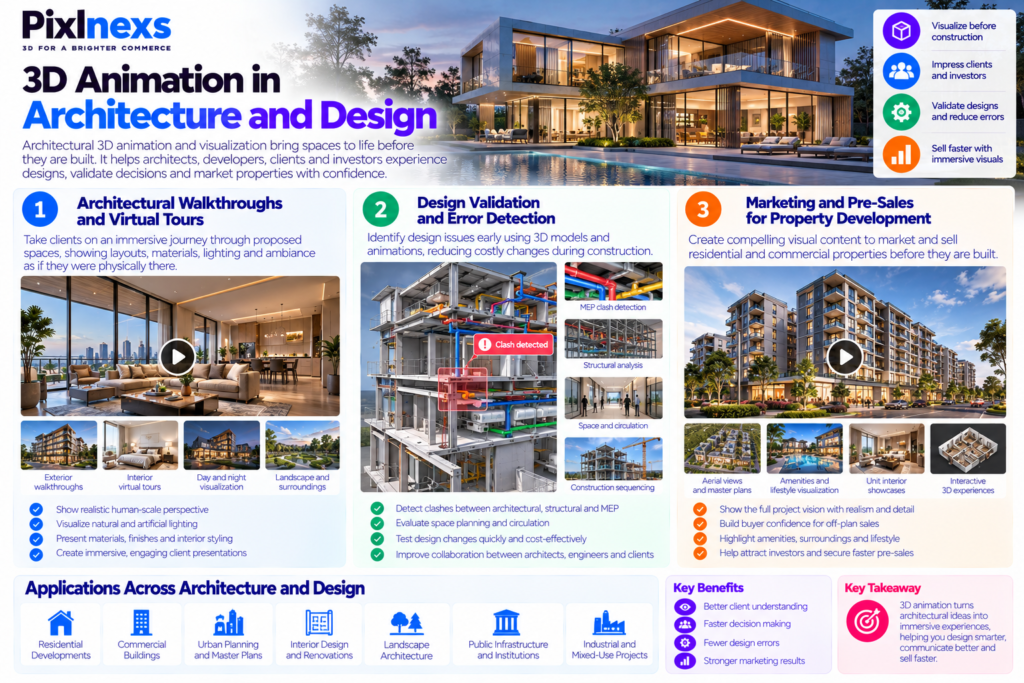
Architectural 3D animation and visualization transform the way buildings and spaces are designed, presented and sold giving clients, planners and investors the ability to experience a space before it physically exists.
Architectural Walkthroughs and Virtual Tours
An architectural walkthrough animation takes the viewer through a proposed space a residential development, a commercial building, an urban planning proposal as if they were physically present within it. The animation shows how the space is organized, how natural and artificial light behaves within it across different times of day and different seasons, how the materials and finishes appear in context and how the proportions feel from a human perspective inside the space.
This experiential dimension is not available from architectural plans, elevations or even static renders. A client who walks through an animated version of their proposed home or office building understands what they are commissioning with a degree of certainty that no other presentation format provides.
Design Validation and Error Detection
3D modeling and animation are used by architects and engineers as tools for identifying design errors before construction begins. Clash detection identifying where building services, structural elements and architectural finishes occupy conflicting positions in three-dimensional space is significantly more reliable in a 3D model than in traditional 2D drawing sets. An architectural animation that moves through a building and reveals spatial conflicts before any physical construction begins can prevent costly change orders and construction delays.
Marketing and Pre-Sales for Property Development
For residential and commercial property developers, 3D architectural animation is a standard marketing tool. A development that is sold off-plan before the building exists needs a visual presentation that allows buyers to evaluate the space with sufficient confidence to make a purchase decision. A high-quality architectural walkthrough animation, supplemented by rendered apartment plans and material selection visualizations, provides that confidence in a way that site plans and architect’s drawings do not.
3D Animation in Commercial Advertising
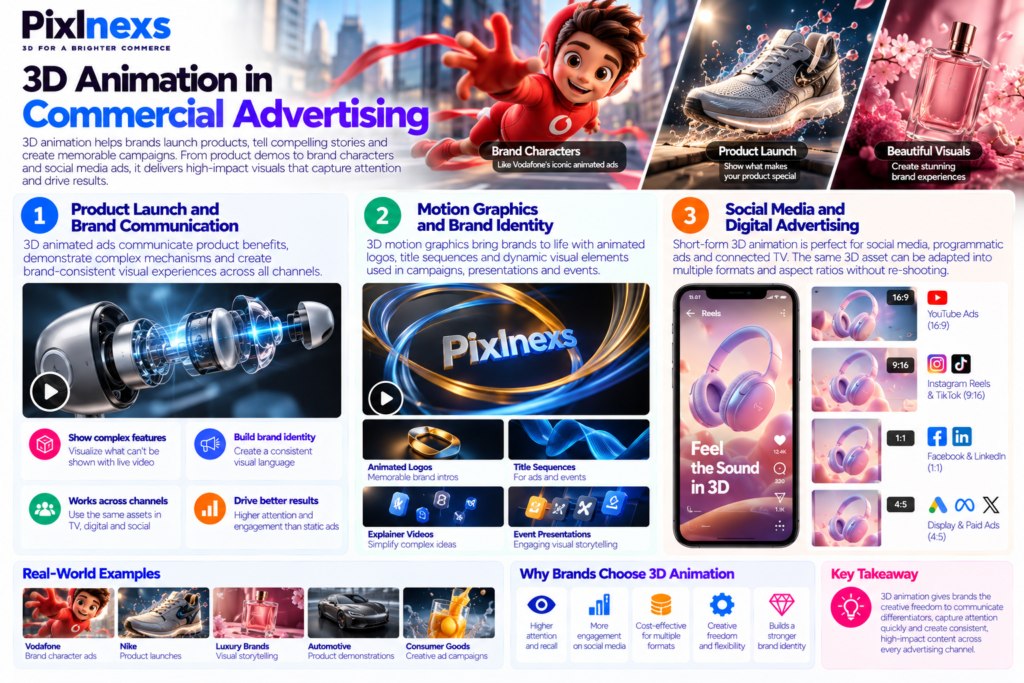
Commercial advertising was one of the earliest adopters of 3D animation outside the entertainment industry and remains one of the most commercially significant applications.
Product Launch and Brand Communication
3D animated commercial ads are used by brands to communicate product benefits, demonstrate mechanisms that cannot be shown through live video and create brand-consistent visual experiences across advertising channels. For products where the key differentiator is internal a pharmaceutical’s mechanism, an appliance’s engineering, a material’s molecular structure, 3D animation allows that differentiator to be communicated in a way that no other format can.
The Vodafone animated advertisements referenced in the original draft of this article are one example of a well-known brand using animation not just to explain a product but to build an emotional and aesthetic identity through a consistent animated character and visual language. This is a sophisticated advertising use of animation that goes beyond product demonstration it uses the creative flexibility of 3D to create characters, worlds and situations that would be impossible or prohibitively expensive to produce through live action.
Motion Graphics and Brand Identity
Motion graphics animation the animation of graphic elements, text and abstract visual forms is used in brand communication for animated logos, title sequences, social media content, explainer videos and event presentation materials. Cinema 4D’s dominance in this segment reflects the specific technical strengths of procedural motion graphics tools for producing the branded, geometric, type-driven animation style that commercial clients frequently require.
Social Media and Digital Advertising
The shift of advertising spending toward digital channels, social media, programmatic display, connected TV has created high demand for short-form 3D animated content that works without sound, communicates quickly in the first three seconds and can be produced in multiple aspect ratios and formats for different placements. 3D animation production is well-suited to this format because the same source model can generate multiple output cuts and formats without re-shooting and the visual quality and attention-capture of 3D animation consistently outperforms static imagery in digital advertising measurement.
Choosing the Right Type of 3D Animation for Your Project
Realism vs. Stylization
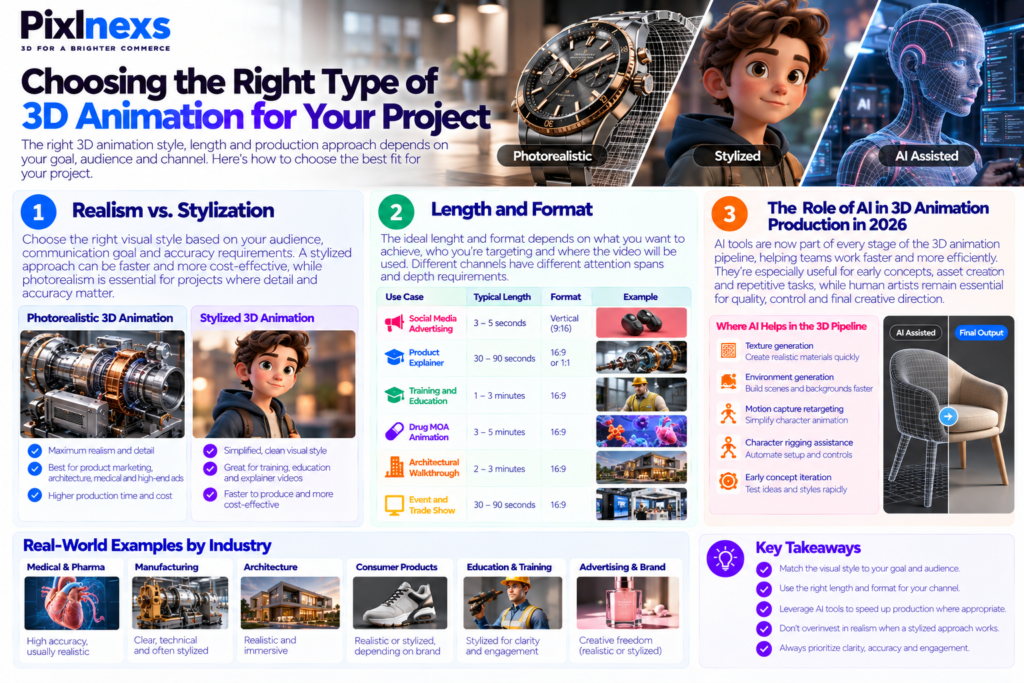
Not every 3D animation project requires photorealistic output and pursuing photorealism when a stylized approach would serve the communication goal equally well is a common source of unnecessary cost. A stylized 3D animation for a training or education context can be produced faster and at lower cost than a photoreal equivalent and for many audiences stylization is more engaging than realism because it abstracts away visual detail that is irrelevant to the training objective.
Medical and pharmaceutical animation tends to require higher fidelity because accuracy is operationally important a surgical animation that misrepresents anatomical relationships is not just aesthetically wrong but potentially harmful. Advertising animation tends to have more creative latitude for stylization because the communication goal is attention, emotion and brand association rather than clinical precision.
Length and Format
The optimal length for a 3D animation is determined by the communication goal, the audience context and the distribution channel not by convention. A drug MOA animation used in a physician consultation may need three to five minutes to cover the mechanism with sufficient depth. A social media advertising animation has typically three to five seconds before viewer attention drops. An architectural walkthrough for a client presentation may run two to three minutes and include a voiceover narrative. These are fundamentally different production briefs despite sharing the same underlying 3D production pipeline.
The Role of AI in 3D Animation Production in 2026
AI-assisted tools have entered every stage of the 3D animation pipeline and are changing the speed and cost structure of production for specific types of work. AI tools accelerate texture generation, motion capture retargeting, character rigging assistance, environment generation and the early-concept iteration stages of a project. For the specific comparison of AI-assisted and traditional animation approaches including where each is appropriate and where the quality and control trade-offs matter see our guide on AI animation vs traditional animation.
What to Expect When Commissioning 3D Animation
The Brief
A 3D animation project that starts with a strong brief clear communication objective, defined audience, specified length and format, style references and any technical accuracy requirements produces better output faster and with fewer revision rounds than one that begins with a vague creative direction. The pre-production stage is where creative decisions are cheapest to make and most expensive to change later; a thorough brief invested upfront pays back across every subsequent stage.
Revision Rounds
Most studio quotes include a defined number of revision rounds at each stage of the production pipeline typically one or two at pre-production (script and storyboard) and one or two at production (animation and rendering). Revisions requested after a stage is complete carry a higher cost because the work has already progressed. Understanding which revision rounds are included and what constitutes a new request rather than a revision is one of the most important conversations to have before signing a production agreement.
Turnaround Times
3D animation production timelines are determined by the complexity of the project and the scope of the pipeline stages it requires. A simple short-form motion graphics piece may take days. A 60-to-90-second product explainer with a custom character typically takes several weeks. A complex medical MOA animation with anatomically accurate models and simulation may take several months. Timeline tracks closely with complexity and with the extent of the revision and approval process which is why locking the script and storyboard before any 3D work begins is the most effective way to keep a project on schedule.
Ready to bring your project to life with 3D animation?
Pixlnexs produces 3D animation for medical, industrial, architectural and commercial applications combining technical accuracy with production quality and a transparent brief-to-delivery process.
See Our Animation Services Talk to Our TeamConclusion
3D animation has moved from a specialized film production technique to a foundational communication tool across medicine, industry, architecture and advertising. The underlying reason is consistent across every application: 3D animation can show things that no other medium can mechanisms at scales invisible to the naked eye, environments that do not yet exist, processes that are too dangerous to demonstrate in person and product behaviors that live video cannot capture in a visual format that is immediately comprehensible to the intended audience.
The production pipeline, the software tools and the quality bar for 3D animation have all advanced substantially since John Whitney’s mechanical experiments in the 1950s. What has not changed is the core value: making the invisible visible, the complex simple and the abstract concrete.
Frequently Asked Questions
What is 3D animation used for?
3D animation is used across medical training and pharmaceutical marketing, industrial safety and equipment training, architectural visualization and pre-sales, commercial advertising and brand communication, entertainment and film and product visualization for ecommerce. The common thread is that 3D animation can show things that physical production cannot internal mechanisms, future environments, molecular-scale processes, hazardous events and complex spatial relationships in a visual format that audiences can understand immediately.
What is the difference between 2D and 3D animation?
2D animation creates motion by drawing sequences of flat images. 3D animation creates motion by animating objects and characters within a three-dimensional digital environment and rendering that environment as a sequence of frames. 3D animation produces depth, perspective and physically accurate material behavior; 2D animation is typically faster and cheaper to produce for simpler content but has inherent constraints on spatial complexity and photorealism.
What software is used for 3D animation?
The major professional tools are Autodesk Maya (industry standard for character animation and visual effects) Blender (free and open-source, professional-grade) ZBrush (digital sculpting for high-detail models) Cinema 4D (motion graphics and commercial animation) and Houdini (visual effects simulation). Most studios use a combination of tools across the pipeline rather than a single application for every stage.
How long does a 3D animation project take?
Timeline depends on complexity and length. A simple 30-second motion graphics piece may take days. A 60-to-90-second explainer with custom characters typically takes several weeks. A complex medical or pharmaceutical animation with anatomically accurate models may take several months. The most significant variable is the revision and approval process projects with clear briefs and defined review cycles consistently deliver faster than those without.
How much does 3D animation cost?
3D animation costs vary significantly with project type, length and quality requirements. Short AI-assisted clips can cost from a few hundred dollars. A professional 60-second explainer with custom characters typically runs from several thousand to tens of thousands of dollars. Broadcast-quality cinematic animation and complex medical or pharmaceutical animation can cost significantly more. For a detailed cost breakdown by project type, see our guide on how much a 3D animation video costs.
What is medical 3D animation specifically?
Medical 3D animation is a specialized application of 3D production techniques to create accurate visual representations of anatomical structures, biological processes, surgical procedures and drug mechanisms. It requires scientific accuracy in addition to visual quality and is produced by studios or teams with specific expertise in medical illustration, anatomy and the regulatory context in which the output will be used.
Can 3D animation be used for product advertising?
Yes it is widely used for product advertising, particularly for products where the key benefit is internal (a mechanism, an engineering advantage) or where physical production would be impossible or cost-prohibitive. 3D animation lets a brand show how a product works at any scale, from molecular to architectural and produces output that can be repurposed across multiple formats and channels from a single production run.
Who was the father of computer animation?
John Whitney is widely credited as the father of computer animation. In the 1950s, Whitney developed mechanical and early algorithmic techniques to create animated motion for film title sequences, commercial work and artistic films. His innovations established the conceptual foundation for the computer animation techniques that followed.
Related guide
Low-Poly vs High-Poly 3D Models: Which One Wins?
3D Scanning vs 3D Modeling: Which One Does Your Product Catalog Actually Need?
Manual 3D Modeling vs AI 3D Models: Which Is Right for Your Brand in 2026?







Leave a Reply