
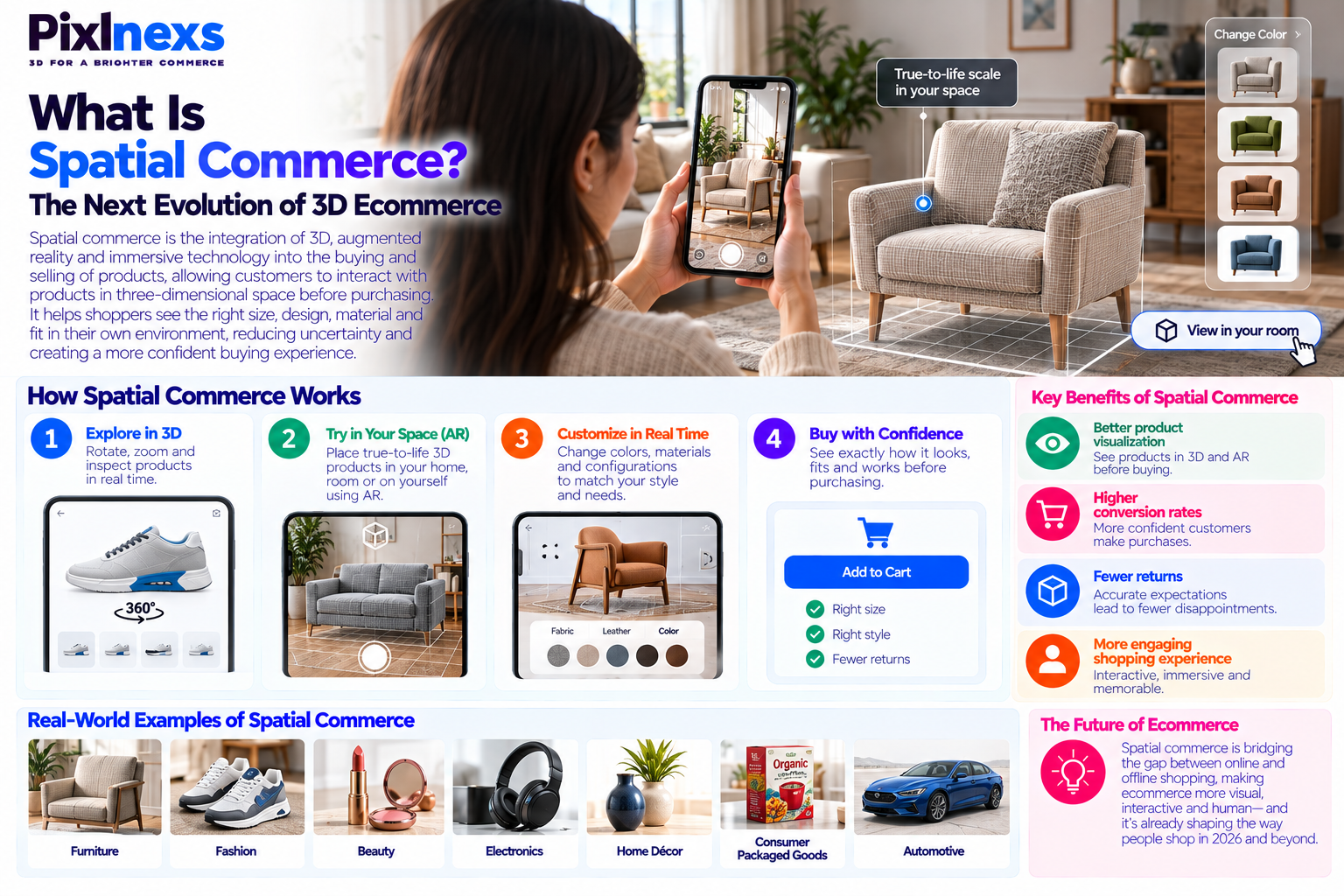
Quick answer: Spatial commerce is the integration of three-dimensional, augmented reality and immersive technology into the buying and selling of products allowing customers to interact with products in three-dimensional space before purchasing, either by placing them in their own physical environment through AR or by exploring them in virtual shopping environments. It represents the next evolution beyond flat ecommerce by collapsing the information gap between what a product looks like on a screen and what it looks and feels like in real life. In 2026, spatial commerce is no longer a future concept it is an active deployment across furniture, fashion, beauty, electronics and consumer packaged goods, driven by AR-capable smartphones in the hands of billions of shoppers worldwide.
By Bali Balaji, Pixlnexs Studio. Pixlnexs builds the 3D and AR product assets that power spatial commerce experiences for ecommerce brands across furniture, fashion, packaging and consumer electronics and this guide reflects what our production team sees working in live deployments, not theoretical predictions.
Key Takeaways
- Spatial commerce uses 3D models, AR placement and immersive technology to let customers experience products in three-dimensional space before buying addressing the information gap that drives most non-defect ecommerce returns.
- The hardware is already in customers’ hands. Modern iPhones and ARCore-compatible Android devices support AR without an app download, which means spatial commerce is available to the majority of shoppers without any additional hardware investment.
- The business case is measurable. Shopify’s data and independent studies consistently show that products with 3D and AR experiences convert at higher rates and generate fewer returns than equivalent flat-photo listings.
- Spatial commerce is not a single technology it is a spectrum from basic interactive 3D viewers through AR placement through fully immersive virtual shopping environments and most brands start at the accessible end of that spectrum.
- The 3D model is the foundation of every spatial commerce experience. A poorly built model undermines the entire value proposition; an accurately dimensioned, correctly materialed model is what makes spatial commerce trustworthy.
- For ecommerce brands in 2026, spatial commerce is transitioning from a competitive differentiator to a customer expectation in categories where size, scale and material texture are important to the purchase decision.
What is Spatial Commerce Means for Ecommerce in 2026
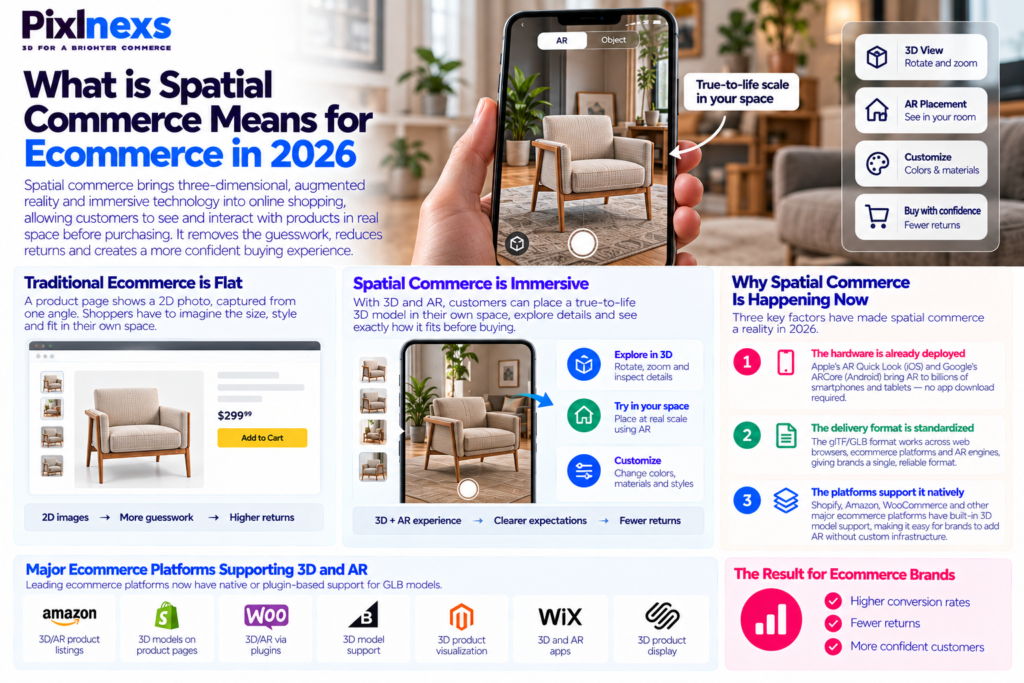
The word “spatial” refers to space physical, three-dimensional space. Spatial commerce, at its core, is commerce that happens in or through that three-dimensional space rather than on a flat two-dimensional screen.
Traditional ecommerce is inherently flat. A product page shows a photograph a two-dimensional representation of a three-dimensional object, captured at one moment, from one angle, under one lighting setup. The shopper’s job is to translate that flat image into a mental model of what the product will actually look like, how big it will actually be and whether it will actually work in the context they are buying it for. This translation process is where most ecommerce purchases go wrong: the shopper’s mental model is incorrect, the product arrives and does not match expectations and a return is initiated.
Spatial commerce removes or significantly reduces this translation requirement. Instead of asking a shopper to imagine a sofa in their living room from a studio photograph, AR placement puts a three-dimensional model of that sofa in the shopper’s actual living room, at true-to-life scale, through their phone camera. The imagination step is replaced by a direct visual experience.
Why Spatial Commerce Is Happening Now, Not Later
Spatial commerce has been discussed as a future trend for years. The reason it is a present reality in 2026 rather than still a future prediction comes down to three converging factors.
The hardware is already deployed. Apple’s AR Quick Look, available on every iPhone and iPad running iOS 12 or later, gives AR placement capability to hundreds of millions of devices without any app download. Google’s ARCore, available on Android devices, extends this to the Android installed base. The AR hardware that spatial commerce requires is not something brands need to convince customers to buy it is already in their pockets.
The delivery format is standardized. The glTF/GLB standard from the Khronos Group, widely adopted by web browsers, ecommerce platforms and AR engines, gives brands a single format that works across web product pages, Amazon listings, Android AR and iOS AR. For a full explanation of how GLB and glTF relate and when to use each, see our guide on GLB vs glTF: the real difference.
The platforms support it natively. Shopify, Amazon, WooCommerce and most major ecommerce platforms now have native or plugin-based 3D model support built in. A brand does not need to build custom AR infrastructure they upload a GLB file to an existing product page and the platform handles the rest.
The Spatial Commerce Technology Stack: What Powers a 3D Ecommerce Experience
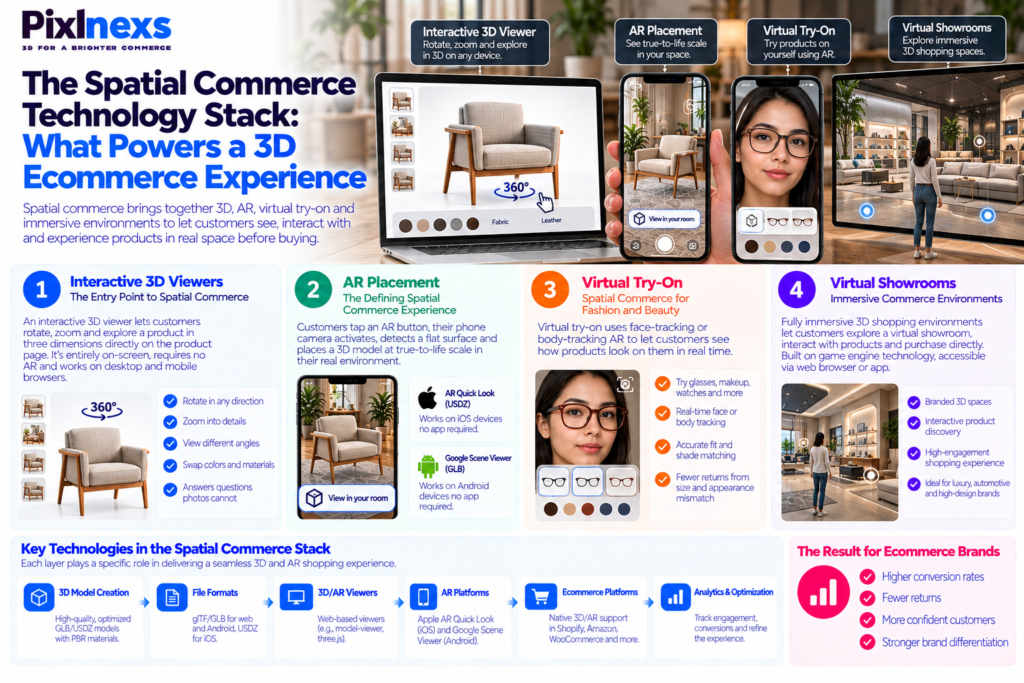
Understanding what spatial commerce is built from helps brands make informed decisions about where to invest and what each component delivers.
Interactive 3D Viewers: The Entry Point to Spatial Commerce
An interactive 3D viewer on a product page is the most accessible form of spatial commerce. The shopper sees a 3D model they can rotate in any direction, zoom into and, in some implementations, configure by swapping materials or colors. There is no AR the experience is entirely on-screen but it already delivers significant improvements over static photography by giving the shopper control over what they see and how they see it.
A well-built 3D viewer on a product page answers questions that photography cannot: what does the product look like from underneath? How does the fabric texture look when viewed close up? What does the back panel look like?
AR Placement: The Defining Spatial Commerce Experience
AR placement is the technology that most people mean when they say “spatial commerce.” The shopper taps an AR button on a product page, their phone camera activates, the phone detects a flat surface in the room and a three-dimensional model of the product appears anchored to that surface at true-to-life scale.
On iOS, this is delivered through AR Quick Look using a USDZ file. On Android, it is delivered through Google Scene Viewer using a GLB file. Both experiences are browser-based no app download required which is what makes them viable for mainstream ecommerce use.
The value AR placement delivers is spatial reasoning: a customer who has placed a sofa in their living room using AR does not need to calculate whether it will fit, visualize how it will look against the wall color or guess whether the scale photographs gave them an accurate impression. They see it, at real size, in their real space.
Virtual Try-On: Spatial Commerce for Fashion and Beauty
Virtual try-on extends AR placement into wearable and applicable products. Instead of placing an object in a room, it places the object on the customer a pair of glasses on their face, a lipstick shade on their lips, a watch on their wrist. The technology uses face-tracking or body-tracking AR to align the virtual product with the customer’s own image in real time.
For fashion accessories, eyewear and beauty, virtual try-on addresses the fit and shade-match return drivers that are equivalent to the scale and size problems that room-placement AR addresses for furniture and home goods.
Virtual Showrooms and Immersive Commerce Environments
At the furthest end of the spatial commerce spectrum are fully immersive virtual shopping environments brand-built 3D spaces where customers navigate through a virtual showroom, interact with products in a curated environment and purchase directly. These are built on game engine technology and accessed through a web browser or a dedicated application.
Virtual showrooms are the most capital-intensive form of spatial commerce but they offer the highest degree of brand expression and the most immersive customer experience. In 2026, they are being deployed by luxury brands, automotive companies and high-design furniture brands where the purchase journey justifies the investment in a premium discovery experience.
Why Spatial Commerce Reduces Ecommerce Returns
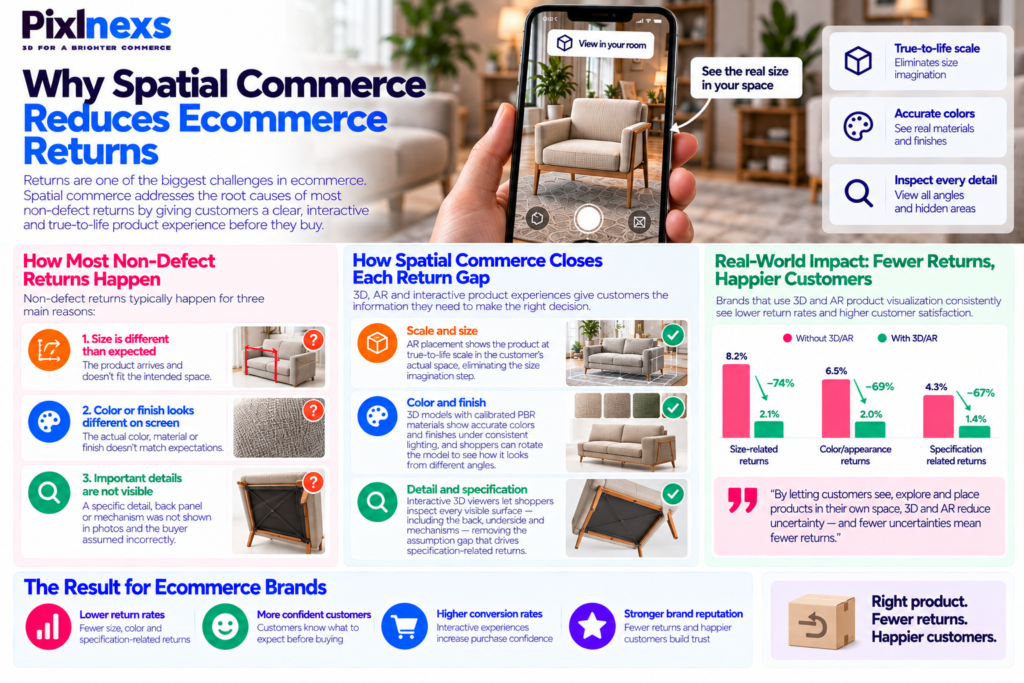
Returns are the most expensive problem in ecommerce and spatial commerce addresses the root causes of most non-defect returns more directly than any other technology.
How Most Non-Defect Returns Happen
Non-defect returns returns that do not involve a damaged or faulty product consistently trace to three causes: the product was a different size than expected, the color or finish looked different than it appeared on screen and a specific detail was not visible in the product photography and the buyer assumed incorrectly.
All three are information failures. The customer made a purchase based on insufficient or misleading information and the return is the correction. For a detailed analysis of each return cause and how 3D addresses them, see our full guide on reducing ecommerce returns with 3D product visualization.
How Spatial Commerce Closes Each Return Gap
Scale and size: AR placement eliminates the size-imagination step entirely. A customer who has placed a product at true-to-life scale in their own space using AR is not guessing about size they have seen it. Size mismatch returns in categories with AR placement consistently fall.
Color and finish: A 3D model with correctly calibrated PBR materials renders product color under standardized lighting rather than under the specific conditions of a photoshoot. A color code-calibrated model renders more accurately than a retouched photograph and the shopper can rotate the model to see how the finish responds to light from different angles which is how they will experience it in their home.
Detail and specification: A 3D viewer that lets shoppers inspect every visible surface of a product including the back panel, the underside, the mechanism, the label removes the assumption gap that drives specification-related returns. The shopper either finds the information they need in the viewer or determines it is not visible, in which case they ask before buying rather than assuming and returning.
Spatial Commerce by Category: Where It Delivers the Most Value
Spatial commerce is not equally valuable across all product categories. Its impact is greatest where the information gap between a flat photograph and the real product is largest.
Furniture and Home Décor: The Highest-Impact Spatial Commerce Category
Furniture is the category where spatial commerce delivers the most measurable impact, because the dominant purchase anxiety is spatial: will this piece fit in my room and will it look right with my existing décor? AR placement answers both questions directly and has consistently shown the largest conversion and return-rate improvements of any category deploying spatial commerce.
A customer placing a dining table in their kitchen through AR, walking around it virtually, checking it from the doorway angle this is an experience that the most detailed product photography cannot replicate. For our full guide on 3D visualization for furniture specifically, see our article on 3D product visualization for furniture and home décor.
Consumer Electronics and Appliances
For electronics and large appliances, spatial commerce addresses two specific return drivers: size surprise (the product was larger or smaller than expected) and port or connection confusion (the buyer assumed a specific interface that was not present). An interactive 3D viewer that shows the product at correct scale and allows inspection of every port and panel addresses both.
Fashion Accessories, Footwear and Eyewear
Scale and proportion are the dominant purchase anxieties for bags, watches and accessories. A bag that looks substantial in a styled flat lay photograph may be a small crossbody in person. AR placement at true-to-life scale or virtual try-on for wearable items, gives the customer the sizing information they need before committing.
Beauty and Cosmetics
Shade mismatch is the dominant return driver in beauty the product arrived in a shade that looked different on screen than in person. Virtual try-on tools that overlay a color product (lipstick, eyeshadow, foundation) on the shopper’s own face using real-time AR give a significantly better shade preview than a swatch photograph under studio lighting.
Packaged Goods and Food
Volume and size surprise are the key return and dissatisfaction drivers for packaged goods the product was smaller than expected or the packaging looked different in person. A 3D model at correct scale, with an accurate label wrap showing real label text and branding, gives shoppers a reliable pre-purchase impression.
How to Build a Spatial Commerce Strategy for Your Ecommerce Brand
Start With Your Highest-Return, Highest-Value Products
The ROI case for spatial commerce is clearest and fastest to validate on the products where the information gap is causing the most damage your highest-return SKUs in expectation-mismatch categories. Start there, measure the impact on conversion and return rate and scale from validated results.
Invest in Model Quality First
The 3D model is the foundation of every spatial commerce experience. A model built at incorrect scale, with poorly calibrated materials or with visual inaccuracies that do not match the real product, undermines the entire value proposition. A customer who places a spatially inaccurate model in their room is getting worse information than a well-staged photograph would give them.
For the specific technical requirements that separate a trustworthy spatial commerce model from a decorative one, see our guide on manual 3D modeling vs AI-generated 3D models for ecommerce.
Choose the Right Platform Integration
Most major ecommerce platforms support spatial commerce in 2026 through native 3D model support or through available plugins:
- Shopify supports GLB and USDZ natively as product media types, with AR handoff to AR Quick Look on iOS and Scene Viewer on Android built in.
- Amazon offers the “View in your room” AR feature for brand-registered sellers in supported categories.
- WooCommerce supports 3D viewers through plugins and the model-viewer web component.
- Custom storefronts can implement spatial commerce using the open-source
<model-viewer>component, which handles 3D rendering and AR handoff without custom development.
Test on Real Devices Before Going Live
Every spatial commerce deployment needs to be tested on real iOS and Android devices not just in desktop browser simulators before going live. AR placement behavior, scale accuracy and material rendering all behave differently on real hardware than in a preview environment. For our complete pre-launch testing checklist, see our article on how to test 3D and AR on product pages before launch.
The Metrics That Measure Spatial Commerce Success
Implementing spatial commerce is only the start measuring its impact is what justifies scaling it.
Conversion Rate on 3D-Enabled Product Pages
The primary performance metric for spatial commerce is conversion rate on the product pages where 3D or AR is active, compared to equivalent pages without it. Industry data consistently shows a meaningful lift for categories where spatial commerce addresses the real purchase anxiety, with furniture and home décor showing the largest effects.
Return Rate on Products With Spatial Commerce
The return rate metric tells you whether spatial commerce is setting accurate expectations. If the feature is working, return reasons related to size, appearance and specification confusion should decrease on products with 3D and AR compared to equivalent products without it. Track return reasons at SKU level, not just aggregate return rate.
AR Interaction Rate
The proportion of product page visitors who trigger the AR placement experience tells you how discoverable and accessible the feature is. A low AR interaction rate on a product where the feature should be highly relevant often indicates that the AR trigger is not prominent enough on the page or that customers are not aware of it.
Session Duration and Engagement
Customers who interact with a 3D viewer or AR placement spend more time on the product page and are more engaged with the product information. Higher session duration and lower bounce rate on 3D-enabled product pages versus equivalent static pages is a consistent signal that the feature is adding value to the discovery and evaluation experience.
The Future of Spatial Commerce Beyond 2026
Spatial commerce in 2026 is the early chapter of a longer story. Several developments in technology and platform capability are pointing toward where the discipline is heading.
Generative AI and Real-Time 3D Personalization
Generative AI tools are beginning to enable real-time environment customization in spatial commerce experiences a shopper will be able to see a product placed not just in a generic AR overlay but in a virtually generated version of a room that matches their own home’s style and color scheme. This moves spatial commerce from “place it in your space” to “see it in your curated space.”
Spatial Computing Devices
Apple Vision Pro and its successors represent a hardware category that makes fully immersive spatial commerce accessible without a dedicated app. A shopper using a spatial computing device can browse a virtual product catalog in their living room, pick up and inspect products at full size and make purchases without leaving the spatial environment. As this hardware category matures, spatial commerce experiences built on quality 3D assets will benefit directly.
Connected Physical and Digital Commerce
Spatial commerce is beginning to connect physical retail with digital inventory a customer in a physical store can use their phone to see a product in a color or configuration that is not stocked on the shelf, place it in AR in their home and order it for delivery. This bridges the information advantage of physical retail (you can see and touch the product) with the catalog depth of online commerce.
Conclusion
Spatial commerce is not a niche experiment or a distant future it is the current direction of ecommerce, driven by hardware that is already deployed, formats that are already standardized and platforms that already support 3D natively. The question for ecommerce brands in 2026 is not whether spatial commerce will matter to their customers but whether they will build it into their product experience before their competitors do.
The foundation of every spatial commerce deployment is the same: a well-built, accurately dimensioned, correctly materialed 3D model. Everything else the AR viewer, the platform integration, the interactive configurator is built on top of that foundation. Invest in the model quality first, measure the impact on your most important product pages and scale from validated results.
The transition from flat to spatial ecommerce is happening now. Brands that move early build the asset library, the operational process and the customer expectation advantage that compounds over time. Brands that move late are playing catch-up against competitors who already have spatial commerce built into their standard product page stack.
Ready to Build Your Spatial Commerce Experience?
Pixlnexs builds the 3D and AR product assets that power spatial commerce accurately dimensioned, calibrated for AR placement and optimized for every platform your customers shop on.
Get a Quote for 3D and AR Assets Talk to Our TeamFrequently Asked Questions
What Is the Difference Between Spatial Commerce and Regular Ecommerce?
Regular ecommerce shows products as flat photographs on a two-dimensional screen. Spatial commerce lets customers interact with products in three-dimensional space rotating a 3D model, zooming into material detail, placing a product at true-to-life scale in their own room through AR or virtually trying on wearable items. The difference is in the information quality available to the customer before purchase, which directly affects whether the product meets expectations when it arrives.
Does Spatial Commerce Require Special Hardware?
No. The AR capabilities that power spatial commerce are built into modern iPhones and ARCore-compatible Android devices the phones most customers already have. AR Quick Look on iOS and Google Scene Viewer on Android both work through the browser without an app download. The customer needs no special hardware; they need a GLB or USDZ file delivered correctly by the product page.
Is Spatial Commerce Only for Large Brands?
No. The technology that enables spatial commerce GLB file format, model-viewer web component, Shopify’s native 3D support is accessible to brands of all sizes. The barrier is not technology or platform access; it is the production cost of building quality 3D models. For brands with a small number of high-value products, even a handful of 3D models can deliver measurable conversion and return-rate improvements that justify the production cost.
How Long Does It Take to Implement Spatial Commerce?
For a brand with a Shopify store, uploading a GLB file to a product page activates the 3D viewer and AR handoff automatically. The implementation itself takes minutes once the model file is ready. The production timeline for the model typically around four to six working days per product for standard consumer goods is the real project length. For a complete guide to the process, see our article on interactive 3D product visualization for ecommerce.
What Is the ROI of Spatial Commerce?
The ROI case has two components: higher conversion rate on spatial-commerce-enabled product pages (more revenue from the same traffic) and lower return rate on products purchased after an AR or 3D interaction (less margin eroded by return costs). Industry data puts the conversion lift at up to 94% for product pages with interactive 3D compared to static photography and return rate reduction at up to 40%. The exact impact varies by category, product type and implementation quality.
What File Format Is Required for Spatial Commerce?
GLB the binary packaging of the glTF 2.0 standard is the primary delivery format for spatial commerce across web product pages, Android AR and Amazon listings. USDZ is additionally required for iOS AR Quick Look. Both files are typically produced from the same modeling and export process. For a full explanation of how these formats relate, see our guide on GLB vs glTF: the real difference.
How Does Spatial Commerce Affect SEO?
Spatial commerce does not directly affect search engine rankings. The indirect effects higher conversion rate, longer session duration, lower bounce rate, more backlinks from industry coverage of innovative customer experience all influence the behavioral signals that search engines measure as quality indicators. A product page with spatial commerce typically performs better on these indirect SEO metrics over time than an equivalent page with static photography alone.
Which Product Categories Should Prioritize Spatial Commerce First?
Prioritize categories where the information gap between a flat photograph and the real product is largest and where that gap is causing returns. Furniture, home décor and large appliances (size and spatial fit) fashion accessories and eyewear (scale and proportion) beauty (shade match) consumer electronics (size and specification detail) and packaged goods (volume and label clarity) are consistently the categories with the strongest spatial commerce ROI.










Leave a Reply