
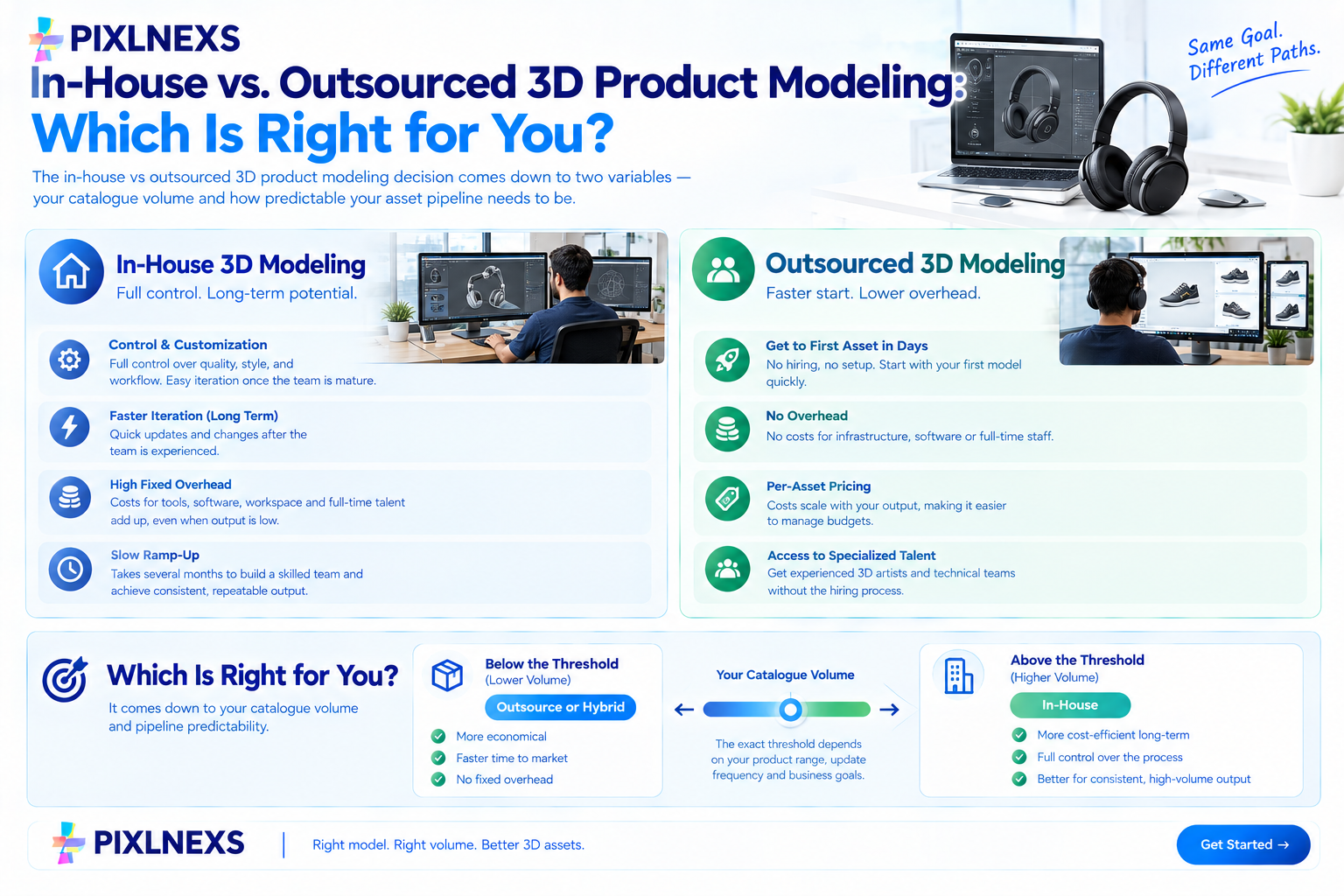
Quick Answer: The in-house vs outsourced 3D product modeling decision comes down to two variables your catalogue volume and how predictable your asset pipeline needs to be. In-house gives you control and fast iteration once the team is mature but carries high fixed overhead and a slow ramp of several months before clean, repeatable output. Outsourcing a studio gets you to your first asset in days with no overhead, at a per-asset price that scales with your output rather than against your payroll. For most ecommerce brands below a certain volume threshold, outsourcing or a hybrid model is the more economical and faster path. Above that threshold, in-house becomes the more defensible long-term choice.
By Manoj, Pixlnexs Studio. Pixlnexs models, textures and renders product assets for ecommerce brands every week, so this guide reflects the framework we use when clients ask which path fits their catalogue not a vendor pitch for one approach over the other but a practical decision tool.
Key Takeaways
- Cost structure is the real fork: in-house is fixed overhead (salaries, software, hardware); outsourcing is variable cost you only pay when you produce.
- Outsourcing wins on time-to-first-asset weeks of hiring and pipeline setup versus a studio that is already running.
- In-house wins on day-to-day control once mature: instant iteration, deep product knowledge and tight brand consistency.
- Catalogue size decides scalability a fixed in-house team has a throughput ceiling; a studio flexes up and down with your volume.
- The hybrid model often beats both: keep art direction in-house, outsource production capacity.
- Quality at maturity is comparable between the two paths but comes from different sources in-house quality comes from tribal product knowledge and proximity, studio quality comes from specialist range and documented standards.
- Starting outsourced and moving to hybrid or in-house as volume justifies it is a lower-risk path than committing to in-house before you know what quality and standards your catalogue actually requires.
The Core Decision: Fixed Cost vs Variable Cost
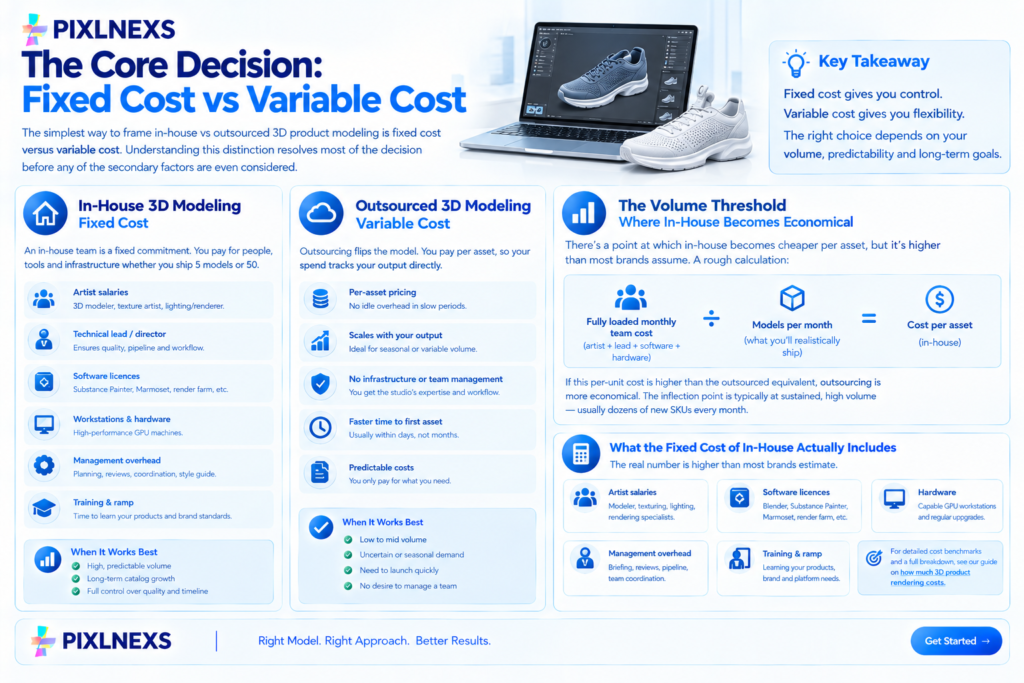
The cleanest way to frame in-house vs outsourced 3D product modeling is fixed cost versus variable cost and understanding this distinction resolves most of the decision before any of the secondary factors are even considered.
An in-house team is a fixed commitment. You pay artist salaries, a technical director or lead, software seats, capable GPU workstations and the management overhead of running a production team whether you ship 5 models a month or 50. In slow periods, you are paying for capacity you are not using. In high-volume periods, you get the benefit of that fixed cost spread across more units, which is where in-house eventually wins on a per-unit basis.
Outsourcing flips this entirely. You pay per asset, so your spend tracks your output directly. There is no idle overhead in a slow quarter and no capacity crisis in a launch spike. The trade-off is that the per-unit price includes the studio’s margin and the convenience of not managing any of it. For brands with variable, seasonal or uncertain volume, paying a modest premium per unit for that flexibility is typically the more economical choice over the whole year compared to carrying a salaried team through its idle periods.
The Volume Threshold Where In-House Becomes Economical
There is a volume level at which in-house becomes the cheaper path per asset but it is higher than most brands assume when they are first doing the math. A rough calculation: take the fully loaded monthly cost of a minimal capable in-house team (one mid-level artist, one technical lead, software and hardware amortized) and divide it by the number of production-quality models you realistically expect to ship per month. If the per-unit cost of that team is higher than the outsourced equivalent, you are in the range where outsourcing is more economical regardless of which path you prefer operationally.
The inflection point is typically reached only at sustained, high volume a brand producing dozens of new SKUs every month on a predictable cadence. Below that level, in-house is paying for capacity that exists but is not being used. For the raw cost benchmarks that let you do this calculation, see our breakdown of how much 3D product rendering costs.
What the Fixed Cost of In-House Actually Includes
A detailed list of what in-house costs is the point at which most brands discover the real number is higher than they estimated.
Artist salaries a 3D artist capable of producing production-quality, web-optimized ecommerce assets commands a real market rate. A single mid-level 3D generalist is rarely sufficient for a serious ecommerce catalogue; you typically need at minimum a modeler, someone with materials and texturing depth and a person who can handle lighting and rendering optimization.
Software licences Blender is free but the broader software stack for a professional production pipeline is not. Substance Painter, Marmoset Toolbag, a render farm service or GPU hardware for offline rendering, review and approval tools and project management software all carry ongoing costs.
Hardware capable GPU workstations for real-time preview and offline rendering are a significant capital cost and they need to be refreshed on a cycle that keeps pace with software requirements.
Management overhead somebody has to brief the team, review the work, maintain the style guide, manage the pipeline and handle the relationship between 3D production and the broader product and marketing team. This is typically a senior function that does not appear in the “artist headcount” calculation.
Training and ramp even a hired 3D artist takes time to learn your specific product range, your brand’s aesthetic standards and the particular technical requirements of your target viewer or platform.
Time-to-First-Asset and Ramp Speed
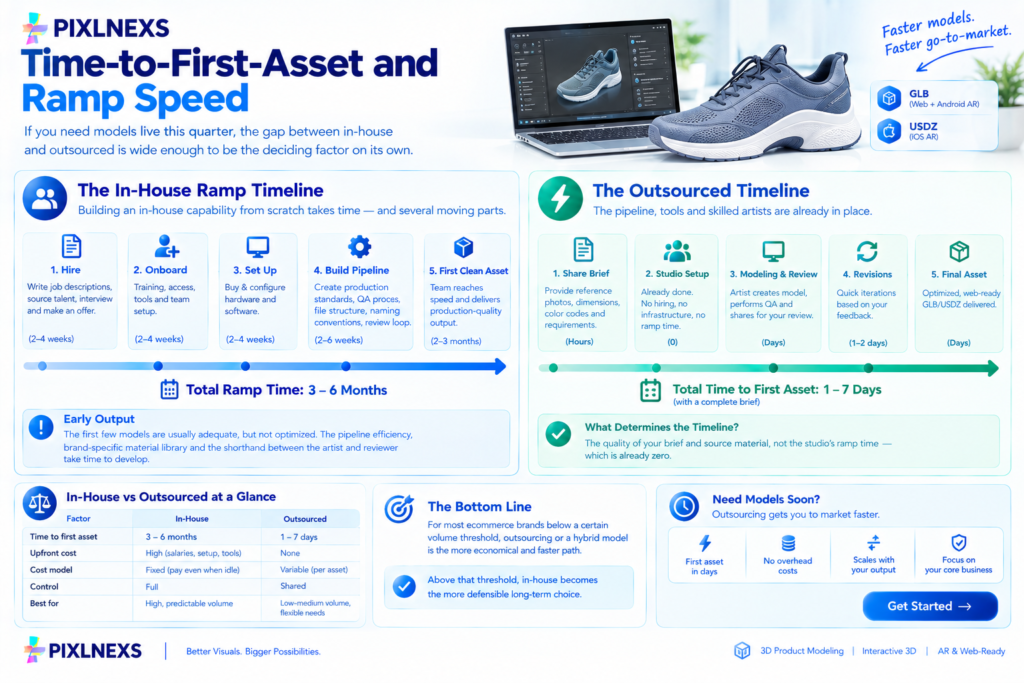
If you need models live this quarter, the gap between in-house and outsourced is wide enough to be the deciding factor on its own.
The In-House Ramp Timeline
Building an in-house capability from scratch requires: writing and publishing job descriptions (3D specialist roles draw from a thin talent pool, particularly for artists with ecommerce and web optimization experience specifically) interviewing a small number of genuinely qualified candidates, extending an offer, onboarding the hire, buying and configuring hardware and software and then designing a production pipeline texture standards, naming conventions, file organization, QA process and a review loop between the 3D team and the product and marketing stakeholders who will use the output.
Realistically, this process takes several months before a clean, repeatable, production-quality asset comes out the other end. The early output from a newly assembled team is typically adequate but not optimized the pipeline efficiency, the brand-specific material library and the shorthand between the artist and the reviewer take time to develop.
The Outsourced Timeline
A studio is already past all of this. The pipeline exists, the tooling is already configured, the QA process is already running and the artists are already skilled. What determines the first model turnaround on an outsourced project is the quality of the brief and the source material provided not the studio’s ramp time, which is already zero.
A complete brief with accurate reference photos, exact product dimensions and correct color codes can produce a first model in review within days. An incomplete brief that requires back-and-forth to resolve gaps adds time but the structural pipeline delay that characterizes in-house ramp does not exist. For what a complete brief actually looks like, see our guide on how to brief a 3D studio and for the source material checklist, see our guide on what assets you need to provide for a 3D product model.
Quality, Consistency and Control
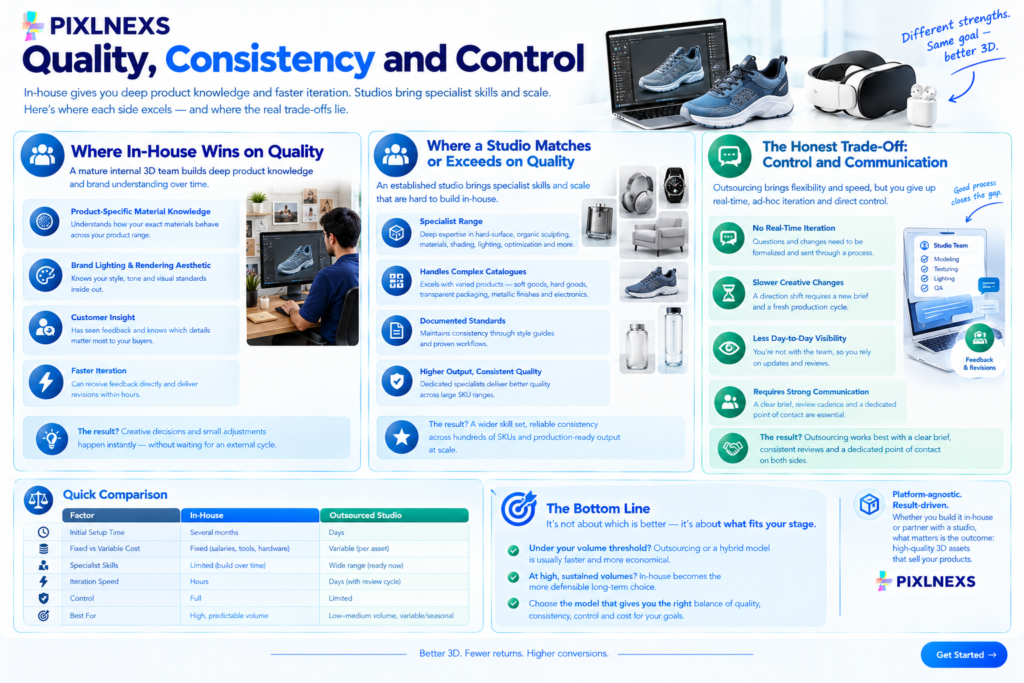
This is the category where in-house earns its keep but only at maturity and only for specific things.
Where In-House Wins on Quality
A settled internal 3D team accumulates knowledge that is genuinely difficult to replicate through a studio relationship: they understand how your specific materials behave in your product range, they have internalized your brand’s lighting and rendering aesthetic, they know which details matter most to your customers because they have seen the feedback loops play out and they can make judgment calls about creative decisions without a briefing conversation because they have the accumulated context to do so.
Iteration speed is the most tangible version of this advantage. An in-house artist who can receive feedback directly and turn around a revision within an hour is operationally different from an outsourced process where feedback has to be formalized, transmitted, processed and returned even when that outsourced cycle is efficient and well-managed.
Where a Studio Matches or Exceeds on Quality
An established studio brings specialist range that is genuinely hard to hire in one or two people. Hard-surface modeling, organic sculpting, materials and shading specialization, technical optimization for web and AR delivery and lighting direction are each a deep discipline. A small in-house team that needs to cover all of them is typically a team of generalists who are good at several things and excellent at few.
For complex or varied catalogues a range that includes soft goods, hard goods, transparent packaging, metallic finishes and electronics across the same seasonal release a studio with dedicated specialists in each area often produces higher quality than an in-house generalist team stretched across every product type. Consistency in a studio context comes from documented standards and a locked style guide rather than from proximity and verbal shorthand and a well-managed studio relationship with a thorough style guide can maintain catalogue-level consistency across hundreds of SKUs as reliably as an in-house team.
The Honest Trade-Off: Control and Communication
The honest limitation of outsourcing is control. You give up real-time, ad-hoc iteration. A question that an in-house artist can answer by looking at the product sitting on the shelf next to their workstation requires a communication exchange with an outsourced studio. A creative direction change that an in-house team absorbs immediately in a hallway conversation requires a formal brief update and a new production cycle externally.
A strong brief, a well-defined review cadence and a consistent point of contact on both sides close most of this gap in practice but the gap is genuine and worth naming rather than dismissing.
Scalability and Catalogue Volume
Catalogue volume is usually the deciding factor for brands that are growing, seasonal or uncertain about their production needs.
The In-House Throughput Ceiling
A fixed in-house team has a throughput ceiling that is set by headcount and cannot be exceeded without hiring which is slow and expensive. If you launch 300 new SKUs for a seasonal collection, that team becomes a bottleneck and the options are either to deliver models late (which misses the launch window) to compromise quality (which undermines the investment) or to hire and onboard additional capacity on a timeline that seasonal planning does not allow.
Steady, predictable volume the same number of new SKUs coming through the pipeline every month, every quarter is the scenario where in-house scales most efficiently. The fixed cost spreads across a consistent output, the team develops rhythm and efficiency over time and the management overhead per model decreases as the pipeline matures.
How a Studio Handles Volume Spikes
A studio flexes. It can allocate additional artists to a project during a launch period and scale back afterward you are not carrying that capacity year-round and you do not absorb the cost of finding and training it. This makes outsourcing structurally better suited to spiky, seasonal or uncertain volume than any fixed in-house configuration.
For brands whose 3D models will eventually power interactive product experiences a 360-degree viewer, an AR placement feature, a product configurator it is worth planning the asset standards for that destination from the start rather than retrofitting them later. See our guide on interactive 3D product visualization for the asset specification differences between models built for static renders versus models built for real-time web delivery.
Side-by-Side Comparison: In-House vs Outsourced 3D Product Modeling
| Factor | In-House Team | Outsourced Studio |
|---|---|---|
| Cost structure | High fixed overhead (salaries, software, hardware) | Variable, per-asset scales with output |
| Time to first asset | Slow months to hire and build pipeline | Fast days, pipeline already exists |
| Quality at maturity | Strong, with deep product knowledge | Strong, with broad specialist range |
| Day-to-day control | High instant iteration | Moderate depends on brief and cadence |
| Scalability | Capped by team size; spikes cause bottlenecks | Flexes up and down with volume |
| Tooling and hardware | You buy and maintain everything | Included in the price |
| Talent availability | Hard to hire; thin specialist pool | Pre-assembled, multi-discipline team |
| Best fit | High, steady volume; control-critical brands | Variable volume; fast start; lean teams |
The Hybrid Model: Art Direction In, Production Out
For many brands, the most effective answer to in-house vs outsourced 3D product modeling is neither extreme. The hybrid model keeps a small, senior function in-house an art director or 3D lead who owns the style guide, sets quality standards, defines the brief format and reviews every asset while outsourcing the heavy production work to a studio.
This structure captures most of the control benefits of in-house (the brand’s visual language is defined and enforced by someone internally) while preserving the scalability and flexibility benefits of outsourcing (production capacity flexes with volume without a corresponding headcount commitment).
Why Hybrid Often Beats Both Extremes
The in-house art director accumulates the product knowledge and brand context that makes briefing efficient and review meaningful. The studio brings the specialist range and scalable capacity that a two-person in-house production team cannot. The result is a structure where the creative decision-making is internal and the execution is external which is a well-established model in other production disciplines (creative agencies with in-house strategy and outsourced production, editorial teams with in-house editors and freelance writers).
Starting Outsourced as a Path to Hybrid
The hybrid model also represents a natural progression path. Starting fully outsourced lets you learn what quality and standards your catalogue actually requires before you commit to a salaried function. Once you know what good looks like for your specific product range and audience, bringing an art director in-house to own those standards is a lower-risk step than hiring a full production team before you have developed that knowledge.
If part of your decision also involves how the models are produced the tools and techniques used our comparison of manual 3D modeling vs AI 3D models is worth reading alongside the in-house vs studio choice, particularly for brands where production speed and cost per asset are primary constraints.
How to Decide: The Framework
Choose In-House If:
Your catalogue volume is high and sustained enough to keep a salaried team genuinely productive without significant idle time.
3D is a core differentiator for your brand your visual standards are sufficiently specific and your competitive advantage sufficiently dependent on 3D quality that the investment in an owned team is strategically justified.
You need same-day iteration your product development process involves rapid creative changes that require an artist to respond in hours, not days.
You can absorb the ramp you have the hiring timeline, the onboarding budget and the patience for several months before clean, repeatable output begins.
Choose Outsourced If:
You need assets quickly your first model needs to be in review within days, not months.
Your volume is variable or seasonal you have launch spikes you cannot carry as permanent headcount.
You do not want to manage tooling, hardware and hiring the overhead of running a production function is not something your operational structure can absorb easily.
You want specialist quality without building a department your catalogue spans multiple product types that each require different specialist skills.
Choose Hybrid If:
You care about control but are not ready to staff a full production team you want the brand integrity benefit of in-house direction without the full headcount commitment.
You are at a stage where volume is growing but not yet high enough to justify full in-house production the hybrid model scales with you as volume increases.
You have (or can hire) a strong art director or 3D lead who can own the brief and review function without needing to execute production themselves.
The Platform Dimension
The decision about how models are produced also has implications for where they will live. If your 3D assets are going into a viewer, a configurator or an AR experience, asset specifications for those destinations are different from specifications for static renders and building to the wrong specification means rework. Our roundup of the best 3D product visualization platforms and our comparison of 3D configurator software vs custom development both help you make sure your production decision is aligned with your downstream platform requirements before you start.
Common Mistakes in the In-House vs Outsourced Decision
Underestimating the In-House Fixed Cost
The most common calculation error is counting only artist salaries and forgetting the full cost stack: management overhead, software licences, hardware, training, ramp time and the opportunity cost of months before the team is producing at full quality. The true monthly cost of a capable in-house team is typically 30 to 50 percent higher than the number that appears in a simple “headcount times salary” estimate.
Assuming Quality Is Better In-House
Quality at maturity is strong in-house but maturity takes time. A newly assembled in-house team is typically producing at below the quality of an established studio with a settled pipeline and accumulated tooling. Brands that build in-house expecting an immediate quality advantage over outsourcing are usually disappointed in the first several months.
Not Accounting for Volume Variability
Planning headcount for average volume rather than peak volume means the team is a bottleneck during launches and is underutilized between them. Planning for peak volume means the team is expensive during off-peak periods. Neither is comfortable which is exactly why variable volume favours outsourcing or hybrid over a fixed in-house configuration.
Skipping the Style Guide
Whether you build in-house or outsource, the style guide is the document that enforces catalogue consistency. In-house teams can operate without one in early stages because verbal shorthand and proximity substitute for documentation but when the team grows, when artists turn over or when an outsourced overflow partner is added, the absence of a documented style guide becomes immediately visible as consistency drift across the catalogue.
Getting Started: The First Decision You Actually Have to Make
Regardless of which path you choose long-term, the decision you have to make right now is whether to start building in-house or to commission your first model from a studio. For most brands, the pragmatic answer is to commission the first model externally even if you intend to build in-house eventually because it gives you:
A reference quality standard before you hire, so you know what you are trying to recruit and build toward.
A production asset that is live on your product page before your in-house ramp is complete, rather than waiting several months for your first deliverable.
Real production experience a brief, a review cycle, a QA process that informs how you design your in-house pipeline when you do build it.
If you decide to stay outsourced, you are already producing. If you decide to build in-house or hybrid, you have a working model for what quality and process should look like.
Not sure which path fits your catalogue?
Start with one model from Pixlnexs it gives you a quality reference, a live asset on your product page and real production experience before you make any hiring or infrastructure decisions.
Commission Your First Model Talk to Our TeamConclusion
The in-house vs outsourced 3D product modeling decision is not primarily a question of quality mature versions of both paths can produce excellent ecommerce assets. It is primarily a question of cost structure, volume predictability and how much management overhead you want to carry.
For most ecommerce brands at an early or growing stage, starting outsourced or hybrid is the lower-risk, faster and more economical path. For established brands with high, predictable volume where 3D is a strategic differentiator, in-house investment earns its cost over time.
If you are unsure which path fits your catalogue, the answer is almost always: start with one model. Commission it from a studio, put it on your product page and measure what it does. The decision about how to scale the production function gets much easier once you have a quality reference and real conversion data to work from.
Frequently Asked Questions
Is in-house 3D modeling cheaper than outsourcing?
Only at high, sustained volume. In-house is fixed cost, so the per-asset price drops the more you produce but if the team sits idle in slow periods, you are paying for unused capacity. At low or variable volume, outsourcing’s pay-per-asset model is usually more economical when the full fixed cost stack is counted accurately.
How long does it take to build an in-house 3D team?
Realistically several months before clean, repeatable output at production quality. You have to hire from a thin specialist talent pool, configure hardware and software, then design and stabilize a pipeline with texture standards, naming conventions, QA and a review process. A studio skips all of this because the pipeline already exists.
Can I switch from outsourced to in-house later?
Yes and many brands follow exactly this path. Starting outsourced lets you learn what quality and standards your catalogue needs before committing to salaries. The hybrid model in-house art direction, outsourced production is a natural and low-risk stepping stone between the two extremes.
What if my catalogue volume is unpredictable?
Variable or seasonal volume strongly favors outsourcing or a hybrid setup. A studio absorbs launch spikes without you carrying that headcount year-round. A fixed in-house team either becomes a bottleneck during peaks or an underused overhead during troughs neither of which is a comfortable position at a growing ecommerce brand.
What does a hybrid model actually look like in practice?
Typically: one internal person (an art director, a senior 3D lead or a creative director with 3D fluency) who owns the style guide, briefs the studio and reviews every model that comes back. The studio executes the production work modeling, texturing, rendering, optimization under the art director’s direction. The internal person does not need to produce assets themselves; their function is setting the standard and enforcing it.
Which approach produces better quality for ecommerce specifically?
Both can produce excellent quality for ecommerce. In-house quality at maturity reflects deep product-specific knowledge. Studio quality reflects specialist range and a pre-built pipeline. For most ecommerce use cases standard product visualization, AR-ready GLB models, rendered images a well-briefed studio with documented standards matches or exceeds what a small in-house team of generalists delivers, particularly in the first year of operation. Quality parity emerges after the in-house team has been running for 12 to 18 months and has built its product-specific knowledge base.
How do I know when my volume justifies in-house?
Take the fully loaded monthly cost of a minimal capable in-house team (salaries, software, hardware, management) and divide by your realistic monthly model output. If the per-unit cost is higher than what a studio charges per model, you are not at the volume threshold yet. When the in-house per-unit cost drops below the outsourced equivalent, the economics favor in-house assuming volume is steady enough to keep the team consistently productive.
What should I do first if I am unsure which path to take?
Commission one model from a studio. It gives you a quality reference, a live asset on your product page and real production experience all before you make any hiring or infrastructure decisions. See our briefing checklist for how to start that process efficiently.









Leave a Reply