
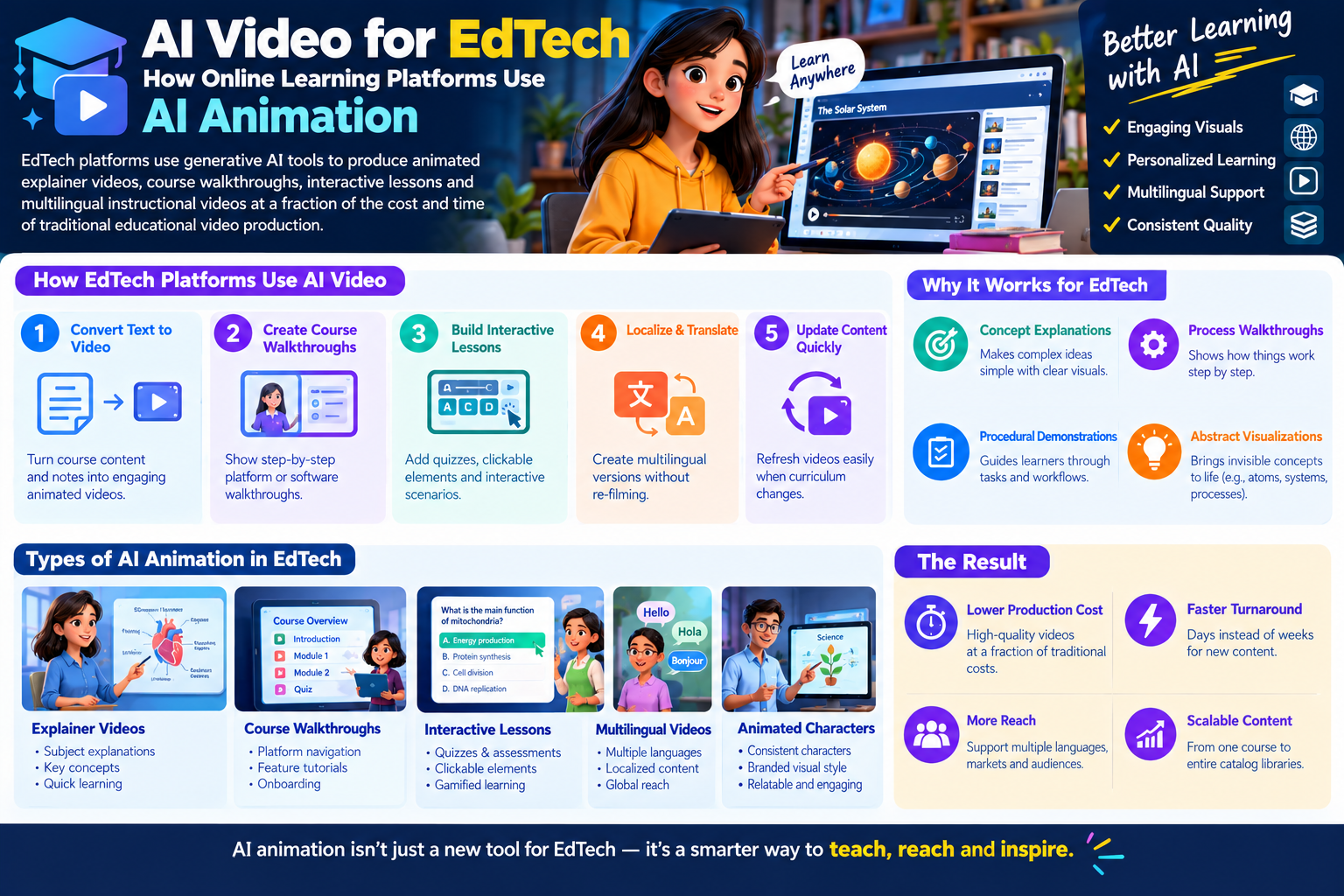
Quick answer: AI video for EdTech platforms uses generative AI tools to produce animated explainer videos, course walkthroughs, interactive lesson content and multilingual instructional videos at a fraction of the cost and time of traditional educational video production. Online learning platforms in 2026 use AI animation to convert text-based course content into engaging visual lessons, update existing video content quickly when curriculum changes, localize content into multiple languages without re-filming and produce consistent, branded visual content across large course catalogs.
The educational video content that AI animation produces best concept explanations, process walkthroughs, procedural demonstrations and abstract visualizations maps directly to the most common content needs in EdTech, which is why AI animation has moved from an experimental approach to a mainstream production method across online learning platforms in 2026.
By Bali Balaji, Pixlnexs Studio. Pixlnexs produces AI-assisted animated video content for EdTech platforms, children’s education channels and corporate learning applications and this guide reflects the production approaches, content strategies and technical considerations our team applies to real educational video briefs across K-12, higher education and professional development platforms.
Key Takeaways: AI Video for EdTech
- AI animation for EdTech dramatically reduces the cost and time of educational video production content that previously required a professional animation studio and weeks of production time can now be produced in days at a fraction of the cost.
- The educational content types that AI animation handles best are concept explanations, process walkthroughs, abstract visualizations and procedural demonstrations the same content types that are most common in online learning.
- Curriculum alignment and pedagogical accuracy cannot be automated human subject matter experts must validate educational content regardless of how quickly AI generates the visual component.
- Localization is one of AI animation’s strongest advantages for EdTech the same base animation can be adapted into multiple languages with AI voice synthesis and caption generation, making global course deployment significantly more accessible.
- Learner engagement data consistently shows that animated video outperforms talking-head lecture video for conceptual content not because of production quality alone but because animation can show abstract processes, invisible mechanisms and spatial relationships that a camera cannot capture.
- For EdTech platforms serving diverse learners, AI animation enables a volume of content production that was previously cost-prohibitive enough visual content to support different learning styles, different pacing preferences and different curriculum sequences without a proportional production budget increase.
Why EdTech Platforms Are Adopting AI Animation in 2026
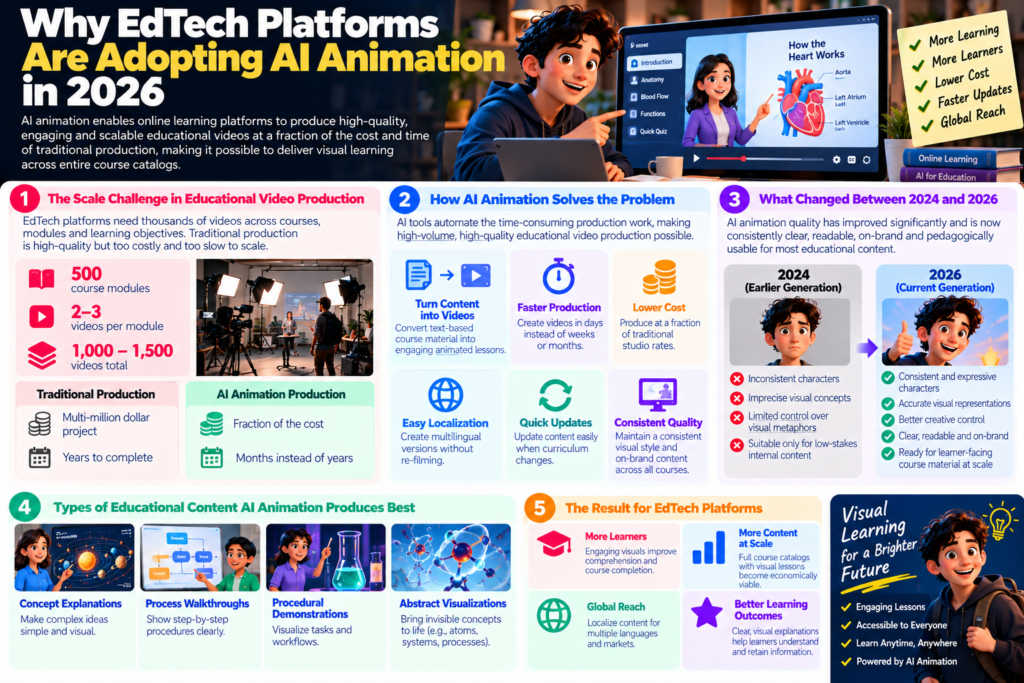
The educational video production challenge for online learning platforms is fundamentally different from commercial brand video production. A brand might need one hero video per product launch; an EdTech platform might need one video per lesson topic across dozens of courses, hundreds of modules and thousands of learning objectives before accounting for updates when content needs to change, localization for different language markets and accessibility adaptations for different learner needs.
Traditional educational video production script, storyboard, illustration, animation, voiceover, sound design, review, revision, delivery produces excellent output at a cost and timeline that simply cannot scale to the volume most EdTech platforms require. A platform with 500 course modules that needs two to three videos per module needs somewhere between 1,000 and 1,500 videos. At traditional studio rates and timelines, that is a multi-year, multi-million dollar production project.
AI animation changes the production economics fundamentally. The same volume of content 1,000 to 1,500 short explainer videos is achievable in months rather than years, at a per-video cost that makes full-catalog visual coverage economically viable for platforms of all sizes. This is not a marginal improvement; it is a structural change in what EdTech content production can look like.
What Changed in AI Animation Quality for Education Between 2024 and 2026
The quality of AI-generated animation has improved significantly enough in the past two years to cross the threshold relevant for educational use: the output is now consistently clear, readable, on-brand and pedagogically usable for the majority of educational content types. The earlier-generation AI animation outputs inconsistent character appearance, imprecise visual representations of concepts, limited control over visual metaphor were adequate for low-stakes internal content but not for learner-facing course material at scale.
The 2026 generation of AI animation tools, combined with a production workflow that uses AI for the generative work and human expertise for curriculum alignment and quality review, produces educational video content that learners engage with at rates comparable to or exceeding traditional studio-produced animation.
How AI Animation Works in an EdTech Production Pipeline
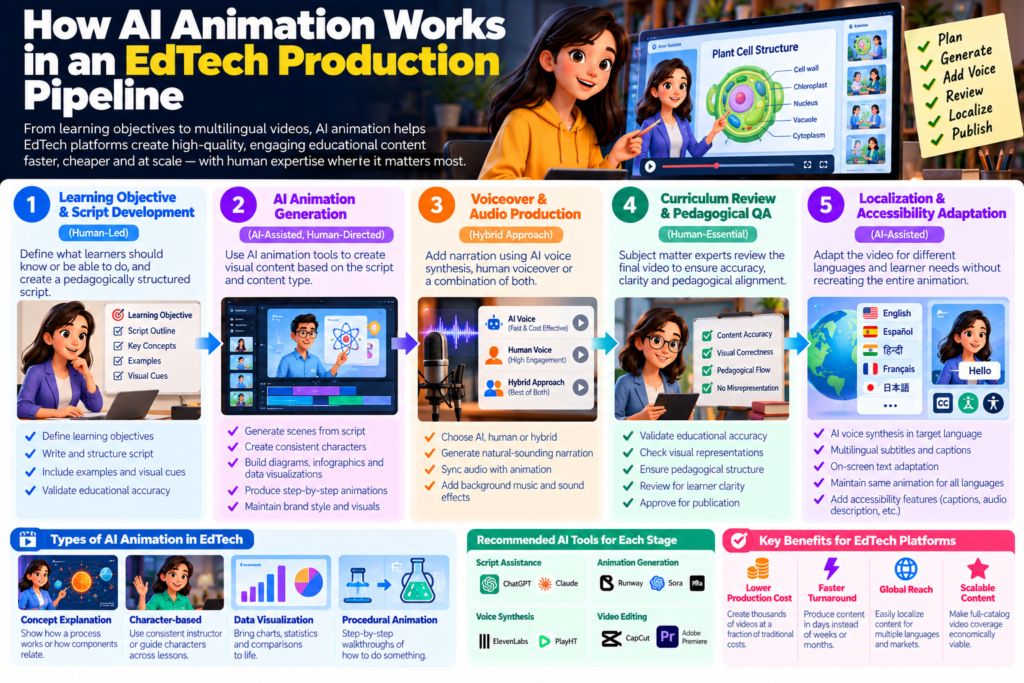
Understanding the production workflow helps EdTech platform teams plan the integration of AI animation into their content strategy including where AI contributes most, where human expertise is still essential and what the overall production process looks like.
Stage 1: Learning Objective and Script Development (Human-Led)
The starting point for any educational video is the learning objective what specific knowledge, skill or understanding should the learner have after watching. This stage is entirely human-led, by instructional designers and subject matter experts. AI can assist with script drafting and editing but the educational accuracy and pedagogical structure of the content must be validated by qualified humans before any production begins.
A well-structured educational animation script differs from a commercial video script in important ways: it explicitly states the learning objective, structures content in a sequence that builds understanding progressively, includes concrete examples for abstract concepts and signals to the animator where visual representations are needed versus where narration alone is sufficient.
Stage 2: AI Animation Generation (AI-Assisted, Human-Directed)
With a validated script, AI animation generation tools produce the visual content. The production approach varies by content type:
Concept explanation animations showing how a process works, what a system looks like or how components relate are well-served by AI animation tools that can generate diagrammatic and illustrative content from text descriptions and reference materials.
Character-based animations where a consistent instructor character or guide character walks learners through content require character design establishment upfront (the character’s appearance, style and color palette) and then AI-assisted generation maintaining that character’s consistency across scenes.
Data visualization and infographic animation bringing charts, statistics and comparative information to life is one of AI animation’s strongest capabilities for educational content, since it can generate clean, accurate visual representations of data-based information.
Procedural and process animations step-by-step walkthroughs of how to do something are well-suited to AI animation because the sequential nature of the content translates cleanly into a sequence of animated scenes with consistent visual style.
Stage 3: Voiceover and Audio Production (Hybrid Approach)
Voiceover for AI-animated educational video uses either AI voice synthesis or recorded human voiceover or a hybrid of both. The choice affects both cost and learner perception:
AI voice synthesis is fastest and cheapest and quality has improved significantly in 2026. Modern AI voice synthesis produces natural-sounding narration that passes without friction for most learners in most educational contexts. For platforms producing high-volume content across many topics, AI voice synthesis makes the production economics of visual narration viable at scale.
Human voiceover remains preferable for high-stakes content, for content where emotional connection is important (early childhood education, motivation-heavy content, content for vulnerable learner populations) and for content where the instructor’s personal voice is part of the educational brand.
Hybrid approach: human voiceover for flagship courses and hero content, AI voice synthesis for supplemental material, practice support and high-volume catalog content.
Stage 4: Curriculum Review and Pedagogical QA (Human-Essential)
The curriculum review stage validates that the generated animation correctly represents the learning content that the visuals accurately illustrate the concepts being narrated, that no visual misrepresentation of the content has been introduced in the generation process and that the pedagogical structure is intact.
This stage cannot be automated. AI animation generates visual content from descriptions; it cannot validate that the generated content correctly represents the underlying educational concept. A subject matter expert must review each video for accuracy before it is published to learners.
Stage 5: Localization and Accessibility Adaptation (AI-Assisted)
Localization adapting the video for learners in different language markets is one of the strongest practical advantages of AI animation for EdTech. A base animation with AI-generated narration can be localized into additional languages through:
- AI voice synthesis in the target language, synchronized to the existing animation timing
- AI-generated subtitle and caption files in multiple languages
- On-screen text adaptation (labels, callouts, captions within the animation) for the target language
The animation itself the visual content does not need to change for most language adaptations. This makes per-language localization cost a fraction of traditional video localization, which requires re-recording narration, re-timing animation to match new narration pacing and adapting on-screen text.
For our full guide to multilingual AI video localization for educational and brand content.
Best Educational Content Types for AI Animation in EdTech
Not all educational content benefits equally from AI animation. Understanding which content types AI animation handles best helps EdTech teams prioritize where to apply it first and where traditional production methods may still be appropriate.
| Content Type | AI Animation Suitability | Why AI Animation Works | Human Component Still Required |
|---|---|---|---|
| Abstract concept explanation | Excellent | Animation can show invisible processes, internal mechanisms and spatial relationships cameras cannot | Subject matter expert content accuracy review |
| Step-by-step procedural walkthroughs | Excellent | Sequential scenes map naturally to step-by-step processes | Script accuracy, step sequence validation |
| Data visualization and statistics | Excellent | Animated charts, graphs and comparative data are AI animation’s natural output | Data accuracy verification, source attribution |
| Historical narrative and timeline | Good | Scene-based narrative structure maps to animation scenes well | Historical accuracy, depiction sensitivity review |
| Science and STEM demonstrations | Excellent | Can show cellular processes, atomic structure, circuit behavior that is impossible to film | Scientific accuracy is critical expert review mandatory |
| Language and vocabulary learning | Good | Visual word-concept association, pronunciation audio, contextual scene generation | Linguistic accuracy, native speaker audio review |
| Instructor-led lecture content | Moderate | AI can animate slide content and supporting visuals but talking-head replacement has limits | Instructor identity and personal connection cannot be fully AI-replicated for many learner types |
AI Animation for Specific EdTech Platform Types
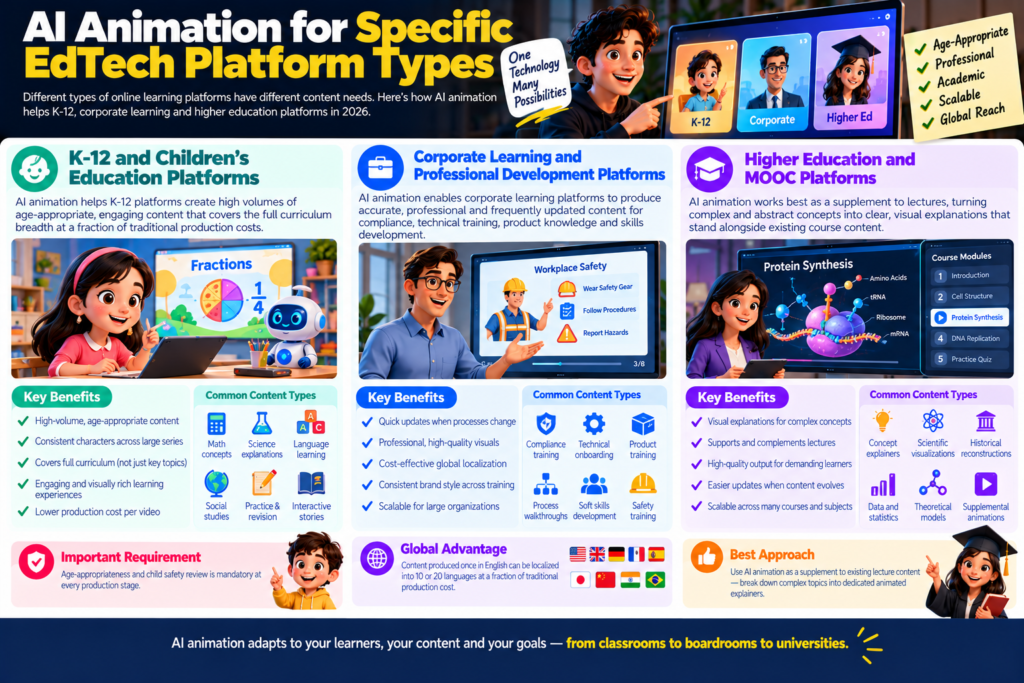
K-12 and Children’s Education Platforms
For K-12 and children’s content, AI animation’s strongest contribution is the ability to produce high volumes of age-appropriate, visually engaging content that covers the full curriculum breadth not just the headline topics.
Traditional educational animation for children requires character design, style guide development and consistent character animation across every video in a series work that was expensive enough to limit most children’s educational platforms to a small library of character-based animations covering only the most important topics.
AI animation, working from an established character design and style guide, can maintain character consistency across a large volume of content while dramatically reducing per-video production cost. A K-12 platform that previously had 50 animated math concept videos can now afford 500 covering not just the key concepts but the practice supports, extension materials and challenge content that differentiate a strong curriculum from an adequate one.
Critical requirement for children’s content: age-appropriateness and child safety review is mandatory at every production stage. For our full guide to AI animated explainer video production specifically for school and education contexts.
Corporate Learning and Professional Development Platforms
Corporate learning platforms face a specific content challenge: high volume of specialized, frequently updated content for a professional audience with low tolerance for low-quality presentation. Compliance training, technical onboarding, product knowledge updates and skills development content all need to be accurate, visually professional and updated regularly as products, regulations and procedures change.
AI animation addresses the update problem particularly well for corporate learning. When a product changes, a regulation updates or a process is revised, traditional animated video requires a full production cycle to update the affected content. AI-animated content can be updated at the script level and regenerated changing only the affected scenes while maintaining the overall style and character consistency in a fraction of the time.
The production efficiency compounds for global organizations: content produced once in English can be localized into 10 or 20 languages for the cost that traditional production would charge for two or three localized versions. For multinationals deploying compliance or technical training globally, this is a transformative cost reduction.
Higher Education and MOOC Platforms
Massive open online courses (MOOCs) and university-affiliated online learning platforms face the content challenge from both ends: the volume requirement (thousands of lessons across hundreds of courses) and the quality expectation (learners comparing against professional media have a high visual quality threshold).
AI animation in higher education works best as a supplement to existing content rather than a wholesale replacement taking the conceptual and abstract content from within longer lecture videos and expanding it into dedicated animated explainer videos that stand alongside the lecture content. A lecture that explains protein synthesis in 10 minutes of talking-head video with a slide deck can be supplemented by a two-minute AI-animated visual of how the process actually works at the molecular level an animation that a camera could never film.
The supplemental animated content increases the visual richness of the course, gives learners an additional entry point for difficult concepts and can be updated independently of the lecture video when the underlying science or content evolves.
Ready to Scale Educational Video Production With AI Animation?
Pixlnexs produces AI-assisted educational animation for EdTech platforms, corporate learning teams and educational publishers curriculum-aligned, multi-language capable and built for the volume that online learning requires.
See Pixlnexs AI Animation for EdTech Talk to Our TeamAI Animation Quality Standards for Educational Video
Educational video has specific quality standards that differ from commercial brand video the content must be pedagogically sound, visually accurate and accessible across a range of learner abilities and contexts.
Accuracy: The Non-Negotiable Standard
Visual accuracy in educational animation is not a quality preference it is a requirement. A visual representation of a scientific process, a historical event or a mathematical concept that is incorrect or misleading actively harms learner understanding. AI animation generation cannot guarantee content accuracy it generates visual content that is statistically plausible for a given prompt, not visual content that has been verified against an authoritative source.
Every AI-animated educational video requires a human subject matter expert review before publication to learners. This review confirms that the visual representation matches the educational concept being taught, that no visual errors or misleading representations have been introduced in generation and that the content sequence builds understanding correctly.
Accessibility Standards for AI Animated Educational Content
Educational content has accessibility requirements that commercial video does not always address closed captions, audio descriptions, reading level considerations and cognitive load management for learners with different abilities.
AI animation’s caption and subtitle generation is a genuine accessibility advantage: accurate caption files can be generated automatically and reviewed much faster than traditional caption authoring. Audio descriptions for visually impaired learners require human authoring describing what is happening in the animation visually in a way that conveys the educational content to someone who cannot see the screen.
Cognitive load management designing the visual complexity of each frame to support rather than overwhelm working memory requires human instructional design judgment in the script and storyboard stage. AI animation produces what is prompted; whether that visual complexity is appropriate for the target learner’s cognitive capacity is a design decision that the instructional designer makes.
Consistent Visual Style Across a Course Library
For EdTech platforms, visual style consistency across the entire course library is an important quality signal it communicates to learners that the platform has invested in coherent, professional content rather than assembled a patchwork of differently styled materials.
Achieving visual style consistency in AI animation requires establishing a clear style guide before production begins character design, color palette, typography, background style, motion language and referencing it consistently in every generation prompt. A well-established style guide applied rigorously produces a course library where every video feels like it belongs to the same world.
The Business Case for AI Animation in EdTech
Cost per Video at Scale
The economics of AI animation for EdTech are most compelling when viewed at catalog scale rather than per-video. A traditional studio-produced animated educational video might cost considerably more than AI-assisted production. At a catalog of 1,000 videos, this difference represents significant budget budget that can be redirected toward learner acquisition, platform development or curriculum development rather than video production alone.
The cost advantage is largest for:
- High-volume, catalog-wide coverage of topics that are important but not commercially critical enough to justify studio production budgets individually
- Content updates and refreshes updating AI-animated content when curriculum changes is significantly cheaper than re-producing traditionally animated content
- Localization AI voice synthesis and caption generation reduce per-language localization cost substantially
Time to Publication
Educational content has a timeliness dimension that many commercial content types do not curriculum updates, regulatory changes and market developments mean that the faster content moves from decision to published lesson, the more useful it is. AI animation dramatically compresses the time between a validated script and a published video, which directly improves the platform’s ability to respond to curriculum changes and content gaps quickly.
Learner Engagement Data
Platform analytics on learner engagement with animated versus non-animated educational content consistently show that animation even AI-generated animation at moderate quality produces higher completion rates and better knowledge retention scores for conceptual content compared to equivalent talking-head lecture video. This is not specific to AI animation; the engagement advantage of animation for conceptual content is well-established in educational research. AI animation simply makes the delivery mechanism economically accessible at scale.
Pixlnexs AI Animation for EdTech: What We Build
At Pixlnexs, our educational AI animation production combines AI generation with human instructional design review and subject matter expert validation the hybrid approach that delivers AI’s volume and cost advantages without sacrificing the accuracy standards that educational content requires.
We work with EdTech platforms, corporate learning teams and educational publishers to produce:
- Curriculum-aligned concept explanation animations for K-12, higher education and professional development
- Multilingual course content with AI voice synthesis and professionally reviewed localization
- Character-consistent series animation across large course catalogs
- STEM and science visualization animations for topics that standard photography or video cannot represent
- Corporate compliance and technical training animation with regular update cycles built into the production process
For brands that also need interactive 3D product visualization alongside educational video content for product training, technical onboarding or skills development content involving physical products Pixlnexs’s 3D visualization capabilities extend the same production quality to interactive product learning experiences. See our interactive 3D ecommerce page for more.
Conclusion
AI animation for EdTech platforms is not a future possibility it is a present production reality that has changed what online learning content looks like and what producing it costs. The volume of visual educational content that was previously accessible only to well-resourced platforms with significant production budgets is now accessible to platforms of every size, because AI animation makes the production of that volume economically viable.
The transition has a clear prerequisite: human expertise remains central to the production process, not as a check on AI output but as the source of the learning objectives, the curriculum design and the accuracy validation that make educational content educational rather than merely visual. AI generates the animation; humans ensure it teaches.
For EdTech platforms evaluating AI animation for their content strategy, the starting point is the same as for any content investment: identify the highest-priority content gaps, produce a pilot batch of AI-animated content using the production workflow described above, measure learner engagement and learning outcomes against equivalent non-animated content and scale from validated results.
The platforms that integrate AI animation into their content strategy now build the production capability, the style guide infrastructure and the quality workflow that will define their content advantage as the market continues to move toward visual, at-scale educational content delivery.
Frequently Asked Questions
What Is AI Animation for EdTech and How Does It Work?
AI animation for EdTech uses generative AI tools to produce animated educational videos from scripts, text descriptions and reference materials replacing or supplementing the traditional process of manual illustration, character animation and compositing. A validated educational script is processed through AI animation tools that generate visual scenes, character motion, data visualizations and environmental elements, which are then reviewed by human educators and subject matter experts before publication.
Does AI Animation Replace Human Educators and Instructional Designers?
No. AI animation replaces the visual production labor that turns a validated educational script into an animated video the illustration, motion and compositing work that studios previously performed. The curriculum design, learning objective development, content accuracy validation and pedagogical structure decisions remain entirely human-led. Instructional designers and subject matter experts are more important in an AI animation workflow, not less, because the speed of AI generation means their review and validation work must keep pace with a much faster production process.
How Accurate Is AI-Generated Educational Content?
AI animation generates visual content that is statistically plausible for a given prompt it does not verify educational accuracy. Every AI-animated educational video requires human subject matter expert review to confirm that the visual representation accurately illustrates the underlying concept, that no visual errors have been introduced and that the content sequence builds understanding correctly. Educational accuracy is always a human responsibility in an AI animation workflow.
What Are the Best AI Animation Tools for EdTech in 2026?
The strongest AI animation tools for educational content production in 2026 combine AI video generation (from platforms such as Runway, Kling or Veo) with AI illustration and character generation tools, AI voice synthesis and automated caption generation. No single tool covers the full educational animation pipeline professional EdTech animation production uses a combination of tools in a human-directed workflow. For a full comparison of AI video generation platforms.
How Long Does It Take to Produce an AI Animated Educational Video?
For a two to three minute educational animation, an AI-assisted production workflow from validated script to reviewable video typically takes one to three working days, compared to two to four weeks for traditional studio animation of equivalent length. The review and revision cycle adds time depending on the complexity of the content and the number of accuracy issues found in review. The total time from script to published video is still significantly shorter than traditional production.
Can AI Animation Handle Complex Scientific Visualizations for Education?
Yes this is one of AI animation’s strongest educational use cases. Processes that occur at scales impossible to photograph (cellular biology, chemical reactions, atomic structure), in timescales that cameras cannot capture (geological processes, evolutionary change) or inside systems that are opaque to cameras (internal combustion engines, computer processor operations) are exactly the visualizations that animation including AI animation makes accessible to learners. The accuracy requirement for scientific visualization is high, making expert review particularly critical for this content type.
How Does AI Animation Support Multilingual EdTech Content?
A base animation produced with AI voice synthesis in one language can be adapted for additional languages by substituting the synthesized narration audio with the target language, generating subtitle and caption files in the target language and adapting any on-screen text within the animation. The visual animation itself typically does not change between language versions. This approach reduces per-language localization cost significantly compared to traditional video localization, which requires re-recording narration and re-timing animation to match different speech patterns.
What Accessibility Features Should AI Animated Educational Videos Include?
Minimum accessibility requirements for educational video include: closed captions synchronized to the narration audio, audio descriptions for visually impaired learners (describing what is happening in the visual animation), sufficient color contrast for color-blind learners and transcripts of the full narration. AI caption generation significantly reduces the production cost of caption creation; audio descriptions require human authoring to describe the educational content in a way that is meaningful without the visual component.
Related Guide
Best AI Video Generators in 2026: Sora vs Kling






Leave a Reply