
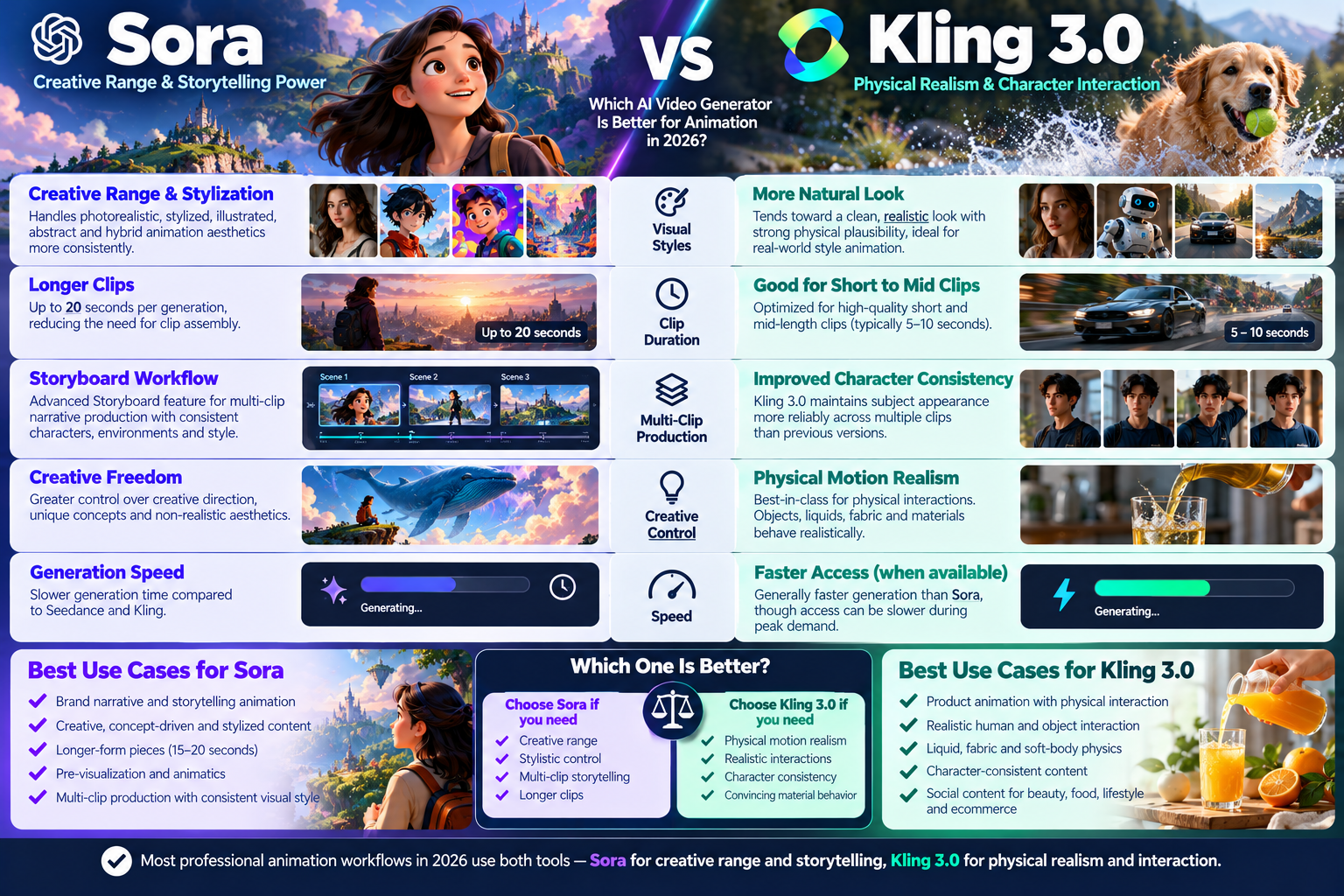
Quick answer: Sora and Kling 3.0 are the two strongest AI video generators for animation in 2026 but they lead in different areas. Sora produces the most creative range and stylistic flexibility it handles everything from photorealistic to stylized, illustrated and abstract animation aesthetics, supports clips up to 20 seconds and offers the most advanced multi-clip production workflow through its Storyboard feature. Kling 3.0 produces the most physically realistic motion objects fall, interact and deform with a physical plausibility that Sora does not consistently match and its character consistency across frames has improved significantly in its 3.0 update.
For animation specifically, the choice comes down to what the animation needs to do: if creative range, stylistic control and multi-clip narrative are the priority, Sora wins. If physical motion realism, character interaction and convincing material behavior are the priority, Kling 3.0 wins. Most professional animation workflows in 2026 use both.
By Bali Balaji, Pixlnexs Studio. Pixlnexs produces AI-assisted animation for ecommerce brands, EdTech platforms and creative agencies and this comparison reflects hands-on production experience with both Sora and Kling 3.0 across real animation briefs, including the specific conditions where each platform outperforms the other.
Key Takeaways
- Sora leads on creative range, aesthetic flexibility and multi-clip narrative production. Its Storyboard tool makes it the closest thing to a complete AI animation production environment.
- Kling 3.0 leads on physical motion realism and character consistency. Its 3.0 update specifically improved the reliability of consistent subject appearance across frames the problem that made earlier versions less useful for character-based animation.
- For ecommerce product animation, Kling 3.0 is the stronger single-platform choice because product interaction (picking up, placing, pouring, opening) requires physical plausibility that Kling 3.0 handles better than Sora.
- For brand storytelling animation, educational animation and any content with an intentional visual aesthetic that departs from photorealism, Sora is the stronger single-platform choice.
- Prompt structure matters differently on each platform Sora responds to scene-level and aesthetic-level prompting, Kling 3.0 responds to action-specific and physics-specific prompting.
- Neither platform eliminates the need for post-production. Color grading, sound design and motion graphics are production layers both platforms require before output reaches a finished deliverable standard.
Why the Sora vs Kling 3.0 Comparison Matters for Animation
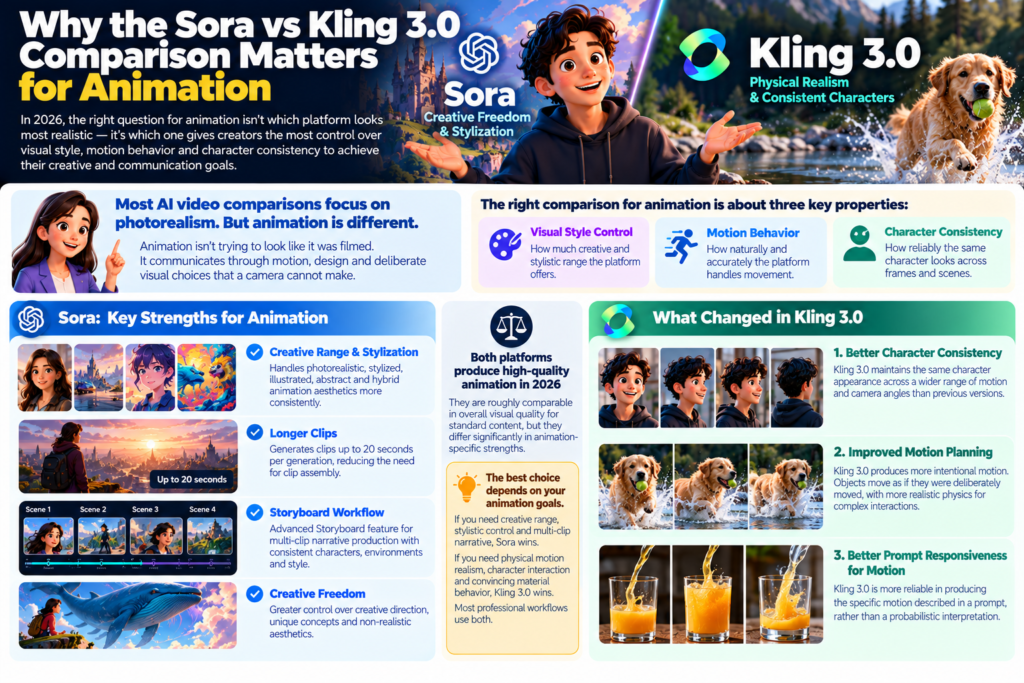
In the crowded AI video market of 2026, most comparisons focus on photorealism which platform makes video that is hardest to distinguish from filmed content. For animation specifically, that is not the right question. Animation, by definition, is not trying to look like it was filmed. Animation communicates through motion, through design, through the deliberate visual choices that a camera cannot make.
The right question for animation is: which platform gives creators the most control over visual style, motion behavior and character consistency the three properties that determine whether an animation achieves its communicative purpose.
Sora and Kling 3.0 have converged on roughly comparable visual output quality for standard content but they diverge significantly on these three animation-specific properties. Understanding exactly where each platform is stronger and why is what determines which one to use for a given animation brief.
What Changed in Kling 3.0
Kling 3.0 represents a significant update from Kling 2.1 in three specific areas relevant to animation:
Character consistency improved substantially. Earlier Kling versions produced good output for single-scene clips but struggled to maintain consistent subject appearance when the subject moved significantly or the camera angle changed. Kling 3.0 addresses this directly the same character, from the same generation session with the same reference, now remains visually consistent across a wider range of motion and camera angles.
Motion planning improved. Kling 3.0 produces more intentional motion objects move as if they were deliberately moved rather than simply changing position. The physics simulation that was already Kling’s strongest capability received further refinement for complex interactions.
Prompt responsiveness for motion improved. Kling 3.0 is more reliable in producing the specific motion described in a prompt rather than a probabilistic interpretation of it.
Sora vs Kling 3.0: Visual Style and Aesthetic Control
How Sora Handles Visual Style in Animation
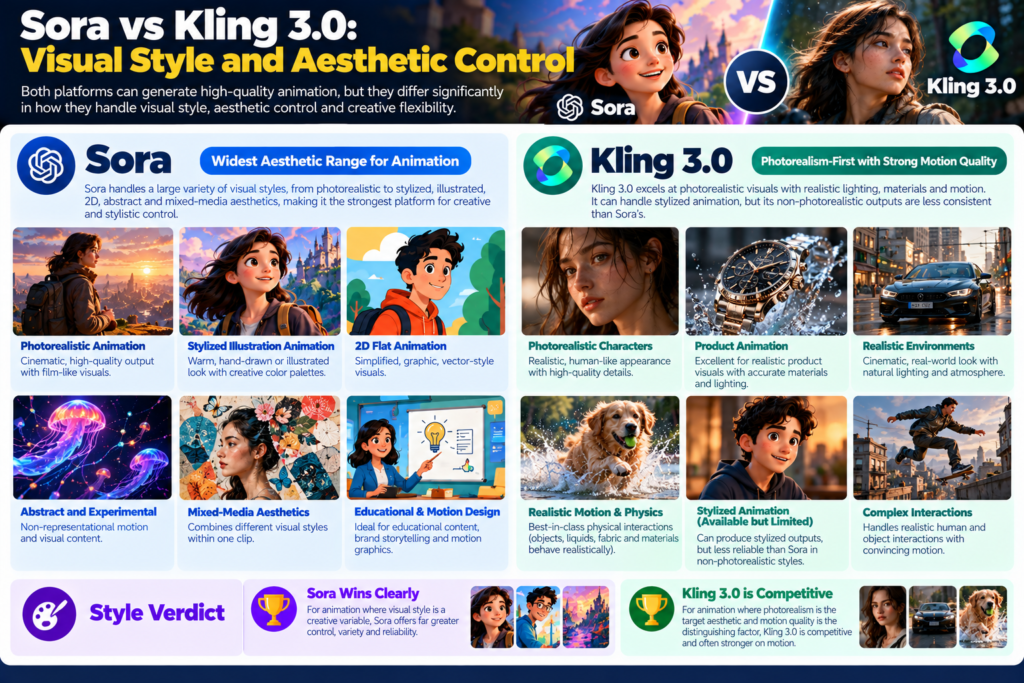
Sora’s training data and model architecture give it the widest aesthetic range of any current AI video generator. It handles:
- Photorealistic animation output that resembles filmed content but with the motion characteristics of animation
- Stylized illustration animation output that departs from photorealism toward a designed, illustrated aesthetic
- 2D flat animation simplified, graphic, vector-style visual output
- Abstract and experimental animation non-representational motion and visual content
- Mixed-media aesthetics combining characteristics of different visual styles within one clip
This range means Sora is the strongest platform for animation briefs where the visual style is itself a creative decision where the brief specifies a particular aesthetic rather than just a photorealistic rendition of a scene.
For educational animation, brand storytelling and motion design applications, Sora’s aesthetic flexibility is its defining production advantage. A brief that asks for “a warm, hand-drawn illustrative style with soft colors” or “a bold, high-contrast flat design aesthetic” produces the intended visual result from Sora more reliably than from Kling 3.0.
How Kling 3.0 Handles Visual Style in Animation
Kling 3.0 is photorealism-first. Its strongest outputs are cinematic, live-action-style video with photorealistic lighting, materials and motion. It handles stylized animation aesthetics but its outputs in non-photorealistic territory are less reliable than Sora’s.
For animation briefs where the visual style is inherently photorealistic lifestyle product animation, character animation that needs to look like real people, environment animation that needs to match real-world appearance Kling 3.0 is competitive with or better than Sora in specific motion quality.
The Style Verdict
For animation where visual style is a creative variable: Sora wins clearly.
For animation where photorealism is the target aesthetic and motion quality is the distinguishing factor: Kling 3.0 is competitive and often stronger on motion.
Sora vs Kling 3.0: Physical Motion Realism
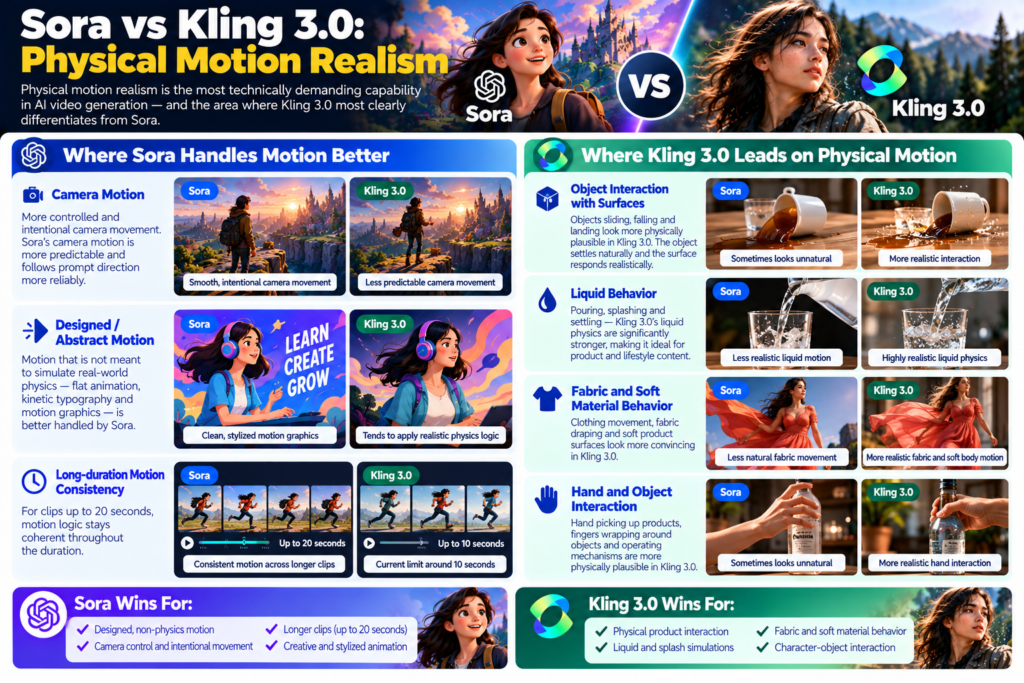
Physical motion realism how convincingly objects, characters and materials behave according to real-world physics is the most technically demanding capability in AI video generation and the area where Kling 3.0 most clearly differentiates from Sora.
Where Kling 3.0 Leads on Physical Motion
Object interaction with surfaces. An object placed on a surface, sliding across a table, falling and landing Kling 3.0 produces these with a physical plausibility that Sora does not consistently match. The object settles, the surface responds, the motion eases naturally at the point of contact.
Liquid behavior. Pouring, splashing, settling Kling 3.0’s liquid physics are significantly stronger than Sora’s. A coffee pour, water in a glass, a product being dispensed from a bottle these are motions that appear in product lifestyle content constantly and Kling 3.0 handles them with greater realism.
Fabric and soft material behavior. Clothing movement, fabric draping, soft product surfaces responding to touch Kling 3.0’s soft body simulation produces more convincing results than Sora for materials that deform.
Hand and object interaction. A hand picking up a product, fingers wrapping around a handle, thumbs operating a mechanism these interactions are significantly more physically plausible in Kling 3.0.
Where Sora Handles Motion Better
Camera motion. Sora produces more controlled, intentional camera movement. While Higgsfield AI (covered in our ) leads on explicit camera control, Sora’s camera motion in response to prompt direction is more predictable than Kling 3.0’s.
Abstract and designed motion. Motion that is not meant to simulate physics designed motion in flat animation, kinetic typography, motion graphics-style animation is better handled by Sora because Kling 3.0 tends to apply photorealistic physics logic to all motion regardless of the visual style.
Long-duration motion consistency. For clips approaching Sora’s 20-second maximum, motion logic stays coherent across the full duration. Kling 3.0’s current maximum of approximately 10 seconds means long-form motion consistency comparisons are somewhat moot.
The Physical Motion Verdict
For animation involving physical product interaction, liquid, fabric or character-object interaction: Kling 3.0 wins clearly.
For designed, non-physics motion and camera control: Sora is stronger or comparable.
Sora vs Kling 3.0: Character Consistency for Animation
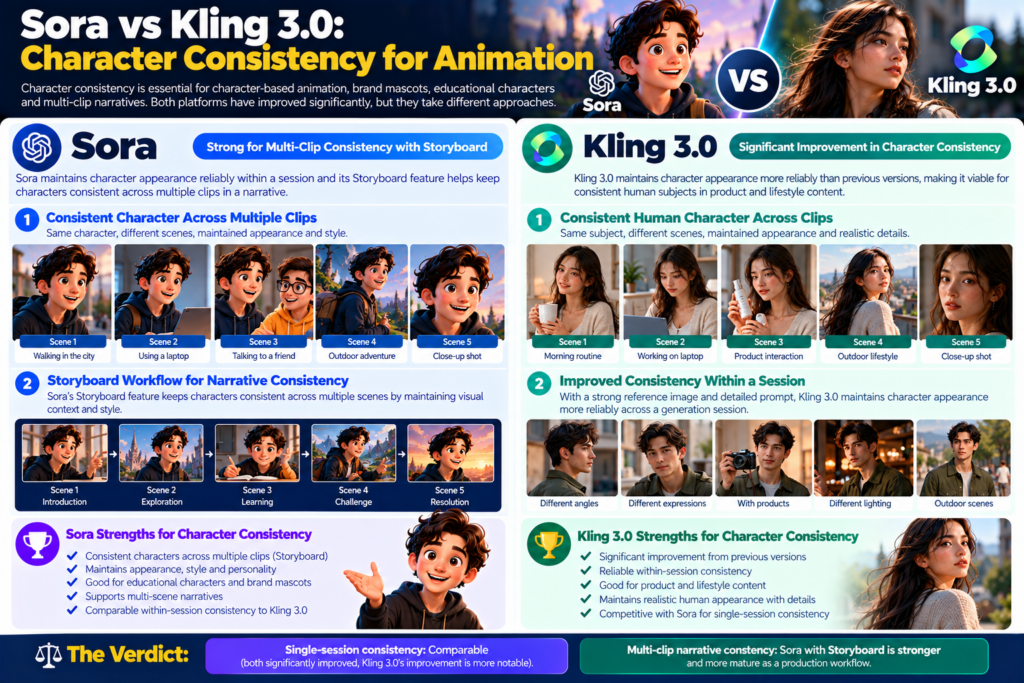
Character consistency maintaining a character’s appearance across multiple clips or across a single longer clip is one of the most important requirements for character-based animation and one of the hardest problems in AI video generation.
Character Consistency in Kling 3.0
Kling 3.0’s character consistency improvement is the most production-relevant update in the 3.0 release for animation work. With a strong reference image and a detailed subject description, Kling 3.0 maintains character appearance more reliably across a generation session than previous Kling versions.
For ecommerce product content involving a consistent human subject interacting with products a lifestyle character that appears in multiple clips throughout a campaign Kling 3.0 is now viable as a character consistency solution in a way that earlier versions were not.
The practical limitation remains: character consistency is strongest within a single generation session with consistent reference inputs. Cross-session consistency maintaining a character’s appearance across multiple separate generation sessions days or weeks apart still requires careful reference management and human QA review of each generation.
Character Consistency in Sora
Sora’s character consistency for human subjects is comparable to Kling 3.0 for within-session generation. Its Storyboard feature specifically addresses multi-clip character consistency for narrative productions the storyboard context informs each clip’s generation with awareness of the character established in adjacent clips.
For character-based animation that spans multiple scenes in a planned narrative an educational character guide, a brand mascot appearing across a campaign Sora’s Storyboard workflow is a more mature production tool for maintaining character consistency than Kling 3.0’s current implementation.
The Character Consistency Verdict
For single-session character consistency: Comparable both improved significantly, Kling 3.0’s improvement is more notable as the larger delta from previous version.
For multi-clip narrative character consistency: Sora with Storyboard is the stronger production workflow.
Sora vs Kling 3.0: Production Workflow and Tools
Sora’s Production Workflow Advantages
Sora’s most significant production tool is Storyboard the ability to plan and generate a multi-clip sequence with visual and narrative continuity between clips. For any animation project that tells a story across multiple scenes, Storyboard changes the production workflow from “generate and assemble” to “plan and generate” a meaningfully more controlled creative process.
Sora also supports:
- Remix: modifying generated clips by changing elements while maintaining others
- Blend: combining characteristics of two clips into a new generation
- Loop: creating seamlessly looping animations
- Variable aspect ratios optimized for different platform formats
For animation workflows that include social media distribution, Sora’s native format support for 9:16 vertical, 1:1 square and 16:9 widescreen from a single production session is a practical advantage.
Kling 3.0’s Production Workflow
Kling 3.0 is primarily a generation tool rather than a complete production environment. Its production workflow centers on image-to-video and text-to-video generation with strong reference image support and its camera control options have improved in the 3.0 update.
For animation workflows that prioritize generation quality for individual clips where the assembly and narrative structure work happens in a video editing tool Kling 3.0’s simpler workflow is appropriate. For workflows that require multi-clip narrative planning and generation with cross-clip consistency, Sora’s more developed production environment is the better fit.
How to Choose Between Sora and Kling 3.0 for Animation
| Animation Use Case | Recommended Platform | Why |
|---|---|---|
| Ecommerce product lifestyle with physical interaction | Kling 3.0 | Physical motion realism for product interaction is Kling 3.0’s defining strength |
| Brand storytelling multi-clip narrative | Sora | Storyboard workflow for multi-clip narrative with cross-clip visual consistency |
| Educational animation with specific visual style | Sora | Widest aesthetic range for non-photorealistic educational animation styles |
| Lifestyle animation with liquid or fabric behavior | Kling 3.0 | Liquid and soft material physics are significantly stronger in Kling 3.0 |
| Social media short-form character animation | Kling 3.0 | Improved character consistency in 3.0 update makes it viable for single-session character content |
| Long-form animation (15–20 seconds) | Sora | Longer clip duration with maintained temporal consistency; Kling 3.0 tops at ~10 seconds |
| Food and beverage product pour and serve | Kling 3.0 | Liquid physics and surface interaction for food and beverage is Kling’s clearest use case |
| Abstract or motion-design-style animation | Sora | Kling 3.0 applies photorealistic physics to all motion; Sora handles designed non-physics motion better |
Prompting Sora vs Kling 3.0 for Animation: What Works on Each Platform
The same prompt produces meaningfully different outputs on Sora and Kling 3.0 not just in visual quality but in the type of output produced. Understanding the prompt structure that works best on each platform is the single most important practical skill for using both effectively.
How to Prompt Sora for Animation
Sora responds best to prompts that specify three things simultaneously: the visual aesthetic, the scene description and the motion intention.
Visual aesthetic first. Start the Sora prompt with the aesthetic style: “In a warm, illustrated 2D animation style,” “In a cinematic, high-contrast graphic style,” “In a photorealistic but slightly stylized aesthetic.” Sora’s aesthetic range is only accessible if it is directed without aesthetic direction, Sora defaults to photorealism.
Scene description second. Describe the environment, subject and composition: what is visible, how it is positioned, what the lighting is like, what the background and foreground contain.
Motion intention third. Describe how the scene moves not just what the subject does but what the motion feels like: “A slow, deliberate reveal,” “An energetic, fast-paced sequence,” “A gentle, floating motion,” “A dramatic, purposeful action.”
For Sora’s Storyboard, each clip description follows the same structure but is informed by the adjacent clips in the sequence the aesthetic established in clip one informs how Sora interprets the aesthetic description in clips two through four.
How to Prompt Kling 3.0 for Animation
Kling 3.0 responds best to prompts that are specific about the physical action. The more precisely the physical interaction is described, the more physically accurate the output.
Subject description with physical specificity. Rather than “a person holds a bottle,” write “a hand enters frame from the right, fingers wrapping around the glass bottle’s neck, thumb against the label, lifting it with a natural wrist rotation toward the camera.” The specificity of the physical description directly translates to motion quality.
Material descriptions for physics accuracy. Describe the material properties of objects that interact: “a crystal wine glass with thin walls,” “a thick ceramic mug,” “a soft leather bag.” Material descriptions activate Kling 3.0’s material-specific physics simulation.
Environmental context for physical anchoring. Describe the surface and environment the interaction takes place on: “on a warm marble counter surface,” “on a soft linen cloth,” “on a dark polished wood table.” The surface context determines how objects settle, slide and interact.
Avoid abstract or aesthetic-first prompts for Kling 3.0. Kling 3.0 performs less reliably when the prompt leads with aesthetic direction rather than scene and action description it tends to override aesthetic instructions with its photorealism default.
Using Sora and Kling 3.0 Together in an Animation Production Workflow
The most effective professional animation workflows in 2026 use Sora and Kling 3.0 for different clip types within the same production rather than choosing one exclusively.
A typical hybrid workflow for an ecommerce brand product animation campaign:
Clip type → Platform allocation:
- Product lifestyle with physical product interaction (opening, pouring, placing) → Kling 3.0 for physical motion realism
- Cinematic establishing shots and environment scenes → Sora or Veo for visual quality and camera motion
- Brand narrative sequence with consistent visual style → Sora Storyboard for multi-clip consistency
- Character interaction with product → Kling 3.0 for character-object physics
- Abstract or designed motion (brand elements, logo animation context) → Sora for aesthetic flexibility
The clips are then assembled in a video editor DaVinci Resolve, Premiere Pro or similar with color grading applied to normalize the visual look across platforms, sound design added and motion graphics layered on top.
For ecommerce brands working with Pixlnexs, this hybrid workflow integrates with 3D product model renders and AR-ready GLB assets using AI animation for the lifestyle and motion content and Pixlnexs-produced 3D models for product detail accuracy. The combination delivers visually compelling campaign content and accurate, trustworthy product representation across every customer touchpoint.
For our interactive 3D and AR visualization service, see the
Need AI Animation and Interactive 3D for Your Brand?
Pixlnexs combines AI-assisted animation production with interactive 3D product visualization cinematic product video for your social ads and AR-ready 3D models for your product pages, from one production partner.
See Pixlnexs Interactive 3D and AI Animation Talk to Our TeamPost-Production for Sora and Kling 3.0 Animation Output
Neither Sora nor Kling 3.0 produces finished deliverable animation straight from generation. Both require post-production work before output is ready for distribution.
Color Grading Sora vs Kling 3.0 Output
Sora’s output tends toward elevated saturation and contrast in photorealistic generations and toward the specific aesthetic characteristics of whatever style was prompted in stylized generations. Color grading for Sora output involves normalizing saturation, matching the color science to brand guidelines and conforming the grade across multiple clips generated in different sessions.
Kling 3.0’s output has a clean, vivid photorealistic aesthetic that responds well to a natural film look grade reducing the slight over-saturation and adding the organic color science of professionally filmed content. For campaigns combining Kling 3.0 clips with professionally filmed B-roll, color matching in DaVinci Resolve is the most reliable way to make the AI-generated and filmed content look visually coherent.
Sound Design for AI Animation
Both platforms generate silent video. Sound design product sounds synchronized to visual interactions, ambient environment audio, music and voiceover is added in post-production and has a significant impact on how professional the final animation feels. An AI-animated product being poured into a glass without a pour sound feels visually incomplete; the same animation with synchronized audio feels produced.
Sora and Kling 3.0 for Animation in Social Media
Both platforms produce animation appropriate for social media distribution but with different strengths per platform.
Sora Animation for Meta and Instagram
Sora’s visual aesthetic range makes it particularly strong for Meta and Instagram content where brand visual identity is a priority content that reflects a specific, intentional look rather than generic AI-generated output. The Storyboard workflow enables coherent visual campaigns across multiple posts or a series of Stories or Reels.
Kling 3.0 Animation for TikTok
Kling 3.0’s physical motion realism is well-suited to TikTok product content where the product interaction being unboxed, used, poured, applied is the content hook. TikTok’s culture of authentic-feeling content is served by Kling 3.0’s physically plausible motion in a way that more stylized Sora output sometimes is not.
Conclusion
Sora and Kling 3.0 are the two most capable AI video generators for animation in 2026 and they are strongest in areas that complement each other rather than compete with each other. Sora for creative range, aesthetic control and multi-clip narrative. Kling 3.0 for physical motion realism, product interaction and character consistency.
The professional production approach that produces the best animation output is not choosing one platform it is routing different clip types to the platform that handles them best and assembling the results in post-production. This hybrid workflow is what the most effective AI animation teams in ecommerce, EdTech and brand content are running in 2026.
For ecommerce brands, AI animation from Sora and Kling 3.0 serves the discovery and engagement layer of the customer journey driving attention, demonstrating product appeal and creating the visual desire that leads to a product page visit. The product page itself, where the purchase decision is made, benefits from accurate interactive 3D visualization and AR placement that AI video generation does not produce. Pixlnexs builds that 3D layer the GLB and USDZ models that make product pages more informative, more trustworthy and more likely to convert.
Want the Full AI Video Platform Comparison?
Our complete platform comparison covers Sora vs kling.
From Script to Screen: The AI Animated Video Production Workflow See the Full AI Video WorkflowFrequently Asked Questions
Is Sora or Kling 3.0 Better for Animation Overall?
Neither is objectively better across all animation use cases. Sora leads on visual style flexibility, long-form clip production and multi-clip narrative workflow. Kling 3.0 leads on physical motion realism, liquid behavior and product interaction animation. For any specific animation brief, the platform that leads on the properties most important to that brief is the better choice which is why professional workflows use both.
What Is New in Kling 3.0 Compared to Earlier Versions?
Kling 3.0’s most significant updates are improved character consistency across frames (the defining limitation of earlier versions for animation use), more intentional and accurate motion planning in response to prompts and better multi-subject scene handling. The core physics simulation that made Kling notable was already strong in earlier versions; the 3.0 update compounds that strength while addressing the consistency weaknesses.
Does Sora Support Longer Animation Clips Than Kling 3.0?
Yes Sora supports clips up to 20 seconds per generation. Kling 3.0’s current maximum is approximately 10 seconds per generation. For animation pieces that need longer single clips or for narrative productions where longer individual clips reduce the amount of assembly required, Sora’s longer clip duration is a practical production advantage.
Can I Use Kling 3.0 for Educational Animation?
Kling 3.0 is useful for educational animation where physical processes need to be shown realistically science demonstrations, physical processes, material behavior. For educational animation where the visual style is a designed, illustrative aesthetic rather than photorealism, Sora is the better platform because Kling 3.0 defaults toward photorealistic output regardless of style direction.
Which Platform Is Better for Product Animation in Ecommerce?
Kling 3.0 for product interaction animation any content where the product is being physically handled, opened, poured from or interacted with. Sora for product narrative animation content that tells a brand story around the product with a specific visual aesthetic. For product visualization with accurate detail on ecommerce product pages, both platforms produce video content but neither produces the interactive 3D models (GLB files) that power in-page 3D viewers and AR placement that requires a dedicated 3D modeling pipeline.
How Do I Get Consistent Character Appearance Across Multiple Kling 3.0 Clips?
Use a strong reference image of the character from multiple angles as input for every generation in the session, maintain a detailed and consistent character description across all clip prompts in the session and review each generation for character drift before accepting it. For cross-session character consistency, maintain a reference image library and include the same reference in every new session. Kling 3.0’s improved character consistency reduces but does not eliminate the human QA requirement for multi-clip character animation.
Is Sora Free to Use for Animation?
Sora is available through OpenAI’s subscription there is no permanent free tier but access tiers vary in generation volume and resolution. Kling 3.0 offers a free tier with limited monthly generations through Kling.ai. For production use at any meaningful volume, paid tiers are required on both platforms. Verify current pricing directly on each platform, as it changes frequently.
What Post-Production Does AI Animation From Sora and Kling 3.0 Require?
Both platforms generate silent video without music, sound design or text graphics. Minimum post-production for a finished deliverable includes: color grading to normalize the AI output and match brand guidelines, sound design (ambient audio, product sounds, music), voiceover or caption if required and motion graphics for any text overlays, logos or calls to action. Both platforms produce raw animation that is the starting point for post-production, not finished output.
Read Related Guide
Higgsfield AI: How to Make Cinematic AI Videos in 2026
How Much Does an AI Animated Video Cost?




Leave a Reply