
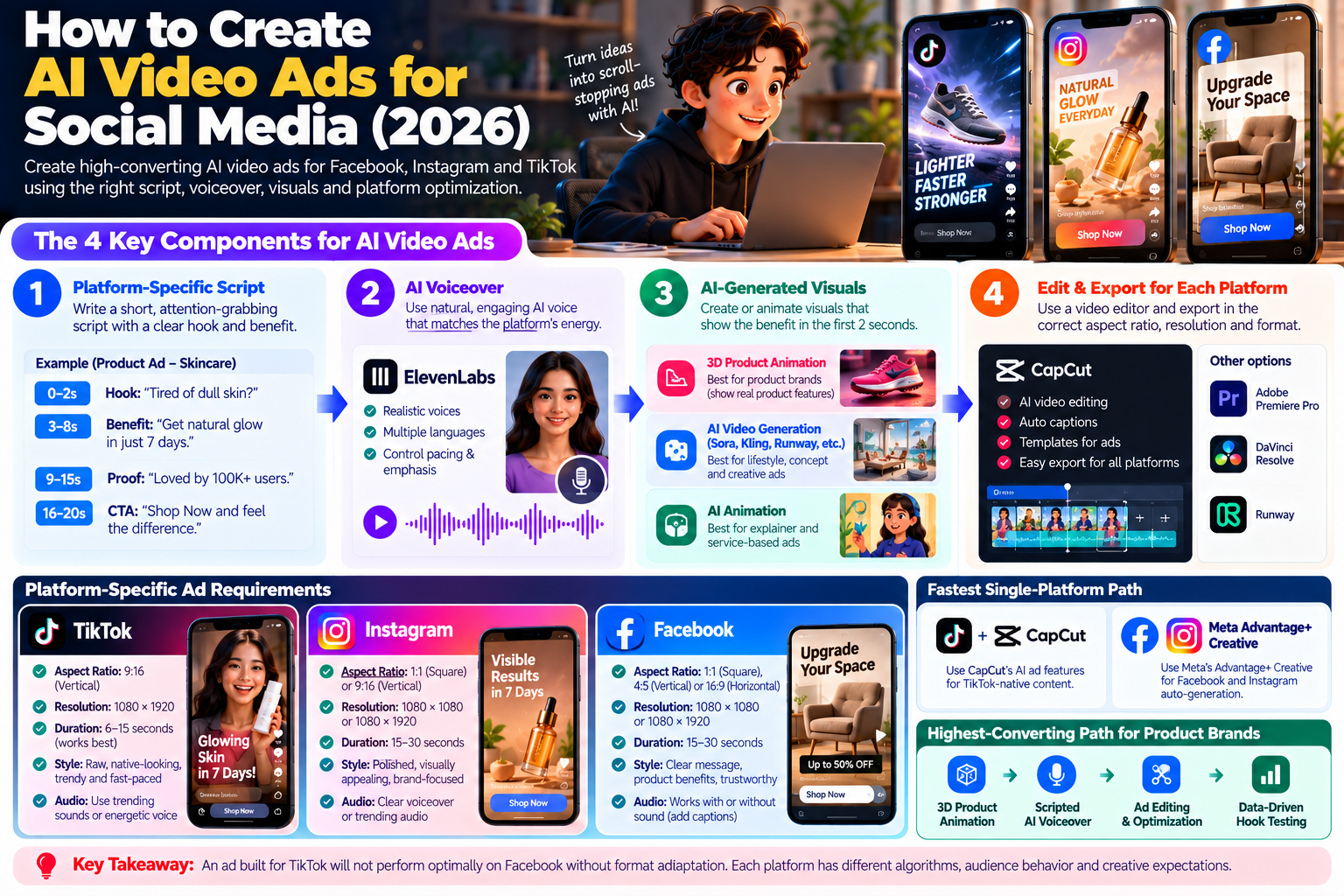
Quick Answer: How to create AI video ads for Facebook, Instagram and TikTok in 2026, you need four components working together: a platform-specific script written around a single clear hook and benefit claim, AI voiceover that matches the platform’s audio energy (ElevenLabs for most formats, native text-to-speech for TikTok-native content), AI-generated or AI-animated visuals that illustrate the benefit claim in the first two seconds and a video editor that exports in the correct aspect ratio and resolution for each platform. The fastest single-platform path is CapCut’s AI ad features for TikTok-native content or Meta’s Advantage+ Creative tool for Facebook and Instagram auto-generation.
The highest-converting path for product brands is a specialist pipeline combining production-accurate 3D product animation with scripted AI voiceover and data-driven hook testing which is what separates advertising-grade AI video from content-grade AI video. Platform algorithm differences mean that an ad built for TikTok will not perform optimally on Facebook without format adaptation and a Facebook-optimized ad will rarely succeed natively on TikTok without tonal adjustment.
By Bali Balaji, Pixlnexs Studio. Pixlnexs produces AI animated video ads for ecommerce brands and consumer businesses and our team runs active ad campaigns across Facebook, Instagram and TikTok using AI-produced creative. This guide reflects live campaign experience with real ad spend behind these formats not a compilation of platform documentation.
Key Takeaways: How to Create AI Video Ads for Facebook, Instagram and TikTok
- AI video ads are now the dominant creative format across Facebook, Instagram and TikTok the platforms’ own algorithms consistently favor video over static image in reach, engagement and conversion metrics.
- The hook (the first 2 to 3 seconds of the ad) is more important than any other production element the decision to swipe or engage is made before most viewers have processed the brand’s name or the product being advertised.
- Platform personality differs fundamentally: Facebook rewards informational depth and trust-building for older, higher-consideration audiences; Instagram rewards visual premium and aspirational lifestyle positioning; TikTok rewards authenticity, entertainment value and pattern disruption. An AI video ad should be built for one primary platform and adapted for others, not produced generically for all three.
- AI video ad creative in 2026 has reached quality parity with moderately-budgeted live-action ad creative for product categories where the story is told through animation, demonstration or visualization rather than through human emotional performance.
- The creative testing volume that drives paid social performance multiple hook variants, multiple benefit claim framings, multiple call-to-action formats is significantly more achievable with AI video production than with live-action, because the cost per creative variant is lower and the production turnaround is faster.
- Product accuracy in AI video ads for ecommerce is commercially critical: an ad that shows the wrong color, wrong scale or an inaccurate product representation generates high click-through but poor conversion and high return rates which is worse for unit economics than a lower-traffic ad.
- For brands that need advertising-grade AI video with product accuracy, character consistency and data-driven creative iteration, a professional AI video studio like Pixlnexs produces the quality and volume of creative variants that in-house self-service tools consistently cannot.
Why AI Video Ads Are Now the Default for Facebook, Instagram and TikTok
The Algorithm Shift Toward Video Creative
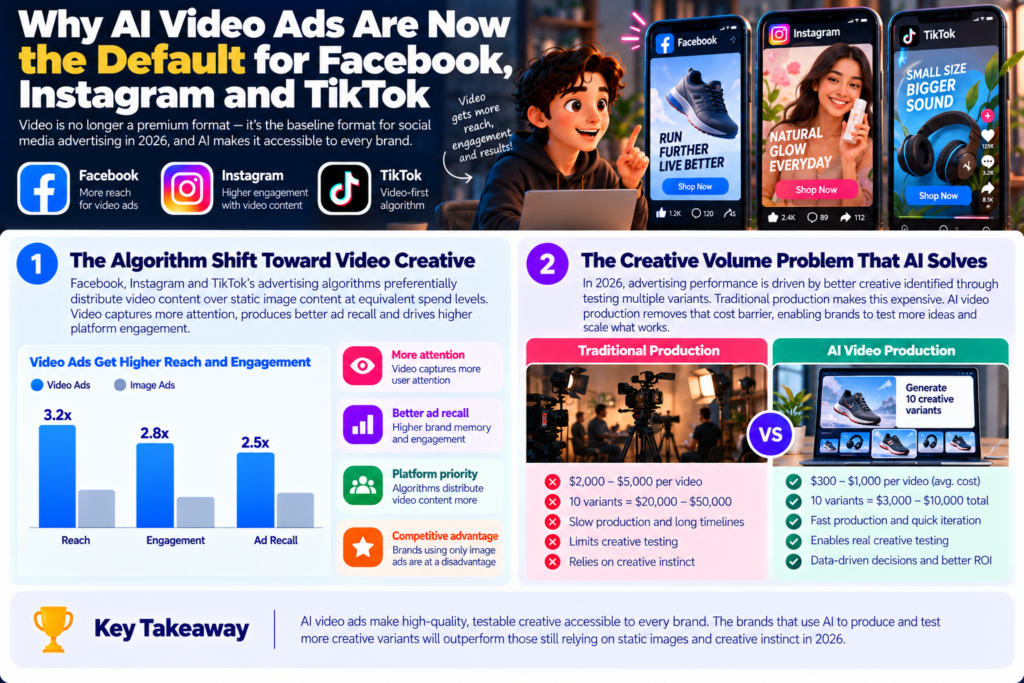
Facebook, Instagram and TikTok’s advertising algorithms share one consistent property in 2026: they preferentially distribute video content over static image content at equivalent spend levels. This is partly a platform business decision (video captures more attention, producing better ad recall and platform engagement metrics) and partly a genuine audience behavior difference users interact with and recall video ads more reliably than static image ads across all three platforms.
The practical consequence for advertisers is straightforward: video creative is no longer a premium format that deserves more budget it is the baseline format that performs adequately and from which competitive advertisers distinguish themselves through creative quality and hook effectiveness. Brands running only static image ads on these platforms in 2026 are competing with one hand behind their back.
AI video production makes video the accessible baseline rather than the expensive premium option. The traditional production barriers to consistent video ad creative crew costs, filming logistics, post-production time are removed, enabling brands at any budget level to compete in the video ad format that the platforms algorithmically prefer.
The Creative Volume Problem That AI Solves
The insight that drives paid social advertising performance in 2026 is not better targeting audiences are relatively well-defined across all three platforms. It is better creative. And better creative is identified through testing, not intuition: running multiple creative variants against the same audience to identify which hook, which benefit claim, which call-to-action and which visual treatment generates the best cost per result.
The problem with creative testing under traditional production is cost. A brand that needs to test 10 creative variants at $2,000 to $5,000 per live-action production is looking at $20,000 to $50,000 in production costs before the first test result arrives which makes creative testing prohibitively expensive for most brands and keeps the industry relying on creative instinct rather than performance data.
AI video production changes this math fundamentally. A brand that can produce 10 AI video creative variants for $3,000 to $10,000 total can run genuine creative testing, identify what works and scale the winning creative with real performance data behind it. The testing volume that was previously available only to brands with large production budgets is now accessible to brands with modest production budgets and the brands that use this capability well outperform those still relying on creative instinct.
Understanding Platform Differences: Facebook vs Instagram vs TikTok AI Video Ads
Facebook AI Video Ads: Informational Depth and Trust-Building
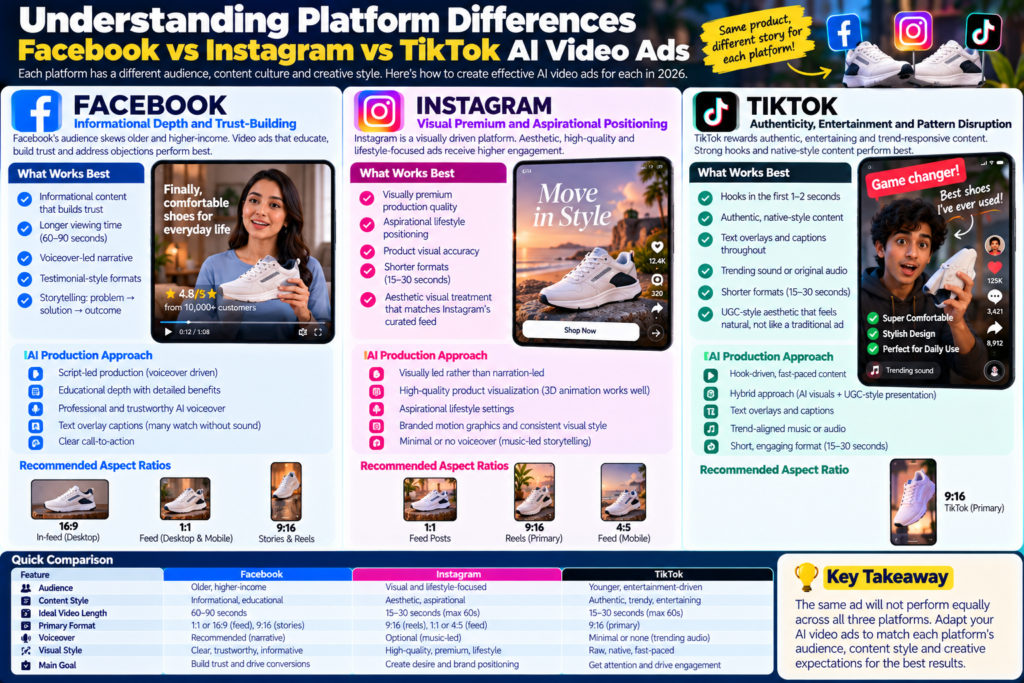
Facebook’s advertising audience in 2026 skews older and higher-income than TikTok’s and its dominant content context is newsfeed browsing rather than entertainment-first scrolling. These properties shape what AI video ad format works best.
Facebook ad creative rewards: informational content that establishes trust and addresses objections before asking for a purchase, longer viewing time (Facebook supports up to 15 minutes of video but 60 to 90 seconds is the practical sweet spot for ad content), voiceover-led narrative that explains the product’s benefit claim in detail, testimonial-style formats where a spokesperson or character walks through the product’s value proposition and storytelling that moves from problem identification through product solution to outcome.
The AI video production approach for Facebook: script-led production where the voiceover carries the narrative and visuals illustrate rather than drive it, longer format with educational depth, authoritative or warm presenter voice (AI voiceover that sounds professional and trustworthy), text overlay captions (Facebook video is frequently watched without sound) and a clear CTA that gives the viewer a specific next action.
Facebook’s aspect ratio preferences: landscape 16:9 for in-feed on desktop, square 1:1 for the most versatile placement that works across both desktop and mobile feeds and 9:16 for Stories and Reels placements.
Instagram AI Video Ads: Visual Premium and Aspirational Positioning
Instagram’s advertising environment is defined by high visual standards the feed is curated aesthetic content and advertising that does not match that aesthetic standard receives lower engagement and less favorable algorithmic treatment. This creates a higher visual quality bar for Instagram ad creative than for either Facebook or TikTok.
Instagram ad creative rewards: visually premium production quality (high-resolution, beautifully lit or rendered visuals that look at home in a design-forward feed), aspirational lifestyle positioning (the product in the context of the life the audience aspires to rather than the life they currently have), product visual accuracy (Instagram audiences are visually literate and notice when a product’s color or finish looks off), shorter formats (15 to 30 seconds is the primary Instagram Reels ad sweet spot, with 60 seconds as the maximum before engagement drops) and aesthetic visual treatment that communicates brand positioning through style rather than through explanation.
The AI video production approach for Instagram: visually led rather than narration-led, high-quality product visualization (3D product animation for physical product brands is particularly effective because it achieves the product-photography-quality standard that Instagram demands), aspirational environmental context (the product in beautifully rendered lifestyle settings), branded motion graphic elements that maintain channel identity and either no voiceover (music-led visual storytelling) or minimal, stylistically matched AI voiceover.
TikTok AI Video Ads: Authenticity, Entertainment and Pattern Disruption
TikTok’s advertising environment is the most different from the other two platforms and the most demanding creatively. TikTok’s organic content is characterized by authenticity, humor, trend-responsiveness and genuine entertainment value and advertising that does not match these properties is immediately recognized and scrolled past. TikTok’s algorithm is uniquely sensitive to creative quality at the first-impression level: ads with poor hooks are distributed to fewer users and charged higher CPMs than ads with strong hooks.
TikTok ad creative rewards: hooks that disrupt the scroll in the first 1 to 2 seconds with something unexpected or immediately engaging, content that matches the visual language and energy of TikTok’s organic feed rather than looking like a polished brand advertisement, text overlays and captions throughout (TikTok is a high-text-engagement platform with many users watching with sound on but following text simultaneously), trending sound or original audio that creates familiarity, shorter formats (15 to 30 seconds for most product categories, 30 to 60 seconds for educational or storytelling formats) and a UGC (user-generated content) aesthetic that feels native rather than produced.
AI video ads on TikTok face a specific challenge: highly polished AI animation immediately reads as a brand ad rather than organic content, which reduces the native feel that TikTok rewards. The most effective AI video ad approach for TikTok in 2026 is a hybrid: use AI-generated or animated visuals for the product demonstration layer but frame it in a raw, text-overlay-heavy, direct-address format that matches TikTok’s organic content aesthetic rather than producing a conventionally polished ad.
Step 1: Scripting AI Video Ads That Stop the Scroll
The Hook Formula for AI Video Ads
The hook is the first 2 to 3 seconds of an AI video ad and is the single most important creative decision in the production. A strong hook earns the viewer’s continued attention; a weak hook loses them before the product is mentioned. Across Facebook, Instagram and TikTok, hook effectiveness is what determines whether an AI video ad generates click-through at a viable cost or generates impressions at a cost that makes the campaign unprofitable.
Four hook frameworks that consistently work across platforms for AI video ads:
The Surprising Claim hook: open with a statement that violates the viewer’s expectations and creates curiosity about how the claim is substantiated. “This $40 product replaced my $800 skincare routine.” The viewer who matches the target audience cannot hear this and not want to know what the product is.
The Problem Identification hook: open by naming a specific, painful problem the target audience experiences. The specificity is critical not “tired of bad sleep?” but “do you lie awake at 2am with your brain running even though you’re exhausted?” The viewer who recognizes themselves in the specific description stops because the ad is talking to them specifically.
The Visual Pattern Disruption hook: open with a visual that is immediately unexpected not the product, not a lifestyle scene but something that creates an incongruity or curiosity that the viewer’s brain needs to resolve. For AI animated ads, this means opening with a dynamic animation sequence rather than a static product reveal.
The Direct Address hook: open by speaking directly to the viewer’s identity or situation. “If you run Facebook ads and you’re wasting money on creative that doesn’t convert, watch this.” The direct qualification (“if you”) activates the relevant audience while filtering out irrelevant viewers which improves the ad’s engagement rate among the audience it actually reaches.
Script Structure for AI Video Ads by Platform
Facebook AI video ad script structure (60 to 90 seconds): Hook (0 to 5 seconds) → Problem expansion and qualification (5 to 20 seconds) → Product introduction and mechanism explanation (20 to 50 seconds) → Social proof or outcome evidence (50 to 70 seconds) → CTA (70 to 90 seconds).
Instagram AI video ad script structure (15 to 30 seconds): Hook (0 to 3 seconds) → Product benefit claim (3 to 15 seconds) → Visual product showcase (15 to 25 seconds) → CTA (25 to 30 seconds).
TikTok AI video ad script structure (15 to 30 seconds): Hook (0 to 2 seconds) → Problem or tension (2 to 8 seconds) → Product as solution reveal (8 to 20 seconds) → Outcome and CTA (20 to 30 seconds).
Using AI to Generate and Iterate Ad Scripts
ChatGPT, Claude and Gemini can all produce useful first drafts of ad scripts from a brief but the brief needs to be specific about platform, audience, product, tone and hook type. A generic “write an ad for my skincare product” prompt produces a generic output. A specific prompt produces a usable first draft.
Effective AI ad script prompt structure: “Write a [platform] video ad script for [specific product]. Target audience: [specific description]. Hook type: [surprising claim / problem identification / direct address]. Tone: [energetic/authoritative/warm/casual]. Key benefit claim: [specific benefit]. CTA: [specific action]. Duration: [target seconds]. Word count: [target].”
After generating the draft, test each version by reading it aloud at the target playback speed and rate the hook on a 1 to 10 scale if it does not rate 8 or above, generate a new hook variant rather than proceeding to production with a weak hook. The script’s hook quality is the most important production quality check before any asset is produced.
Step 2: AI Voiceover for Social Media Video Ads
Platform-Specific Voiceover Energy
Voiceover energy should match the platform’s ambient content tone. Facebook’s dominant voiceover energy in high-performing ads is measured, warm and authoritative the voice of someone explaining something useful and trustworthy. Instagram’s dominant voiceover energy is aspirational and emotionally resonant the voice that makes the lifestyle feel accessible and desirable. TikTok’s dominant energy is energetic, direct and conversational the voice of someone talking to a friend rather than narrating a brand film.
Using ElevenLabs for platform-specific voice configuration: the stability setting controls how consistent or varied the voice delivery is lower stability produces more natural variation and is better for TikTok’s conversational energy; higher stability is better for Facebook’s measured, authoritative delivery. The speaking rate should be set faster for TikTok (120 to 140% of default) and closer to default or slightly slower for Facebook’s trust-building format. For Instagram’s music-led formats where the voiceover is absent or minimal, ElevenLabs can produce a brief aspirational end frame narration that matches the visual’s mood.
Sound Design and Music for AI Video Ads
Music is not decoration in a social media video ad it is a mood and identity signal that the audience processes before the voiceover and visuals. The music choice communicates the brand’s target market, emotional register and cultural positioning in the first half-second of audio exposure.
For TikTok specifically, audio is uniquely important: TikTok’s algorithm surfaces content with trending sounds and using a recognizable trending audio (when licensing permits) or original audio that sounds native to TikTok’s content culture significantly improves organic distribution and ad performance. Many TikTok advertisers use a sound approach where the “ad” sounds like organic content a hook spoken directly to camera over a native-sounding music track.
Licensed music for AI video ads: use royalty-free platforms (Epidemic Sound, Artlist, Musicbed) for music that does not generate copyright claims on any platform. Do not use unlicensed popular music in paid advertising the copyright claim will either mute the audio or terminate the ad delivery.
Step 3: AI Visual Production for Social Media Video Ads
Choosing the Right AI Visual Approach by Product Type
Different product types benefit from different AI visual approaches in video advertising and matching the visual approach to the product is one of the most important production decisions in the AI ad workflow.
For physical products where visual accuracy drives purchasing confidence (electronics, fashion accessories, beauty, packaged goods): 3D product animation from a production-quality GLB model is the most reliable approach. The animation shows the product at correct scale, in accurate materials and colors, from the angles most relevant to the purchase decision achieving the visual accuracy standard that Instagram demands and the product clarity that Facebook ad content needs to convert. For brands that need this level of product accuracy in their video ads, Pixlnexs produces 3D product animation built from precise product models, not prompt-based approximations.
For abstract service and software products where the value is in outcomes rather than physical appearance: AI-generated atmospheric and environmental footage, motion graphics animation and character-driven explainer animation all serve the visualization function effectively. Runway Gen-3, Pika Labs and animation platforms handle this category well because the visual accuracy requirement is lower than for physical product advertising.
For lifestyle and brand positioning advertising where aspiration and context matter more than product specificity: AI-generated lifestyle footage combined with product visualization creates the aspirational environment with product clarity. This hybrid approach (AI-generated environment + accurate 3D product model) is the combination that performs best for lifestyle-driven product categories on Instagram.
AI Video Ad Visual Specifications by Platform
Producing AI video ads in the correct technical format for each platform is not optional incorrectly formatted ads are cropped, distorted or suppressed in delivery.
Facebook: 16:9 (1920×1080) for in-stream and newsfeed on desktop, 1:1 (1080×1080) for the most versatile feed placement across desktop and mobile, 9:16 (1080×1920) for Stories and Reels. File format: MP4 H.264, maximum 4GB, recommended duration 15 seconds to 90 seconds for most ad objectives. Minimum resolution: 1080px on the shortest side.
Instagram: 1:1 (1080×1080) for feed, 9:16 (1080×1920) for Reels and Stories, 4:5 (1080×1350) for feed optimization on mobile (this aspect ratio fills more of the mobile screen than square and often outperforms 1:1 in mobile-first delivery). Maximum duration: 60 seconds for Reels ads, 15 seconds for Stories. Minimum resolution: 1080px.
TikTok: 9:16 (1080×1920) is the standard and only practically relevant format. Duration: 5 to 60 seconds, with 15 to 30 seconds the optimal range for most product categories. Frame rate: 24 to 60fps. File format: MP4 or MOV. The safe zone for text and UI elements: keep all important text between 150px from the top and 250px from the bottom (to avoid overlapping with TikTok’s native UI elements).
Text Overlays and Captions in AI Video Ads
Text overlays are a functional requirement across all three platforms a significant proportion of social media video is consumed without audio and ads that do not caption their audio are excluding a large fraction of their potential audience.
Beyond accessibility, text overlays in AI video ads serve an active engagement function: word-by-word or phrase-by-phrase text reveals that follow the voiceover timing create micro-moments of visual engagement that increase completion rates. This is particularly true on TikTok, where native text overlay is a core creative language of the platform and on Facebook, where many viewers browse in contexts where audio is off.
The visual design of text overlays in AI video ads: high contrast between text and background (white text on dark backgrounds or dark text with a light shadow for legibility on any background), large enough to read on a mobile screen at glance-speed, positioned in the safe zone of each platform’s UI and styled consistently with the brand’s visual language rather than using generic default fonts.
Step 4: AI Video Ad Production Tools Full Platform Guide
Best AI Tools for Facebook AI Video Ads
For Facebook-optimized AI video ad production, the tool combination that produces the best results is:
Script: Claude or ChatGPT with a detailed platform-specific prompt, human-edited for hook strength and spoken naturalness.
Voiceover: ElevenLabs at default stability and default speaking rate, with a voice selected from the “authoritative” or “conversational professional” personality categories. For Facebook’s longer format, the voiceover quality and naturalness matter more than for short-form platforms.
Visuals: a combination of stock footage (Artgrid, Storyblocks) for lifestyle and environmental context, 3D product animation for product visualization and motion graphics for text emphasis and brand elements. For brands with 3D product models, rendering the product in the ad’s environmental context produces the product clarity and visual quality that Facebook’s higher-consideration audience responds to.
Assembly and captions: Adobe Premiere Pro or DaVinci Resolve for professional quality, CapCut for faster production at adequate quality. Auto-captions from either tool, reviewed and corrected before publishing.
Best AI Tools for Instagram AI Video Ads
Instagram’s visual quality bar requires a production approach that prioritizes visual aesthetics over speed of production.
Visuals: Runway Gen-3 for atmospheric and lifestyle footage generation, Midjourney or Adobe Firefly for still image generation used as video frames or environment references, 3D product animation for product showcase segments. The visual production investment for Instagram is higher than for TikTok or Facebook because the audience is more visually critical.
Design: Canva Pro or Adobe Express for motion graphic elements and text overlay design, maintaining brand color palette and typography.
Editing: After Effects or CapCut for motion graphics and text animation, Premiere Pro or DaVinci Resolve for timeline assembly and color grading. Instagram-specific color grade: most high-performing Instagram content has a distinctive color treatment that positions it within aesthetic trends neutral moody tones, warm golden tones or high-contrast clean tones depending on the brand’s market positioning.
Best AI Tools for TikTok AI Video Ads
TikTok’s native content aesthetic creates a unique production direction the ad should not look like an ad and the production tools should support that native feel.
Script and hook: the hook for TikTok should be tested through direct, unscripted-sounding writing rather than polished copy. AI tools can draft this but human editing for “sounds like a real person talking” is essential.
Visuals: CapCut’s AI video features are the most TikTok-native production tool available, producing output that looks and feels native to TikTok’s visual language. Pika Labs for short AI-generated B-roll inserts. Product visualization for TikTok can be slightly lower in production polish than for Instagram the native aesthetic tolerates imperfection in a way that Instagram does not.
Audio: TikTok’s in-app audio library for trending sounds (when licensing permits). For AI voiceover, ElevenLabs at 130 to 140% speaking rate, low stability setting for natural variation and a voice from the “energetic” or “casual” personality categories.
CapCut’s TikTok integration: CapCut produces TikTok-ready exports by default (9:16, 1080×1920, correct frame rate) and its auto-caption feature generates TikTok-style caption formats that match the platform’s visual language. For brands publishing directly to TikTok Business Manager, CapCut’s direct TikTok export reduces the technical friction of the production-to-platform workflow.
AI Video Ad Creative Testing: The System That Scales Winners
The Creative Testing Framework for AI Video Ads
Creative testing is the methodology that separates brands whose paid social advertising improves over time from brands whose performance plateaus. The testing framework for AI video ads has three levels: hook testing (multiple versions of the opening 2 to 3 seconds on the same underlying ad), concept testing (different benefit claim framings or story structures on the same product) and format testing (different visual treatment approaches animated, lifestyle footage, UGC-style for the same script).
AI video production enables this testing framework at realistic budget levels. Testing three hook variants of an AI video ad costs a fraction of testing three hook variants of a live-action ad, which means more of the advertising budget goes to media spend (reaching actual customers) and less goes to producing the creative to be tested.
The practical testing setup: launch three to five AI video ad variants in a single ad set with equal budget distribution, let each variant run until it reaches 500 to 1,000 impressions (enough data to see meaningful engagement differences), identify the hook and format that drives the highest click-through rate, produce more variants of the winning creative direction and repeat.
Scaling AI Video Ad Creative from Test Winners
Once a winning creative direction has been identified through testing, AI video production allows rapid scaling of that direction into multiple variants that can be sustained in delivery over a longer campaign period.
A winning hook can be adapted into five or ten additional concepts that maintain the hook’s core appeal while varying the specific claim, the product visual or the environmental context. A winning format (animated product demo, for example) can be replicated across multiple products in the same range. A winning voiceover tone and script structure can be applied to new audiences through minimal script adaptation.
This scaling pattern is where the production volume advantage of AI video ads compounds into sustained campaign performance not just a single winning ad but a continuous creative library of tested and validated variants that maintain audience freshness and prevent the creative fatigue that causes paid social campaign performance to decay over time.
What does professional AI video ad production actually cost?
Before you decide how to budget your next campaign’s creative production, read our honest breakdown of AI video pricing what drives cost per variant, how to compare studio and self-service options, and what each budget level realistically delivers.
Read: AI Video Generation Cost Guide →AI Video Ads Platform Specifications at a Glance
| Platform & Placement | Aspect Ratio | Resolution | Optimal Duration | Creative Tone |
|---|---|---|---|---|
| Facebook Feed | 1:1 or 16:9 | 1080×1080 or 1920×1080 | 30 to 90 seconds | Informational, trust-building, authoritative voice |
| Facebook Reels and Stories | 9:16 | 1080×1920 | 15 to 60 seconds | Energetic, direct hook, captioned throughout |
| Instagram Feed | 1:1 or 4:5 | 1080×1080 or 1080×1350 | 15 to 30 seconds | Visually premium, aspirational, minimal text |
| Instagram Reels | 9:16 | 1080×1920 | 15 to 60 seconds | Dynamic, visually led, hook in first 2 seconds |
| Instagram Stories | 9:16 | 1080×1920 | Under 15 seconds | Single clear message, tappable CTA element |
| TikTok In-Feed Ad | 9:16 only | 1080×1920 | 15 to 30 seconds (optimal) | Native feel, energetic, text-heavy, direct address hook |
| TikTok TopView / Brand Takeover | 9:16 | 1080×1920 | 5 to 60 seconds | High visual impact, immediate brand recognition |
Common Mistakes When Creating AI Video Ads
Producing for All Three Platforms Without Adaptation
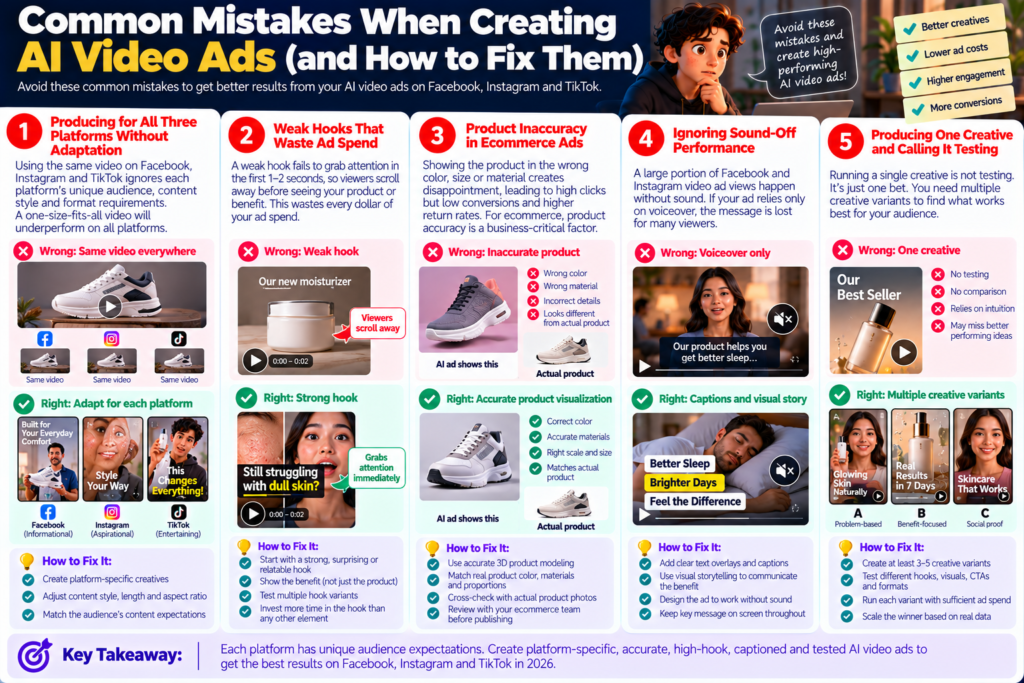
The most common and most costly mistake in AI video ad production is producing a single video and running it identically on Facebook, Instagram and TikTok. The platforms have different audience ages, different content energy expectations, different aspect ratio standards and different hook conventions. A video produced for Facebook’s informational depth will perform poorly on TikTok’s entertainment-first feed. A video produced for TikTok’s raw energy will feel out of place on Instagram’s polished aesthetic standard. Each platform needs either a purpose-built creative or a deliberate adaptation of the master creative for its specific context.
Weak Hooks That Waste Ad Spend
An AI video ad with a weak hook wastes every dollar of media spend behind it, because the target audience makes its swipe-or-engage decision before the product is revealed or the benefit is stated. The most common weak hook in AI video ad production is a product reveal showing the product in the first second with a brand logo. This hook is weak because it gives the viewer no reason to stay. Invest more production time in the hook than in any other element, test multiple hook variants before scaling and treat a strong hook as the primary production quality metric.
Product Inaccuracy in Ecommerce Ads
An AI video ad that shows the product in the wrong color, at the wrong scale or with inaccurate materials generates a specific failure mode: high click-through from visually engaged viewers who are then disappointed when the product page shows the real product, producing high traffic with low conversion and high return rates. For ecommerce advertising specifically, product visual accuracy is not a polish issue it is a unit economics issue. The production investment in accurate 3D product modeling pays back in conversion rates and return rate reduction rather than in visual quality alone.
Ignoring Sound-Off Performance
Facebook and Instagram both report that a significant proportion of video ad views occur without sound. An AI video ad that relies entirely on voiceover to communicate its benefit claim is invisible to this audience segment. Captions, text overlays and a visual narrative that communicates the core benefit independently of audio are requirements for sound-off performance, not optional enhancements.
Producing One Creative and Calling It Testing
Running a single AI video ad creative without testing variants is not a testing strategy it is a single bet. The performance of one creative variant is informative about that creative; it is not informative about what would have performed better. Creative testing requires at least three to five variants per test, with sufficient impression volume per variant to produce statistically meaningful engagement data before budget is shifted to the winner.
Conclusion
Creating AI video ads for Facebook, Instagram and TikTok in 2026 is not a single production task it is a platform-adapted creative strategy supported by an AI production pipeline that enables the testing volume and creative variant output that paid social performance requires.
The foundational elements are consistent across all three platforms: a strong hook in the first 2 to 3 seconds, a clear and specific benefit claim, product visual accuracy for ecommerce brands and a call to action that gives the viewer a specific next step. The execution of these elements differs by platform in depth, in visual energy, in audio approach and in the technical format that each platform’s algorithm rewards.
AI video production makes this platform-specific, multi-variant approach achievable at budget levels where it was previously impossible. The brand that uses this capability testing hooks systematically, scaling winners, maintaining product accuracy and building a library of platform-adapted creative has a structural creative advantage over brands still treating video ad creative as a one-shot production decision.
For brands that need advertising-grade AI video production with product accuracy, character consistency and creative testing strategy, Pixlnexs builds the creative that performs not just looks good.
Need AI video ads that actually convert not just look good?
Pixlnexs produces AI animated video ads for Facebook, Instagram and TikTok product-accurate 3D animation, scripted hooks, platform-specific formats and creative variant packages built for testing and scaling.
See Our AI Video Ad Services Get an Ad Creative QuoteFrequently Asked Questions
Can AI video ads actually compete with live-action ads in conversion?
Yes in controlled A/B tests across categories including beauty, fashion accessories, consumer electronics and packaged goods, AI video ads produced by professional studios have matched or outperformed live-action equivalents on cost per click, cost per purchase and return on ad spend. The performance parity depends on the production quality self-service AI tools do not yet produce the quality level needed to compete with professional live-action in premium product categories but professional AI video production does.
What is the ideal length for an AI video ad on each platform?
Facebook: 30 to 90 seconds for the primary feed placement, with the first 15 seconds designed to sustain attention independently if the viewer does not continue watching. Instagram Reels: 15 to 30 seconds for the primary sweet spot, with 60 seconds as the maximum before engagement decay. TikTok: 15 to 30 seconds for most product categories, with 30 to 60 seconds working for educational or story-driven formats where the content justifies the length.
How much does it cost to produce AI video ads?
Self-service AI tools can produce a basic AI video ad for near-zero cost in tool fees (free tier tools) plus the creator’s time. Professional AI video ad production from a specialist studio like Pixlnexs costs from a few hundred dollars for a straightforward single-product ad to several thousand for a multi-variant ad package with custom 3D product modeling. The relevant comparison is not production cost in isolation but production cost as a percentage of media spend if the production produces a 20% improvement in conversion rate, the production cost pays back quickly against the media budget behind it. For detailed cost benchmarks, see our complete guide on AI video generation cost.
Do I need a real person on camera for TikTok ads to perform?
No many high-performing TikTok ads use AI voiceover, animated visuals and text overlay without any human on camera. The requirement is that the format feels native to TikTok’s content style raw, direct, text-heavy and energetically engaging rather than polished in a way that reads as traditional advertising. A well-produced AI animated ad in TikTok’s native visual language outperforms a mediocre live-action ad that ignores the platform’s content conventions.
What is the most important element of an AI video ad?
The hook the first 2 to 3 seconds. Across all three platforms, the engagement decision is made before the majority of the ad’s content has been delivered. A strong hook with an adequate production standard outperforms a weak hook with a perfect production standard in every platform test. Invest more creative effort in the hook than in any other single element.
Can Pixlnexs create AI video ads for my brand’s products?
Yes Pixlnexs produces AI animated video ads for ecommerce brands and consumer product companies, including product-accurate 3D animation, scripted AI voiceover, branded motion graphics and platform-specific format exports. For brands that need advertising-grade creative quality with the product accuracy that drives ecommerce conversion, our production pipeline delivers what self-service tools currently cannot. We also advise on creative testing strategy alongside production, so the creative investment generates performance data rather than a single untested execution.
How many AI video ad variants should I produce for a campaign launch?
For a campaign launch with a new creative direction, produce a minimum of three hook variants on the same underlying concept, plus one alternative concept variant (a different story structure or benefit claim angle). This gives you four variants minimum to test, which is enough to identify a directional winner while managing production cost. Once a winning direction is identified, scale with five to ten additional variants of the winner for sustained delivery.
Should I use the same AI voice across all three platforms?
No adapt the voiceover energy to the platform. Use a measured, warm voice for Facebook’s trust-building format; a brief, aspirational narration for Instagram’s visually-led format (or no voiceover if the visual communicates independently); and a fast, energetic, conversational delivery for TikTok. ElevenLabs’ voice style and speed controls allow the same voice to be configured differently for each platform from the same voice base maintaining a recognizable brand voice while adapting its energy to platform context.
Related Guide
AI Animation vs Traditional Studio Animation which is better in 2026
Runway vs Sora vs Veo vs Pika: The 2026 AI Video Tool Showdown
Higgsfield AI: How to Make Cinematic AI Videos in 2026
Best AI Video Generators in 2026: Sora vs Kling vs Seedance vs Veo Compared



Leave a Reply