
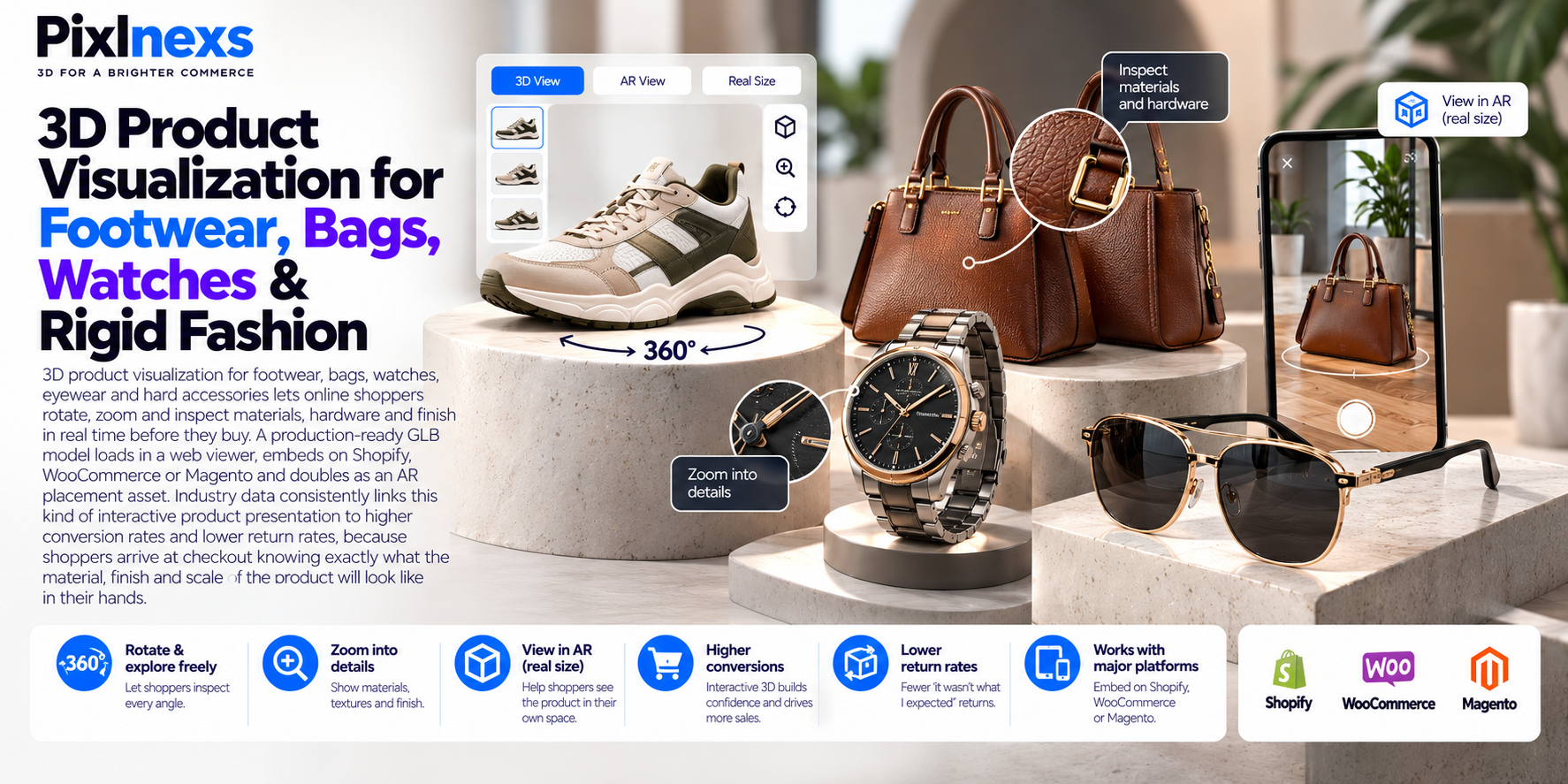
Quick Answer: 3D product visualization for footwear, bags, watches, eyewear and hard accessories lets online shoppers rotate, zoom and inspect materials, hardware and finish in real time before they buy. A production-ready GLB model loads in a web viewer, embeds on Shopify, WooCommerce or Magento and doubles as an AR placement asset. Industry data consistently links this kind of interactive product presentation to higher conversion rates and lower return rates, because shoppers arrive at checkout knowing exactly what the material, finish and scale of the product will look like in their hands.
By Manoj, Pixlnexs Studio. Pixlnexs models rigid fashion items footwear, bags, watches, eyewear and hard accessories for ecommerce brands, delivering production-ready GLB files, rendered images and AR-ready assets and this guide reflects the decisions our modeling team makes on every brief we receive.
Key Takeaways
- 3D and AR add real conversion and returns value for rigid fashion items where material, finish and scale are what shoppers need to evaluate before buying.
- Footwear, handbags, wallets, watches, eyewear, belts and hard accessories are strong fits for interactive 3D. Flowing garments, dresses and loose fabric are not drape and fit are physical and a web viewer cannot represent them honestly.
- A production-ready GLB file is the deliverable that matters. It embeds on your store, on marketplaces and in social posts and doubles as the AR asset for both Android and iOS.
- The most common return reason for fashion accessories is that the item looked different online than in real life. 3D visualization closes that gap by showing material grain, hardware finish and actual scale rather than a styled photo under ideal lighting.
- Most rigid fashion models take between 3 and 5 working days from a reference photo to a production-ready GLB, depending on material complexity and variant count.
- The correct brief is what determines turnaround and accuracy. A single clear reference photo, exact dimensions and material/finish names are what our team actually needs to start.
Why Rigid Fashion Ecommerce Has a Specific Problem 3D Solves
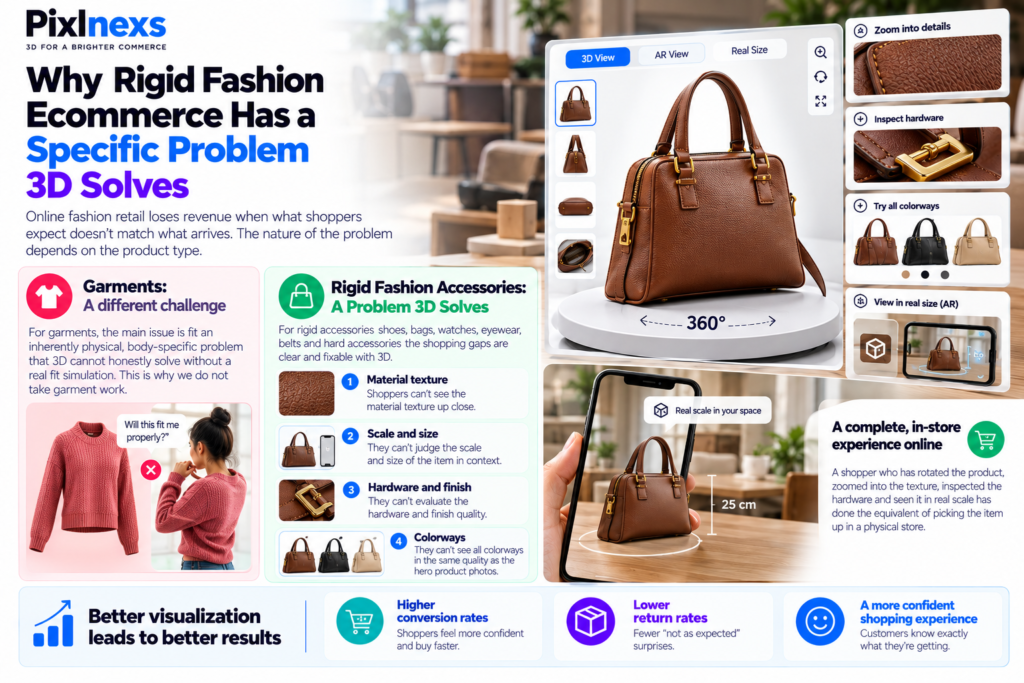
Online fashion retail loses a significant portion of its potential revenue to one specific failure: the gap between what a shopper expects from a product page and what arrives in the package. For garments, this gap is mostly about fit an inherently physical, body-specific problem that 3D cannot honestly solve without a real fit simulation, which is why we do not take garment work.
For rigid fashion accessories shoes, bags, watches, eyewear, belts and hard accessories the gap is different and much more addressable. The problems shoppers have with rigid accessories are: they cannot see the material texture up close; they cannot judge the scale and size of the item in context; they cannot evaluate the hardware and finish quality; and they cannot see all colorway’s in the same quality that the hero colorway gets in a styled photo shoot.
A good interactive 3D model solves all four of these. A shopper who has rotated a leather bag, zoomed into the stitching, inspected the zip hardware and seen the bag placed in AR at real scale next to a reference object has done the equivalent of picking the item up in a physical store. That is the experience that converts and it is why return rates consistently fall when accurate 3D visualization is implemented for rigid accessories.
What Makes a Good Fit for 3D Product Visualization for Footwear, Bags and Watches
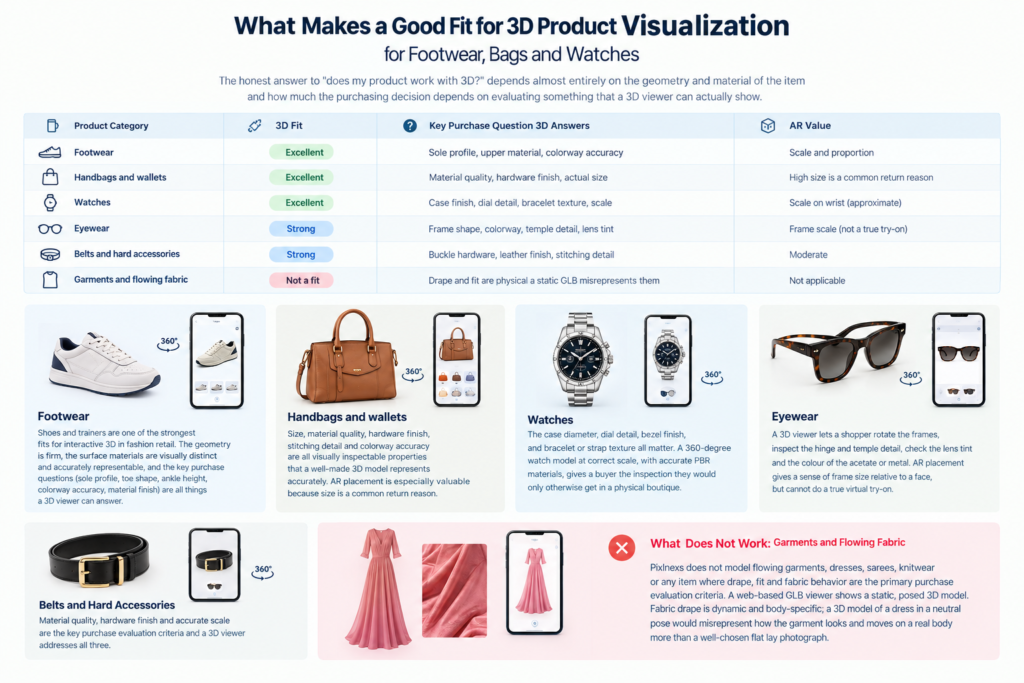
The honest answer to “does my product work with 3D?” depends almost entirely on the geometry and material of the item and how much the purchasing decision depends on evaluating something that a 3D viewer can actually show.
| Product Category | 3D Fit | Key Purchase Question 3D Answers | AR Value |
|---|---|---|---|
| Footwear | Excellent | Sole profile, upper material, colorway accuracy | Scale and proportion |
| Handbags and wallets | Excellent | Material quality, hardware finish, actual size | High size is a common return reason |
| Watches | Excellent | Case finish, dial detail, bracelet texture, scale | Scale on wrist (approximate) |
| Eyewear | Strong | Frame shape, colorway, temple detail, lens tint | Frame scale (not a true try-on) |
| Belts and hard accessories | Strong | Buckle hardware, leather finish, stitching detail | Moderate |
| Garments and flowing fabric | Not a fit | Drape and fit are physical a static GLB misrepresents them | Not applicable |
Footwear
Shoes and trainers are one of the strongest fits for interactive 3D in fashion retail. The geometry is firm, the surface materials (leather, suede, mesh, synthetic) are visually distinct and accurately representable in PBR textures and the key purchase questions sole profile, toe shape, ankle height, colorway accuracy, material finish are all things a 3D viewer can answer.
A 360-degree trainer model lets a shopper see the full sole unit, check the heel counter shape, inspect the upper’s material and texture and see the exact colorway without relying on a flat image that may be lit to flatter rather than to inform. For footwear brands selling online without a physical retail presence, this is often the clearest ROI case for interactive 3D.
Handbags and Wallets
Handbags and wallets are a similarly strong fit. The purchase decision for a bag depends heavily on size (will this actually fit what I carry?) material quality (does the leather look premium?) hardware finish (is the gold hardware warm or cold?) stitching detail and colorway accuracy. These are all visually inspectable properties that a well-made 3D model represents accurately.
AR placement is particularly valuable for bags, because the most common complaint about buying bags online is “it was much smaller than I expected.” A bag placed in AR at true-to-scale dimensions next to a real-world reference object a kitchen counter, a chair, a person’s shoulder answers that size question in a way that no photo with a size chart can.
Watches
Watches require precise modeling to be valuable. The case diameter, lug width, dial detail, bezel finish and bracelet or strap texture all matter to a watch buyer in ways that a flat image frequently gets wrong due to lens distortion and lighting choices. A 360-degree watch model at correct scale, with accurate PBR materials for the case finish (brushed steel, polished gold, PVD black) and the dial colour, gives a buyer the kind of inspection they would only otherwise get in a physical boutique.
For watch brands selling direct-to-consumer, this is one of the highest-value interactive 3D use cases in fashion, because the items are high-value, the purchase is considered and the cost of a return on a watch is disproportionately high relative to the cost of producing a 3D model.
Eyewear
Eyewear is a strong fit for interactive 3D and a reasonable fit for AR, with one honest caveat: AR can show scale and frame shape convincingly but it cannot perform a true virtual try-on that accurately accounts for face shape and frame bridge fit. A 3D viewer lets a shopper rotate the frames, inspect the hinge and temple detail, check the lens tint and the colour of the acetate or metal and confirm the scale looks right for them. AR placement, while not a substitute for trying frames on, does give a usable sense of frame size relative to a face.
For eyewear brands, the conversion argument for 3D is strongest for the frame inspection and colorway evaluation use cases, rather than for the try-on use case, which is an important distinction to make upfront.
Belts and Hard Accessories
Belts, wallets, cardholders, key fobs, hardware accessories and similar items are a good fit for 3D for the same reason bags are: material quality, hardware finish and accurate scale are the key purchase evaluation criteria and a 3D viewer addresses all three.
What Does Not Work: Garments and Flowing Fabric
Pixlnexs does not model flowing garments, dresses, sarees, knitwear or any item where drape, fit and fabric behavior are the primary purchase evaluation criteria. This is not a capability limitation it is an honesty decision.
A web-based GLB viewer shows a static, posed 3D model. Fabric drape is dynamic and body-specific; the way a dress falls on a size 8 and on a size 14 body are fundamentally different physical simulations. A 3D model of a dress in a neutral pose would misrepresent how the garment looks and moves on a real body more than a well-chosen flat lay photograph and we do not want to contribute to a higher return rate by creating an inaccurate product representation.
The Production Pipeline: From Reference Photo to Live GLB
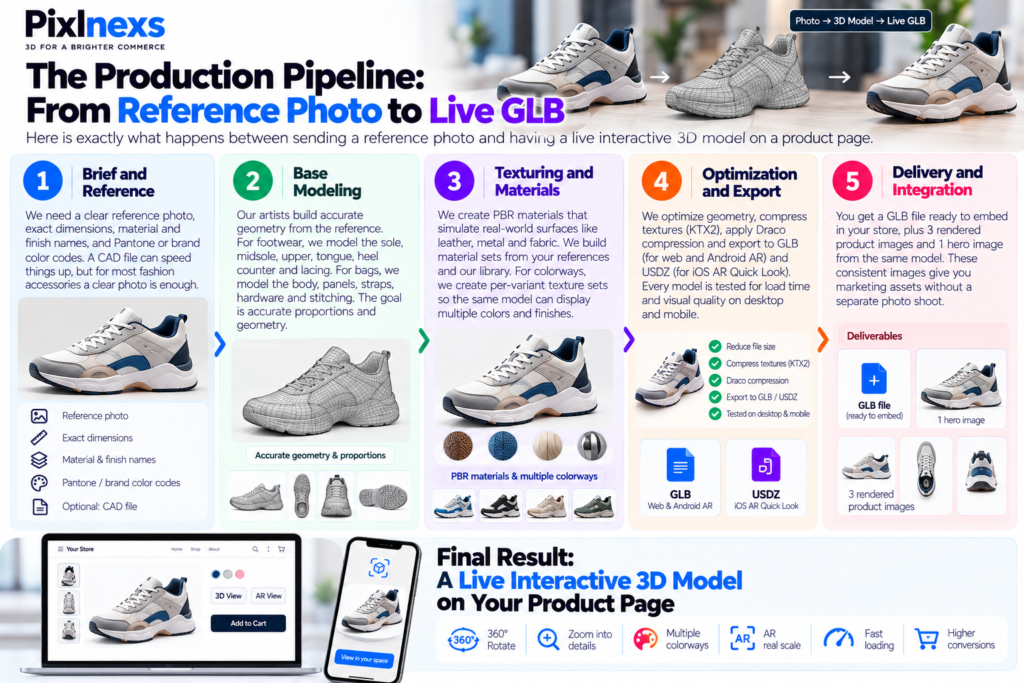
Here is exactly what happens between sending a reference photo and having a live interactive 3D model on a product page.
Stage 1- Brief and Reference
The input we need is minimal but specific: one clear reference photo of the product, the exact dimensions, the material and finish names and the Pantone or brand color codes for any colorways that need to match exactly. If you have a CAD file, it speeds things up but for most fashion accessories a clear photo is sufficient.
The brief determines accuracy more than anything else. A reference photo taken in poor lighting with the item partially obscured takes longer and produces a less accurate first pass than a clean, even-lit image. We ask for clear references before starting, not because we are being difficult but because we will not produce a model we cannot stand behind.
Stage 2 Base Modeling
Our artists build the base geometry from the reference. For footwear, this means modeling the sole unit, midsole, upper, tongue, heel counter and lacing in accurate proportions. For bags, this means the main body, panels, straps, hardware, stitching lines and any structural elements. For watches, this means the case, crown, bezel, dial, indices, hands and bracelet or strap.
The goal at this stage is accurate proportions and geometry materials come next.
Stage 3 Texturing and Materials
This is where a fashion 3D model lives or dies. PBR (Physically Based Rendering) materials simulate how light actually interacts with surfaces: the specular response of polished metal versus brushed metal, the subsurface behavior of leather, the glossiness gradient of lacquered finishes. Getting these right is what makes a viewer look at a 3D bag and think “that leather looks expensive” rather than “that looks like a plastic toy.”
We build material sets from reference both from the photos provided and from our own material library built over many projects. For colorways, we create per-variant texture sets so the same model geometry can display multiple colors, finishes or materials without re-modeling from scratch.
Stage 4 Optimization and Export
A production model needs to be under a certain file size to load acceptably on mobile devices. We optimize geometry and compress textures using formats like KTX2, apply Draco compression to the mesh data and export to GLB for web and Android AR and USDZ for iOS AR Quick Look.
Every model we deliver has been tested for load time and visual quality on both desktop and mobile before it leaves us. A model that looks stunning in a desktop viewer but takes 12 seconds to load on a 4G connection is not a deliverable.
Stage 5 Delivery and Integration
The deliverable is a GLB file, ready to embed in your store. We also deliver 3 rendered product images and 1 hero image from the same model, so you get consistent-quality marketing images as part of the same production run without a separate photo shoot.
How AR Works for Rigid Fashion Accessories
AR placement works by anchoring the 3D model at its real-world dimensions in the camera feed. A bag modeled at its actual dimensions say, 38cm wide and 28cm tall appears at that size when placed in a room, which lets a shopper hold their phone up and see exactly how the bag would look sitting on a surface in their home.
For iOS, this uses Apple’s AR Quick Look viewer, which launches automatically when a shopper taps a model on an iPhone or iPad running Safari. For Android, it uses Google’s Scene Viewer, which launches from Chrome. Both systems require no app download.
The critical requirement for AR to be useful rather than misleading is dimensional accuracy. A model built at approximate dimensions will look wrong in AR immediately. This is why we require exact dimensions as part of every brief.
The SEO and Page Speed Angle
An unoptimized 3D model can significantly hurt Largest Contentful Paint (LCP) and Core Web Vitals scores if the viewer initializes eagerly and blocks page rendering. A correctly implemented viewer loads lazily it initializes only after the main page content has rendered and only when a shopper scrolls to or interacts with the product.
When implemented correctly, interactive 3D tends to improve the SEO signals that matter for ecommerce: time on page and engagement increase because shoppers spend more time with the product and return rates decrease over time.
We deliver optimized GLB files with compression applied and provide guidance on lazy loading implementation for the most common viewer integrations.
Cost and What Determines It
A fashion accessory 3D model is priced based on the complexity of the geometry, the number of distinct materials on the surface, the number of color or material variants required and the turnaround time.
Simple accessories with one or two materials and no variants sit at the lower end. A watch with a complex multi-part case, applied dial indices, a bracelet with intricate link geometry and multiple colorway variants sits at the higher end. Bags with complex hardware, multiple external pockets and stitching detail sit in the mid-to-high range.
The relationship between model cost and revenue impact is strong for fashion accessories. A high-quality 3D model of a bag that retails at several hundred pounds, if it converts even a modest additional percentage of product page visitors to buyers, recovers its cost within a small number of sales.
Ready to add interactive 3D to your fashion accessories store?
Send one reference photo of your footwear, bag, watch or accessory and Pixlnexs will get you an exact quote GLB model, rendered images, AR-ready, typically in 4 working days.
Get a Quote Talk to Our TeamComparison: Interactive 3D vs. Styled Photography for Fashion Accessories
Styled photography will always have a place in fashion there are emotional and lifestyle signals a photography team can communicate that a 3D viewer cannot. But for the product inspection use case, the comparison is not as straightforward as “photos are simpler and cheaper.”
A photo shoot produces fixed outputs. If a new colorway launches, a new photoshoot is needed. A 3D model, once built, produces unlimited angles and renders and can be updated for colorway or hardware changes at a fraction of the cost of a new shoot.
For brands with large variant counts multiple colorways, hardware options, size ranges 3D visualization often becomes more cost-effective than photography at scale because of this reusability.
Common Questions Before Starting a Project
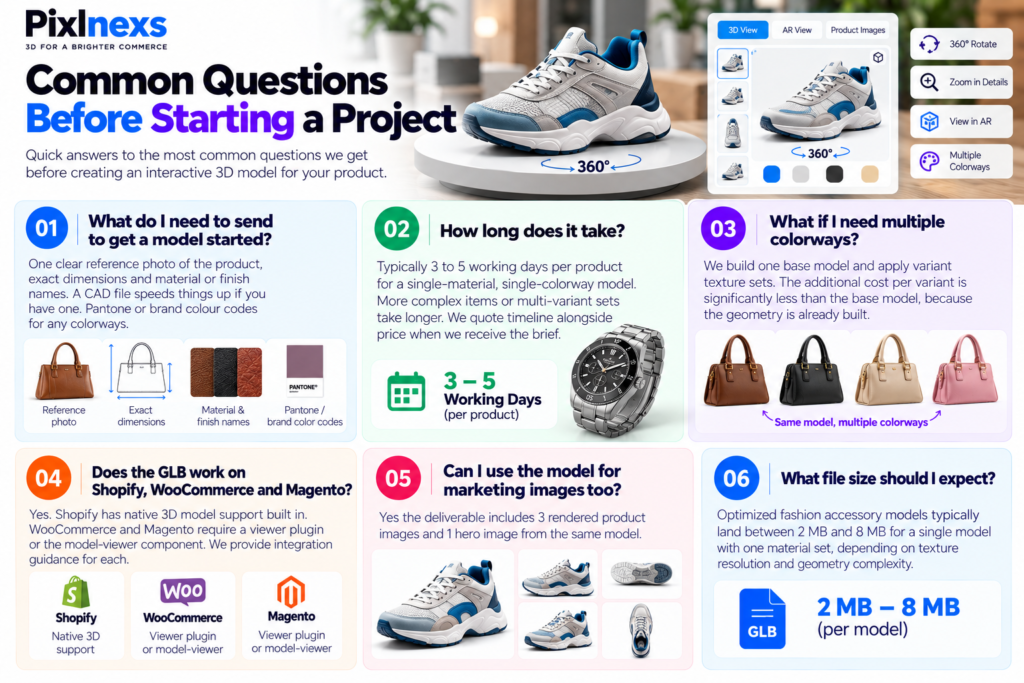
What do I need to send to get a model started?
One clear reference photo of the product, exact dimensions and material or finish names. A CAD file speeds things up if you have one. Pantone or brand colour codes for any colorways.
How long does it take?
Typically 3 to 5 working days per product for a single-material, single-colorway model. More complex items or multi-variant sets take longer we quote timeline alongside price when we receive the brief.
What if I need multiple colorways?
We build one base model and apply variant texture sets. The additional cost per variant is significantly less than the base model, because the geometry is already built.
Does the GLB work on Shopify, WooCommerce and Magento?
Yes. Shopify has native 3D model support built in. WooCommerce and Magento require a viewer plugin or the model-viewer component. We provide integration guidance for each.
Can I use the model for marketing images too?
Yes the deliverable includes 3 rendered product images and 1 hero image from the same model.
What file size should I expect?
Optimized fashion accessory models typically land between 2 MB and 8 MB for a single model with one material set, depending on texture resolution and geometry complexity.
Conclusion
Interactive 3D product visualization for rigid fashion accessories solves a specific and commercially significant problem: the gap between what a shopper expects from a product page and what arrives in a package. For rigid items, that gap is about material, finish, hardware quality and scale and a well-made 3D model with AR placement closes it in a way that even excellent photography cannot.
Pixlnexs models rigid fashion items to production-ready GLB standard, delivers rendered images from the same model and provides both web and AR formats as a standard deliverable. We do not model flowing garments, because honesty about what 3D can and cannot do is part of how we protect the brands we work with.
Send one reference photo of your footwear, bag, watch or accessory and we will get you an exact quote.
Frequently Asked Questions
What is 3D product visualization for fashion accessories?
3D product visualization for fashion accessories means building an accurate digital model of a shoe, bag, watch, eyewear or hard accessory and delivering it as an interactive web viewer that shoppers can rotate, zoom and inspect on your product page.
Why is 3D better for rigid fashion than for clothing?
Rigid items have fixed geometry that a 3D model can represent accurately. Garment fit and drape are body-specific and dynamic a dress falls differently on every body and cannot be accurately represented in a static 3D web viewer without cloth simulation technology.
How accurate are the materials in a 3D model compared to the real product?
When built correctly with PBR materials, the surface behavior of leather, metal, fabric and other materials is closely approximated. The limiting factor is reference quality models built from clear, accurate reference photos are much more accurate than those built from partial references.
Will interactive 3D slow down my product page?
Not if implemented correctly. A viewer that loads lazily adds no meaningful page speed cost to the initial page load. We optimize every GLB we deliver and provide lazy loading guidance.
What platforms does the GLB format support?
GLB supports web browsers via WebGL, Android AR via Google Scene Viewer and can be embedded in social posts and marketplace listings. iOS AR Quick Look uses USDZ we deliver both formats.
How many products can I have modeled at once?
There is no practical upper limit. For catalog-scale projects, we set up a consistent material and quality standard and batch the work to deliver at an agreed cadence.
Can I use the same 3D model in advertising and marketing?
Yes. The rendered images we deliver alongside the GLB are production-quality. The GLB itself can be embedded in social posts on platforms that support 3D.
What is the difference between a GLB and a USDZ file?
GLB is the standard for web-based viewers and Android AR. USDZ is Apple’s native AR format for iPhone and iPad. A complete delivery includes both formats.







Leave a Reply