
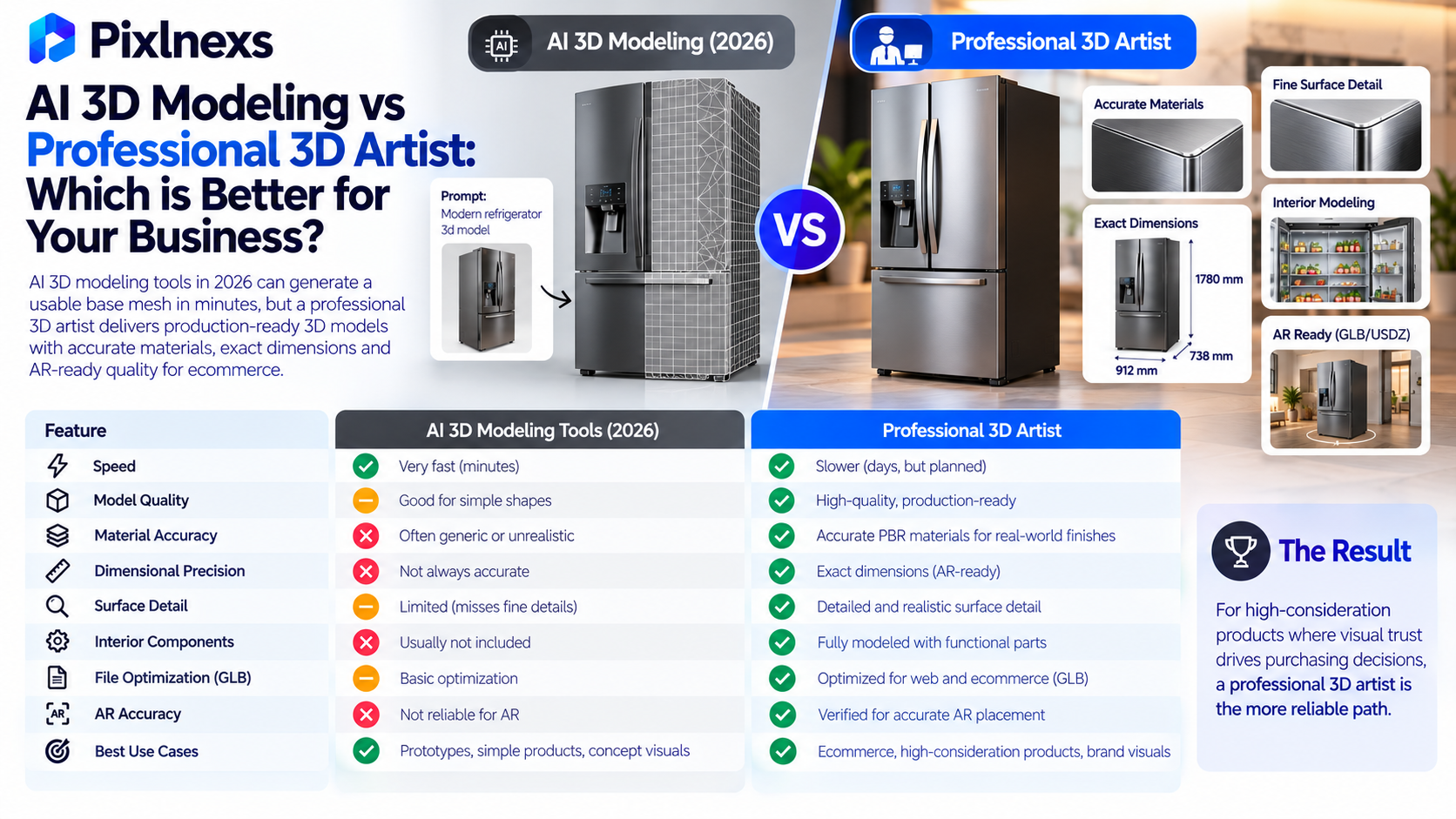
Quick Answer: AI 3D modeling tools in 2026 can generate a usable base mesh from a photo or text prompt in minutes and handle simple product geometries reasonably well but they currently fall short on material accuracy, surface detail, dimensional precision and the iterative quality refinement that ecommerce product visualization requires. A professional 3D artist delivers a production-ready GLB file with exact dimensions, calibrated PBR materials, optimized polygon count and verified AR accuracy that an AI tool cannot consistently match. For high-consideration products where visual trust drives purchasing decisions, a professional artist is the more reliable path.
AI tools are genuinely useful for rapid prototyping, concept visualization and low-stakes content and the gap between the two is narrowing fast enough that this comparison will look different in 12 to 18 months.
By Manoj, Pixlnexs Studio. Pixlnexs builds production-quality 3D models and AI-assisted content for ecommerce brands and this guide reflects our direct production experience with both approaches not a vendor pitch for either one but an honest assessment of where each performs and where each falls short in 2026.
Key Takeaways:
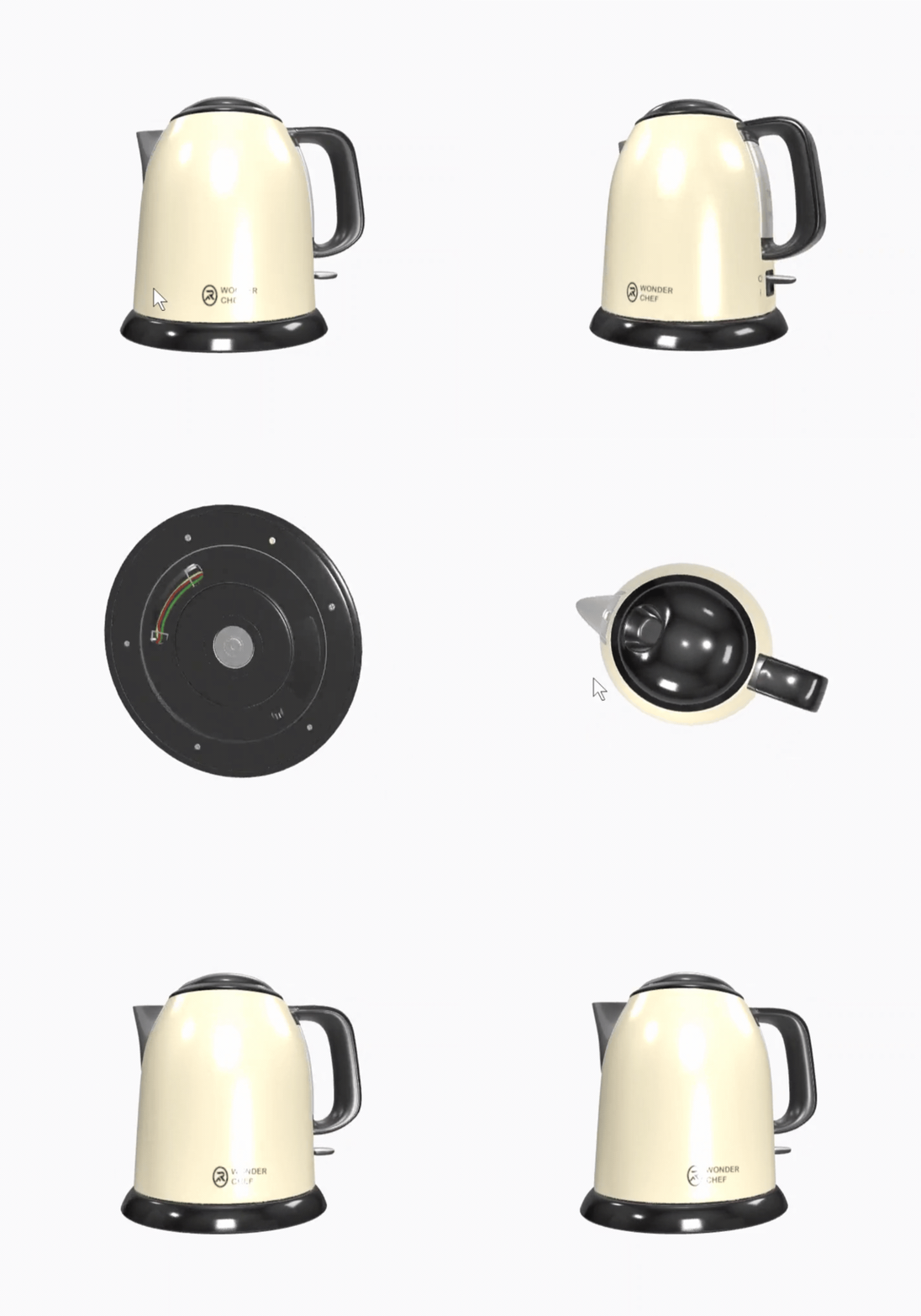
Ai 3d modeling vs professional 3d artist:
AI 3D modeling tools can generate geometry from a photo or text prompt rapidly but generation speed is not the same as production readiness and the gap between the two is where most AI-generated models fail for ecommerce use.
A professional 3D artist delivers dimensional accuracy, calibrated PBR materials, verified AR scale and a model that has been checked by a human being against a quality standard things that current AI tools do not reliably provide.
Cost comparison is not as simple as “AI is cheaper” AI-generated models that require extensive manual cleanup by an artist often cost more in total than commissioning a professional model from the start.
The quality gap is most visible for complex surface materials (metallic finishes, frosted glass, soft-touch coatings, translucent liquids), fine geometric detail (stitching, embossed logos, port geometry) and dimensional accuracy for AR placement.
AI tools are genuinely useful for specific tasks: concept visualization, rapid iteration on form factor, generating base meshes for artist refinement and producing content for low-stakes channels where visual perfection is not the conversion driver.
The practical answer for most ecommerce brands is a hybrid: AI tools where speed and volume matter for early-stage work, professional artists for the hero assets that appear on product pages and drive purchasing decisions.
The technology is improving fast. What AI tools cannot do reliably in mid-2026 may be routine capability by late 2027 building a rigid opinion on this comparison is a mistake.
The State of AI 3D Modeling in 2026
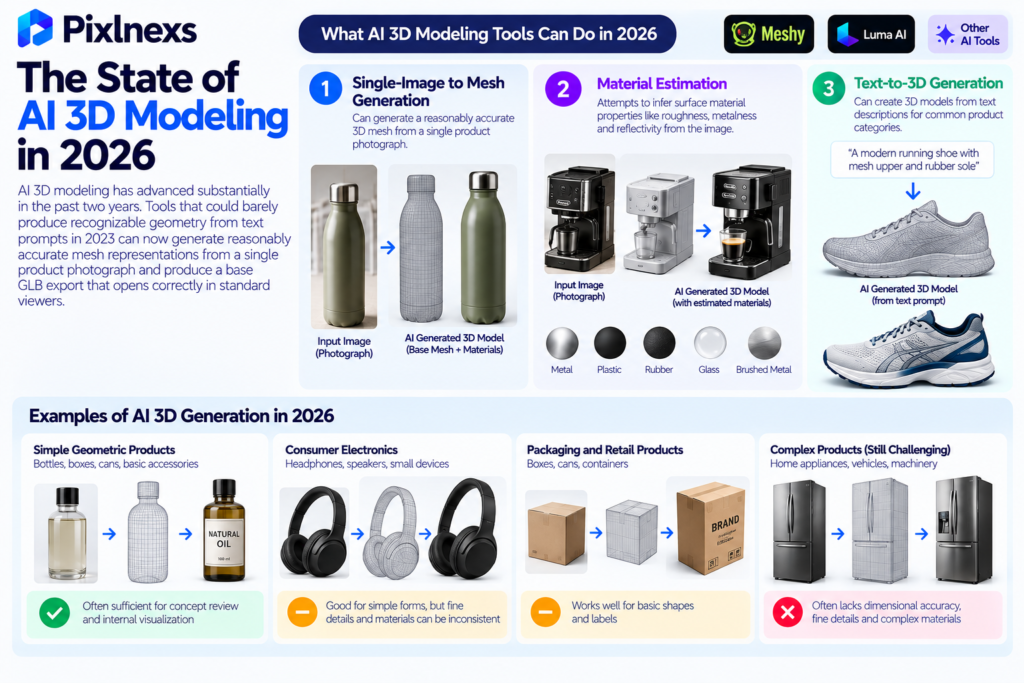
AI 3D modeling has advanced substantially in the past two years. Tools that could barely produce recognizable geometry from text prompts in 2023 can now generate reasonably accurate mesh representations from a single product photograph, estimate surface normals and produce a base GLB export that opens correctly in standard viewers. The pace of improvement has been fast enough that any assessment of current capability needs to be dated clearly this guide reflects the state of the technology in mid-2026.
What AI 3D Modeling Tools Can Do in 2026
Single-image to mesh generation has reached a level of reliability that makes it genuinely useful for early-stage prototyping. Tools like Meshy, Luma AI and several newer entrants can take a clear product photograph and produce a watertight mesh that captures the rough form factor of the product. For simple geometric products bottles, boxes, cans, basic accessories the output quality is often sufficient for concept review and internal visualization.
Material estimation has improved: some tools attempt to infer surface material properties (roughness, metalness, reflectivity) from the photograph, which produces PBR-like output rather than a flat color mesh. This material estimation is increasingly plausible for simple surfaces but remains inconsistent for complex, nuanced finishes.
Prompt-based 3D generation producing a model from a text description rather than a reference image has improved significantly for common product categories where the training data was abundant. “A cylindrical glass bottle with a metal cap and a paper label” produces recognizable output. The output is not dimensionally accurate, not material-accurate and not production-ready but it is a useful starting point for rapid visualization.
What AI 3D Modeling Tools Cannot Reliably Do in 2026
Dimensional accuracy remains a fundamental limitation. AI 3D tools generate plausible geometry, not measured geometry. A bottle generated from a photograph will have approximately the right proportions relative to the photo but it will not know that the bottle is 240mm tall and 72mm in diameter and without that dimensional accuracy, AR placement is unreliable. A shopper who places an AI-generated model in their space and sees a bottle that looks slightly too small or too large has received inaccurate information.
Fine geometric detail the inset geometry of a port, the seam line of a cap, the raised texture of embossed packaging, the precise profile of a shoe sole is frequently smoothed out or misrepresented in AI-generated geometry. The tools generate a plausible surface rather than an accurate one and for technically literate audiences (electronics buyers, watch enthusiasts, footwear collectors) that imprecision is immediately apparent.
Material accuracy for complex surfaces is inconsistent. Frosted glass, soft-touch rubber coatings, metallic foil labels, semi-transparent liquids inside clear bottles the PBR material estimation for these finishes is frequently wrong in ways that make the product look significantly different from the real item. A frosted bottle that renders as opaque, a metallic cap that renders as matte plastic and a liquid fill that renders as absent are all common AI material failures.
Manual cleanup and QA remain necessary for any AI-generated model that will appear on a live product page. The cleanup work correcting mesh errors, fixing inverted normals, re-mapping UV coordinates, rebuilding material properties from scratch often takes as long as or longer than modeling the product from reference in the first place.
What a Professional 3D Artist Delivers
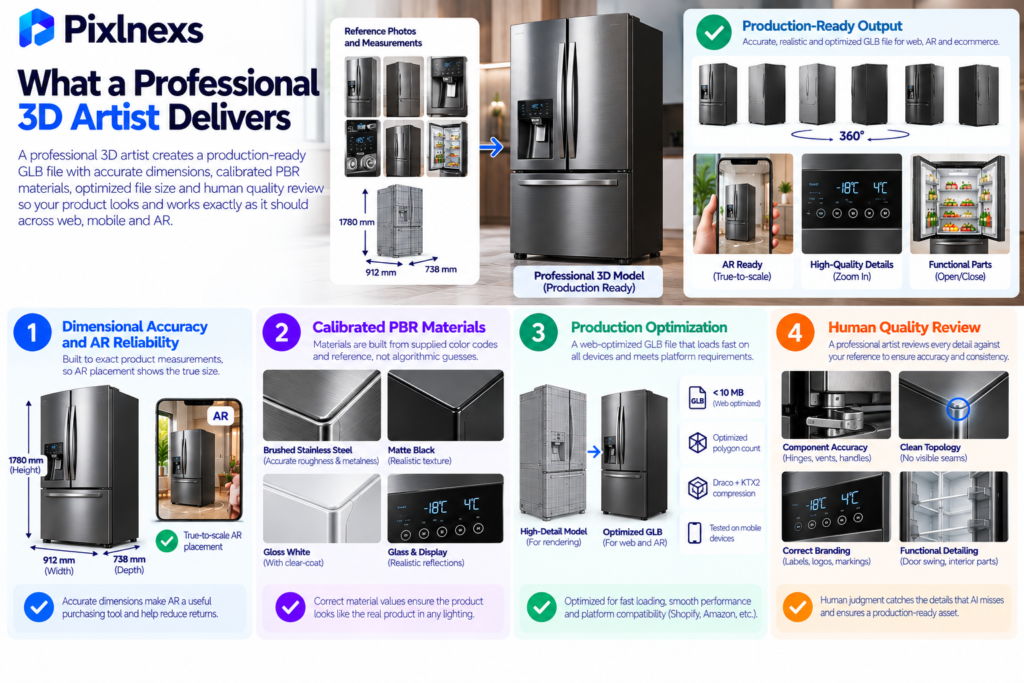
A professional 3D artist working from a complete brief reference photos from every angle, exact dimensions and color codes produces an asset that is fundamentally different in nature from an AI-generated model, not just in quality level but in what it is.
Dimensional Accuracy and AR Reliability
A professionally modeled product is built to the product’s actual measurements, not to a photographic estimation. Every edge, proportion and feature dimension is derived from supplied measurements or from the reference photos cross-referenced against each other. The result is a model that, when placed in AR at its stated scale, shows the product at its true size which is what makes AR placement a useful purchasing tool rather than an approximate visualization.
For ecommerce brands where AR placement is a key feature furniture, home décor, large accessories, watches the difference between “accurate to within 2mm” and “plausible from a photo” is the difference between a tool that reduces returns and one that increases them.
Calibrated PBR Materials
A professional 3D artist builds PBR materials from the supplied color codes and from reference, not from algorithmic inference. The roughness value for a matte soft-touch surface is set from knowledge of how that surface responds to light, cross-referenced against the reference photos, adjusted until the model reads correctly. The metalness value for a brushed aluminum component is set from material knowledge and verified visually. The transmission values for frosted glass are tuned until the model’s translucency matches the real product.
This process is slower than AI material generation it takes a skilled artist time to get materials right but the result is a model that reliably communicates what the real product looks like, rather than a model that communicates what the AI estimated the product might look like from a photograph.
Production Optimization
A professional 3D artist does not just produce a high-quality model they produce a web-optimized GLB file that loads within the target file size, has a polygon count appropriate for the target viewer and platform, has correctly applied Draco compression and KTX2 texture compression and has been tested for load time on mobile before delivery. This optimization is part of the production process, not an afterthought.
An AI-generated model that exports a 25 megabyte GLB is not a production-ready asset, even if the visual quality were acceptable. The file has to be manually optimized compressed, decimated and verified before it can go onto a product page. That optimization work is skilled work that takes real time.
Human Quality Review
A professional 3D artist looks at the model against the reference material and applies judgment. They notice that the cap’s embossed logo is slightly too deep relative to the reference. They see that the specular response of the metallic band reads as painted metal rather than real chrome. They catch the UV seam that runs across the front label where it should not be visible. These are the quality catches that an AI tool has no mechanism to make, because they require comparing the output against a human’s knowledge of what the real product looks like and what the viewer’s expectation of it will be.
AI 3D Modeling vs Professional 3D Artist: Direct Comparison
| Factor | AI 3D Modeling Tools | Professional 3D Artist |
|---|---|---|
| Time to first draft | Minutes | 1 to 3 days |
| Time to production-ready | Days to weeks (includes cleanup) | 3 to 5 working days |
| Dimensional accuracy | Low estimated from photo | High built to exact measurements |
| Material accuracy | Inconsistent inferred from image | High calibrated from color codes and reference |
| AR placement reliability | Unreliable without dimension input | Reliable exact scale from measurements |
| Fine geometric detail | Frequently smoothed or missing | Modeled accurately to reference |
| Web optimization (GLB) | Requires manual post-processing | Delivered optimized and compressed |
| Cost for simple products | Lower (less cleanup required) | Higher per model |
| Cost for complex products | Often comparable after cleanup | Predictable, quoted upfront |
| Best for | Concepts, drafts, simple products, rapid volume | Production, hero assets, complex products, AR |
Cost Comparison: AI 3D Modeling vs Hiring a Professional 3D Artist
The Surface-Level Cost Comparison
On the surface, the cost comparison appears strongly in favor of AI tools: most AI 3D modeling subscriptions cost between $20 and $150 per month for unlimited generations, while a professional 3D artist charges per model, per hour or on a project basis at rates that quickly exceed the subscription cost.
This surface-level comparison is accurate for the specific use case of generating large volumes of draft or concept models for internal review. It is misleading for the use case of producing production-ready models that will appear on live product pages.
The True Cost of an AI-Generated Production Model
The true cost of an AI-generated model for production use includes: the subscription cost, the time to generate and select the best output (which may require multiple generation attempts for complex products), the time for manual cleanup of the mesh (fixing topology errors, correcting normals, rebuilding UV maps), the time for manual material rebuilding (replacing estimated materials with accurate PBR setups), the time for optimization and compression and the time for visual quality review.
For a complex product a watch, a detailed handbag, an electronics device with port geometry this total time investment frequently equals or exceeds the time a professional 3D artist would take to model the product correctly from the start. The difference is that the professional artist’s time is visible as a line item in the quote, while the artist’s or developer’s internal time spent cleaning up the AI output is often not tracked or accounted for correctly.
For simple products a basic cylindrical bottle, a rectangular box, a simple round jar the cleanup time is lower and the AI-first approach is more likely to produce a genuine cost saving over professional modeling.
When AI Saves Real Money
AI 3D modeling genuinely reduces cost in specific scenarios: concept visualization and form factor iteration before committing to production modeling, generating placeholder assets for website development and internal review, producing content for low-stakes digital channels where visual quality is not the conversion driver and generating large numbers of simple geometric products where the cleanup time per model is low and predictable.
For a deeper dive into what professional 3D modeling costs by product type and complexity, see our guide on 3D product model cost.
Quality Comparison: AI 3D Modeling vs Professional 3D Artist
Simple Products: Where AI Performs Best
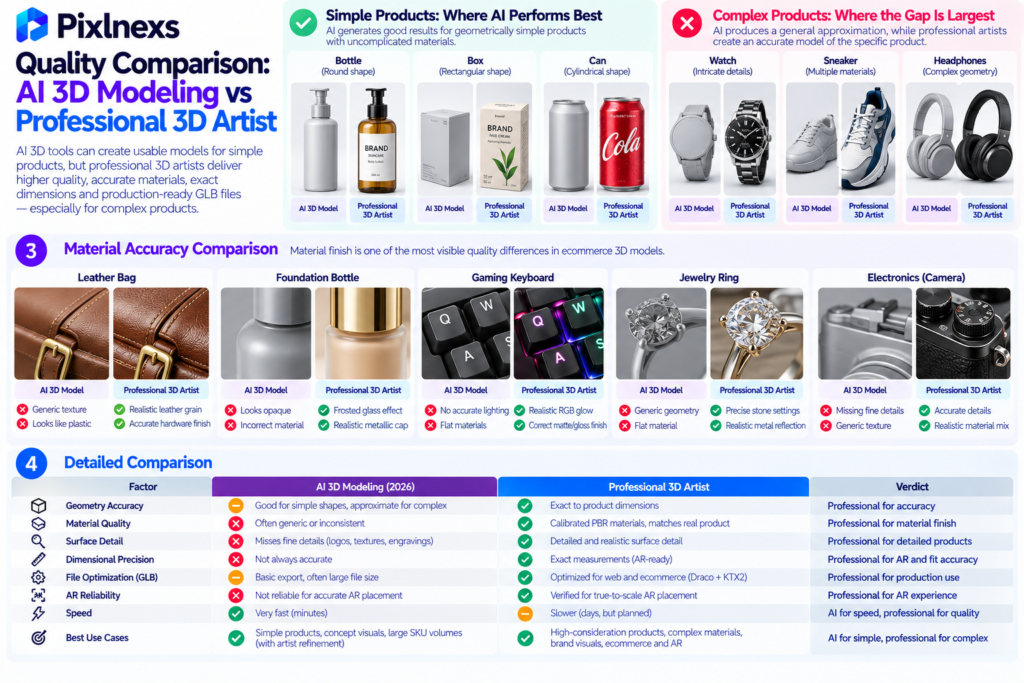
For geometrically simple products with uncomplicated materials a round bottle with a flat label, a rectangular box, a basic cylindrical can AI 3D tools perform at their best relative to professional modeling. The geometry is simple enough that photographic reconstruction produces an approximately accurate result, the material is simple enough that estimation works reasonably well and the cleanup requirement is manageable.
For brands producing large numbers of SKUs that fall into this simple-product category, an AI-assisted workflow using AI generation as a starting point that is then refined by an artist can produce acceptable results faster and at lower cost per SKU than full professional modeling for each one.
Complex Products: Where the Gap Is Largest
The gap between AI-generated and professionally modeled assets is widest for products with complex geometry, complex materials or both.
Watches with intricate case geometry, multi-link bracelets and dial detail. Electronics with specific port shapes, logo embossing and precise material transitions. Footwear with midsole geometry, sole profile, upper texture and hardware detail. Jewelry with stone settings, metal grain direction and surface variations. Beauty products with frosted glass, metallic foil labels and semi-transparent product fills.
For each of these categories, an AI tool produces an approximation that is visually recognizable as the general product type but not accurately representative of the specific product. A Pixlnexs-modeled watch looks like that specific watch. An AI-generated watch looks like a watch.
Material Accuracy: The Most Visible Quality Gap
Material accuracy is where AI-generated models most consistently fall short for ecommerce use. This matters because material finish is one of the primary purchase evaluation criteria in the categories where 3D modeling adds the most value.
A leather bag’s grain texture, the sheen of its hardware, the translucency of its glazed finish. A foundation bottle’s matte soft-touch surface, the metallic rim of its cap, the semi-opaque fill visible through the slightly translucent body. A gaming keyboard’s per-key RGB glow, the matte surface of its body, the slightly glossy legends on the keycaps.
Professional PBR material setup gets these right because a skilled artist knows what each material should look like and adjusts the parameters until the model matches the reference. AI material estimation gets these approximately right in favorable conditions and wrong in unfavorable ones and the failure modes (a matte surface that shines like plastic, a metallic element that looks painted, a glass that renders as opaque) are immediately visible to anyone who knows the product.
Speed Comparison: AI 3D Modeling vs Professional Artist
Time to First Usable Draft
AI 3D tools produce a first draft in minutes. A text prompt or a single product photograph generates a mesh that can be opened in a viewer within minutes of starting the process. For rapid concepting, this speed advantage is genuine and valuable.
A professional 3D artist typically produces a first review model in one to three days for a standard ecommerce product, depending on complexity and the completeness of the reference material provided.
Time to Production-Ready Asset
The time comparison looks very different when measured to production-ready output rather than first draft.
An AI-generated model that reaches a production-ready state after cleanup, material rebuilding, optimization and quality review may have taken four to eight hours of artist time plus the generation time to reach the same quality level that a professional artist produces as their first review deliverable.
A professional 3D artist working from a complete brief typically delivers a production-ready model in three to five working days per product which, for the specific end state of a model that is accurate, optimized and verified, is frequently faster than the end-to-end time for an AI-generated model to reach the same standard.
Speed at Scale
For brands needing to produce large numbers of models a 50-SKU range, a full product catalog speed at scale is the most relevant comparison. AI tools can generate 50 first drafts in an afternoon. A professional studio processes 50 models over several weeks.
Whether the AI-generated 50 models are usable depends entirely on the product complexity and the quality bar. For a range of simple cylindrical bottles with flat labels, AI-generated drafts may need relatively little work to reach an acceptable quality level. For a range of luxury accessories with complex materials and fine geometry, AI-generated drafts for each product may each require more cleanup work than the professional modeling cost would have been in the first place.
When to Choose AI 3D Modeling Over a Professional Artist
Choose AI 3D Modeling When:
Your products are geometrically simple bottles, boxes, basic accessories, simple packaging and the primary purpose is a consistent, recognizable shape rather than a material-accurate premium experience.
You need rapid concept visualization for internal review, client presentations or design iteration and the models will not appear on live product pages.
You have an in-house 3D artist who can take AI-generated base meshes and refine them using AI to speed up the initial blocking phase rather than as a replacement for the full modeling process.
Your volume is very high and your quality bar is lower than ecommerce product page standard for example, rendering large product catalogs for internal use, generating assets for draft marketing materials or producing placeholder models for a website under development.
Choose a Professional 3D Artist When:
Your product will appear on a live product page where visual accuracy is directly connected to conversion rate and return rate.
Your product is complex intricate geometry, demanding materials, precise dimensional requirements for AR placement.
Your brand’s visual positioning depends on the product appearing premium, accurate and trustworthy in its digital representation.
You need a production-ready GLB file that is optimized, compressed, AR-ready and verified not a mesh that requires further processing.
You need a USDZ companion file for iOS AR Quick Look in addition to the web GLB a complete AR delivery package.
The Hybrid Approach: Combining AI Tools with Professional Expertise
AI for Base Mesh, Artist for Refinement
The most productive approach for many studios in 2026 is to use AI generation as an accelerator for the early stages of the modeling process rather than as a replacement for it. An AI tool that generates a rough base mesh from a reference photograph gives an artist a starting point for retopology and refinement faster than starting from a cube, even if the AI output is not close enough to production quality to ship without significant work.
This hybrid approach is particularly effective for organic forms (product shapes that do not have a clean geometric base) where manual blocking is slow and less useful for simple geometric products (cylinders, boxes) where manual blocking is fast anyway.
AI for Concept, Professional Artist for Production
Another effective hybrid workflow is using AI visualization for early concept stages form factor exploration, color and finish iteration, design direction review and transitioning to professional modeling for the final production assets. This gives the design team rapid visual feedback during the exploration phase without committing professional artist time to a direction that may change and produces production-quality assets for the approved direction.
For the specific comparison of AI-assisted and traditionally modeled assets in an animation context which shares many of the same trade-offs as this static modeling comparison see our guide on AI animation vs traditional animation.
Real-World Scenarios: Which Approach Wins
Scenario 1: DTC Skincare Brand, 12-SKU Range
A direct-to-consumer skincare brand needs 3D models for 12 products a mix of glass dropper bottles, cylindrical serum bottles, frosted glass jars and aluminium tubes. The products have complex materials (frosted glass, metallic caps, semi-transparent liquid fills) and will appear on product pages where shade and finish accuracy are critical purchase evaluation criteria.
Verdict: professional 3D artist. The material complexity, the dimensional accuracy requirement for AR placement and the visual stakes of product page presentation all point to professional modeling. AI-generated models for frosted glass and metallic caps are consistently inaccurate for these material types and the cleanup cost to reach the required quality standard would likely exceed the professional modeling cost.
Scenario 2: FMCG Brand, 50 Product Variants for Internal Review
A food and beverage brand needs 3D representations of 50 product variants for an internal packaging review and design iteration session. The models do not need to be production-ready they need to be recognizable, consistent and available quickly enough to support a design decision timeline.
Verdict: AI 3D modeling. The use case is concept visualization rather than production, the quality bar is internal review rather than ecommerce product page and the volume and timeline favor AI generation. An artist should review the AI output before the internal presentation but professional modeling is not required for this use case.
Scenario 3: Electronics Brand, Hero Product Launch
A consumer electronics brand is launching a new wireless headphone product. They need one hero 3D model for the product page accurate port geometry, correct material rendering for the matte housing and metallic accents, dimensional accuracy for AR placement and a production-ready compressed GLB plus USDZ file.
Verdict: professional 3D artist. The geometry specificity (port shapes, hinge mechanisms, driver housing geometry), material complexity (matte rubber, metallic elements, mesh speaker grille) and the high conversion stakes of a hero product launch all favor professional modeling. This is exactly the use case where AI model inaccuracies even small ones in port geometry or material response are immediately visible to technically literate buyers.
The Future of AI 3D Modeling: What to Expect
Where AI 3D Tools Are Improving Fastest
Material estimation from reference images is improving faster than geometry accuracy. The next generation of AI tools is likely to produce more reliable PBR material estimates, particularly for common surface types, as training data and model architecture improve.
Point cloud and multi-view reconstruction using multiple photographs from different angles rather than a single image is already producing more dimensionally accurate output than single-image tools and is likely to become the dominant input modality for product-focused AI 3D generation.
Integration with measurement data using a smartphone’s LiDAR sensor or AR features to capture real-world dimensions and feed them into the generation process would address the dimensional accuracy limitation that currently makes AI-generated models unreliable for AR placement.
What Will Not Change
The fundamental requirement for a human being to compare the output against the real product and make quality judgments is unlikely to be automated away in the near term. The question “does this model accurately represent what the shopper will receive in the post?” is a judgment that requires someone who knows what the product looks like and for the foreseeable future, that someone is a skilled 3D artist reviewing and refining the output before it goes live.
Conclusion
The AI 3D modeling vs professional 3D artist comparison in 2026 is not a simple “which is better” question it is a question of which is better for what, at what quality level and for what commercial stakes.
AI 3D tools are genuinely useful for specific applications: rapid concept visualization, base mesh generation for artist refinement and producing content for contexts where visual accuracy is not the primary conversion driver. The technology is improving fast and its capabilities in 12 to 18 months will be meaningfully different from today.
Professional 3D artists remain the more reliable path for production-ready assets on live product pages where visual accuracy is directly connected to conversion rate, return rate and brand trust. The dimensional accuracy, calibrated materials, optimized delivery and human quality review that a professional artist provides are not currently replicable by automated tools for the full range of ecommerce product types.
For most ecommerce brands, the practical answer is a hybrid AI tools where they genuinely accelerate the process without compromising the output, professional modeling for the hero assets where visual quality is the competitive difference.
Need production-ready 3D models not just plausible drafts?
Pixlnexs builds dimensionally accurate, PBR-calibrated, web-optimized GLB models for ecommerce brands every model delivered production-ready, compressed and AR-verified.
Get a Professional 3D Model Talk to Our TeamFrequently Asked Questions
Can AI generate a production-ready 3D model from a product photo?
Not reliably, as of mid-2026. AI tools can generate a recognizable mesh from a product photograph but the output typically requires manual cleanup, material rebuilding and optimization before it reaches production-ready quality for an ecommerce product page. For geometrically simple products with uncomplicated materials, the cleanup is manageable. For complex products with demanding materials, the cleanup often costs more than professional modeling would have.
How accurate are AI-generated 3D models for AR placement?
Current AI tools do not produce dimensionally accurate models they generate geometrically plausible models based on visual estimation from a photograph. A model built to estimated proportions rather than measured dimensions will look wrong in AR immediately if the scale is materially off. For AR placement to be a useful tool (rather than a misleading one), dimensional accuracy is non-negotiable and that currently requires measured input and a professional artist.
Which AI 3D modeling tools are best for ecommerce in 2026?
Meshy, Luma AI and several newer tools produce the most usable output for ecommerce product types from a single reference image. None of them consistently produce production-ready output without cleanup. For the specific use case of generating base meshes that an artist then refines, Meshy’s multi-view reconstruction mode currently produces the most structurally clean output for hard-surface products.
Is AI 3D modeling cheaper than hiring a 3D artist?
For simple products used in low-stakes contexts, yes. For complex products that will appear on live product pages, not necessarily when the total cost of AI generation plus cleanup plus optimization plus QA is calculated honestly, it frequently approaches or exceeds professional modeling cost, while producing a lower-quality result. The honest answer is: it depends on the product complexity, the quality bar and how accurately the internal cleanup time is being counted.
Will AI replace professional 3D artists?
For commodity-level work generating placeholder assets, producing concept visualization, building base meshes for refinement AI tools are already displacing some professional modeling work. For production-quality ecommerce product visualization where visual accuracy drives purchasing decisions, professional artists remain the more reliable path and are likely to remain so for the next several years as the technology continues to improve. The more likely outcome is a significant shift in how professional artists work using AI tools to accelerate specific stages rather than a wholesale replacement.
What should I do if I need models quickly but cannot compromise on quality?
Commission professional models from a studio with a clear, complete brief reference photos from every angle, exact dimensions and color codes. A studio with an established pipeline delivers first models in three to five working days with no compromise on accuracy. The “AI is faster” advantage applies to first draft generation, not to the time from brief to production-ready deliverable. For how to prepare that brief efficiently, see our guide on how to brief a 3D studio.
Can I use AI tools to speed up professional 3D modeling?
Yes this is increasingly common practice. Professional studios use AI tools to accelerate specific stages: generating base meshes for artist refinement, creating draft texture concepts for artist evaluation, producing reference-based lighting setups that artists then refine. The AI accelerates the process without replacing the artist’s judgment and quality control. This hybrid approach is the direction the industry is moving, not a binary choice between fully AI and fully manual.
Related Guide
ow poly vs high poly 3D models
how to compress a GLB file without losing quality







Leave a Reply