
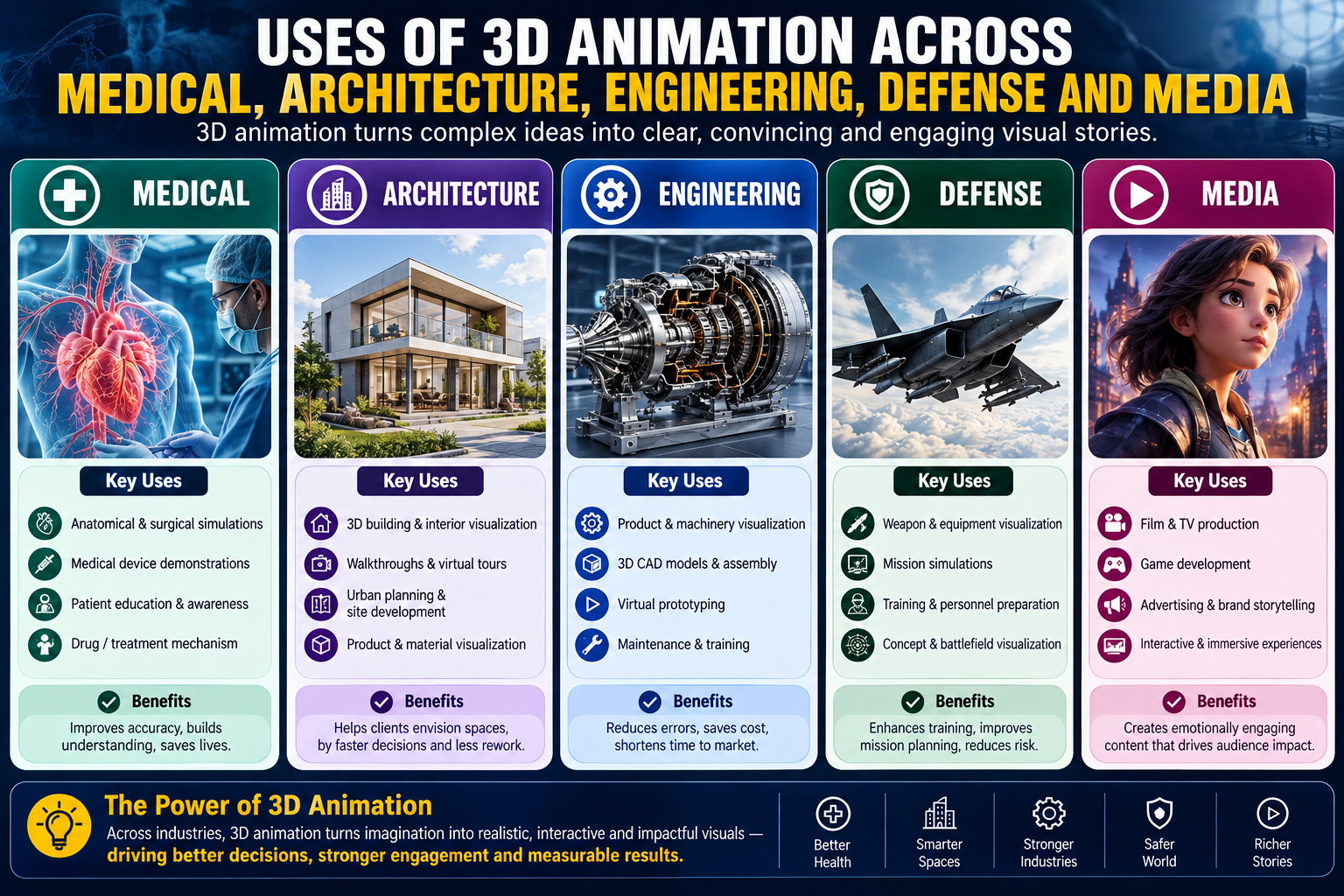
Quick answer: The uses of 3D animation span five major fields today: medicine (surgical training and anatomy visualization), architecture and construction (walkthroughs and clash detection before a single brick is laid), engineering (rapid prototyping and virtual testing), defence (simulation-based training and terrain modeling), and media (film, advertising, and game production). Pixlnexs builds custom 3D animation and visualization assets for teams in these industries who need to explain, sell, or train on something that does not exist yet in physical form.
A 2D drawing can show you what a part looks like. It cannot show you how that part moves, fails, or fits into a system with forty other moving pieces. That gap between “flat description” and “working understanding” is exactly what 3D animation closed, and it is why the technology moved so fast from movie studios into hospitals, job sites, and military simulators.
Below is where 3D animation is doing real work in 2026, what changed since the early days of the technology, and how each field is applying it differently.
Key takeaways
- 3D animation replaces static 2D drawings and physical models with something you can walk through, test, or rehearse before it exists in the real world.
- The biggest gains show up in fields where mistakes are expensive: surgery, construction, engineering, and defence training.
- Media still produces the most volume, but it is no longer the field getting the most business value per project.
| Field | Old approach | 3D animation replaces it with |
|---|---|---|
| Medical | 2D anatomy charts, physical models | Patient-specific 3D models, surgical rehearsal |
| Architecture | 2D/CAD drawings | Full walkthroughs, AR previews, clash detection |
| Engineering | Physical prototypes | Simulated stress testing, virtual iteration |
| Defence | Live-only training exercises | Simulated terrain and scenario training |
| Media | Practical sets and 2D animation | Fully virtual environments and reusable 3D assets |
Medical: from anatomy charts to surgical rehearsal
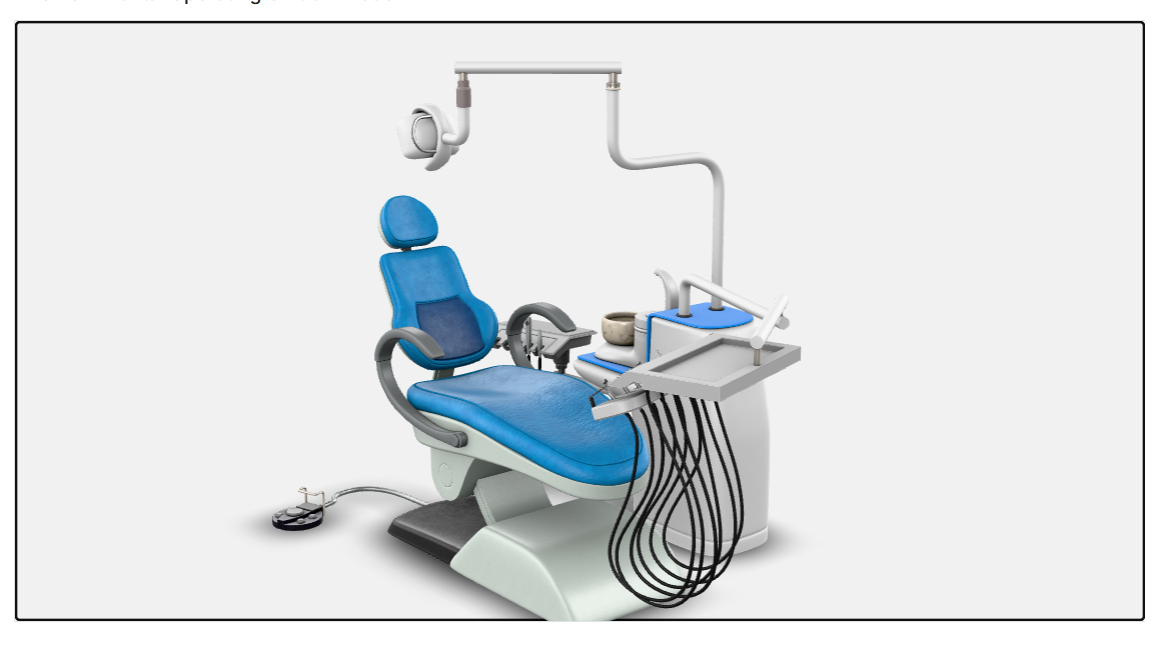
Medical training used to rely on 2D illustrations and physical models. Both had the same limitation: neither could show a process happening inside the body in real time. A 2D chart shows a static heart. It cannot show how blood actually moves through four chambers during a single heartbeat.
“Medical education researchers have found that 3D visualization improves trainee comprehension compared to static diagrams, which is why more medical schools are adopting it for anatomy and procedural training.”
See how Pixlnexs approaches 3D product animation for a sense of the same modeling process applied outside medicine.
Architecture and construction: catching problems before they cost money
Architectural drawings moved from paper to CAD decades ago, but even a detailed 2D or basic 3D CAD file leaves a client guessing what the finished building will actually feel like. 3D animation changed that by making a full walkthrough possible before construction starts.
Firms now build animated walkthroughs and augmented reality previews that let a client walk through a building that does not exist yet. This does two things for a construction budget. First, it catches design flaws, like a hallway that is too narrow or a stairwell that clashes with mechanical systems, while they are still cheap to fix on screen instead of expensive to fix on site. Second, it closes sales faster, because a client approving a photorealistic walkthrough moves with far more confidence than a client approving a floor plan.
Engineering: prototyping without the physical prototype
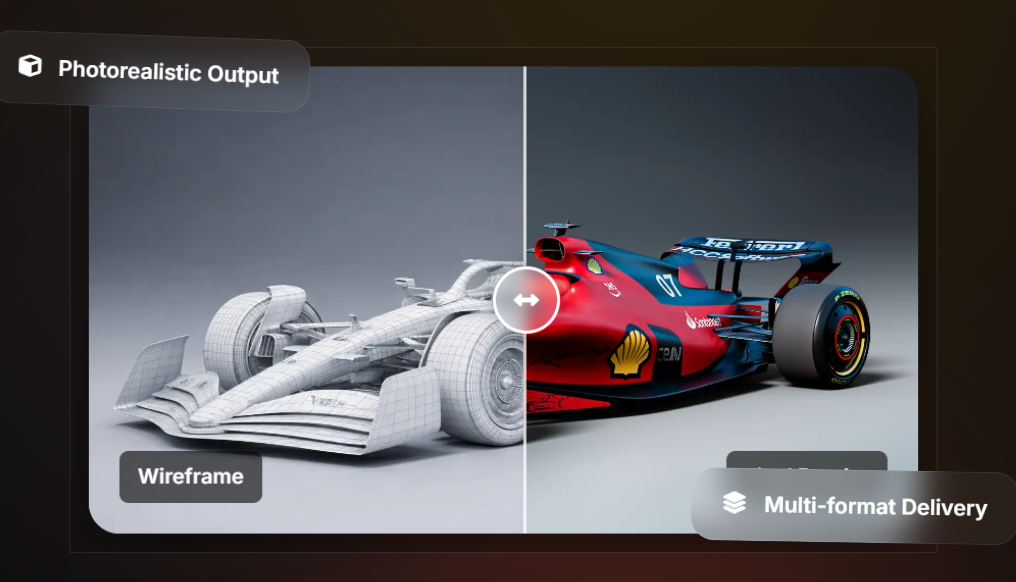
Physical prototyping is slow and expensive. Every iteration means new materials, new machining time, and a new wait before you know if the design actually works.
3D animation and simulation let engineering teams test a design’s behavior, stress points, and mechanical interactions on screen first. A part can be animated through its full range of motion, loaded with simulated stress, and revised in an afternoon instead of a production cycle. This has not eliminated physical prototyping, but it has pushed most of the failure discovery earlier, where a fix costs a software revision instead of a re-tooled part.
Military, police and defense: training without the risk
Live training exercises are expensive to run and carry real safety risk. 3D animation gives defence and law enforcement teams a way to rehearse high-risk scenarios, terrain, and building layouts without putting personnel or equipment on the line during the learning phase.
This shows up in three ways: simulation-based training environments that replicate real terrain and buildings, 3D modeling of border and perimeter areas that are difficult to monitor in person, and equipment design work that happens virtually before anything is manufactured. The core value is the same one seen in medicine and architecture: rehearse the hard part digitally before you do it for real.
Media: still the field that built the toolset
Film, television, and advertising are where 3D animation was refined first, and the field keeps pushing the technology forward for everyone else. What has changed since the 2D cartoon era is the realism ceiling. Modern 3D animation renders environments, from deep space to underwater scenes, that would be either impossible or extremely costly to film practically.
For commercial and advertising work specifically, this has a direct cost impact. A product shoot that once required a physical set, lighting rig, and studio rental can now be built once as a 3D asset and reused across ads, product pages, and social content without rebuilding the set each time.
The pattern across every field
Every industry above adopted 3D animation for the same underlying reason: it turns something abstract, risky, or expensive to test in the real world into something you can see, test, and revise on screen first. Medicine gets safer training. Construction gets fewer costly surprises. Engineering gets faster iteration. Defence gets safer rehearsal. Media gets scenes that were never physically possible.
“Pixlnexs has built 3D animation and visualization assets for clients including Campus Polyplast, Carxneo, and Russell Hobbs, applying the same walkthrough-before-you-build approach across product, architectural, and industrial projects.”
Pixlnexs builds 3D animation and visualization assets across product, architectural, and industrial use cases, turning designs and concepts into renders and animations teams can use for training, sales, or production before anything physical exists. You can see this pattern in practice across our case studies, where the same walkthrough-before-you-build approach shows up in different industries.
FAQ
Want a 3D animation or visualization asset built for your product, building, or training program? Get a quote from the Pixlnexs team.
Read More :
Manual 3D Modeling vs AI Generated 3D Models










Leave a Reply